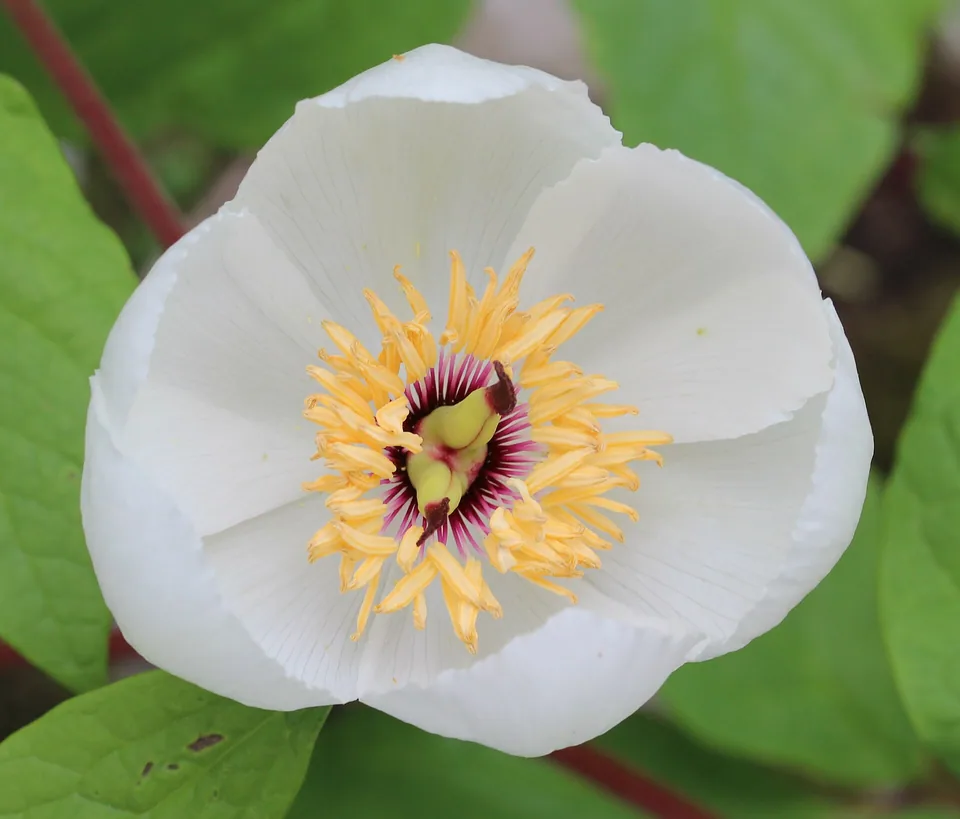

How to Grow and Care for Paeonia obovata
Paeonia japonica
Written by Emilio Marruso · last checked
At a glance
This peony is a long-lived perennial you can easily share with friends: divide the clump in spring or fall, or sow fresh seed as soon as it ripens. Give it moderate, steady watering, never soggy and never too dry, and it will keep coming back. Even its young leaves can be eaten cooked.
- Water
Moderate water: it dies if the soil stays soggy or gets too dry
What the sources say (2)
Watering: Moderate
Water moderate Hardiness Zone 7+ Soil textures sandy, loamy, clay, heavy clay
— Yama-Shakuyaku (Paeonia japonica) — Practical Plants [2] Watering notes: Will not survive if the soil becomes waterlogged or is too dry
Plants are tolerant of a wide range of soil conditions, but will not survive if the soil becomes waterlogged or is too dry
— Yama-Shakuyaku (Paeonia japonica) — Practical Plants [2] - Cold
Survives winters down to 0 °F (−17.8 °C)
Hardy in very cold winters · USDA 7 · RHS H6 · Z7
What the sources say (1)
Hardiness, coldest zone: 7 [winter low −17.8 to −12.2 °C (0 to 10 °F)]
Water moderate Hardiness Zone 7+ Soil textures sandy, loamy, clay, heavy clay
— Yama-Shakuyaku (Paeonia japonica) — Practical Plants [2] - Planting
Plant in spring while it's growing; seedlings after at least two seasons in a cold frame
What the sources say (1)
Planting: Spring, when in growth (seedlings after at least two growing seasons in a cold frame)
grow them on in a cold frame for at least two growing seasons before planting them out when they are in growth in the spring
— Yama-Shakuyaku (Paeonia japonica) — Practical Plants [2] - Harvest
Young leaves can be eaten cooked; the root can be chewed
- Pests
Watch for gray mold, powdery mildew, leaf spots, scale insects and thrips
What the sources say (10)
Pests: foliar nematodes, scale insects, thrips
Foliar nematodes are microscopic worm-like pathogens that feed within the leaf tissue.
— Peony | Home Garden Education Office | College of Agriculture, Health and Natural Resources | University of Connecticut [4] Scale insects look like little raised bumps on the plant.
— Peony | Home Garden Education Office | College of Agriculture, Health and Natural Resources | University of Connecticut [4] Thrips are narrow, tiny insects which may damage buds and leaves with their piercing and sucking mouthparts.
— Peony | Home Garden Education Office | College of Agriculture, Health and Natural Resources | University of Connecticut [4] Diseases: botrytis blight (gray mold), leaf spots, Phytophthora blight, powdery mildew, white mold, southern blight, Verticillium wilt, viruses
Botrytis blight (a.k.a. gray mold) is caused by a couple of species of fungi in the genus Botrytis.
— Peony | Home Garden Education Office | College of Agriculture, Health and Natural Resources | University of Connecticut [4] A number of fungi and a bacterial pathogen can sometimes cause leaf spots or blotches on peony.
— Peony | Home Garden Education Office | College of Agriculture, Health and Natural Resources | University of Connecticut [4] If peonies are planted in a poorly drained soil, Phytophthora blight, caused by the water mold Phytophthora cactorum , can cause trouble.
— Peony | Home Garden Education Office | College of Agriculture, Health and Natural Resources | University of Connecticut [4] Peonies are susceptible to the common problem of powdery mildew.
— Peony | Home Garden Education Office | College of Agriculture, Health and Natural Resources | University of Connecticut [4] These diseases, white mold ( Sclerotinia sclerotiorum ) and southern blight ( Sclerotium rolfsii ) both result in stem wilt and death.
— Peony | Home Garden Education Office | College of Agriculture, Health and Natural Resources | University of Connecticut [4] Peonies are hosts of Verticillium wilt caused by the fungi Verticllium albo-atrum and V. dahlia .
— Peony | Home Garden Education Office | College of Agriculture, Health and Natural Resources | University of Connecticut [4] There are several viruses that can infect peony. The symptoms may include dwarfing, abnormal growth forms
— Peony | Home Garden Education Office | College of Agriculture, Health and Natural Resources | University of Connecticut [4] - Propagation
Grow from seed, or divide the clump in spring or fall
What the sources say (2)
- Sowing
Sow seed as soon as it's ripe, in a cold frame
What the sources say (1)
Sowing: As soon as the seed is ripe, in a cold frame
Seed - best sown as soon as it is ripe in a cold frame
— Yama-Shakuyaku (Paeonia japonica) — Practical Plants [2]
Overview
Paeonia japonica (woodland peony) is one of the peony types grown in the home landscape. [4] Seed is best sown as soon as it is ripe in a cold frame, and plants can be divided in spring or autumn. [2]
This record is incomplete: the sources we read do not cover every field yet.
Not yet covered by our sources: Hardiness, warmest zone, Pruning
Paeonia obovata care
How to water Paeonia obovata
Watering
Moderate
What the sources say (1)
Water
moderate
Hardiness
Zone 7+
Soil textures
sandy, loamy, clay, heavy clayWatering notes
Will not survive if the soil becomes waterlogged or is too dry
What the sources say (1)
Plants are tolerant of a wide range of soil conditions, but will not survive if the soil becomes waterlogged or is too dryHow much light Paeonia obovata needs
The sources give different values depending on region, zone or growing conditions.
What each source says
According to The Peony Society (Burrell): Does well in shade
What the sources say (3)
According to The Peony Society (Burrell): Some peonies that do well in shade: most of the species, especially P. japonicaLight
full sun
Shade tolerance
light shade
Water
moderatedoing quite well in sun or light shadeHow much cold Paeonia obovata can take
Hardiness, coldest zone
7 [winter low −17.8 to −12.2 °C (0 to 10 °F)]
What the sources say (1)
Water
moderate
Hardiness
Zone 7+
Soil textures
sandy, loamy, clay, heavy clayHardiness, warmest zone
Not stated in the sources we read.
How to propagate Paeonia obovata
Seed; division in spring or autumn
How to grow Paeonia obovata
The plant
Life cycle
perennial
What the sources say (1)
Family Paeoniaceae Peonies are herbaceous perennials that have few rivals for their floral display and foliage.Family
Paeoniaceae
What the sources say (1)
Family Paeoniaceae Peonies are herbaceous perennials that have few rivals for their floral display and foliage.Pests and diseases
Pests
foliar nematodes, scale insects, thrips
What the sources say (3)
Foliar nematodes are microscopic worm-like pathogens that feed within the leaf tissue.Scale insects look like little raised bumps on the plant.Thrips are narrow, tiny insects which may damage buds and leaves with their piercing and sucking mouthparts.Diseases
botrytis blight (gray mold), leaf spots, Phytophthora blight, powdery mildew, white mold, southern blight, Verticillium wilt, viruses
What the sources say (7)
Botrytis blight (a.k.a. gray mold) is caused by a couple of species of fungi in the genus Botrytis.A number of fungi and a bacterial pathogen can sometimes cause leaf spots or blotches on peony.If peonies are planted in a poorly drained soil, Phytophthora blight, caused by the water mold Phytophthora cactorum , can cause trouble.Peonies are susceptible to the common problem of powdery mildew.These diseases, white mold ( Sclerotinia sclerotiorum ) and southern blight ( Sclerotium rolfsii ) both result in stem wilt and death.Peonies are hosts of Verticillium wilt caused by the fungi Verticllium albo-atrum and V. dahlia .There are several viruses that can infect peony. The symptoms may include dwarfing, abnormal growth formsRemedies
Each remedy shows what official sources say about it; traditional remedies without an official source are marked as such. Harmful ones are listed so you know to avoid them.
Treating the plant
botrytis blight
sanitation and debris clean-up Partly works
How: Remove severely infected plant parts or plants and clean up debris thoroughly at the end of the season.
Sanitation includes removal of severely infected plant parts or plants and a thorough clean-up of debris at the end of the season.
— Peony | Home Garden Education Office | College of Agriculture, Health and Natural Resources | University of Connecticut [4] What the evidence says Control practices for this and other fungal diseases of above ground plant parts include sanitation, moisture management and fungicides.
— Peony | Home Garden Education Office | College of Agriculture, Health and Natural Resources | University of Connecticut [4] watering early in the morning Partly works
How: Avoid overhead irrigation or, if used, water early in the morning; space plants for good air circulation.
Avoid overhead irrigation or, if used, water early in the morning. Space plants to allow for good air circulation between them.
— Peony | Home Garden Education Office | College of Agriculture, Health and Natural Resources | University of Connecticut [4] What the evidence says Minimizing humidity and leaf wetness reduces opportunities for spores to germinate and infect the plant. Avoid overhead irrigation or, if used, water early in the morning.
— Peony | Home Garden Education Office | College of Agriculture, Health and Natural Resources | University of Connecticut [4]
leaf spots
cleaning up diseased debris Official source, not independently tested
How: Clean up diseased debris well at the end of the season and do not add it to the compost pile.
Clean up diseased debris well at the end of the season and do not add to your compost pile.
— Peony | Home Garden Education Office | College of Agriculture, Health and Natural Resources | University of Connecticut [4]
powdery mildew
full sun and wide spacing Official source, not independently tested
How: Plant in full sun and space plants to allow air flow that keeps humidity low.
Discourage disease by planting in full sun and spacing plants to allow for air flow that minimizes humidity.
— Peony | Home Garden Education Office | College of Agriculture, Health and Natural Resources | University of Connecticut [4]
phytophthora blight
removing infected plants Partly works
How: Once infected, remove the plants; avoid planting in poorly drained sites.
Once infected, the only solution is removal of the plants. Avoid planting in poorly drained sites.
— Peony | Home Garden Education Office | College of Agriculture, Health and Natural Resources | University of Connecticut [4] What the evidence says Once infected, the only solution is removal of the plants. Avoid planting in poorly drained sites.
— Peony | Home Garden Education Office | College of Agriculture, Health and Natural Resources | University of Connecticut [4]
stem rot
removing infected plants and replanting non-hosts Official source, not independently tested
How: Remove infected plants and choose non-host plants as replacements.
Remove infected plants and select non-hosts as replacements. Fungicides are not typically recommended in the landscape.
— Peony | Home Garden Education Office | College of Agriculture, Health and Natural Resources | University of Connecticut [4]
verticillium wilt
discarding infected plants Official source, not independently tested
How: Remove and discard infected plants and replace them with a non-host.
Check for Verticillium wilt by cutting a symptomatic stem longitudinally and looking for streaks of brown discoloration. Remove and discard infected plants and replace with a non-host.
— Peony | Home Garden Education Office | College of Agriculture, Health and Natural Resources | University of Connecticut [4]
foliar nematodes
removing infested leaves Partly works
How: Keep leaves as dry as possible and remove infested leaves.
Control measures include keeping leaves dry as much as possible, removing infested leaves, and using insecticidal soap products.
— Peony | Home Garden Education Office | College of Agriculture, Health and Natural Resources | University of Connecticut [4] What the evidence says Control measures include keeping leaves dry as much as possible, removing infested leaves, and using insecticidal soap products.
— Peony | Home Garden Education Office | College of Agriculture, Health and Natural Resources | University of Connecticut [4]
thrips
insecticidal soap Partly works
To preserve these beneficials, only use insecticides when absolutely necessary and never during bloom to protect pollinators.
— Peony | Home Garden Education Office | College of Agriculture, Health and Natural Resources | University of Connecticut [4] How: Spray insecticidal soap with thorough coverage of leaf undersides and crevices: the product must coat the pest to kill it.
Insecticidal soap can be used for thrips but thorough coverage of leaf undersides and crevices is needed because these products must coat the pest to kill it.
— Peony | Home Garden Education Office | College of Agriculture, Health and Natural Resources | University of Connecticut [4] What the evidence says Insecticidal soap can be used for thrips but thorough coverage of leaf undersides and crevices is needed because these products must coat the pest to kill it.
— Peony | Home Garden Education Office | College of Agriculture, Health and Natural Resources | University of Connecticut [4] strong water spray Partly works
How: A strong spray of water may remove many thrips.
A strong spray of water may remove many thrips. In addition, many naturally occurring predators help keep populations under control.
— Peony | Home Garden Education Office | College of Agriculture, Health and Natural Resources | University of Connecticut [4] What the evidence says A strong spray of water may remove many thrips. In addition, many naturally occurring predators help keep populations under control.
— Peony | Home Garden Education Office | College of Agriculture, Health and Natural Resources | University of Connecticut [4]
Calendar
Sowing
As soon as the seed is ripe, in a cold frame
What the sources say (1)
Seed - best sown as soon as it is ripe in a cold framePlanting
Spring, when in growth (seedlings after at least two growing seasons in a cold frame)
What the sources say (1)
grow them on in a cold frame for at least two growing seasons before planting them out when they are in growth in the springPruning
Not stated in the sources we read.
Months as given by the sources, which are mostly from the United States (northern hemisphere). In the southern hemisphere they shift by about six months.
Edibility
Reported by the source, quoted verbatim. Do not eat a plant on the basis of this page alone: identification mistakes can be dangerous.
Indicative values
Values from a secondary source, not checked word for word like the rest of this page. Use them as a starting point.
- Mature height
- 30.5-45.7 cm (1-1.5 ft)Indicative value, adapt it to your climate · Secondary source
- Soil pH
- 6-7Indicative value, adapt it to your climate · Secondary source
- Care level
- MediumIndicative value, adapt it to your climate · Secondary source
- Growth rate
- LowIndicative value, adapt it to your climate · Secondary source
- Pruning
- February, March, AprilIndicative value, adapt it to your climate · Secondary source
Similar plants
- Common peony Paeonia officinalis
- Moutan peony Paeonia suffruticosa
- Paeonia tenuifolia Paeonia tenuifolia
- Paeonia mascula Paeonia mascula
- Aaron's Beard Hypericum calycinum
- Abies grandis Abies grandis
- Abraham Trachystemon orientalis
- Abyssinian banana Ensete ventricosum
Sources
Every value above is quoted from these documents. Links lead to the original publisher.
- Paeonia japonica - Useful Temperate Plants · temperate.theferns.info, consulted
- Yama-Shakuyaku (Paeonia japonica) — Practical Plants · practicalplants.org, consulted
- Growing species peonies (Galen Burrell) – The Peony Society · peonysociety.eu, consulted
- Peony | Home Garden Education Office | College of Agriculture, Health and Natural Resources | University of Connecticut · homegarden.cahnr.uconn.edu, consulted
- · paeon.de, consulted
- How to grow peonies – The Peony Society · peonysociety.eu, consulted
Written by Emilio Marruso · last checked