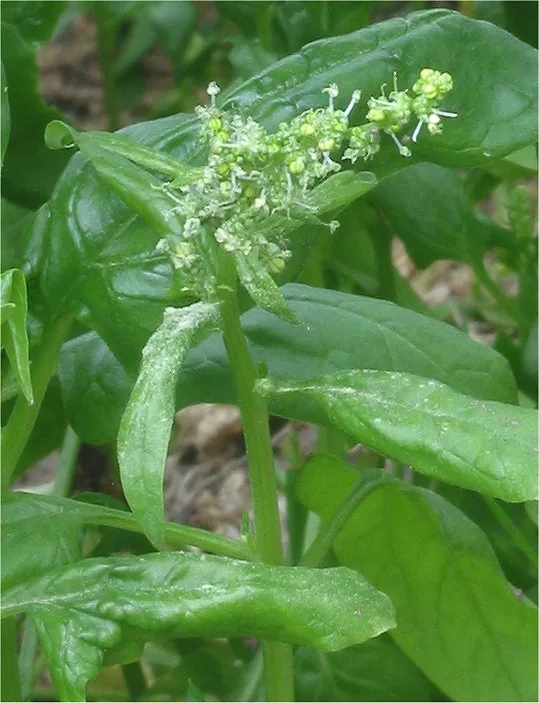


Cómo cultivar y cuidar Espinaca
Spinacia oleracea
Escrito por Emilio Marruso · última revisión
Tóxica para: Personas · Por qué
De un vistazo
La espinaca es uno de los cultivos más rápidos: sus hojas tiernas están listas 37–45 días después de sembrarla. Siémbrala a principios de primavera, o de nuevo para una cosecha de otoño, con sol pleno o semisombra y la tierra siempre húmeda. Después, recoge las hojas exteriores cuando las necesites, para comerlas crudas o cocinadas.
- Sol
Sol pleno o semisombra; un poco de sombra la ayuda cuando hace calor
Qué dicen las fuentes (6)
Luz: Pleno sol a semisombra
Spinach grows best in moist, rich, well-drained soil and in full sun to partial shade.
— Spinacia oleracea (Spinach, Spinaches) | North Carolina Extension Gardener Plant Toolbox [1] Spinach likes full sun but will tolerate partial shade.
— Growing Spinach, A Cool-Season Vegetable [5] Calor: El calor y el aumento de la duración del día hacen que se espigue (tallo floral, hojas amargas), a partir de 26.7 °C [80 °F]; cultivares resistentes al espigado para cultivos de primavera en climas cálidos; algo de sombra ayuda en climas calurosos.
Once the days warm up and the temperature reaches 80°F, spinach will want to bolt.
— Growing Spinach, A Cool-Season Vegetable [5] It is sensitive to the increasing day length and heat that comes with summer, causing plants to "bolt" and send up flowering stalks
— Spinacia oleracea (Spinach, Spinaches) | North Carolina Extension Gardener Plant Toolbox [1] as this process stops leaf growth and makes them bitter, bolt-resistant cultivars are recommended if growing a spring crop in warm climates.
— Spinacia oleracea (Spinach, Spinaches) | North Carolina Extension Gardener Plant Toolbox [1] It can tolerate 3 to 4 hours of sun a day, and some shade can be beneficial in hot weather.
— Spinacia oleracea (Spinach, Spinaches) | North Carolina Extension Gardener Plant Toolbox [1] - Riego
Al menos 2,5 cm de agua a la semana; mantén la tierra siempre húmeda y riega el suelo por la mañana
Qué dicen las fuentes (6)
Riego: Mantén el suelo uniformemente húmedo; al menos 1 pulgada (2.5 cm) de agua por semana; riega profundamente y con regularidad durante los períodos secos
Watering - Keep plants uniformly supplied with moisture for best performance. Water deeply and regularly during dry periods.
— Growing Spinach in a Home Garden | University of Maryland Extension [6] Keep plants well-watered during hot, dry weather, to promote fast growth. Plants should receive at least one inch of water a week.
— How to grow Bloomsdale long standing spinach (Spinacia oleracea) | Extension [3] Water the garden sufficiently to moisten the soil to a depth of 6 inches. Light sprinklings will encourage shallow rooting of the plants. Spinach requires a consistent supply of moisture to produce a high-quality crop.
— Spinach | Home & Garden Information Center [4] Notas sobre el riego: Riega el suelo, no las hojas; riega por la mañana para que el follaje esté seco antes de la noche; aplica mantillo para retener la humedad
When you must supplement with irrigation, water the soil, not the plant leaves. Moisture on the leaves can encourage fungal diseases.
— Growing Spinach, A Cool-Season Vegetable [5] The garden should be watered in the morning so that the foliage is dry before dark.
— Spinach | Home & Garden Information Center [4] You can mulch around the plants to help retain moisture and keep soil off the leaves.
— Spinach, Spinacia oleracea – Wisconsin Horticulture [2] - Frío
Aguanta inviernos de hasta −45,6 °C (−50 °F)
Muy rústica · USDA 2a · RHS H7 · Z2
Qué dicen las fuentes (2)
Rusticidad, zona más fría: 2a [mínima invernal de −45,6 a −42,8 °C (de −50 a −45 °F)]
USDA Plant Hardiness Zone: 2a, 2b, 3a, 3b, 4a, 4b, 5a, 5b, 6a, 6b, 7a, 7b, 8a, 8b, 9a, 9b, 10a, 10b, 11a, 11b
— Spinacia oleracea (Spinach, Spinaches) | North Carolina Extension Gardener Plant Toolbox [1] Rusticidad, zona más cálida: 11b [mínima invernal de 7,2 a 10 °C (de 45 a 50 °F)]
USDA Plant Hardiness Zone: 2a, 2b, 3a, 3b, 4a, 4b, 5a, 5b, 6a, 6b, 7a, 7b, 8a, 8b, 9a, 9b, 10a, 10b, 11a, 11b
— Spinacia oleracea (Spinach, Spinaches) | North Carolina Extension Gardener Plant Toolbox [1] - Suelo
Suelo con pH 6,0–7,0, mullido a 30–46 cm de profundidad para su raíz larga
Qué dicen las fuentes (3)
pH del suelo, mínimo: 6.0
Spinach is sensitive to acidic soils; therefore, follow the results of a soil test to maintain a soil pH between 6.0 and 7.0.
— Spinach | Home & Garden Information Center [4] pH del suelo, máximo: 7.0
Spinach is sensitive to acidic soils; therefore, follow the results of a soil test to maintain a soil pH between 6.0 and 7.0.
— Spinach | Home & Garden Information Center [4] Sistema radicular: La espinaca madura tiene una raíz principal larga; afloja el suelo hasta una profundidad de 30.5-45.7 cm [12–18 in].
Mature spinach has a long taproot, so loosen the soil to a depth of 12 to 18 inches.
— Growing Spinach, A Cool-Season Vegetable [5] - Distancia
De 30 a 90 cm entre hileras
Qué dicen las fuentes (2)
Distancia entre hileras: 30-91 cm (1 a 3 pies)
cultivar 'Bloomsdale Long Standing': Plant seeds evenly in rows that are 1-2’ apart.
— How to grow Bloomsdale long standing spinach (Spinacia oleracea) | Extension [3] Plant spinach seed in rows 1 to 3 feet apart, spacing seed 2 inches apart in the row.
— Spinach | Home & Garden Information Center [4] - Abonado
Compost o estiércol maduro antes de sembrar, y más abono 3–4 semanas después, a 10–15 cm de las plantas
Qué dicen las fuentes (7)
Abonos naturales: Compost rico o estiércol añejado incorporado al suelo antes de plantar
Spinach likes full sun but will tolerate partial shade. Prepare the planting bed by amending the soil with rich compost or aged manure.
— Growing Spinach, A Cool-Season Vegetable [5] Fertilizer needs: High requirement for nutrients, either from soil organic matter or fertilizers. Incorporate compost or fertilizer before planting.
— Growing Spinach in a Home Garden | University of Maryland Extension [6] Cuándo: Antes de plantar, luego un abono lateral durante la temporada (a mitad de temporada, tres o cuatro semanas después de plantar)
Abono lateral o fertilizante líquido: Apply a side dressing or liquid fertilizer when plants are about 2 inches tall.
— Spinach, Spinacia oleracea – Wisconsin Horticulture [2] Spinach is a heavy feeder . Fertilize before planting and at midseason to stimulate growth and yield.
— Spinach, Spinacia oleracea – Wisconsin Horticulture [2] Fertilizer needs: High requirement for nutrients, either from soil organic matter or fertilizers. Incorporate compost or fertilizer before planting. Side-dress as needed.
— Growing Spinach in a Home Garden | University of Maryland Extension [6] Side dress 1 pound of calcium nitrate (15.5-0-0) per 100 square feet (30 feet of row) three to four weeks after planting.
— Spinach | Home & Garden Information Center [4] Evitar: Fertilizante colocado a menos de 10.2–15.2 cm [4–6 in] de las plantas, que quema las raíces; gránulos que quedan en las hojas después de esparcir, que queman el follaje (lávelos regando por arriba)
To avoid burning the roots, side-dress fertilizer 4 to 6 inches away from the plants. If fertilizer is broadcast, avoid burning the plant foliage by watering overhead after the application to wash fertilizer granules off the leaves.
— Spinach | Home & Garden Information Center [4] - Cosecha
Lista en 37–45 días; recoge las hojas exteriores de 8–15 cm, para comer crudas o cocinadas
Qué dicen las fuentes (7)
Cosecha: 37-45 días después de la siembra; hojas individuales a partir de la etapa de al menos 6 hojas verdaderas, o plantas enteras en la madurez
Según Clemson HGIC: Spinach should be ready to harvest in about 37 to 45 days after planting.
— Spinach | Home & Garden Information Center [4] Según University of Maryland Extension: - Days to maturity: 28 - 55 from seed.
— Growing Spinach in a Home Garden | University of Maryland Extension [6] Bloomsdale Long Standing (fuente: Extensión de la Universidad de New Hampshire): Bloomsdale Long Standing Spinach matures in 40-48 days.
— How to grow Bloomsdale long standing spinach (Spinacia oleracea) | Extension [3] Spinach should be ready to harvest in about 37 to 45 days after planting.
— Spinach | Home & Garden Information Center [4] Individual leaves can be harvested periodically starting when the plants have at least 6 true leaves, or entire plants can be harvested at maturity
— Spinach, Spinacia oleracea – Wisconsin Horticulture [2] Cómo cosechar: Recoge o corta hojas individuales de color verde oscuro y tiernas de 3 a 6 pulgadas (7.6-15 cm) de largo, comenzando con las hojas exteriores; las plantas enteras se pueden cortar a nivel del suelo en la madurez.
Harvest dark green, tender leaves that are 3 to 6 inches long by picking or cutting individual leaves. Start by picking the outer leaves and then harvest the newer leaves as they reach the desired size.
— Spinach | Home & Garden Information Center [4] Cutting the plants off at the soil line will keep the harvested leaves cleaner than if the whole plant with its roots is removed.
— Spinach, Spinacia oleracea – Wisconsin Horticulture [2] - Plagas
Pulgones, minador de la espinaca y babosas; mildiu y roya blanca
Qué dicen las fuentes (5)
Plagas: pulgones, gusanos cortadores, orugas del repollo, gusanos de la mazorca, orugas de la polilla del repollo, minador de la hoja de la espinaca, babosas
Insect pests that may become a problem in growing spinach include aphids, cutworms, cabbage loopers, corn earworms, and diamondback moth caterpillars.
— Spinach | Home & Garden Information Center [4] Spinach leafminer is a fly that lays its eggs on the undersides of the leaves.
— Spinach, Spinacia oleracea – Wisconsin Horticulture [2] Slugs can also be a problem in very moist situations.
— Spinach, Spinacia oleracea – Wisconsin Horticulture [2] Enfermedades: mildiú velloso, roya blanca, damping-off de plántulas, mancha foliar por Cercospora, antracnosis
The primary disease problems with this crop are downy mildew, white rust, and seedling damping-off.
— Spinach | Home & Garden Information Center [4] Occasionally leaf spots, either Cercospora leaf spot or Anthracnose, may develop on the upper sides of the leaves, then fall out to form holes.
— Spinach, Spinacia oleracea – Wisconsin Horticulture [2] - Atención
El calor de más de 27 °C, los días largos y la tierra seca la hacen florecer y amargan las hojas
Qué dicen las fuentes (6)
Calor: El calor y el aumento de la duración del día hacen que se espigue (tallo floral, hojas amargas), a partir de 26.7 °C [80 °F]; cultivares resistentes al espigado para cultivos de primavera en climas cálidos; algo de sombra ayuda en climas calurosos.
Once the days warm up and the temperature reaches 80°F, spinach will want to bolt.
— Growing Spinach, A Cool-Season Vegetable [5] It is sensitive to the increasing day length and heat that comes with summer, causing plants to "bolt" and send up flowering stalks
— Spinacia oleracea (Spinach, Spinaches) | North Carolina Extension Gardener Plant Toolbox [1] as this process stops leaf growth and makes them bitter, bolt-resistant cultivars are recommended if growing a spring crop in warm climates.
— Spinacia oleracea (Spinach, Spinaches) | North Carolina Extension Gardener Plant Toolbox [1] It can tolerate 3 to 4 hours of sun a day, and some shade can be beneficial in hot weather.
— Spinacia oleracea (Spinach, Spinaches) | North Carolina Extension Gardener Plant Toolbox [1] Sequía: El suelo seco hace que se espigue y produzca semillas: mantén el suelo constantemente húmedo.
Dry, infertile soil encourages spinach to bolt and go to seed.
— Spinach, Spinacia oleracea – Wisconsin Horticulture [2] Try to keep the soil consistently moist, as spinach will bolt if it dries out.
— Growing Spinach, A Cool-Season Vegetable [5] - Tamaño
De 15 a 30 cm de ancho
Qué dicen las fuentes (1)
Anchura adulta: 15-30 cm (6 pulgadas a 1 pie)
Width: 0 ft. 6 in. - 1 ft. 0 in.
— Spinacia oleracea (Spinach, Spinaches) | North Carolina Extension Gardener Plant Toolbox [1] - Multiplicación
Se multiplica por semilla
Qué dicen las fuentes (1)
Propagación: Semilla
Recommended Propagation Strategy: Seed Country Or Region Of Origin:
— Spinacia oleracea (Spinach, Spinaches) | North Carolina Extension Gardener Plant Toolbox [1] - Siembra
Siembra a 1 cm de hondo, 4–8 semanas antes de la última helada o 6–8 antes de la primera del otoño
Qué dicen las fuentes (13)
Siembra: Principios de primavera, de 4 a 8 semanas antes de la fecha promedio de la última helada; cosecha de otoño de 6 a 8 semanas antes de la fecha promedio de la primera helada
Según Penn State Extension: Recommendations are to plant spinach about four to eight weeks before your average last frost date in the spring and six to eight weeks before the average first frost date in the fall.
— Growing Spinach, A Cool-Season Vegetable [5] Según University of Wisconsin Extension (spring): Spinach is a cool-season crop best planted in early spring, about 4 weeks before the average date of last frost .
— Spinach, Spinacia oleracea – Wisconsin Horticulture [2] Según University of Wisconsin Extension (fall): Plant a fall crop in mid-August for a late-September (or later) harvest .
— Spinach, Spinacia oleracea – Wisconsin Horticulture [2] Según University of Maryland Extension: Planting: Sow seed early in the spring after soil temperatures have reached 45°F.
— Growing Spinach in a Home Garden | University of Maryland Extension [6] Según University of New Hampshire Extension: Sow in early spring for the first crop, and again in late summer for a fall crop.
— How to grow Bloomsdale long standing spinach (Spinacia oleracea) | Extension [3] Carolina del Sur: Spinach ( Spinacia oleracea ) is a hardy, cool-season crop that can be planted in early spring or fall throughout South Carolina.
— Spinach | Home & Garden Information Center [4] Recommendations are to plant spinach about four to eight weeks before your average last frost date in the spring and six to eight weeks before the average first frost date in the fall.
— Growing Spinach, A Cool-Season Vegetable [5] Spinach is a cool-season crop best planted in early spring, about 4 weeks before the average date of last frost .
— Spinach, Spinacia oleracea – Wisconsin Horticulture [2] Profundidad de siembra: 1.3 cm (1/2 pulgada)
Plant seeds 1 to 4 inches apart and about ½ inch deep.
— Spinach, Spinacia oleracea – Wisconsin Horticulture [2] Plant spinach seed in rows 1 to 3 feet apart, spacing seed 2 inches apart in the row. Plant seed ½ inch deep and firm the soil over the seed to help ensure germination.
— Spinach | Home & Garden Information Center [4] Sow the seeds ½ inch deep, two inches apart, in rows 12 to 18 inches apart.
— Growing Spinach, A Cool-Season Vegetable [5] Días de germinación: 7-10 días
cultivar 'Bloomsdale Long Standing': 7-14 days depending on soil and weather conditions
— How to grow Bloomsdale long standing spinach (Spinacia oleracea) | Extension [3] Within 7 to 10 days, the first signs of sprouting usually appear as the cotyledon (seed leaves) emerge.
— Growing Spinach, A Cool-Season Vegetable [5] - Maceta
Crece también en maceta
Qué dicen las fuentes (1)
En maceta: Sí
It can be grown at home in containers or beds and tolerates areas too shady for most other vegetables to thrive.
— Spinacia oleracea (Spinach, Spinaches) | North Carolina Extension Gardener Plant Toolbox [1] - Seguridad
Se puede comer sin problema; solo en grandes cantidades y con el tiempo dificulta absorber hierro y calcio
Resumen
La espinaca es una hortaliza anual de estación fría que se cultiva a partir de semillas en primavera u otoño. [1][2] Crece a pleno sol o semisombra con suelo uniformemente húmedo y bien drenado, y se puede cultivar en contenedores. [1][6] El clima cálido y los días largos causan el espigamiento, que detiene el crecimiento de las hojas y las vuelve amargas. [1]
Citado en inglés, como en la fuente.
Cuidados
Las medidas entre corchetes son nuestra conversión al otro sistema de unidades; el texto citado no cambia.
Riego
Riego
Mantén el suelo uniformemente húmedo; al menos 1 pulgada (2.5 cm) de agua por semana; riega profundamente y con regularidad durante los períodos secos
Qué dicen las fuentes (3)
Watering - Keep plants uniformly supplied with moisture for best performance. Water deeply and regularly during dry periods.Keep plants well-watered during hot, dry weather, to promote fast growth. Plants should receive at least one inch of water a week.Water the garden sufficiently to moisten the soil to a depth of 6 inches. Light sprinklings will encourage shallow rooting of the plants. Spinach requires a consistent supply of moisture to produce a high-quality crop.Notas sobre el riego
Riega el suelo, no las hojas; riega por la mañana para que el follaje esté seco antes de la noche; aplica mantillo para retener la humedad
Qué dicen las fuentes (3)
When you must supplement with irrigation, water the soil, not the plant leaves. Moisture on the leaves can encourage fungal diseases.The garden should be watered in the morning so that the foliage is dry before dark.You can mulch around the plants to help retain moisture and keep soil off the leaves.Luz
Pleno sol a semisombra
Qué dicen las fuentes (2)
Spinach grows best in moist, rich, well-drained soil and in full sun to partial shade.Spinach likes full sun but will tolerate partial shade.Clima y frío
Rusticidad, zona más fría
2a [mínima invernal de −45,6 a −42,8 °C (de −50 a −45 °F)]
Qué dicen las fuentes (1)
USDA Plant Hardiness Zone:
2a, 2b, 3a, 3b, 4a, 4b, 5a, 5b, 6a, 6b, 7a, 7b, 8a, 8b, 9a, 9b, 10a, 10b, 11a, 11bRusticidad, zona más cálida
11b [mínima invernal de 7,2 a 10 °C (de 45 a 50 °F)]
Qué dicen las fuentes (1)
USDA Plant Hardiness Zone:
2a, 2b, 3a, 3b, 4a, 4b, 5a, 5b, 6a, 6b, 7a, 7b, 8a, 8b, 9a, 9b, 10a, 10b, 11a, 11bSuelo
pH del suelo, mínimo
6.0
Qué dicen las fuentes (1)
Spinach is sensitive to acidic soils; therefore, follow the results of a soil test to maintain a soil pH between 6.0 and 7.0.pH del suelo, máximo
7.0
Qué dicen las fuentes (1)
Spinach is sensitive to acidic soils; therefore, follow the results of a soil test to maintain a soil pH between 6.0 and 7.0.Dónde cultivarla
En maceta
Sí
Qué dicen las fuentes (1)
It can be grown at home in containers or beds and tolerates areas too shady for most other vegetables to thrive.Distancia de plantación
Las fuentes dan valores distintos según la región, la zona o las condiciones de cultivo.
Lo que dice cada fuente
Según NC State Extension Plant Toolbox (thinned seedlings): 5.1-7.6 cm (2-3 pulgadas) de separación
Según University of New Hampshire Extension (thinned seedlings): 15.2 cm (6 pulgadas) de separación
Según Penn State Extension: 10.2-15.2 cm (4-6 pulgadas) de espacio por planta; semillas a 5.1 cm (2 pulgadas) de separación en filas separadas 30.5-45.7 cm (12-18 pulgadas)
Según University of Maryland Extension: 7.6 cm (3 pulgadas) de separación en hileras; se aclaran a unos 15.2 cm (6 pulgadas) a principios del verano
Según Clemson HGIC (seed spacing): Siembra las semillas a 5.1 cm (2 pulgadas) de distancia en la hilera, con hileras separadas entre 30.5 y 91.4 cm (1 a 3 pies)
Qué dicen las fuentes (5)
Según NC State Extension Plant Toolbox (thinned seedlings): thin seedlings to 2 to 3 inches apart.Según University of New Hampshire Extension (thinned seedlings): Thin seedlings to 6” apart when they are 1-2” tall.Según Penn State Extension: Spinach plants need four to six inches of space to develop properly.Según University of Maryland Extension: Spacing : 3 inches apart in rows or equidistantly in wide rows or beds.Según Clemson HGIC (seed spacing): Plant spinach seed in rows 1 to 3 feet apart, spacing seed 2 inches apart in the row.Propagación
Semilla
Qué dicen las fuentes (1)
Recommended Propagation Strategy:
Seed
Country Or Region Of Origin:Cultivo
La planta
Ciclo de vida
anual
Qué dicen las fuentes (2)
Spinach is an edible, cool season, annual vegetable in the amaranth family (Amaranthaceae) that is widely grown for use as a leafy green in salads and cooked dishes.Spinach ( Spinacia oleracea ) is a cold hardy annual related to beets and Swiss chard that has been a long history of use by humans.Familia
Amaranthaceae
Qué dicen las fuentes (2)
Spinach is an edible, cool season, annual vegetable in the amaranth family (Amaranthaceae) that is widely grown for use as a leafy green in salads and cooked dishes.Spinach ( Spinacia oleracea ) is an edible flowering plant in the family Amaranthaceae.Altura adulta
Anchura adulta
15-30 cm (6 pulgadas a 1 pie)
Qué dicen las fuentes (1)
Width: 0 ft. 6 in. - 1 ft. 0 in.Siembra y crecimiento
Días de germinación
7-10 días
Lo que dice cada fuente
cultivar 'Bloomsdale Long Standing': 7-14 días
Qué dicen las fuentes (2)
cultivar 'Bloomsdale Long Standing': 7-14 days depending on soil and weather conditionsWithin 7 to 10 days, the first signs of sprouting usually appear as the cotyledon (seed leaves) emerge.Profundidad de siembra
1.3 cm (1/2 pulgada)
Qué dicen las fuentes (3)
Plant seeds 1 to 4 inches apart and about ½ inch deep.Plant spinach seed in rows 1 to 3 feet apart, spacing seed 2 inches apart in the row. Plant seed ½ inch deep and firm the soil over the seed to help ensure germination.Sow the seeds ½ inch deep, two inches apart, in rows 12 to 18 inches apart.Distancia entre hileras
30-91 cm (1 a 3 pies)
Lo que dice cada fuente
cultivar 'Bloomsdale Long Standing': 30-61 cm (1-2 pies)
Qué dicen las fuentes (2)
cultivar 'Bloomsdale Long Standing': Plant seeds evenly in rows that are 1-2’ apart.Plant spinach seed in rows 1 to 3 feet apart, spacing seed 2 inches apart in the row.Días hasta la madurez
28-55 días desde la semilla
Lo que dice cada fuente
cultivar 'Bloomsdale Long Standing': 40-48 días
Qué dicen las fuentes (2)
cultivar 'Bloomsdale Long Standing': Bloomsdale Long Standing Spinach matures in 40-48 days.Days to maturity: 28 - 55 from seed.Cosecha y conservación
Cómo cosechar
Recoge o corta hojas individuales de color verde oscuro y tiernas de 3 a 6 pulgadas (7.6-15 cm) de largo, comenzando con las hojas exteriores; las plantas enteras se pueden cortar a nivel del suelo en la madurez.
Qué dicen las fuentes (2)
Harvest dark green, tender leaves that are 3 to 6 inches long by picking or cutting individual leaves. Start by picking the outer leaves and then harvest the newer leaves as they reach the desired size.Cutting the plants off at the soil line will keep the harvested leaves cleaner than if the whole plant with its roots is removed.Conservación
Las hojas frescas se conservan hasta una semana refrigeradas; de 2 a 3 semanas a 0 °C (32 °F) y 95% de humedad relativa; también se pueden congelar, enlatar o secar.
Qué dicen las fuentes (2)
Fresh spinach can be refrigerated for up to one week . The leaves can also be frozen, canned, or dried.Spinach will last 2 to 3 weeks when stored in very cool (32 degrees F), moist (95% RH) conditions.Plagas y enfermedades
Plagas
pulgones, gusanos cortadores, orugas del repollo, gusanos de la mazorca, orugas de la polilla del repollo, minador de la hoja de la espinaca, babosas
Qué dicen las fuentes (3)
Insect pests that may become a problem in growing spinach include aphids, cutworms, cabbage loopers, corn earworms, and diamondback moth caterpillars.Spinach leafminer is a fly that lays its eggs on the undersides of the leaves.Slugs can also be a problem in very moist situations.Enfermedades
mildiú velloso, roya blanca, damping-off de plántulas, mancha foliar por Cercospora, antracnosis
Qué dicen las fuentes (2)
The primary disease problems with this crop are downy mildew, white rust, and seedling damping-off.Occasionally leaf spots, either Cercospora leaf spot or Anthracnose, may develop on the upper sides of the leaves, then fall out to form holes.Abonado
Cuándo
Antes de plantar, luego un abono lateral durante la temporada (a mitad de temporada, tres o cuatro semanas después de plantar)
Lo que dice cada fuente
Abono lateral o fertilizante líquido: Cuando las plantas midan 5.08 cm [2 in] de alto.
Qué dicen las fuentes (4)
Abono lateral o fertilizante líquido: Apply a side dressing or liquid fertilizer when plants are about 2 inches tall.Spinach is a heavy feeder . Fertilize before planting and at midseason to stimulate growth and yield.Fertilizer needs: High requirement for nutrients, either from soil organic matter or fertilizers. Incorporate compost or fertilizer before planting. Side-dress as needed.Side dress 1 pound of calcium nitrate (15.5-0-0) per 100 square feet (30 feet of row) three to four weeks after planting.Frecuencia
Dos veces: una antes de plantar y otra a mitad de temporada; en suelo arenoso, el abono lateral se puede dividir en dos aplicaciones
Qué dicen las fuentes (2)
Spinach is a heavy feeder . Fertilize before planting and at midseason to stimulate growth and yield.Side dress 1 pound of calcium nitrate (15.5-0-0) per 100 square feet (30 feet of row) three to four weeks after planting. On sandier soil, this may need to be split into two applications.Abonos naturales
Compost rico o estiércol añejado incorporado al suelo antes de plantar
Qué dicen las fuentes (2)
Spinach likes full sun but will tolerate partial shade. Prepare the planting bed by amending the soil with rich compost or aged manure.Fertilizer needs: High requirement for nutrients, either from soil organic matter or fertilizers. Incorporate compost or fertilizer before planting.Abonos minerales
Nitrato de calcio (15.5-0-0) como abono lateral, 48.8 g/m², tres o cuatro semanas después de plantar; un fertilizante nitrogenado de nuevo si las hojas se ponen amarillas
Lo que dice cada fuente
fertilizante pre-siembra: Distribuye uniformemente e incorpora al suelo a una profundidad de 15.2 cm [6 in].
Qué dicen las fuentes (3)
fertilizante pre-siembra: Broadcast the fertilizer evenly and incorporate it into the soil by tilling or disking to a depth of around 6 inches.Side dress 1 pound of calcium nitrate (15.5-0-0) per 100 square feet (30 feet of row) three to four weeks after planting.If the leaves begin to yellow, fertilize again with a nitrogen fertilizer.Evitar
Fertilizante colocado a menos de 10.2–15.2 cm [4–6 in] de las plantas, que quema las raíces; gránulos que quedan en las hojas después de esparcir, que queman el follaje (lávelos regando por arriba)
Qué dicen las fuentes (1)
To avoid burning the roots, side-dress fertilizer 4 to 6 inches away from the plants. If fertilizer is broadcast, avoid burning the plant foliage by watering overhead after the application to wash fertilizer granules off the leaves.Signos de carencia
Hojas amarillentas, corregidas con un fertilizante nitrogenado; el suelo seco e infértil hace que la espinaca se espigue y produzca semillas
Qué dicen las fuentes (2)
Apply a side dressing or liquid fertilizer when plants are about 2 inches tall. If the leaves begin to yellow, fertilize again with a nitrogen fertilizer.Dry, infertile soil encourages spinach to bolt and go to seed.Distancias
Entre plantas
Las fuentes dan valores distintos según la región, la zona o las condiciones de cultivo.
Lo que dice cada fuente
Carolina del Norte (EE. UU.), después de aclarar: 5.1-7.6 cm [2–3 in]
Maryland (EE. UU.): 7.6 cm [3 in] en la hilera o equidistante en hileras anchas o camas
Pensilvania (EE. UU.): 10.2-15.2 cm [4–6 in] de espacio por planta
cultivar 'Bloomsdale Long Standing': aclara a 15.2 cm [6 in] cuando los plantones midan 2.5-5.1 cm [1–2 in] de alto
Qué dicen las fuentes (4)
Carolina del Norte (EE. UU.), después de aclarar: Plant seeds ¼ to 1/2 inch deep and thin seedlings to 2 to 3 inches apart.Maryland (EE. UU.): Spacing : 3 inches apart in rows or equidistantly in wide rows or beds.Pensilvania (EE. UU.): Spinach plants need four to six inches of space to develop properly.cultivar 'Bloomsdale Long Standing': Thin seedlings to 6” apart when they are 1-2” tall.Entre hileras
Las fuentes dan valores distintos según la región, la zona o las condiciones de cultivo.
Lo que dice cada fuente
Pensilvania (EE. UU.): 30.5-45.7 cm [12–18 in]
Carolina del Sur (EE. UU.): 30.5-91.4 cm [12–36 in]
cultivar 'Bloomsdale Long Standing': 30.5-61 cm [12–24 in]
Qué dicen las fuentes (3)
Pensilvania (EE. UU.): Sow the seeds ½ inch deep, two inches apart, in rows 12 to 18 inches apart.Carolina del Sur (EE. UU.): Plant spinach seed in rows 1 to 3 feet apart, spacing seed 2 inches apart in the row.cultivar 'Bloomsdale Long Standing': Plant seeds evenly in rows that are 1-2’ apart.Raíces
Sistema radicular
La espinaca madura tiene una raíz principal larga; afloja el suelo hasta una profundidad de 30.5-45.7 cm [12–18 in].
Qué dicen las fuentes (1)
Mature spinach has a long taproot, so loosen the soil to a depth of 12 to 18 inches.Propagación
Germinación
Las temperaturas del suelo superiores a 29.4 °C [85 °F] inhiben la germinación; las semillas de más de un año germinan mal.
Lo que dice cada fuente
Carolina del Sur (EE. UU.): temperatura óptima del suelo 21.1 °C [70 °F]
Pensilvania (EE. UU.): mejor a temperaturas del suelo de 7.2-20 °C [45–68 °F]
cultivar 'Bloomsdale Long Standing': germinación en 7-14 días
Qué dicen las fuentes (5)
Carolina del Sur (EE. UU.): The optimum soil temperature for spinach seed germination is 70 °F.Pensilvania (EE. UU.): Spinach seeds germinate best at soil temperatures between 45°F and 68°F.cultivar 'Bloomsdale Long Standing': Germination 7-14 days depending on soil and weather conditions Planting Sow in early spring for the first cropSoil temperature above 85 °F will inhibit seed germination.Spinach seed that is more than a year old does not germinate well.Tras la cosecha
Conservación
2-3 semanas a 0 °C [32 °F] y 95% de humedad relativa; la espinaca fresca se conserva hasta una semana en el refrigerador.
Qué dicen las fuentes (2)
Spinach will last 2 to 3 weeks when stored in very cool (32 degrees F), moist (95% RH) conditions.Fresh spinach can be refrigerated for up to one weekCalor y sequía
Calor
El calor y el aumento de la duración del día hacen que se espigue (tallo floral, hojas amargas), a partir de 26.7 °C [80 °F]; cultivares resistentes al espigado para cultivos de primavera en climas cálidos; algo de sombra ayuda en climas calurosos.
Qué dicen las fuentes (4)
Once the days warm up and the temperature reaches 80°F, spinach will want to bolt.It is sensitive to the increasing day length and heat that comes with summer, causing plants to "bolt" and send up flowering stalksas this process stops leaf growth and makes them bitter, bolt-resistant cultivars are recommended if growing a spring crop in warm climates.It can tolerate 3 to 4 hours of sun a day, and some shade can be beneficial in hot weather.Sequía
El suelo seco hace que se espigue y produzca semillas: mantén el suelo constantemente húmedo.
Problemas
Pulgones
Síntoma: Infestan las plantas
Qué hacer: Retira las hojas infestadas o usa un chorro de agua vigoroso
Qué dicen las fuentes (1)
Aphids can be controlled by removing infested leaves or with with a vigorous stream of water.
— Spinach, Spinacia oleracea – Wisconsin Horticulture [2] Minador de la hoja de la espinaca
Síntoma: Las larvas perforan la hoja y crean senderos conspicuos
Qué hacer: Retira las hojas con huevos o minas; cubre las plantas con cubiertas flotantes para hileras después de aclarar
Qué dicen las fuentes (2)
Maggots burrow into the leaf and create conspicuous trails as they eat their way through the leaf. Remove leaves with eggs or mines.
— Spinach, Spinacia oleracea – Wisconsin Horticulture [2] To prevent leaf miner damage, cover plants with floating row covers after thinning.
— Spinach, Spinacia oleracea – Wisconsin Horticulture [2] Espigado
Síntoma: Las plantas producen tallos florales, deteniendo el crecimiento de las hojas y haciendo que las hojas se vuelvan amargas
Qué hacer: Cultiva variedades resistentes al espigado si cultivas una cosecha de primavera en climas cálidos
Qué dicen las fuentes (1)
bolt-resistant cultivars are recommended if growing a spring crop in warm climates.
— Spinacia oleracea (Spinach, Spinaches) | North Carolina Extension Gardener Plant Toolbox [1] Mildiú velloso, roya blanca y damping-off de plántulas
Síntoma: Enfermedades que pueden dañar la espinaca
Qué dicen las fuentes (1)
Diseases that can harm spinach are downy mildew, white rust, and seedling damping-off.
— Spinacia oleracea (Spinach, Spinaches) | North Carolina Extension Gardener Plant Toolbox [1] Babosas
Síntoma: Puede ser un problema en situaciones muy húmedas
Qué hacer: No apliques mantillo alrededor de las plantas
Qué dicen las fuentes (1)
Slugs can also be a problem in very moist situations. When slugs are a problem, do not mulch around the plants.
— Spinach, Spinacia oleracea – Wisconsin Horticulture [2]
Remedios
Cada remedio indica qué dicen las fuentes oficiales; los remedios tradicionales sin fuente oficial aparecen marcados. Los perjudiciales están para que sepas evitarlos.
Cuidar la planta
pulgones
chorro de agua fuerte Funciona en parte
Cómo: Retira las hojas infestadas o usa un chorro de agua vigoroso.
Aphids can be controlled by removing infested leaves or with with a vigorous stream of water.
— Spinach, Spinacia oleracea – Wisconsin Horticulture [2] Qué dicen las pruebas Wash aphids from plants with a strong stream of water. This may be ineffective on the low foliage of spinach.
— hortsense.cahnrs.wsu.edu [7] jabón para platos y agua para limpiar Funciona en parte
For example, spraying home remedies that contain dish detergent on plants on a sunny day can injure the plant, essentially burning it.
— extension.psu.edu [9] Do you know if the additives are safe for the plants, for beneficial insects, or for the environment?
— extension.psu.edu [9] Cómo: Limpia las hojas con una solución de 1 a 2 por ciento de jabón para platos (sin aditivos) y agua cada 2 a 3 días durante 2 semanas.
wipe leaves with a 1 to 2 percent solution of dish soap (no additives) and water every 2 to 3 days for 2 weeks
— almanac.com [8] Qué dicen las pruebas For example, spraying home remedies that contain dish detergent on plants on a sunny day can injure the plant, essentially burning it.
— extension.psu.edu [9] spray de aceite de neem Funciona en parte
Despite these being biological pesticides, it is important to read the directions on the label and wear safety equipment.
— extension.illinois.edu [12] Cómo: Si se necesita más ayuda, usa jabones insecticidas o aceite de neem.
Aphids are probably the most common of spinach pests. Natural enemies generally keep them in check. If you need more help, use insecticidal soaps or neem oil
— gardeningknowhow.com [10] Qué dicen las pruebas However, neem oil is not effective against every insect and disease, and often must be frequently reapplied to reach the desired outcome.
— extension.unh.edu [11] ajo plantado cerca No verificado
Remedio tradicional, no verificado por una fuente oficial.
Cómo: Planta ajo para mantener alejados a los pulgones.
cáscaras de plátano o naranja alrededor de las plantas No verificado
Remedio tradicional, no verificado por una fuente oficial.
Cómo: Pon cáscaras de plátano o naranja alrededor de las plantas.
babosas
recolección manual No verificado
Remedio tradicional, no verificado por una fuente oficial.
Cómo: Recoge babosas y caracoles de las plantas a mano.
gusanos de alambre
trampas de zanahoria enterradas No verificado
Remedio tradicional, no verificado por una fuente oficial.
Cómo: Entierra zanahorias maduras por todo el jardín y revísalas cada pocos días para eliminar cualquier gusano de alambre.
escarabajos de la pulga
mantillo reflectante o papel de aluminio No verificado
Remedio tradicional, no verificado por una fuente oficial.
Cómo: Usa mantillo reflectante o papel de aluminio debajo de las plantas.
minadores de hojas
retirando las hojas minadas y las cubiertas flotantes de fila Fuente oficial, sin prueba independiente
Cómo: Retira las hojas con huevos o minas; cubre las plantas con cubiertas flotantes de hilera después de aclarar.
Maggots burrow into the leaf and create conspicuous trails as they eat their way through the leaf. Remove leaves with eggs or mines.
— Spinach, Spinacia oleracea – Wisconsin Horticulture [2]
Toxicidad
Según la fuente, citada textualmente. No es un consejo médico ni veterinario: si una persona o un animal pudo haber ingerido esta planta, contacta con un centro de toxicología o con un veterinario.
Raw spinach leaves, while edible and safe to eat, contain oxalates that can prevent the absorption of iron and calcium.
[1]- Partes venenosas
Poison Part: Flowers Leaves Stems
[1]- Principio tóxico
Poison Toxic Principle: Oxalic acid
[1]- Síntomas
Poison Symptoms: Only toxic in large quantities over time or with low calcium intake. Can interfere with absorption of iron and calcium as well as increase the risk of developing gout and kidney stones.
[1]- Gravedad
Poison Severity: Low Poison Symptoms: Only toxic in large quantities over time or with low calcium intake.
[1]
Poison Symptoms: Only toxic in large quantities over time or with low calcium intake. Can interfere with absorption of iron and calcium as well as increase the risk of developing gout and kidney stones.
[1]
Calendario
Siembra
Principios de primavera, de 4 a 8 semanas antes de la fecha promedio de la última helada; cosecha de otoño de 6 a 8 semanas antes de la fecha promedio de la primera helada
Lo que dice cada fuente
Según Penn State Extension: Primavera: de 4 a 8 semanas antes de la fecha promedio de la última helada; otoño: de 6 a 8 semanas antes de la fecha promedio de la primera helada
Según University of Wisconsin Extension (spring): Principios de primavera, unas 4 semanas antes de la fecha promedio de la última helada
Según University of Wisconsin Extension (fall): Mediados de agosto para una cosecha a fines de septiembre; un cultivo de invierno a fines de septiembre
Según University of Maryland Extension: Principios de primavera, después de que la temperatura del suelo haya alcanzado los 45°F [7 °C]
Según University of New Hampshire Extension: Principios de primavera para la primera cosecha, fines de verano para una cosecha de otoño
Carolina del Sur: Principios de primavera u otoño
Qué dicen las fuentes (8)
Según Penn State Extension: Recommendations are to plant spinach about four to eight weeks before your average last frost date in the spring and six to eight weeks before the average first frost date in the fall.Según University of Wisconsin Extension (spring): Spinach is a cool-season crop best planted in early spring, about 4 weeks before the average date of last frost .Según University of Wisconsin Extension (fall): Plant a fall crop in mid-August for a late-September (or later) harvest .Según University of Maryland Extension: Planting: Sow seed early in the spring after soil temperatures have reached 45°F.Según University of New Hampshire Extension: Sow in early spring for the first crop, and again in late summer for a fall crop.Carolina del Sur: Spinach ( Spinacia oleracea ) is a hardy, cool-season crop that can be planted in early spring or fall throughout South Carolina.Recommendations are to plant spinach about four to eight weeks before your average last frost date in the spring and six to eight weeks before the average first frost date in the fall.Spinach is a cool-season crop best planted in early spring, about 4 weeks before the average date of last frost .Cosecha
37-45 días después de la siembra; hojas individuales a partir de la etapa de al menos 6 hojas verdaderas, o plantas enteras en la madurez
Lo que dice cada fuente
Según Clemson HGIC: 37 a 45 días después de la siembra
Según University of Maryland Extension: 28 - 55 días desde la semilla
Bloomsdale Long Standing (fuente: Extensión de la Universidad de New Hampshire): 40-48 días
Qué dicen las fuentes (5)
Según Clemson HGIC: Spinach should be ready to harvest in about 37 to 45 days after planting.Según University of Maryland Extension: - Days to maturity: 28 - 55 from seed.Bloomsdale Long Standing (fuente: Extensión de la Universidad de New Hampshire): Bloomsdale Long Standing Spinach matures in 40-48 days.Spinach should be ready to harvest in about 37 to 45 days after planting.Individual leaves can be harvested periodically starting when the plants have at least 6 true leaves, or entire plants can be harvested at maturityMeses tal como los dan las fuentes, en su mayoría de Estados Unidos (hemisferio norte). En el hemisferio sur se desplazan unos seis meses.
Respecto a las heladas
Estimación menos precisa: no hay ninguna estación meteorológica a menos de 300 km.
Busca las fechas de heladas por código postal o ciudad
Siembra en interior: 8 semanas antes de la primera helada
For spring crops, plant seed directly in the soil in early spring or start indoors eight weeks before the first frost for later transplant.
— Spinacia oleracea (Spinach, Spinaches) | North Carolina Extension Gardener Plant Toolbox [1] Plantación: de 4 a 8 semanas antes de la última helada
Recommendations are to plant spinach about four to eight weeks before your average last frost date in the spring and six to eight weeks before the average first frost date in the fall.
— Growing Spinach, A Cool-Season Vegetable [5] Plantación: de 6 a 8 semanas antes de la primera helada
Recommendations are to plant spinach about four to eight weeks before your average last frost date in the spring and six to eight weeks before the average first frost date in the fall.
— Growing Spinach, A Cool-Season Vegetable [5] Plantación: 4 semanas antes de la última helada
Spinach is a cool-season crop best planted in early spring, about 4 weeks before the average date of last frost .
— Spinach, Spinacia oleracea – Wisconsin Horticulture [2]
Cuenta desde las fechas medias de las heladas de tu zona.
Comestibilidad
Según la fuente, citada textualmente. No comas una planta basándote solo en esta página: los errores de identificación pueden ser peligrosos.
Valores orientativos
Valores de una fuente secundaria, no comprobados palabra por palabra como el resto de esta página. Úselos como punto de partida.
- Horas de sol
- 6-8 horasValor orientativo, adáptalo a tu clima · Fuente secundaria
- Resiste la sequía
- SíValor orientativo, adáptalo a tu clima · Fuente secundaria
- Nivel de cuidado
- MedioValor orientativo, adáptalo a tu clima · Fuente secundaria
- Crecimiento
- BajoValor orientativo, adáptalo a tu clima · Fuente secundaria
- Poda
- Marzo, abril, mayo, junio, julio, agosto, septiembre, junio, julio, agosto, junio, julio, agosto, mayo, marzo, abril, mayo, junio, julio, agosto, septiembre, marzo, abril, mayo, junio, julio, agosto, septiembre, junio, julio, agosto, marzo, abril, mayo, junio, julio, agosto, septiembreValor orientativo, adáptalo a tu clima · Fuente secundaria
Plantas similares
- Bledo Amaranthus hybridus
- Carelessweed Amaranthus palmeri
- Flor de amor Celosia argentea
- Quihuicha Amaranthus caudatus
- Goosefoot Dysphania botrys
- Ala de loro Amaranthus tricolor
- Cenizo Chenopodium album
- Bledo Amaranthus blitum
Fuentes
Cada valor anterior se cita de estos documentos. Los enlaces llevan al editor original.
- Spinacia oleracea (Spinach, Spinaches) | North Carolina Extension Gardener Plant Toolbox · plants.ces.ncsu.edu, consultado
- Spinach, Spinacia oleracea – Wisconsin Horticulture · hort.extension.wisc.edu, consultado
- How to grow Bloomsdale long standing spinach (Spinacia oleracea) | Extension · extension.unh.edu, consultado
- Spinach | Home & Garden Information Center · hgic.clemson.edu, consultado
- Growing Spinach, A Cool-Season Vegetable · extension.psu.edu, consultado
- Growing Spinach in a Home Garden | University of Maryland Extension · extension.umd.edu, consultado
- hortsense.cahnrs.wsu.edu · hortsense.cahnrs.wsu.edu
- almanac.com · almanac.com
- extension.psu.edu · extension.psu.edu
- gardeningknowhow.com · gardeningknowhow.com
- extension.unh.edu · extension.unh.edu
- extension.illinois.edu · extension.illinois.edu
Escrito por Emilio Marruso · última revisión