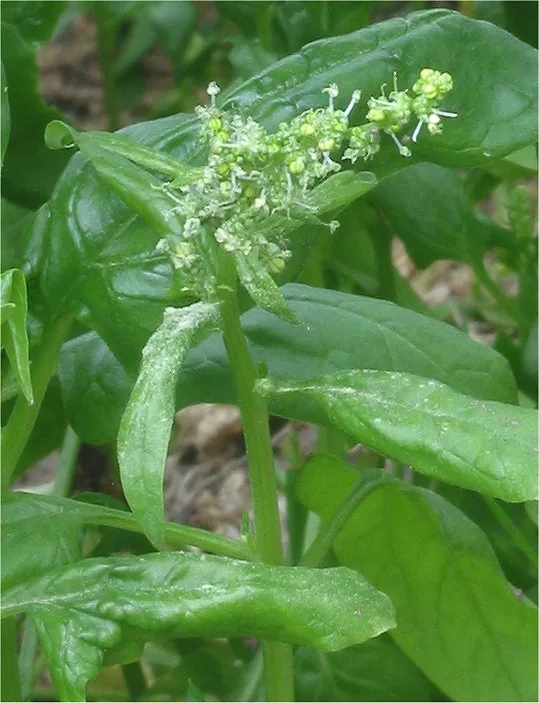


How to Grow and Care for Spinach
Spinacia oleracea
Written by Emilio Marruso · last checked
Toxic to: People · Why
At a glance
Spinach is one of the quickest crops you can grow: tender leaves are ready 37–45 days after planting. Sow it in early spring, or again for a fall crop, and give it full sun or partial shade and evenly moist soil. Then pick the outer leaves whenever you need them, to eat fresh or cooked.
- Sun
Full sun to partial shade; some shade helps in hot weather
What the sources say (6)
Light: Full sun to partial shade
Spinach grows best in moist, rich, well-drained soil and in full sun to partial shade.
— Spinacia oleracea (Spinach, Spinaches) | North Carolina Extension Gardener Plant Toolbox [1] Spinach likes full sun but will tolerate partial shade.
— Growing Spinach, A Cool-Season Vegetable [5] Heat: Heat and increasing day length make it bolt (flower stalk, bitter leaves), from 26.7 °C [80 °F]; bolt-resistant cultivars for spring crops in warm climates; some shade helps in hot weather.
Once the days warm up and the temperature reaches 80°F, spinach will want to bolt.
— Growing Spinach, A Cool-Season Vegetable [5] It is sensitive to the increasing day length and heat that comes with summer, causing plants to "bolt" and send up flowering stalks
— Spinacia oleracea (Spinach, Spinaches) | North Carolina Extension Gardener Plant Toolbox [1] as this process stops leaf growth and makes them bitter, bolt-resistant cultivars are recommended if growing a spring crop in warm climates.
— Spinacia oleracea (Spinach, Spinaches) | North Carolina Extension Gardener Plant Toolbox [1] It can tolerate 3 to 4 hours of sun a day, and some shade can be beneficial in hot weather.
— Spinacia oleracea (Spinach, Spinaches) | North Carolina Extension Gardener Plant Toolbox [1] - Water
At least 1 inch of water a week; keep the soil evenly moist and water the soil in the morning
What the sources say (6)
Watering: Keep soil uniformly moist; at least 1 inch (2.5 cm) of water a week; water deeply and regularly during dry periods
Watering - Keep plants uniformly supplied with moisture for best performance. Water deeply and regularly during dry periods.
— Growing Spinach in a Home Garden | University of Maryland Extension [6] Keep plants well-watered during hot, dry weather, to promote fast growth. Plants should receive at least one inch of water a week.
— How to grow Bloomsdale long standing spinach (Spinacia oleracea) | Extension [3] Water the garden sufficiently to moisten the soil to a depth of 6 inches. Light sprinklings will encourage shallow rooting of the plants. Spinach requires a consistent supply of moisture to produce a high-quality crop.
— Spinach | Home & Garden Information Center [4] Watering notes: Water the soil, not the leaves; water in the morning so the foliage is dry before dark; mulch to retain moisture
When you must supplement with irrigation, water the soil, not the plant leaves. Moisture on the leaves can encourage fungal diseases.
— Growing Spinach, A Cool-Season Vegetable [5] The garden should be watered in the morning so that the foliage is dry before dark.
— Spinach | Home & Garden Information Center [4] You can mulch around the plants to help retain moisture and keep soil off the leaves.
— Spinach, Spinacia oleracea – Wisconsin Horticulture [2] - Cold
Survives winters down to −50 °F (−45.6 °C)
Very hardy · USDA 2a · RHS H7 · Z2
What the sources say (2)
Hardiness, coldest zone: 2a [winter low −45.6 to −42.8 °C (−50 to −45 °F)]
USDA Plant Hardiness Zone: 2a, 2b, 3a, 3b, 4a, 4b, 5a, 5b, 6a, 6b, 7a, 7b, 8a, 8b, 9a, 9b, 10a, 10b, 11a, 11b
— Spinacia oleracea (Spinach, Spinaches) | North Carolina Extension Gardener Plant Toolbox [1] Hardiness, warmest zone: 11b [winter low 7.2 to 10 °C (45 to 50 °F)]
USDA Plant Hardiness Zone: 2a, 2b, 3a, 3b, 4a, 4b, 5a, 5b, 6a, 6b, 7a, 7b, 8a, 8b, 9a, 9b, 10a, 10b, 11a, 11b
— Spinacia oleracea (Spinach, Spinaches) | North Carolina Extension Gardener Plant Toolbox [1] - Soil
Soil with pH 6.0–7.0, loosened 12–18 in deep for its long root
What the sources say (3)
Soil pH, minimum: 6.0
Spinach is sensitive to acidic soils; therefore, follow the results of a soil test to maintain a soil pH between 6.0 and 7.0.
— Spinach | Home & Garden Information Center [4] Soil pH, maximum: 7.0
Spinach is sensitive to acidic soils; therefore, follow the results of a soil test to maintain a soil pH between 6.0 and 7.0.
— Spinach | Home & Garden Information Center [4] Root system: Mature spinach has a long taproot; loosen the soil to a depth of 30.5-45.7 cm [12–18 in].
Mature spinach has a long taproot, so loosen the soil to a depth of 12 to 18 inches.
— Growing Spinach, A Cool-Season Vegetable [5] - Spacing
1 to 3 ft between rows
What the sources say (2)
Row spacing: 30-91 cm (1 to 3 feet)
cultivar 'Bloomsdale Long Standing': Plant seeds evenly in rows that are 1-2’ apart.
— How to grow Bloomsdale long standing spinach (Spinacia oleracea) | Extension [3] Plant spinach seed in rows 1 to 3 feet apart, spacing seed 2 inches apart in the row.
— Spinach | Home & Garden Information Center [4] - Feeding
Compost or aged manure before planting, more food 3–4 weeks later; keep it 4–6 in from the plants
What the sources say (7)
Natural fertilizers: Rich compost or aged manure worked into the bed before planting
Spinach likes full sun but will tolerate partial shade. Prepare the planting bed by amending the soil with rich compost or aged manure.
— Growing Spinach, A Cool-Season Vegetable [5] Fertilizer needs: High requirement for nutrients, either from soil organic matter or fertilizers. Incorporate compost or fertilizer before planting.
— Growing Spinach in a Home Garden | University of Maryland Extension [6] When: Before planting, then a side-dressing during the season (midseason, three to four weeks after planting)
side-dressing or liquid fertilizer: Apply a side dressing or liquid fertilizer when plants are about 2 inches tall.
— Spinach, Spinacia oleracea – Wisconsin Horticulture [2] Spinach is a heavy feeder . Fertilize before planting and at midseason to stimulate growth and yield.
— Spinach, Spinacia oleracea – Wisconsin Horticulture [2] Fertilizer needs: High requirement for nutrients, either from soil organic matter or fertilizers. Incorporate compost or fertilizer before planting. Side-dress as needed.
— Growing Spinach in a Home Garden | University of Maryland Extension [6] Side dress 1 pound of calcium nitrate (15.5-0-0) per 100 square feet (30 feet of row) three to four weeks after planting.
— Spinach | Home & Garden Information Center [4] Avoid: Fertilizer placed closer than 10.2–15.2 cm [4–6 in] to the plants, which burns the roots; granules left on the leaves after broadcasting, which burn the foliage (wash them off by watering overhead)
To avoid burning the roots, side-dress fertilizer 4 to 6 inches away from the plants. If fertilizer is broadcast, avoid burning the plant foliage by watering overhead after the application to wash fertilizer granules off the leaves.
— Spinach | Home & Garden Information Center [4] - Harvest
Ready in 37–45 days; pick outer leaves 3–6 in long, to eat fresh or cooked
What the sources say (7)
Harvest: 37-45 days after planting; individual leaves from the stage of at least 6 true leaves, or whole plants at maturity
According to Clemson HGIC: Spinach should be ready to harvest in about 37 to 45 days after planting.
— Spinach | Home & Garden Information Center [4] According to University of Maryland Extension: - Days to maturity: 28 - 55 from seed.
— Growing Spinach in a Home Garden | University of Maryland Extension [6] Bloomsdale Long Standing (fonte: University of New Hampshire Extension): Bloomsdale Long Standing Spinach matures in 40-48 days.
— How to grow Bloomsdale long standing spinach (Spinacia oleracea) | Extension [3] Spinach should be ready to harvest in about 37 to 45 days after planting.
— Spinach | Home & Garden Information Center [4] Individual leaves can be harvested periodically starting when the plants have at least 6 true leaves, or entire plants can be harvested at maturity
— Spinach, Spinacia oleracea – Wisconsin Horticulture [2] How to harvest: Pick or cut individual dark green, tender leaves 3 to 6 inches (7.6-15 cm) long, starting with the outer leaves; whole plants can be cut at the soil line at maturity.
Harvest dark green, tender leaves that are 3 to 6 inches long by picking or cutting individual leaves. Start by picking the outer leaves and then harvest the newer leaves as they reach the desired size.
— Spinach | Home & Garden Information Center [4] Cutting the plants off at the soil line will keep the harvested leaves cleaner than if the whole plant with its roots is removed.
— Spinach, Spinacia oleracea – Wisconsin Horticulture [2] - Pests
Aphids, leafminers and slugs; downy mildew and white rust
What the sources say (5)
Pests: aphids, cutworms, cabbage loopers, corn earworms, diamondback moth caterpillars, spinach leafminer, slugs
Insect pests that may become a problem in growing spinach include aphids, cutworms, cabbage loopers, corn earworms, and diamondback moth caterpillars.
— Spinach | Home & Garden Information Center [4] Spinach leafminer is a fly that lays its eggs on the undersides of the leaves.
— Spinach, Spinacia oleracea – Wisconsin Horticulture [2] Slugs can also be a problem in very moist situations.
— Spinach, Spinacia oleracea – Wisconsin Horticulture [2] Diseases: downy mildew, white rust, seedling damping-off, Cercospora leaf spot, anthracnose
The primary disease problems with this crop are downy mildew, white rust, and seedling damping-off.
— Spinach | Home & Garden Information Center [4] Occasionally leaf spots, either Cercospora leaf spot or Anthracnose, may develop on the upper sides of the leaves, then fall out to form holes.
— Spinach, Spinacia oleracea – Wisconsin Horticulture [2] - Watch out
Heat above 80 °F (27 °C), long days and dry soil make it flower and turn the leaves bitter
What the sources say (6)
Heat: Heat and increasing day length make it bolt (flower stalk, bitter leaves), from 26.7 °C [80 °F]; bolt-resistant cultivars for spring crops in warm climates; some shade helps in hot weather.
Once the days warm up and the temperature reaches 80°F, spinach will want to bolt.
— Growing Spinach, A Cool-Season Vegetable [5] It is sensitive to the increasing day length and heat that comes with summer, causing plants to "bolt" and send up flowering stalks
— Spinacia oleracea (Spinach, Spinaches) | North Carolina Extension Gardener Plant Toolbox [1] as this process stops leaf growth and makes them bitter, bolt-resistant cultivars are recommended if growing a spring crop in warm climates.
— Spinacia oleracea (Spinach, Spinaches) | North Carolina Extension Gardener Plant Toolbox [1] It can tolerate 3 to 4 hours of sun a day, and some shade can be beneficial in hot weather.
— Spinacia oleracea (Spinach, Spinaches) | North Carolina Extension Gardener Plant Toolbox [1] Drought: Dry soil makes it bolt and go to seed: keep the soil consistently moist.
Dry, infertile soil encourages spinach to bolt and go to seed.
— Spinach, Spinacia oleracea – Wisconsin Horticulture [2] Try to keep the soil consistently moist, as spinach will bolt if it dries out.
— Growing Spinach, A Cool-Season Vegetable [5] - Size
6 in to 1 ft wide
What the sources say (1)
Mature width: 15-30 cm (6 in to 1 ft)
Width: 0 ft. 6 in. - 1 ft. 0 in.
— Spinacia oleracea (Spinach, Spinaches) | North Carolina Extension Gardener Plant Toolbox [1] - Propagation
Grown from seed
What the sources say (1)
Propagation: Seed
Recommended Propagation Strategy: Seed Country Or Region Of Origin:
— Spinacia oleracea (Spinach, Spinaches) | North Carolina Extension Gardener Plant Toolbox [1] - Sowing
Sow 1/2 in deep, 4–8 weeks before the last frost or 6–8 weeks before the first fall frost
What the sources say (13)
Sowing: Early spring, 4 to 8 weeks before the average last frost date; fall crop 6 to 8 weeks before the average first frost date
According to Penn State Extension: Recommendations are to plant spinach about four to eight weeks before your average last frost date in the spring and six to eight weeks before the average first frost date in the fall.
— Growing Spinach, A Cool-Season Vegetable [5] According to University of Wisconsin Extension (spring): Spinach is a cool-season crop best planted in early spring, about 4 weeks before the average date of last frost .
— Spinach, Spinacia oleracea – Wisconsin Horticulture [2] According to University of Wisconsin Extension (fall): Plant a fall crop in mid-August for a late-September (or later) harvest .
— Spinach, Spinacia oleracea – Wisconsin Horticulture [2] According to University of Maryland Extension: Planting: Sow seed early in the spring after soil temperatures have reached 45°F.
— Growing Spinach in a Home Garden | University of Maryland Extension [6] According to University of New Hampshire Extension: Sow in early spring for the first crop, and again in late summer for a fall crop.
— How to grow Bloomsdale long standing spinach (Spinacia oleracea) | Extension [3] South Carolina: Spinach ( Spinacia oleracea ) is a hardy, cool-season crop that can be planted in early spring or fall throughout South Carolina.
— Spinach | Home & Garden Information Center [4] Recommendations are to plant spinach about four to eight weeks before your average last frost date in the spring and six to eight weeks before the average first frost date in the fall.
— Growing Spinach, A Cool-Season Vegetable [5] Spinach is a cool-season crop best planted in early spring, about 4 weeks before the average date of last frost .
— Spinach, Spinacia oleracea – Wisconsin Horticulture [2] Sowing depth: 1.3 cm (1/2 inch)
Plant seeds 1 to 4 inches apart and about ½ inch deep.
— Spinach, Spinacia oleracea – Wisconsin Horticulture [2] Plant spinach seed in rows 1 to 3 feet apart, spacing seed 2 inches apart in the row. Plant seed ½ inch deep and firm the soil over the seed to help ensure germination.
— Spinach | Home & Garden Information Center [4] Sow the seeds ½ inch deep, two inches apart, in rows 12 to 18 inches apart.
— Growing Spinach, A Cool-Season Vegetable [5] Days to germination: 7-10 days
cultivar 'Bloomsdale Long Standing': 7-14 days depending on soil and weather conditions
— How to grow Bloomsdale long standing spinach (Spinacia oleracea) | Extension [3] Within 7 to 10 days, the first signs of sprouting usually appear as the cotyledon (seed leaves) emerge.
— Growing Spinach, A Cool-Season Vegetable [5] - Containers
Grows in containers too
What the sources say (1)
In containers: Yes
It can be grown at home in containers or beds and tolerates areas too shady for most other vegetables to thrive.
— Spinacia oleracea (Spinach, Spinaches) | North Carolina Extension Gardener Plant Toolbox [1] - Safety
Safe to eat; only large amounts over time can block iron and calcium
Overview
Spinach is a cool-season annual leafy vegetable grown from seed in spring or fall. [1][2] It grows in full sun to partial shade with uniformly moist, well-drained soil and can be grown in containers. [1][6] Warm weather and long days cause bolting, which stops leaf growth and makes the leaves bitter. [1]
Spinach care
Measurements in square brackets are our conversion into the other unit system; the quoted text is unchanged.
How to water Spinach
Watering
Keep soil uniformly moist; at least 1 inch (2.5 cm) of water a week; water deeply and regularly during dry periods
What the sources say (3)
Watering - Keep plants uniformly supplied with moisture for best performance. Water deeply and regularly during dry periods.Keep plants well-watered during hot, dry weather, to promote fast growth. Plants should receive at least one inch of water a week.Water the garden sufficiently to moisten the soil to a depth of 6 inches. Light sprinklings will encourage shallow rooting of the plants. Spinach requires a consistent supply of moisture to produce a high-quality crop.Watering notes
Water the soil, not the leaves; water in the morning so the foliage is dry before dark; mulch to retain moisture
What the sources say (3)
When you must supplement with irrigation, water the soil, not the plant leaves. Moisture on the leaves can encourage fungal diseases.The garden should be watered in the morning so that the foliage is dry before dark.You can mulch around the plants to help retain moisture and keep soil off the leaves.How much light Spinach needs
Full sun to partial shade
What the sources say (2)
Spinach grows best in moist, rich, well-drained soil and in full sun to partial shade.Spinach likes full sun but will tolerate partial shade.How much cold Spinach can take
Hardiness, coldest zone
2a [winter low −45.6 to −42.8 °C (−50 to −45 °F)]
What the sources say (1)
USDA Plant Hardiness Zone:
2a, 2b, 3a, 3b, 4a, 4b, 5a, 5b, 6a, 6b, 7a, 7b, 8a, 8b, 9a, 9b, 10a, 10b, 11a, 11bHardiness, warmest zone
11b [winter low 7.2 to 10 °C (45 to 50 °F)]
What the sources say (1)
USDA Plant Hardiness Zone:
2a, 2b, 3a, 3b, 4a, 4b, 5a, 5b, 6a, 6b, 7a, 7b, 8a, 8b, 9a, 9b, 10a, 10b, 11a, 11bBest soil for Spinach
Soil pH, minimum
6.0
What the sources say (1)
Spinach is sensitive to acidic soils; therefore, follow the results of a soil test to maintain a soil pH between 6.0 and 7.0.Soil pH, maximum
7.0
What the sources say (1)
Spinach is sensitive to acidic soils; therefore, follow the results of a soil test to maintain a soil pH between 6.0 and 7.0.Where to grow Spinach
In containers
Yes
What the sources say (1)
It can be grown at home in containers or beds and tolerates areas too shady for most other vegetables to thrive.Spacing
The sources give different values depending on region, zone or growing conditions.
What each source says
According to NC State Extension Plant Toolbox (thinned seedlings): 5.1-7.6 cm (2 to 3 in) apart
According to University of New Hampshire Extension (thinned seedlings): 15.2 cm (6 in) apart
According to Penn State Extension: 10.2-15.2 cm (4 to 6 in) of space per plant; seeds 5.1 cm (2 in) apart in rows 30.5-45.7 cm (12 to 18 in) apart
According to University of Maryland Extension: 7.6 cm (3 in) apart in rows; thinned to about 15.2 cm (6 in) in early summer
According to Clemson HGIC (seed spacing): Seed 5.1 cm (2 in) apart in the row, rows 30.5-91.4 cm (1 to 3 ft) apart
What the sources say (5)
According to NC State Extension Plant Toolbox (thinned seedlings): thin seedlings to 2 to 3 inches apart.According to University of New Hampshire Extension (thinned seedlings): Thin seedlings to 6” apart when they are 1-2” tall.According to Penn State Extension: Spinach plants need four to six inches of space to develop properly.According to University of Maryland Extension: Spacing : 3 inches apart in rows or equidistantly in wide rows or beds.According to Clemson HGIC (seed spacing): Plant spinach seed in rows 1 to 3 feet apart, spacing seed 2 inches apart in the row.How to propagate Spinach
Seed
What the sources say (1)
Recommended Propagation Strategy:
Seed
Country Or Region Of Origin:How to grow Spinach
The plant
Life cycle
annual
What the sources say (2)
Spinach is an edible, cool season, annual vegetable in the amaranth family (Amaranthaceae) that is widely grown for use as a leafy green in salads and cooked dishes.Spinach ( Spinacia oleracea ) is a cold hardy annual related to beets and Swiss chard that has been a long history of use by humans.Family
Amaranthaceae
What the sources say (2)
Spinach is an edible, cool season, annual vegetable in the amaranth family (Amaranthaceae) that is widely grown for use as a leafy green in salads and cooked dishes.Spinach ( Spinacia oleracea ) is an edible flowering plant in the family Amaranthaceae.Mature height
Mature width
15-30 cm (6 in to 1 ft)
What the sources say (1)
Width: 0 ft. 6 in. - 1 ft. 0 in.Sowing and growth
Days to germination
7-10 days
What each source says
cultivar 'Bloomsdale Long Standing': 7-14 days
What the sources say (2)
cultivar 'Bloomsdale Long Standing': 7-14 days depending on soil and weather conditionsWithin 7 to 10 days, the first signs of sprouting usually appear as the cotyledon (seed leaves) emerge.Sowing depth
1.3 cm (1/2 inch)
What the sources say (3)
Plant seeds 1 to 4 inches apart and about ½ inch deep.Plant spinach seed in rows 1 to 3 feet apart, spacing seed 2 inches apart in the row. Plant seed ½ inch deep and firm the soil over the seed to help ensure germination.Sow the seeds ½ inch deep, two inches apart, in rows 12 to 18 inches apart.Row spacing
30-91 cm (1 to 3 feet)
What each source says
cultivar 'Bloomsdale Long Standing': 30-61 cm (1-2 feet)
What the sources say (2)
cultivar 'Bloomsdale Long Standing': Plant seeds evenly in rows that are 1-2’ apart.Plant spinach seed in rows 1 to 3 feet apart, spacing seed 2 inches apart in the row.Days to maturity
28-55 days from seed
What each source says
cultivar 'Bloomsdale Long Standing': 40-48 days
What the sources say (2)
cultivar 'Bloomsdale Long Standing': Bloomsdale Long Standing Spinach matures in 40-48 days.Days to maturity: 28 - 55 from seed.Harvest and storage
How to harvest
Pick or cut individual dark green, tender leaves 3 to 6 inches (7.6-15 cm) long, starting with the outer leaves; whole plants can be cut at the soil line at maturity.
What the sources say (2)
Harvest dark green, tender leaves that are 3 to 6 inches long by picking or cutting individual leaves. Start by picking the outer leaves and then harvest the newer leaves as they reach the desired size.Cutting the plants off at the soil line will keep the harvested leaves cleaner than if the whole plant with its roots is removed.Storage
Fresh leaves keep up to one week refrigerated; 2 to 3 weeks at 0 °C (32 °F) and 95% relative humidity; can also be frozen, canned or dried.
What the sources say (2)
Fresh spinach can be refrigerated for up to one week . The leaves can also be frozen, canned, or dried.Spinach will last 2 to 3 weeks when stored in very cool (32 degrees F), moist (95% RH) conditions.Pests and diseases
Pests
aphids, cutworms, cabbage loopers, corn earworms, diamondback moth caterpillars, spinach leafminer, slugs
What the sources say (3)
Insect pests that may become a problem in growing spinach include aphids, cutworms, cabbage loopers, corn earworms, and diamondback moth caterpillars.Spinach leafminer is a fly that lays its eggs on the undersides of the leaves.Slugs can also be a problem in very moist situations.Diseases
downy mildew, white rust, seedling damping-off, Cercospora leaf spot, anthracnose
What the sources say (2)
The primary disease problems with this crop are downy mildew, white rust, and seedling damping-off.Occasionally leaf spots, either Cercospora leaf spot or Anthracnose, may develop on the upper sides of the leaves, then fall out to form holes.Fertilizing
When
Before planting, then a side-dressing during the season (midseason, three to four weeks after planting)
What each source says
side-dressing or liquid fertilizer: When plants are 5.08 cm [2 in] tall.
What the sources say (4)
side-dressing or liquid fertilizer: Apply a side dressing or liquid fertilizer when plants are about 2 inches tall.Spinach is a heavy feeder . Fertilize before planting and at midseason to stimulate growth and yield.Fertilizer needs: High requirement for nutrients, either from soil organic matter or fertilizers. Incorporate compost or fertilizer before planting. Side-dress as needed.Side dress 1 pound of calcium nitrate (15.5-0-0) per 100 square feet (30 feet of row) three to four weeks after planting.How often
Twice: once before planting and once at midseason; on sandy soil the side-dressing can be split into two applications
What the sources say (2)
Spinach is a heavy feeder . Fertilize before planting and at midseason to stimulate growth and yield.Side dress 1 pound of calcium nitrate (15.5-0-0) per 100 square feet (30 feet of row) three to four weeks after planting. On sandier soil, this may need to be split into two applications.Natural fertilizers
Rich compost or aged manure worked into the bed before planting
What the sources say (2)
Spinach likes full sun but will tolerate partial shade. Prepare the planting bed by amending the soil with rich compost or aged manure.Fertilizer needs: High requirement for nutrients, either from soil organic matter or fertilizers. Incorporate compost or fertilizer before planting.Mineral fertilizers
Calcium nitrate (15.5-0-0) as a side-dressing, 48.8 g/m², three to four weeks after planting; a nitrogen fertilizer again if the leaves turn yellow
What each source says
pre-plant fertilizer: Broadcast evenly and incorporated into the soil to a depth of 15.2 cm [6 in].
What the sources say (3)
pre-plant fertilizer: Broadcast the fertilizer evenly and incorporate it into the soil by tilling or disking to a depth of around 6 inches.Side dress 1 pound of calcium nitrate (15.5-0-0) per 100 square feet (30 feet of row) three to four weeks after planting.If the leaves begin to yellow, fertilize again with a nitrogen fertilizer.Avoid
Fertilizer placed closer than 10.2–15.2 cm [4–6 in] to the plants, which burns the roots; granules left on the leaves after broadcasting, which burn the foliage (wash them off by watering overhead)
What the sources say (1)
To avoid burning the roots, side-dress fertilizer 4 to 6 inches away from the plants. If fertilizer is broadcast, avoid burning the plant foliage by watering overhead after the application to wash fertilizer granules off the leaves.Signs of deficiency
Yellowing leaves, corrected with a nitrogen fertilizer; dry, infertile soil makes spinach bolt and go to seed
What the sources say (2)
Apply a side dressing or liquid fertilizer when plants are about 2 inches tall. If the leaves begin to yellow, fertilize again with a nitrogen fertilizer.Dry, infertile soil encourages spinach to bolt and go to seed.Spacing
Between plants
The sources give different values depending on region, zone or growing conditions.
What each source says
North Carolina (USA), after thinning: 5.1-7.6 cm [2–3 in]
Maryland (USA): 7.6 cm [3 in] in the row or equidistant in wide rows or beds
Pennsylvania (USA): 10.2-15.2 cm [4–6 in] of space per plant
cultivar 'Bloomsdale Long Standing': thin to 15.2 cm [6 in] when seedlings are 2.5-5.1 cm [1–2 in] tall
What the sources say (4)
North Carolina (USA), after thinning: Plant seeds ¼ to 1/2 inch deep and thin seedlings to 2 to 3 inches apart.Maryland (USA): Spacing : 3 inches apart in rows or equidistantly in wide rows or beds.Pennsylvania (USA): Spinach plants need four to six inches of space to develop properly.cultivar 'Bloomsdale Long Standing': Thin seedlings to 6” apart when they are 1-2” tall.Between rows
The sources give different values depending on region, zone or growing conditions.
What each source says
Pennsylvania (USA): 30.5-45.7 cm [12–18 in]
South Carolina (USA): 30.5-91.4 cm [12–36 in]
cultivar 'Bloomsdale Long Standing': 30.5-61 cm [12–24 in]
What the sources say (3)
Pennsylvania (USA): Sow the seeds ½ inch deep, two inches apart, in rows 12 to 18 inches apart.South Carolina (USA): Plant spinach seed in rows 1 to 3 feet apart, spacing seed 2 inches apart in the row.cultivar 'Bloomsdale Long Standing': Plant seeds evenly in rows that are 1-2’ apart.Roots
Root system
Mature spinach has a long taproot; loosen the soil to a depth of 30.5-45.7 cm [12–18 in].
What the sources say (1)
Mature spinach has a long taproot, so loosen the soil to a depth of 12 to 18 inches.Propagation
Germination
Soil temperatures above 29.4 °C [85 °F] inhibit germination; seed more than a year old germinates poorly.
What each source says
South Carolina (USA): optimum soil temperature 21.1 °C [70 °F]
Pennsylvania (USA): best at soil temperatures of 7.2-20 °C [45–68 °F]
cultivar 'Bloomsdale Long Standing': germination in 7-14 days
What the sources say (5)
South Carolina (USA): The optimum soil temperature for spinach seed germination is 70 °F.Pennsylvania (USA): Spinach seeds germinate best at soil temperatures between 45°F and 68°F.cultivar 'Bloomsdale Long Standing': Germination 7-14 days depending on soil and weather conditions Planting Sow in early spring for the first cropSoil temperature above 85 °F will inhibit seed germination.Spinach seed that is more than a year old does not germinate well.After harvest
Storage
2-3 weeks at 0 °C [32 °F] and 95% relative humidity; fresh spinach keeps up to one week in the refrigerator.
What the sources say (2)
Spinach will last 2 to 3 weeks when stored in very cool (32 degrees F), moist (95% RH) conditions.Fresh spinach can be refrigerated for up to one weekHeat and drought
Heat
Heat and increasing day length make it bolt (flower stalk, bitter leaves), from 26.7 °C [80 °F]; bolt-resistant cultivars for spring crops in warm climates; some shade helps in hot weather.
What the sources say (4)
Once the days warm up and the temperature reaches 80°F, spinach will want to bolt.It is sensitive to the increasing day length and heat that comes with summer, causing plants to "bolt" and send up flowering stalksas this process stops leaf growth and makes them bitter, bolt-resistant cultivars are recommended if growing a spring crop in warm climates.It can tolerate 3 to 4 hours of sun a day, and some shade can be beneficial in hot weather.Drought
Dry soil makes it bolt and go to seed: keep the soil consistently moist.
Spinach pests and problems
Aphids
Symptom: Infest plants
What to do: Remove infested leaves or use a vigorous stream of water
What the sources say (1)
Aphids can be controlled by removing infested leaves or with with a vigorous stream of water.
— Spinach, Spinacia oleracea – Wisconsin Horticulture [2] Spinach leafminer
Symptom: Maggots burrow into the leaf and create conspicuous trails
What to do: Remove leaves with eggs or mines; cover plants with floating row covers after thinning
What the sources say (2)
Maggots burrow into the leaf and create conspicuous trails as they eat their way through the leaf. Remove leaves with eggs or mines.
— Spinach, Spinacia oleracea – Wisconsin Horticulture [2] To prevent leaf miner damage, cover plants with floating row covers after thinning.
— Spinach, Spinacia oleracea – Wisconsin Horticulture [2] Bolting
Symptom: Plants send up flowering stalks, stopping leaf growth and making leaves bitter
What to do: Grow bolt-resistant cultivars if growing a spring crop in warm climates
What the sources say (1)
bolt-resistant cultivars are recommended if growing a spring crop in warm climates.
— Spinacia oleracea (Spinach, Spinaches) | North Carolina Extension Gardener Plant Toolbox [1] Downy mildew, white rust and seedling damping-off
Symptom: Diseases that can harm spinach
What the sources say (1)
Diseases that can harm spinach are downy mildew, white rust, and seedling damping-off.
— Spinacia oleracea (Spinach, Spinaches) | North Carolina Extension Gardener Plant Toolbox [1] Slugs
Symptom: Can be a problem in very moist situations
What to do: Do not mulch around the plants
What the sources say (1)
Slugs can also be a problem in very moist situations. When slugs are a problem, do not mulch around the plants.
— Spinach, Spinacia oleracea – Wisconsin Horticulture [2]
Remedies
Each remedy shows what official sources say about it; traditional remedies without an official source are marked as such. Harmful ones are listed so you know to avoid them.
Treating the plant
aphids
strong water spray Partly works
How: Remove infested leaves or use a vigorous stream of water.
Aphids can be controlled by removing infested leaves or with with a vigorous stream of water.
— Spinach, Spinacia oleracea – Wisconsin Horticulture [2] What the evidence says Wash aphids from plants with a strong stream of water. This may be ineffective on the low foliage of spinach.
— hortsense.cahnrs.wsu.edu [7] dish soap and water wipe Partly works
For example, spraying home remedies that contain dish detergent on plants on a sunny day can injure the plant, essentially burning it.
— extension.psu.edu [9] Do you know if the additives are safe for the plants, for beneficial insects, or for the environment?
— extension.psu.edu [9] How: Wipe leaves with a 1 to 2 percent solution of dish soap (no additives) and water every 2 to 3 days for 2 weeks.
wipe leaves with a 1 to 2 percent solution of dish soap (no additives) and water every 2 to 3 days for 2 weeks
— almanac.com [8] What the evidence says For example, spraying home remedies that contain dish detergent on plants on a sunny day can injure the plant, essentially burning it.
— extension.psu.edu [9] neem oil spray Partly works
Despite these being biological pesticides, it is important to read the directions on the label and wear safety equipment.
— extension.illinois.edu [12] How: If more help is needed, use insecticidal soaps or neem oil.
Aphids are probably the most common of spinach pests. Natural enemies generally keep them in check. If you need more help, use insecticidal soaps or neem oil
— gardeningknowhow.com [10] What the evidence says However, neem oil is not effective against every insect and disease, and often must be frequently reapplied to reach the desired outcome.
— extension.unh.edu [11] garlic planted nearby Not verified
Traditional remedy, not verified by an official source.
How: Plant garlic to keep aphids away.
banana or orange peels around plants Not verified
Traditional remedy, not verified by an official source.
How: Put banana or orange peels around plants.
slugs
handpicking Not verified
Traditional remedy, not verified by an official source.
How: Handpick slugs and snails off the plants.
wireworms
buried carrot traps Not verified
Traditional remedy, not verified by an official source.
How: Bury mature carrots throughout the garden and check them every few days to remove any wireworms.
flea beetles
reflective mulch or aluminum foil Not verified
Traditional remedy, not verified by an official source.
How: Use reflective mulch or aluminum foil beneath plants.
leaf miners
removing mined leaves and floating row covers Official source, not independently tested
How: Remove leaves with eggs or mines; cover plants with floating row covers after thinning.
Maggots burrow into the leaf and create conspicuous trails as they eat their way through the leaf. Remove leaves with eggs or mines.
— Spinach, Spinacia oleracea – Wisconsin Horticulture [2]
Is Spinach poisonous?
Reported by the source, quoted verbatim. This is not medical or veterinary advice: if a person or an animal may have eaten this plant, contact a poison control centre or a veterinarian.
Raw spinach leaves, while edible and safe to eat, contain oxalates that can prevent the absorption of iron and calcium.
[1]- Poisonous parts
Poison Part: Flowers Leaves Stems
[1]- Toxic principle
Poison Toxic Principle: Oxalic acid
[1]- Symptoms
Poison Symptoms: Only toxic in large quantities over time or with low calcium intake. Can interfere with absorption of iron and calcium as well as increase the risk of developing gout and kidney stones.
[1]- Severity
Poison Severity: Low Poison Symptoms: Only toxic in large quantities over time or with low calcium intake.
[1]
Poison Symptoms: Only toxic in large quantities over time or with low calcium intake. Can interfere with absorption of iron and calcium as well as increase the risk of developing gout and kidney stones.
[1]
Calendar
Sowing
Early spring, 4 to 8 weeks before the average last frost date; fall crop 6 to 8 weeks before the average first frost date
What each source says
According to Penn State Extension: Spring: 4 to 8 weeks before the average last frost date; fall: 6 to 8 weeks before the average first frost date
According to University of Wisconsin Extension (spring): Early spring, about 4 weeks before the average date of last frost
According to University of Wisconsin Extension (fall): Mid-August for a late-September harvest; a winter crop in late September
According to University of Maryland Extension: Early spring, after soil temperatures have reached 45°F [7 °C]
According to University of New Hampshire Extension: Early spring for the first crop, late summer for a fall crop
South Carolina: Early spring or fall
What the sources say (8)
According to Penn State Extension: Recommendations are to plant spinach about four to eight weeks before your average last frost date in the spring and six to eight weeks before the average first frost date in the fall.According to University of Wisconsin Extension (spring): Spinach is a cool-season crop best planted in early spring, about 4 weeks before the average date of last frost .According to University of Wisconsin Extension (fall): Plant a fall crop in mid-August for a late-September (or later) harvest .According to University of Maryland Extension: Planting: Sow seed early in the spring after soil temperatures have reached 45°F.According to University of New Hampshire Extension: Sow in early spring for the first crop, and again in late summer for a fall crop.South Carolina: Spinach ( Spinacia oleracea ) is a hardy, cool-season crop that can be planted in early spring or fall throughout South Carolina.Recommendations are to plant spinach about four to eight weeks before your average last frost date in the spring and six to eight weeks before the average first frost date in the fall.Spinach is a cool-season crop best planted in early spring, about 4 weeks before the average date of last frost .Harvest
37-45 days after planting; individual leaves from the stage of at least 6 true leaves, or whole plants at maturity
What each source says
According to Clemson HGIC: 37 to 45 days after planting
According to University of Maryland Extension: 28 - 55 days from seed
Bloomsdale Long Standing (fonte: University of New Hampshire Extension): 40-48 days
What the sources say (5)
According to Clemson HGIC: Spinach should be ready to harvest in about 37 to 45 days after planting.According to University of Maryland Extension: - Days to maturity: 28 - 55 from seed.Bloomsdale Long Standing (fonte: University of New Hampshire Extension): Bloomsdale Long Standing Spinach matures in 40-48 days.Spinach should be ready to harvest in about 37 to 45 days after planting.Individual leaves can be harvested periodically starting when the plants have at least 6 true leaves, or entire plants can be harvested at maturityMonths as given by the sources, which are mostly from the United States (northern hemisphere). In the southern hemisphere they shift by about six months.
Relative to frost
Less precise estimate: there is no weather station within 300 km.
Find frost dates by ZIP code or city
Sow indoors: 8 weeks before the first frost
For spring crops, plant seed directly in the soil in early spring or start indoors eight weeks before the first frost for later transplant.
— Spinacia oleracea (Spinach, Spinaches) | North Carolina Extension Gardener Plant Toolbox [1] Plant: 4 to 8 weeks before the last frost
Recommendations are to plant spinach about four to eight weeks before your average last frost date in the spring and six to eight weeks before the average first frost date in the fall.
— Growing Spinach, A Cool-Season Vegetable [5] Plant: 6 to 8 weeks before the first frost
Recommendations are to plant spinach about four to eight weeks before your average last frost date in the spring and six to eight weeks before the average first frost date in the fall.
— Growing Spinach, A Cool-Season Vegetable [5] Plant: 4 weeks before the last frost
Spinach is a cool-season crop best planted in early spring, about 4 weeks before the average date of last frost .
— Spinach, Spinacia oleracea – Wisconsin Horticulture [2]
Count from the average frost dates where you live.
Edibility
Reported by the source, quoted verbatim. Do not eat a plant on the basis of this page alone: identification mistakes can be dangerous.
Indicative values
Values from a secondary source, not checked word for word like the rest of this page. Use them as a starting point.
- Hours of sun
- 6-8 hoursIndicative value, adapt it to your climate · Secondary source
- Drought tolerant
- yesIndicative value, adapt it to your climate · Secondary source
- Care level
- MediumIndicative value, adapt it to your climate · Secondary source
- Growth rate
- LowIndicative value, adapt it to your climate · Secondary source
- Pruning
- March, April, May, June, July, August, September, June, July, August, June, July, August, May, March, April, May, June, July, August, September, March, April, May, June, July, August, September, June, July, August, March, April, May, June, July, August, SeptemberIndicative value, adapt it to your climate · Secondary source
Similar plants
- Amaranth pigweed Amaranthus hybridus
- Carelessweed Amaranthus palmeri
- Cockscomb Celosia argentea
- Foxtail amaranth Amaranthus caudatus
- Goosefoot Dysphania botrys
- Joseph's Coat Amaranthus tricolor
- Lamb's-quarters Chenopodium album
- Livid Amaranth Amaranthus blitum
Sources
Every value above is quoted from these documents. Links lead to the original publisher.
- Spinacia oleracea (Spinach, Spinaches) | North Carolina Extension Gardener Plant Toolbox · plants.ces.ncsu.edu, consulted
- Spinach, Spinacia oleracea – Wisconsin Horticulture · hort.extension.wisc.edu, consulted
- How to grow Bloomsdale long standing spinach (Spinacia oleracea) | Extension · extension.unh.edu, consulted
- Spinach | Home & Garden Information Center · hgic.clemson.edu, consulted
- Growing Spinach, A Cool-Season Vegetable · extension.psu.edu, consulted
- Growing Spinach in a Home Garden | University of Maryland Extension · extension.umd.edu, consulted
- hortsense.cahnrs.wsu.edu · hortsense.cahnrs.wsu.edu
- almanac.com · almanac.com
- extension.psu.edu · extension.psu.edu
- gardeningknowhow.com · gardeningknowhow.com
- extension.unh.edu · extension.unh.edu
- extension.illinois.edu · extension.illinois.edu
Written by Emilio Marruso · last checked