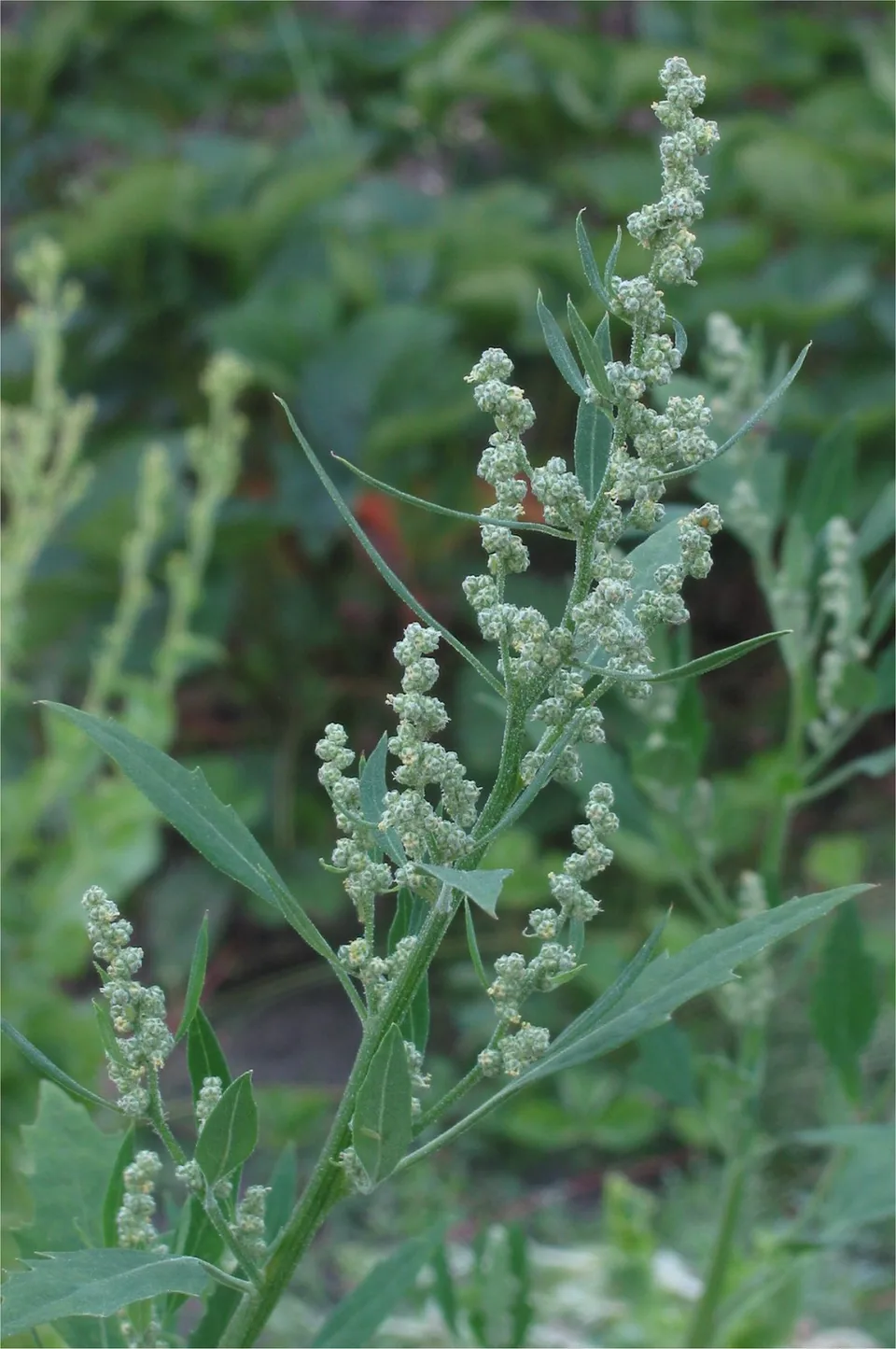


How to Grow and Care for Lamb's-quarters
Chenopodium album
Written by Emilio Marruso · last checked
Toxic to: People · Why
At a glance
Lamb's quarters is an easygoing summer annual that grows from seed in full sun or partial shade. Its young leaves and shoots are edible, and Native Americans even made flour from the dried seeds. Give it moist soil and it can reach 6 feet tall in rich ground; just pull the seedlings before they set seed so it doesn't take over.
- Sun
Full sun; it also handles partial shade
What the sources say (1)
Light: Full sun; tolerates partial shade
is at its best in full sun and moist, fertile, loamy soils, though it tolerates partial shade and a range of soil types.
— Chenopodium album (Baconweed, Bacon Weed, Fat Hen, Frost-blite, Goosefoot, Lambsquarters, Lamb's-quarters, Pigweed, White Goosefoot) | North Carolina Extension Gardener Plant Toolbox [1] - Water
Likes moist soil
What the sources say (1)
Watering: Moist soils
is at its best in full sun and moist, fertile, loamy soils, though it tolerates partial shade and a range of soil types.
— Chenopodium album (Baconweed, Bacon Weed, Fat Hen, Frost-blite, Goosefoot, Lambsquarters, Lamb's-quarters, Pigweed, White Goosefoot) | North Carolina Extension Gardener Plant Toolbox [1] - Cold
Survives winters down to −40 °F (−40 °C)
Very hardy · USDA 3a · RHS H7 · Z3
What the sources say (2)
Hardiness, coldest zone: 3a [winter low −40 to −37.2 °C (−40 to −35 °F)]
3a, 3b, 4a, 4b, 5a, 5b, 6a, 6b, 7a, 7b, 8a, 8b, 9a, 9b, 10a, 10b
— Chenopodium album (Baconweed, Bacon Weed, Fat Hen, Frost-blite, Goosefoot, Lambsquarters, Lamb's-quarters, Pigweed, White Goosefoot) | North Carolina Extension Gardener Plant Toolbox [1] Hardiness, warmest zone: 10b [winter low 1.7 to 4.4 °C (35 to 40 °F)]
3a, 3b, 4a, 4b, 5a, 5b, 6a, 6b, 7a, 7b, 8a, 8b, 9a, 9b, 10a, 10b
— Chenopodium album (Baconweed, Bacon Weed, Fat Hen, Frost-blite, Goosefoot, Lambsquarters, Lamb's-quarters, Pigweed, White Goosefoot) | North Carolina Extension Gardener Plant Toolbox [1] - Feeding
A slow-release fertilizer can be used
What the sources say (1)
Mineral fertilizers: A slow-release fertilizer can be used
Plants are watered as needed, and a slow-release fertilizer may be used.
— [8] - Harvest
Pick the young leaves and shoots to eat; the dried seeds can be made into flour
- Pollination
Its small flowers are pollinated by the wind
- Watch out
Spreads like a weed and seeds last years in the soil: pull or mow plants before they set seed
- Size
4 inches to 6 feet tall and 4–12 inches wide, depending on how rich the soil is
What the sources say (2)
Mature height: 10-183 cm (4 inches to 6 feet), depending on soil nutrient level
anywhere from 4 inches to 6 feet tall and 4 to 12 inches wide, depending on the nutrient level of the soil.
— Chenopodium album (Baconweed, Bacon Weed, Fat Hen, Frost-blite, Goosefoot, Lambsquarters, Lamb's-quarters, Pigweed, White Goosefoot) | North Carolina Extension Gardener Plant Toolbox [1] Mature width: 10-30 cm (4 to 12 inches), depending on soil nutrient level
anywhere from 4 inches to 6 feet tall and 4 to 12 inches wide, depending on the nutrient level of the soil.
— Chenopodium album (Baconweed, Bacon Weed, Fat Hen, Frost-blite, Goosefoot, Lambsquarters, Lamb's-quarters, Pigweed, White Goosefoot) | North Carolina Extension Gardener Plant Toolbox [1] - Propagation
A summer annual grown from seed
What the sources say (2)
Propagation: Seed
Each plant produces large amounts of seed that allow this plant to become aggressive in the landscape.
— Chenopodium album (Baconweed, Bacon Weed, Fat Hen, Frost-blite, Goosefoot, Lambsquarters, Lamb's-quarters, Pigweed, White Goosefoot) | North Carolina Extension Gardener Plant Toolbox [1] Life cycle: annual (summer annual)
Life Cycle: Annual
— Chenopodium album (Baconweed, Bacon Weed, Fat Hen, Frost-blite, Goosefoot, Lambsquarters, Lamb's-quarters, Pigweed, White Goosefoot) | North Carolina Extension Gardener Plant Toolbox [1] - Safety
Older parts are mildly toxic when eaten raw: stick to young leaves and shoots
Overview
Lamb's-quarters is a fast-growing summer annual that does best in full sun and moist, fertile, loamy soils. [1] Its seeds can remain viable in the soil for many years, making it weedy in disturbed areas. [1] Young leaves and shoots are edible, but the plant contains saponins and oxalic acid and should be cooked, steamed or frozen first. [1]
Lamb's-quarters care
How to water Lamb's-quarters
Moist soils
What the sources say (1)
is at its best in full sun and moist, fertile, loamy soils, though it tolerates partial shade and a range of soil types.How much light Lamb's-quarters needs
Full sun; tolerates partial shade
What the sources say (1)
is at its best in full sun and moist, fertile, loamy soils, though it tolerates partial shade and a range of soil types.How much cold Lamb's-quarters can take
Hardiness, coldest zone
3a [winter low −40 to −37.2 °C (−40 to −35 °F)]
What the sources say (1)
3a, 3b, 4a, 4b, 5a, 5b, 6a, 6b, 7a, 7b, 8a, 8b, 9a, 9b, 10a, 10bHardiness, warmest zone
10b [winter low 1.7 to 4.4 °C (35 to 40 °F)]
What the sources say (1)
3a, 3b, 4a, 4b, 5a, 5b, 6a, 6b, 7a, 7b, 8a, 8b, 9a, 9b, 10a, 10bHow to propagate Lamb's-quarters
Seed
What the sources say (1)
Each plant produces large amounts of seed that allow this plant to become aggressive in the landscape.How to grow Lamb's-quarters
The plant
Life cycle
annual (summer annual)
What the sources say (1)
Life Cycle: AnnualFamily
Amaranthaceae
What the sources say (1)
Family: AmaranthaceaeMature height
10-183 cm (4 inches to 6 feet), depending on soil nutrient level
What the sources say (1)
anywhere from 4 inches to 6 feet tall and 4 to 12 inches wide, depending on the nutrient level of the soil.Mature width
10-30 cm (4 to 12 inches), depending on soil nutrient level
What the sources say (1)
anywhere from 4 inches to 6 feet tall and 4 to 12 inches wide, depending on the nutrient level of the soil.Fertilizing
Mineral fertilizers
A slow-release fertilizer can be used
What the sources say (1)
Plants are watered as needed, and a slow-release fertilizer may be used.Lamb's-quarters pests and problems
Weedy spread from seed
Symptom: Quite weedy in disturbed areas; seeds remain viable in the soil for many years.
What to do: Pulling up seedlings before they set seed or mowing over plants before they produce seed.
What the sources say (2)
It can be quite weedy in disturbed areas and the seeds can remain viable in the soil for many years.
— Chenopodium album (Baconweed, Bacon Weed, Fat Hen, Frost-blite, Goosefoot, Lambsquarters, Lamb's-quarters, Pigweed, White Goosefoot) | North Carolina Extension Gardener Plant Toolbox [1] Pulling up seedlings before they set seed or mowing over plants before they produce seed are two management options.
— Chenopodium album (Baconweed, Bacon Weed, Fat Hen, Frost-blite, Goosefoot, Lambsquarters, Lamb's-quarters, Pigweed, White Goosefoot) | North Carolina Extension Gardener Plant Toolbox [1]
Remedies
Each remedy shows what official sources say about it; traditional remedies without an official source are marked as such. Harmful ones are listed so you know to avoid them.
First aid
First aid: not a substitute for a doctor
ingestion
do not induce vomiting, get poison center help Official source, not independently tested
Call your poison center at 1-800-222-1222 for help.
— poison.org [9] Call poison control at 1-800-222-1222 (U.S.) if someone in your household is exposed to poison even if they don’t have symptoms.
— my.clevelandclinic.org [10] How: Do not induce vomiting; get help from poison experts online or by calling the poison center.
Do not induce vomiting. Ipecac syrup is no longer recommended. Then, get help from poison experts.
— poison.org [9]
Getting rid of it
weedy spread
hand pulling seedlings Works
How: Pull up seedlings before they set seed; the plant has a short taproot and pulls up easily.
Lambsquarter has a short taproot, so it pulls up easily. The goal is to remove the weed before it matures enough to produce seeds.
— gardeningknowhow.com [11] What the evidence says Hand pulling young seedlings is the best way to control this weed in your landscape.
— hgic.clemson.edu [12] mowing before seed set Works
How: Mow over plants before they produce seed; in lawns, mow consistently at the recommended height.
Consistent mowing to keep lawns at the recommended height will cut down lambsquarter weed before it has a chance to produce seeds.
— gardeningknowhow.com [11] What the evidence says Mowing to prevent seed production is a very effective means of management.
— hortsense.cahnrs.wsu.edu [13] hoeing Works
How: Hand pulling and hoeing to remove the weed, together with mulching.
Lambsquarter control in the garden begins with hand pulling and hoeing to remove the weed and mulching.
— gardeningknowhow.com [11] What the evidence says Cultivation (rototilling or hoeing) will effectively eliminate plants.
— hortsense.cahnrs.wsu.edu [13] organic mulch Works
How: Organic mulches such as straw, wood shavings, chopped leaves, even newsprint; in landscape beds a 3-inch layer of coarse to medium bark mulch.
the use of organic mulches such as straw, wood shavings, chopped leaves, even newsprint.
— thriftyfun.com [14] What the evidence says Maintaining a 3-inch layer of coarse to medium bark mulch in landscape beds is the best way to prevent lamb’s quarters from becoming a problem in your landscape.
— hgic.clemson.edu [12] wet newspaper smothering Works
The newspaper idea works well, but I've found that it also, to a fair extent, keeps water from reaching the ground underneath.
— thriftyfun.com [14] Be cautious about the weed barrier material used because items such as plastic shower curtains or old tarps are good barriers but can be difficult to work with later when it is time to rework the site.
— extension.usu.edu [15] How: Wet newspaper in place of landscaping fabric: it smothers whatever you put it on.
I have used wet newspaper in place of landscaping fabric.
— thriftyfun.com [14] What the evidence says A variety of household items, such as newspapers, can be used as weed barriers.
— extension.usu.edu [15] careful digging Partly works
How: Careful digging of plants to manage weed populations.
Careful digging is useful to manage weed populations. However, digging can carry undesirable weed seed to the surface and foster further germination.
— hortsense.cahnrs.wsu.edu [13] What the evidence says Careful digging is useful to manage weed populations. However, digging can carry undesirable weed seed to the surface and foster further germination.
— hortsense.cahnrs.wsu.edu [13] removing flowers before seed Works
How: If pulling is too difficult, remove flowers to prevent the plant from producing seeds.
If pulling is too difficult, then make sure to remove flowers to prevent the plant from producing seeds.
— hgic.clemson.edu [12] What the evidence says If pulling is too difficult, then make sure to remove flowers to prevent the plant from producing seeds.
— hgic.clemson.edu [12]
Is Lamb's-quarters poisonous?
Reported by the source, quoted verbatim. This is not medical or veterinary advice: if a person or an animal may have eaten this plant, contact a poison control centre or a veterinarian.
older parts are not particularly palatable and are mildly toxic when consumed raw.
[1]
Edibility
Reported by the source, quoted verbatim. Do not eat a plant on the basis of this page alone: identification mistakes can be dangerous.
Indicative values
Values from a secondary source, not checked word for word like the rest of this page. Use them as a starting point.
- Soil
- Clay, SandIndicative value, adapt it to your climate · Secondary source
- Soil pH
- 6-7.5Indicative value, adapt it to your climate · Secondary source
- Growth rate
- HighIndicative value, adapt it to your climate · Secondary source
- Pruning
- May, June, July, MayIndicative value, adapt it to your climate · Secondary source
Similar plants
- Chenopodium giganteum Chenopodium giganteum
- Pitseed goosefoot Chenopodium berlandieri
- Quinoa Chenopodium quinoa
- Alligatorweed Alternanthera philoxeroides
- Amaranth pigweed Amaranthus hybridus
- Carelessweed Amaranthus palmeri
- Cockscomb Celosia argentea
- Foxtail amaranth Amaranthus caudatus
Sources
Every value above is quoted from these documents. Links lead to the original publisher.
- Chenopodium album (Baconweed, Bacon Weed, Fat Hen, Frost-blite, Goosefoot, Lambsquarters, Lamb's-quarters, Pigweed, White Goosefoot) | North Carolina Extension Gardener Plant Toolbox · plants.ces.ncsu.edu, consulted
- Lambsquarters - Cooperative Extension: Maine Wild Blueberries - University of Maine Cooperative Extension · extension.umaine.edu, consulted
- Fat Hen - Chenopodium album | North Carolina Extension Gardener Plant Toolbox · plants.ces.ncsu.edu, consulted
- Goosefoot - Chenopodium album | North Carolina Extension Gardener Plant Toolbox · plants.ces.ncsu.edu, consulted
- Lamb's-quarters - Chenopodium album | North Carolina Extension Gardener Plant Toolbox · plants.ces.ncsu.edu, consulted
- White Goosefoot - Chenopodium album | North Carolina Extension Gardener Plant Toolbox · plants.ces.ncsu.edu, consulted
- Baconweed - Chenopodium album | North Carolina Extension Gardener Plant Toolbox · plants.ces.ncsu.edu, consulted
- docs-do-not-link.udc.edu · docs-do-not-link.udc.edu
- poison.org · poison.org
- my.clevelandclinic.org · my.clevelandclinic.org
- gardeningknowhow.com · gardeningknowhow.com
- hgic.clemson.edu · hgic.clemson.edu
- hortsense.cahnrs.wsu.edu · hortsense.cahnrs.wsu.edu
- thriftyfun.com · thriftyfun.com
- extension.usu.edu · extension.usu.edu
Written by Emilio Marruso · last checked