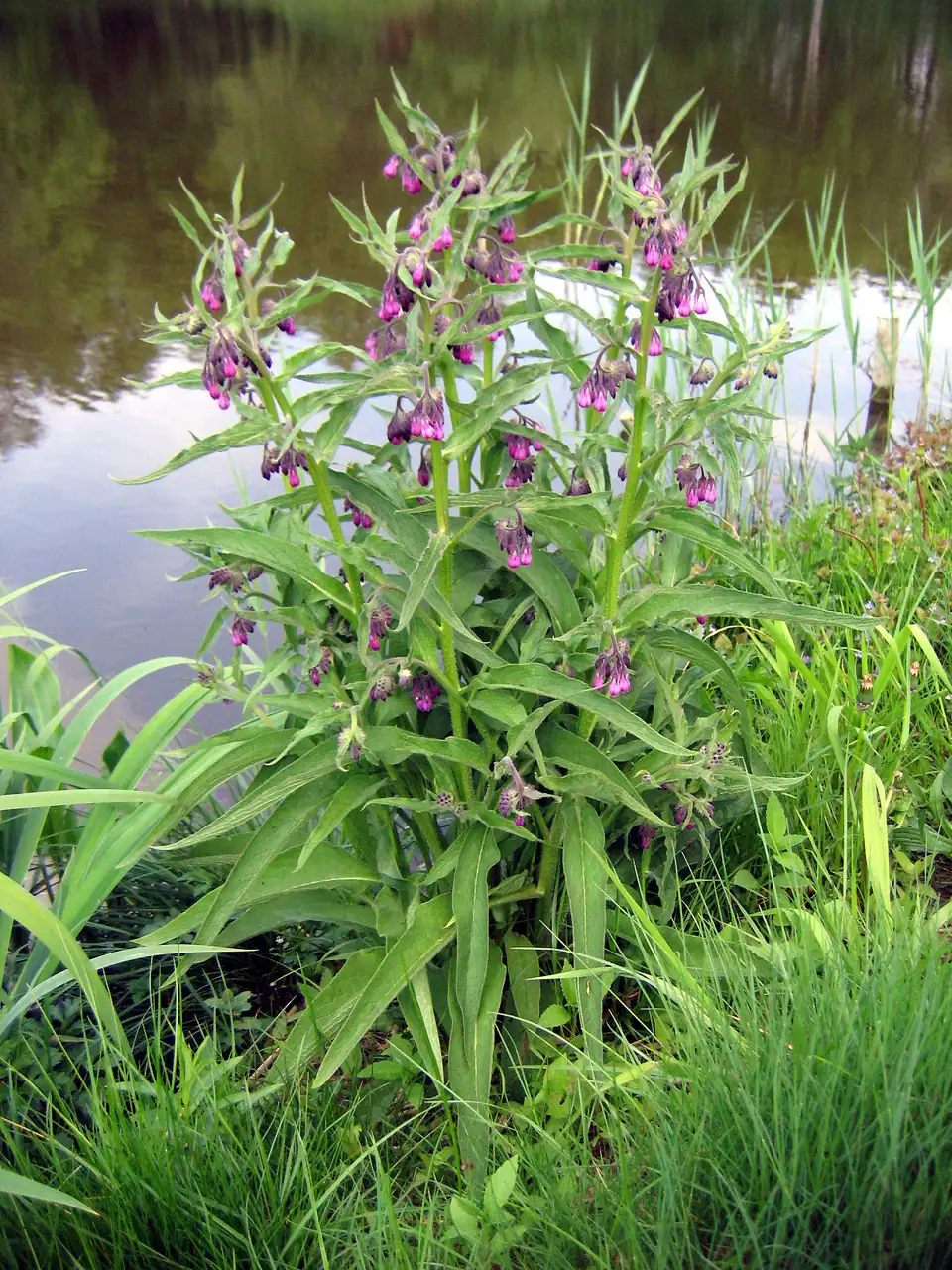


Cómo cultivar y cuidar Consuelda
Symphytum officinale
Escrito por Emilio Marruso · última revisión
Tóxica para: Personas · Por qué
De un vistazo
La consuelda es una perenne resistente que aguanta la sequía gracias a sus raíces profundas, y crece a gusto a pleno sol o en semisombra. Plántala en primavera, abónala una vez al mes y, desde el segundo año, podrás cortar hojas frescas cada 2 semanas durante toda la temporada. Si quieres frenar su expansión, cultívala en una maceta grande.
- Sol
Sol pleno o semisombra; en veranos calurosos, dale sombra por la tarde
Qué dicen las fuentes (5)
Luz: Pleno sol a semisombra; aprecia sombra por la tarde en veranos calurosos
Veranos calurosos de Carolina del Norte: In NC's hot summers, it appreciates some shade from the afternoon sun.
— Symphytum officinale (Black wort, Boneset, Bruise wort, Comfrey, Common Comfrey, Consound, Cultivated Comfrey, Knitbone, Quaker Comfrey, Slippery-Root, True Comfrey) | North Carolina Extension Gardener Plant Toolbox [1] Según NC State Extension: this variety grows best in full sun to part shade and well-drained, moist, rich soil.
— Symphytum officinale (Black wort, Boneset, Bruise wort, Comfrey, Common Comfrey, Consound, Cultivated Comfrey, Knitbone, Quaker Comfrey, Slippery-Root, True Comfrey) | North Carolina Extension Gardener Plant Toolbox [1] Según Utah State University Extension: Comfrey grows best in partial to full sun in moist, fertile soil.
— Comfrey in the Garden | USU [8] One of the many plants called comfrey, this variety grows best in full sun to part shade and well-drained, moist, rich soil. In NC's hot summers, it appreciates some shade
— Symphytum officinale (Black wort, Boneset, Bruise wort, Comfrey, Common Comfrey, Consound, Cultivated Comfrey, Knitbone, Quaker Comfrey, Slippery-Root, True Comfrey) | North Carolina Extension Gardener Plant Toolbox [1] Comfrey grows best in partial to full sun in moist, fertile soil.
— Comfrey in the Garden | USU [8] - Riego
Riega cuando los 5 cm superiores de tierra estén secos; las plantas jóvenes, más a menudo
Qué dicen las fuentes (6)
Riego: Riega cuando las 2 pulgadas [5,1 cm] superiores del suelo estén notablemente secas; tolerante a la sequía
Según NC State Extension: It is deer resistant and tolerant to drought and clay soil.
— Symphytum officinale (Black wort, Boneset, Bruise wort, Comfrey, Common Comfrey, Consound, Cultivated Comfrey, Knitbone, Quaker Comfrey, Slippery-Root, True Comfrey) | North Carolina Extension Gardener Plant Toolbox [1] Según Utah State University Extension: Comfrey is not prone to drought due to its taproot and deep root system but still prefers moderate soil moisture. Water when the top 2 inches of soil are noticeably dry.
— Comfrey in the Garden | USU [8] Water when the top 2 inches of soil are noticeably
— Comfrey in the Garden | USU [8] It is deer resistant and tolerant to drought and clay soil.
— Symphytum officinale (Black wort, Boneset, Bruise wort, Comfrey, Common Comfrey, Consound, Cultivated Comfrey, Knitbone, Quaker Comfrey, Slippery-Root, True Comfrey) | North Carolina Extension Gardener Plant Toolbox [1] Notas sobre el riego: Mantén una humedad moderada del suelo, especialmente cuando las plantas son jóvenes; las plantas jóvenes necesitan riego más frecuente durante el establecimiento
Maintain moderate soil moisture, especially when plants are young.
— Comfrey in the Garden | USU [8] Young plants need more frequent water during the establishment period.
— Comfrey in the Garden | USU [8] - Frío
Aguanta inviernos de hasta −34,4 °C (−30 °F)
Muy rústica · USDA 4a · RHS H7 · Z4
Qué dicen las fuentes (2)
Rusticidad, zona más fría: 4a [mínima invernal de −34,4 a −31,7 °C (de −30 a −25 °F)]
4a, 4b, 5a, 5b, 6a, 6b, 7a, 7b, 8a, 8b
— Symphytum officinale (Black wort, Boneset, Bruise wort, Comfrey, Common Comfrey, Consound, Cultivated Comfrey, Knitbone, Quaker Comfrey, Slippery-Root, True Comfrey) | North Carolina Extension Gardener Plant Toolbox [1] Rusticidad, zona más cálida: 8b [mínima invernal de −9,4 a −6,7 °C (de 15 a 20 °F)]
4a, 4b, 5a, 5b, 6a, 6b, 7a, 7b, 8a, 8b
— Symphytum officinale (Black wort, Boneset, Bruise wort, Comfrey, Common Comfrey, Consound, Cultivated Comfrey, Knitbone, Quaker Comfrey, Slippery-Root, True Comfrey) | North Carolina Extension Gardener Plant Toolbox [1] - Suelo
Suelo de ligeramente ácido a neutro, pH 6,0–7,0
Qué dicen las fuentes (2)
pH del suelo, mínimo: 6.0
Comfrey is adaptable to most soil types but grows best in moist, fertile soil rich in organic matter, with a pH ranging from 6.0
— Comfrey in the Garden | USU [8] pH del suelo, máximo: 7.0
Comfrey is adaptable to most soil types but grows best in moist, fertile soil rich in organic matter, with a pH ranging from 6.0
— Comfrey in the Garden | USU [8] - Distancia
Hileras a 60–90 cm, con las plantas colocadas al tresbolillo
Qué dicen las fuentes (2)
Distancia de plantación: Filas separadas 61-91 cm (2-3 pies), en un arreglo en tablero de ajedrez
Plant in a checkerboard arrangement with rows 2-3 feet apart.
— Comfrey in the Garden | USU [8] Distancia entre hileras: 61-91 cm (2-3 pies)
Plant in a checkerboard arrangement with rows 2–3 feet apart.
— Comfrey in the Garden | USU [8] - Plantación
De abril a septiembre, si la tierra se puede trabajar; mejor en primavera
Qué dicen las fuentes (1)
Plantación: De abril a septiembre siempre que el suelo pueda trabajarse; la primavera es lo mejor
Comfrey can be planted from April to September as long as the soil can be worked, but planting in spring is best.
— Comfrey in the Garden | USU [8] - Abonado
Mezcla compost con la tierra antes de plantar y luego abona una vez al mes
Qué dicen las fuentes (3)
Cuándo: Antes de plantar y, después, regularmente durante todo el año
Comfrey needs adequate nitrogen, so ensure nitrogen levels in the soil are sufficient before planting. Comfrey requires regular nitrogen fertilization throughout the year.
— Comfrey in the Garden | USU [8] Frecuencia: Una vez al mes
Comfrey requires regular nitrogen fertilization throughout the year. Use around 1–2 teaspoons (21-0-0) per square foot per month.
— Comfrey in the Garden | USU [8] Abonos naturales: Materia orgánica bien compostada, no más de 2.54 cm [1 in], incorporada a los 15.2 cm [6 in] superiores del suelo
Work the fertilizer into the top 6 inches of soil. If you fertilize with compost, apply no more than 1 inch of well-composted organic matter over the garden area fertilized.
— Comfrey in the Garden | USU [8] - Cosecha
Desde el segundo año: corta hojas cada 2 semanas, a 5 cm del suelo
Qué dicen las fuentes (3)
Cosecha: Desde el segundo año después de la plantación; cosecha las hojas cada 2 semanas durante toda la temporada de crecimiento
Wait to harvest until the second year after planting. Once established, harvest leaves every 2 weeks throughout the growing season. Gather a
— Comfrey in the Garden | USU [8] Cómo cosechar: Espera hasta el segundo año después de la siembra. Hojas: una vez establecida, cosecha cada 2 semanas durante la temporada de crecimiento, reuniendo un manojo de hojas y cortando a 2 pulgadas (5 cm) por encima del suelo. Raíces: desentierra y lávalas, luego córtalas en secciones más pequeñas antes de secarlas; para cosechar sin matar la planta, usa una pala y toma de un lado del sistema de raíces.
Wait to harvest until the second year after planting. Once established, harvest leaves every 2 weeks throughout the growing season. Gather a bunch of leaves and cut 2 inches above the ground.
— Comfrey in the Garden | USU [8] Dig and wash the roots, then chop them into smaller sections before drying. To harvest roots without killing the plant, use a shovel and harvest from one side of the root system.
— Comfrey in the Garden | USU [8] - Plagas
Vigila los caracoles y las babosas
Qué dicen las fuentes (1)
Plagas: caracoles, babosas
No serious insect or diseases issues. Snails and slugs may damage the foliage.
— Symphytum officinale (Black wort, Boneset, Bruise wort, Comfrey, Common Comfrey, Consound, Cultivated Comfrey, Knitbone, Quaker Comfrey, Slippery-Root, True Comfrey) | North Carolina Extension Gardener Plant Toolbox [1] - Atención
Se extiende con facilidad y rebrota de cualquier trozo de raíz que quede en la tierra
- Tamaño
30–90 cm de alto y 23–76 cm de ancho
Qué dicen las fuentes (2)
Altura adulta: 30-91 cm (1-3 pies)
Height: 1 ft. 0 in. - 3 ft. 0 in.
— Symphytum officinale (Black wort, Boneset, Bruise wort, Comfrey, Common Comfrey, Consound, Cultivated Comfrey, Knitbone, Quaker Comfrey, Slippery-Root, True Comfrey) | North Carolina Extension Gardener Plant Toolbox [1] Anchura adulta: 23-76 cm (9 pulg-2 pies 6 pulg)
Width: 0 ft. 9 in. - 2 ft. 6 in.
— Symphytum officinale (Black wort, Boneset, Bruise wort, Comfrey, Common Comfrey, Consound, Cultivated Comfrey, Knitbone, Quaker Comfrey, Slippery-Root, True Comfrey) | North Carolina Extension Gardener Plant Toolbox [1] - Maceta
Crece bien en macetas grandes, que frenan su expansión
Qué dicen las fuentes (1)
En maceta: Sí
As it easily spreads and will sprout from any root pieces left behind from removal, it can be grown in large containers to better control its spread. Its rapid spreading habit does
— Symphytum officinale (Black wort, Boneset, Bruise wort, Comfrey, Common Comfrey, Consound, Cultivated Comfrey, Knitbone, Quaker Comfrey, Slippery-Root, True Comfrey) | North Carolina Extension Gardener Plant Toolbox [1] - Seguridad
No la comas: ingerida puede dañar el hígado y los pulmones
Resumen
Symphytum officinale crece de 1 a 3 pies [30–91 cm] de alto y de 9 pulgadas [23 cm] a 2.5 pies [76 cm] de ancho. [1] Crece mejor a pleno sol o semisombra y en suelo rico, húmedo y bien drenado. [1] La consuelda se propaga mediante esquejes de raíz o divisiones de corona. [8]
Citado en inglés, como en la fuente.
Esta ficha está incompleta: las fuentes consultadas aún no cubren todos los campos.
Aún no cubierto por nuestras fuentes: Poda
Cuidados
Las medidas entre corchetes son nuestra conversión al otro sistema de unidades; el texto citado no cambia.
Riego
Riego
Riega cuando las 2 pulgadas [5,1 cm] superiores del suelo estén notablemente secas; tolerante a la sequía
Lo que dice cada fuente
Según NC State Extension: Tolerante a la sequía
Según Utah State University Extension: Riega cuando las 2 pulgadas [5,1 cm] superiores del suelo estén notablemente secas; no propenso a la sequía debido a la raíz pivotante y al sistema de raíces profundas
Qué dicen las fuentes (4)
Según NC State Extension: It is deer resistant and tolerant to drought and clay soil.Según Utah State University Extension: Comfrey is not prone to drought due to its taproot and deep root system but still prefers moderate soil moisture. Water when the top 2 inches of soil are noticeably dry.Water when the top 2 inches of soil are noticeablyIt is deer resistant and tolerant to drought and clay soil.Notas sobre el riego
Mantén una humedad moderada del suelo, especialmente cuando las plantas son jóvenes; las plantas jóvenes necesitan riego más frecuente durante el establecimiento
Luz
Pleno sol a semisombra; aprecia sombra por la tarde en veranos calurosos
Lo que dice cada fuente
Veranos calurosos de Carolina del Norte: Algo de sombra del sol de la tarde
Según NC State Extension: Pleno sol a semisombra
Según Utah State University Extension: De semisombra a pleno sol
Qué dicen las fuentes (5)
Veranos calurosos de Carolina del Norte: In NC's hot summers, it appreciates some shade from the afternoon sun.Según NC State Extension: this variety grows best in full sun to part shade and well-drained, moist, rich soil.Según Utah State University Extension: Comfrey grows best in partial to full sun in moist, fertile soil.One of the many plants called comfrey, this variety grows best in full sun to part shade and well-drained, moist, rich soil. In NC's hot summers, it appreciates some shadeComfrey grows best in partial to full sun in moist, fertile soil.Clima y frío
Rusticidad, zona más fría
4a [mínima invernal de −34,4 a −31,7 °C (de −30 a −25 °F)]
Qué dicen las fuentes (1)
4a, 4b, 5a, 5b, 6a, 6b, 7a, 7b, 8a, 8bRusticidad, zona más cálida
8b [mínima invernal de −9,4 a −6,7 °C (de 15 a 20 °F)]
Qué dicen las fuentes (1)
4a, 4b, 5a, 5b, 6a, 6b, 7a, 7b, 8a, 8bSuelo
pH del suelo, mínimo
6.0
Qué dicen las fuentes (1)
Comfrey is adaptable to most soil types but grows best in moist, fertile soil rich in organic matter, with a pH ranging from 6.0pH del suelo, máximo
7.0
Qué dicen las fuentes (1)
Comfrey is adaptable to most soil types but grows best in moist, fertile soil rich in organic matter, with a pH ranging from 6.0Dónde cultivarla
En maceta
Sí
Qué dicen las fuentes (1)
As it easily spreads and will sprout from any root pieces left behind from removal, it can be grown in large containers to better control its spread. Its rapid spreading habit doesDistancia de plantación
Filas separadas 61-91 cm (2-3 pies), en un arreglo en tablero de ajedrez
Qué dicen las fuentes (1)
Plant in a checkerboard arrangement with rows 2-3 feet apart.Propagación
Las fuentes dan valores distintos según la región, la zona o las condiciones de cultivo.
Lo que dice cada fuente
Según NC State Extension: División; esqueje de raíz; semilla
Según Utah State University Extension: Esquejes de raíz; divisiones de corona; trasplantes
Qué dicen las fuentes (4)
Según NC State Extension: Recommended Propagation Strategy:
Division
Root Cutting
Seed
Country Or Region Of Origin:Según Utah State University Extension: Comfrey rarely produces seeds, so propagate new plants from root cuttings, crown divisions, or transplants.Recommended Propagation Strategy:
Division
Root Cutting
Seed
Country Or Region Of Origin:Comfrey rarely produces seeds, so propagate new plants from root cuttings, crown divisions, or transplants. Root cuttingsCultivo
La planta
Ciclo de vida
perenne
Qué dicen las fuentes (2)
Life Cycle:
Perennial
Recommended Propagation Strategy:
Division
Root Cutting
Seed
Country Or Region Of Origin:
Europe, W. AsiaComfrey is a perennial, so it will die back in the fall and grow back vigorously the following spring.Familia
Boraginaceae
Qué dicen las fuentes (1)
Family:
Boraginaceae
Uses (Ethnobotany):
Medicinal use for injuries.Altura adulta
30-91 cm (1-3 pies)
Qué dicen las fuentes (1)
Height: 1 ft. 0 in. - 3 ft. 0 in.Anchura adulta
23-76 cm (9 pulg-2 pies 6 pulg)
Qué dicen las fuentes (1)
Width: 0 ft. 9 in. - 2 ft. 6 in.Siembra y crecimiento
Distancia entre hileras
61-91 cm (2-3 pies)
Qué dicen las fuentes (1)
Plant in a checkerboard arrangement with rows 2–3 feet apart.Cosecha y conservación
Cómo cosechar
Espera hasta el segundo año después de la siembra. Hojas: una vez establecida, cosecha cada 2 semanas durante la temporada de crecimiento, reuniendo un manojo de hojas y cortando a 2 pulgadas (5 cm) por encima del suelo. Raíces: desentierra y lávalas, luego córtalas en secciones más pequeñas antes de secarlas; para cosechar sin matar la planta, usa una pala y toma de un lado del sistema de raíces.
Qué dicen las fuentes (2)
Wait to harvest until the second year after planting. Once established, harvest leaves every 2 weeks throughout the growing season. Gather a bunch of leaves and cut 2 inches above the ground.Dig and wash the roots, then chop them into smaller sections before drying. To harvest roots without killing the plant, use a shovel and harvest from one side of the root system.Conservación
Seca la cosecha: la liofilización es el método más rápido y mantiene la calidad alta; alternativamente, coloca las hojas o raíces en un área seca y abierta durante al menos 3 días.
Qué dicen las fuentes (1)
Freeze-drying is the quickest method to dry comfrey and maintain high quality. A common method to dry comfrey is to lay the leaves or roots in a dry, open area for at least 3 days.Plagas y enfermedades
Plagas
caracoles, babosas
Qué dicen las fuentes (1)
No serious insect or diseases issues. Snails and slugs may damage the foliage.Abonado
Cuándo
Antes de plantar y, después, regularmente durante todo el año
Qué dicen las fuentes (1)
Comfrey needs adequate nitrogen, so ensure nitrogen levels in the soil are sufficient before planting. Comfrey requires regular nitrogen fertilization throughout the year.Frecuencia
Una vez al mes
Qué dicen las fuentes (1)
Comfrey requires regular nitrogen fertilization throughout the year. Use around 1–2 teaspoons (21-0-0) per square foot per month.Abonos naturales
Materia orgánica bien compostada, no más de 2.54 cm [1 in], incorporada a los 15.2 cm [6 in] superiores del suelo
Qué dicen las fuentes (1)
Work the fertilizer into the top 6 inches of soil. If you fertilize with compost, apply no more than 1 inch of well-composted organic matter over the garden area fertilized.Abonos minerales
Fertilizante nitrogenado 21-0-0, 52.7–105 mL/m² al mes
Qué dicen las fuentes (1)
Comfrey requires regular nitrogen fertilization throughout the year. Use around 1–2 teaspoons (21-0-0) per square foot per month.Problemas
Propagación invasiva
Síntoma: Se extiende fácilmente y brotará de cualquier trozo de raíz que quede.
Qué hacer: Cultívalo en contenedores grandes para controlar mejor su propagación.
Qué dicen las fuentes (2)
As it easily spreads and will sprout from any root pieces left behind from removal, it can be grown in large containers to better control its spread. Its rapid spreading habit does
— Symphytum officinale (Black wort, Boneset, Bruise wort, Comfrey, Common Comfrey, Consound, Cultivated Comfrey, Knitbone, Quaker Comfrey, Slippery-Root, True Comfrey) | North Carolina Extension Gardener Plant Toolbox [1] Comfrey can become invasive if not contained or controlled.
— Comfrey in the Garden | USU [8]
Remedios
Cada remedio indica qué dicen las fuentes oficiales; los remedios tradicionales sin fuente oficial aparecen marcados. Los perjudiciales están para que sepas evitarlos.
Cuidar la planta
babosas y caracoles
eliminación manual y ahogamiento en agua jabonosa Funciona
Cómo: Retira las plagas manualmente y ahógalas en agua jabonosa.
You can remove these pests manually and drown them in soapy water,
— gardenerspath.com [9] Qué dicen las pruebas Many insect and disease issues can be solved in the home garden by hand-picking insects or clipping and disposing of diseased plant parts.
— extension.unh.edu [10] trampas de cerveza No verificado
Remedio tradicional, no verificado por una fuente oficial.
Cómo: Entierra pequeñas tazas abiertas con cerveza en el suelo hasta el borde para atraer a las babosas.
roya de la consuelda
Corta y desecha las hojas infectadas. Funciona
Cómo: Con detección temprana, corta y desecha las hojas infectadas; si la infestación se vuelve grave, desentierra y desecha las plantas infectadas.
With early detection, you can simply cut and dispose of infected leaves. If an infestation becomes serious, you may need to dig up and dispose of infected plants.
— gardenerspath.com [9] Qué dicen las pruebas Many insect and disease issues can be solved in the home garden by hand-picking insects or clipping and disposing of diseased plant parts.
— extension.unh.edu [10]
mildiu polvoriento
spray de leche diluida No verificado
Remedio tradicional, no verificado por una fuente oficial.
Cómo: Rocía con leche diluida con agua en una proporción de 1:10; evita el riego por aspersión.
propagación invasiva
cultivo en contenedores grandes Fuente oficial, sin prueba independiente
Cómo: Se puede cultivar en contenedores grandes para controlar mejor su propagación.
As it easily spreads and will sprout from any root pieces left behind from removal, it can be grown in large containers to better control its spread.
— Symphytum officinale (Black wort, Boneset, Bruise wort, Comfrey, Common Comfrey, Consound, Cultivated Comfrey, Knitbone, Quaker Comfrey, Slippery-Root, True Comfrey) | North Carolina Extension Gardener Plant Toolbox [1]
Cómo eliminarla
parche de consuelda
Arranca a mano y corta a nivel del suelo. Funciona en parte
Cómo: Arranca toda la consuelda que puedas a mano o córtala a nivel del suelo con una desbrozadora o cortacésped.
Pull as much comfrey as you can by hand or cut it to ground level with a weed trimmer or mower.
— homeguides.sfgate.com [11] Qué dicen las pruebas Regularly pulling, hoeing or mowing weeds and encouraging grass to grow and out-compete the weeds is an excellent solution.
— extension.usu.edu [12] sofocación con mantillo de plástico negro No verificado
Remedio tradicional, no verificado por una fuente oficial.
Cómo: Corta la consuelda a nivel del suelo, cubre la zona con láminas superpuestas de mantillo de plástico negro sujetas con piedras, y levántalas después de dos temporadas de crecimiento para revisar el progreso; déjalas otra temporada si la consuelda no ha muerto.
acolchado en capas con cartón No verificado
Remedio tradicional, no verificado por una fuente oficial.
Cómo: Corta las plantas por completo, coloca una lámina gruesa de cartón sobre el suelo y cúbrela con varias capas de compost, paja, hojas, estiércol añejado u otro material de mantillo.
cubrimiento con un recipiente de plástico negro No verificado
Remedio tradicional, no verificado por una fuente oficial.
Cómo: Extrae la mayor parte del cepellón, luego sella una maceta o recipiente de plástico negro sobre la planta, colocándolo ligeramente por debajo del nivel del suelo y sujetándolo con una piedra o ladrillos para que no llegue luz, y espera 4 meses.
Toxicidad
Según la fuente, citada textualmente. No es un consejo médico ni veterinario: si una persona o un animal pudo haber ingerido esta planta, contacta con un centro de toxicología o con un veterinario.
Ingestion can lead to liver damage, lung damage, and cancer. Considered possibly safe to use externally. Poison Toxic
[1]- Partes venenosas
Poison Part: Bark Flowers Fruits Leaves Roots Sap/Juice Seeds Stems
[1]- Principio tóxico
Poison Toxic Principle: Pyrrolizidine alkaloids Causes Contact Dermatitis:
[1]- Síntomas
Ingestion can lead to liver damage, lung damage, and cancer.
[1]- Gravedad
Poison Severity: Medium Poison Symptoms: Ingestion can lead to liver damage, lung damage, and cancer.
[1]
This plant has medium severity poison characteristics. See
[1]It is important to note that comfrey contains toxic alkaloids that might cause lethal liver toxicity if repeatedly ingested or if taken at a
[8]
Calendario
Plantación
De abril a septiembre siempre que el suelo pueda trabajarse; la primavera es lo mejor
Qué dicen las fuentes (1)
Comfrey can be planted from April to September as long as the soil can be worked, but planting in spring is best.Cosecha
Desde el segundo año después de la plantación; cosecha las hojas cada 2 semanas durante toda la temporada de crecimiento
Qué dicen las fuentes (1)
Wait to harvest until the second year after planting. Once established, harvest leaves every 2 weeks throughout the growing season. Gather aPoda
No figura en las fuentes consultadas.
Meses tal como los dan las fuentes, en su mayoría de Estados Unidos (hemisferio norte). En el hemisferio sur se desplazan unos seis meses.
Comestibilidad
Según la fuente, citada textualmente. No comas una planta basándote solo en esta página: los errores de identificación pueden ser peligrosos.
Comfrey is used externally for poultices and compresses or internally as teas or eaten
[8]
Valores orientativos
Valores de una fuente secundaria, no comprobados palabra por palabra como el resto de esta página. Úselos como punto de partida.
- Resiste la sequía
- SíValor orientativo, adáptalo a tu clima · Fuente secundaria
- Crecimiento
- BajoValor orientativo, adáptalo a tu clima · Fuente secundaria
- Poda
- Mayo, junio, julio, agosto, septiembre, octubre, diciembre, enero, febreroValor orientativo, adáptalo a tu clima · Fuente secundaria
Plantas similares
- Comfrey Symphytum grandiflorum
- Prickly comfrey Symphytum asperum
- Abraham Trachystemon orientalis
- Lengua de vaca Anchusa azurea
- Blue Showers Cynoglossum amabile
- Viperina Echium vulgare
- Borraja Borago officinalis
- Broad-leaf Waterleaf Hydrophyllum canadense
Fuentes
Cada valor anterior se cita de estos documentos. Los enlaces llevan al editor original.
- Symphytum officinale (Black wort, Boneset, Bruise wort, Comfrey, Common Comfrey, Consound, Cultivated Comfrey, Knitbone, Quaker Comfrey, Slippery-Root, True Comfrey) | North Carolina Extension Gardener Plant Toolbox · plants.ces.ncsu.edu, consultado
- Black wort - Symphytum officinale | North Carolina Extension Gardener Plant Toolbox · plants.ces.ncsu.edu, consultado
- Comfrey - Symphytum officinale | North Carolina Extension Gardener Plant Toolbox · plants.ces.ncsu.edu, consultado
- Slippery-Root - Symphytum officinale | North Carolina Extension Gardener Plant Toolbox · plants.ces.ncsu.edu, consultado
- Quaker Comfrey - Symphytum officinale | North Carolina Extension Gardener Plant Toolbox · plants.ces.ncsu.edu, consultado
- True Comfrey - Symphytum officinale | North Carolina Extension Gardener Plant Toolbox · plants.ces.ncsu.edu, consultado
- Cultivated Comfrey - Symphytum officinale | North Carolina Extension Gardener Plant Toolbox · plants.ces.ncsu.edu, consultado
- Comfrey in the Garden | USU · extension.usu.edu, consultado
- gardenerspath.com · gardenerspath.com
- extension.unh.edu · extension.unh.edu
- homeguides.sfgate.com · homeguides.sfgate.com
- extension.usu.edu · extension.usu.edu
Escrito por Emilio Marruso · última revisión