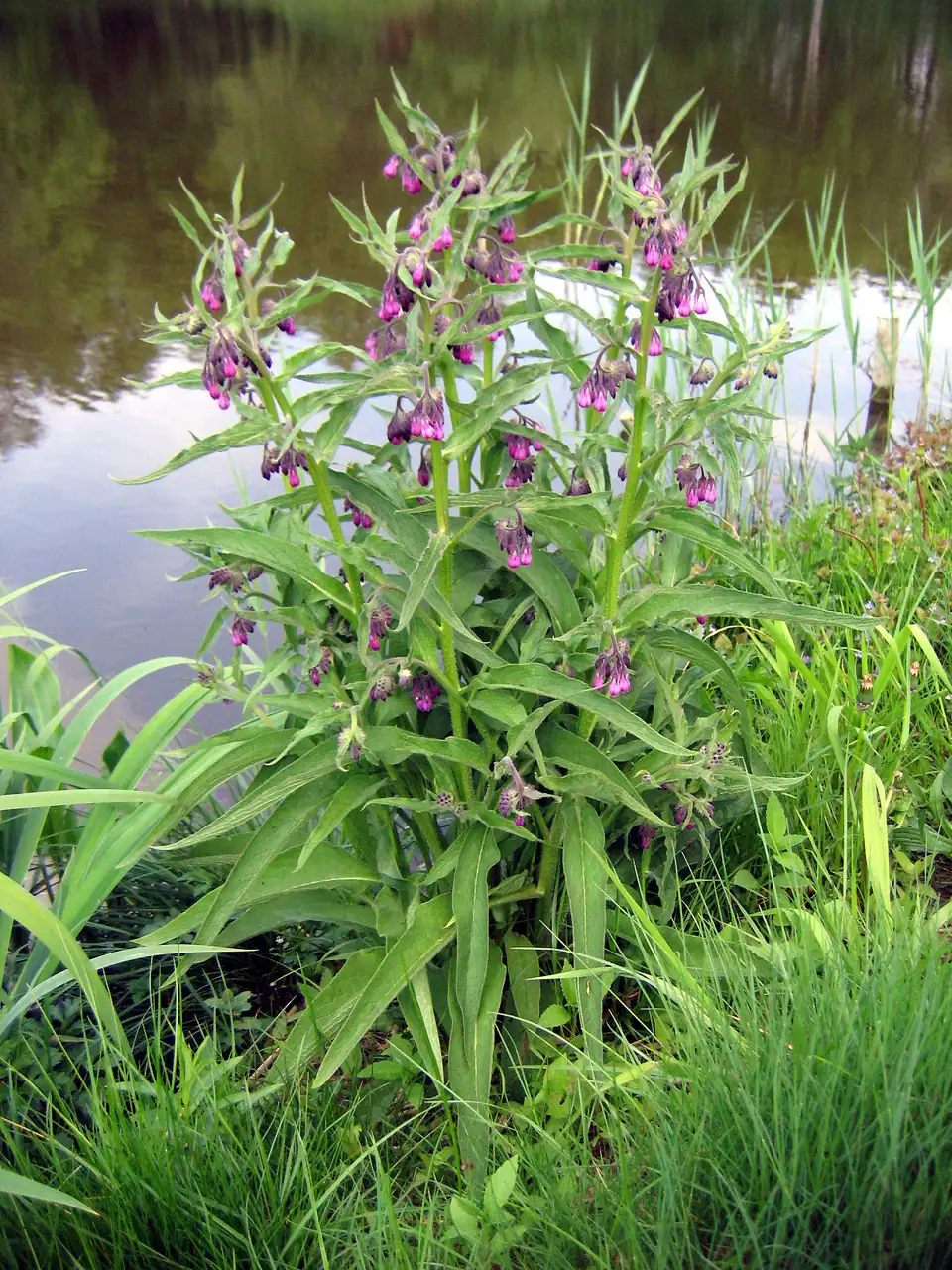


How to Grow and Care for Comfrey
Symphytum officinale
Written by Emilio Marruso · last checked
Toxic to: People · Why
At a glance
Comfrey is a tough perennial that handles dry spells thanks to its deep roots, and it grows happily in full sun or partial shade. Plant it in spring, feed it once a month, and from the second year you can cut fresh leaves every 2 weeks all season long. Grow it in a large container if you want to keep it from spreading.
- Sun
Full sun to partial shade; give it afternoon shade in hot summers
What the sources say (5)
Light: Full sun to partial shade; appreciates afternoon shade in hot summers
NC hot summers: In NC's hot summers, it appreciates some shade from the afternoon sun.
— Symphytum officinale (Black wort, Boneset, Bruise wort, Comfrey, Common Comfrey, Consound, Cultivated Comfrey, Knitbone, Quaker Comfrey, Slippery-Root, True Comfrey) | North Carolina Extension Gardener Plant Toolbox [1] According to NC State Extension: this variety grows best in full sun to part shade and well-drained, moist, rich soil.
— Symphytum officinale (Black wort, Boneset, Bruise wort, Comfrey, Common Comfrey, Consound, Cultivated Comfrey, Knitbone, Quaker Comfrey, Slippery-Root, True Comfrey) | North Carolina Extension Gardener Plant Toolbox [1] According to Utah State University Extension: Comfrey grows best in partial to full sun in moist, fertile soil.
— Comfrey in the Garden | USU [8] One of the many plants called comfrey, this variety grows best in full sun to part shade and well-drained, moist, rich soil. In NC's hot summers, it appreciates some shade
— Symphytum officinale (Black wort, Boneset, Bruise wort, Comfrey, Common Comfrey, Consound, Cultivated Comfrey, Knitbone, Quaker Comfrey, Slippery-Root, True Comfrey) | North Carolina Extension Gardener Plant Toolbox [1] Comfrey grows best in partial to full sun in moist, fertile soil.
— Comfrey in the Garden | USU [8] - Water
Water when the top 2 inches of soil are dry; young plants need water more often
What the sources say (6)
Watering: Water when the top 2 inches [5.1 cm] of soil are noticeably dry; tolerant to drought
According to NC State Extension: It is deer resistant and tolerant to drought and clay soil.
— Symphytum officinale (Black wort, Boneset, Bruise wort, Comfrey, Common Comfrey, Consound, Cultivated Comfrey, Knitbone, Quaker Comfrey, Slippery-Root, True Comfrey) | North Carolina Extension Gardener Plant Toolbox [1] According to Utah State University Extension: Comfrey is not prone to drought due to its taproot and deep root system but still prefers moderate soil moisture. Water when the top 2 inches of soil are noticeably dry.
— Comfrey in the Garden | USU [8] Water when the top 2 inches of soil are noticeably
— Comfrey in the Garden | USU [8] It is deer resistant and tolerant to drought and clay soil.
— Symphytum officinale (Black wort, Boneset, Bruise wort, Comfrey, Common Comfrey, Consound, Cultivated Comfrey, Knitbone, Quaker Comfrey, Slippery-Root, True Comfrey) | North Carolina Extension Gardener Plant Toolbox [1] Watering notes: Maintain moderate soil moisture, especially when plants are young; young plants need more frequent water during establishment
Maintain moderate soil moisture, especially when plants are young.
— Comfrey in the Garden | USU [8] Young plants need more frequent water during the establishment period.
— Comfrey in the Garden | USU [8] - Cold
Survives winters down to −30 °F (−34.4 °C)
Very hardy · USDA 4a · RHS H7 · Z4
What the sources say (2)
Hardiness, coldest zone: 4a [winter low −34.4 to −31.7 °C (−30 to −25 °F)]
4a, 4b, 5a, 5b, 6a, 6b, 7a, 7b, 8a, 8b
— Symphytum officinale (Black wort, Boneset, Bruise wort, Comfrey, Common Comfrey, Consound, Cultivated Comfrey, Knitbone, Quaker Comfrey, Slippery-Root, True Comfrey) | North Carolina Extension Gardener Plant Toolbox [1] Hardiness, warmest zone: 8b [winter low −9.4 to −6.7 °C (15 to 20 °F)]
4a, 4b, 5a, 5b, 6a, 6b, 7a, 7b, 8a, 8b
— Symphytum officinale (Black wort, Boneset, Bruise wort, Comfrey, Common Comfrey, Consound, Cultivated Comfrey, Knitbone, Quaker Comfrey, Slippery-Root, True Comfrey) | North Carolina Extension Gardener Plant Toolbox [1] - Soil
Slightly acidic to neutral soil, pH 6.0–7.0
What the sources say (2)
Soil pH, minimum: 6.0
Comfrey is adaptable to most soil types but grows best in moist, fertile soil rich in organic matter, with a pH ranging from 6.0
— Comfrey in the Garden | USU [8] Soil pH, maximum: 7.0
Comfrey is adaptable to most soil types but grows best in moist, fertile soil rich in organic matter, with a pH ranging from 6.0
— Comfrey in the Garden | USU [8] - Spacing
Rows 2–3 ft apart, plants set in a checkerboard pattern
What the sources say (2)
Spacing: Rows 61-91 cm (2-3 ft) apart, in a checkerboard arrangement
Plant in a checkerboard arrangement with rows 2-3 feet apart.
— Comfrey in the Garden | USU [8] Row spacing: 61-91 cm (2-3 ft)
Plant in a checkerboard arrangement with rows 2–3 feet apart.
— Comfrey in the Garden | USU [8] - Planting
April to September when the soil can be worked; spring is best
What the sources say (1)
Planting: April to September as long as the soil can be worked; spring is best
Comfrey can be planted from April to September as long as the soil can be worked, but planting in spring is best.
— Comfrey in the Garden | USU [8] - Feeding
Mix compost into the soil before planting, then feed once a month
What the sources say (3)
When: Before planting, then regularly throughout the year
Comfrey needs adequate nitrogen, so ensure nitrogen levels in the soil are sufficient before planting. Comfrey requires regular nitrogen fertilization throughout the year.
— Comfrey in the Garden | USU [8] How often: Once a month
Comfrey requires regular nitrogen fertilization throughout the year. Use around 1–2 teaspoons (21-0-0) per square foot per month.
— Comfrey in the Garden | USU [8] Natural fertilizers: Well-composted organic matter, no more than 2.54 cm [1 in], worked into the top 15.2 cm [6 in] of soil
Work the fertilizer into the top 6 inches of soil. If you fertilize with compost, apply no more than 1 inch of well-composted organic matter over the garden area fertilized.
— Comfrey in the Garden | USU [8] - Harvest
From the second year: cut leaves every 2 weeks, 2 inches above the ground
What the sources say (3)
Harvest: From the second year after planting; leaves every 2 weeks throughout the growing season
Wait to harvest until the second year after planting. Once established, harvest leaves every 2 weeks throughout the growing season. Gather a
— Comfrey in the Garden | USU [8] How to harvest: Wait until the second year after planting. Leaves: once established, harvest every 2 weeks through the growing season, gathering a bunch of leaves and cutting 2 inches (5 cm) above the ground. Roots: dig and wash them, then chop into smaller sections before drying; to harvest without killing the plant, use a shovel and take from one side of the root system.
Wait to harvest until the second year after planting. Once established, harvest leaves every 2 weeks throughout the growing season. Gather a bunch of leaves and cut 2 inches above the ground.
— Comfrey in the Garden | USU [8] Dig and wash the roots, then chop them into smaller sections before drying. To harvest roots without killing the plant, use a shovel and harvest from one side of the root system.
— Comfrey in the Garden | USU [8] - Pests
Watch out for snails and slugs
What the sources say (1)
Pests: snails, slugs
No serious insect or diseases issues. Snails and slugs may damage the foliage.
— Symphytum officinale (Black wort, Boneset, Bruise wort, Comfrey, Common Comfrey, Consound, Cultivated Comfrey, Knitbone, Quaker Comfrey, Slippery-Root, True Comfrey) | North Carolina Extension Gardener Plant Toolbox [1] - Watch out
Spreads easily and regrows from any piece of root left in the ground
- Size
1–3 ft tall and 9 in to 2½ ft wide
What the sources say (2)
Mature height: 30-91 cm (1-3 ft)
Height: 1 ft. 0 in. - 3 ft. 0 in.
— Symphytum officinale (Black wort, Boneset, Bruise wort, Comfrey, Common Comfrey, Consound, Cultivated Comfrey, Knitbone, Quaker Comfrey, Slippery-Root, True Comfrey) | North Carolina Extension Gardener Plant Toolbox [1] Mature width: 23-76 cm (9 in-2 ft 6 in)
Width: 0 ft. 9 in. - 2 ft. 6 in.
— Symphytum officinale (Black wort, Boneset, Bruise wort, Comfrey, Common Comfrey, Consound, Cultivated Comfrey, Knitbone, Quaker Comfrey, Slippery-Root, True Comfrey) | North Carolina Extension Gardener Plant Toolbox [1] - Containers
Grows well in large containers, which keep it from spreading
What the sources say (1)
In containers: Yes
As it easily spreads and will sprout from any root pieces left behind from removal, it can be grown in large containers to better control its spread. Its rapid spreading habit does
— Symphytum officinale (Black wort, Boneset, Bruise wort, Comfrey, Common Comfrey, Consound, Cultivated Comfrey, Knitbone, Quaker Comfrey, Slippery-Root, True Comfrey) | North Carolina Extension Gardener Plant Toolbox [1] - Safety
Do not eat it: swallowing it can damage the liver and lungs
Overview
Symphytum officinale grows 1 to 3 feet [30–91 cm] tall and 9 inches [23 cm] to 2.5 feet [76 cm] wide. [1] It grows best in full sun to part shade and well-drained, moist, rich soil. [1] Comfrey is propagated by root cuttings or crown divisions. [8]
This record is incomplete: the sources we read do not cover every field yet.
Not yet covered by our sources: Pruning
Comfrey care
Measurements in square brackets are our conversion into the other unit system; the quoted text is unchanged.
How to water Comfrey
Watering
Water when the top 2 inches [5.1 cm] of soil are noticeably dry; tolerant to drought
What each source says
According to NC State Extension: Tolerant to drought
According to Utah State University Extension: Water when the top 2 inches [5.1 cm] of soil are noticeably dry; not prone to drought due to taproot and deep root system
What the sources say (4)
According to NC State Extension: It is deer resistant and tolerant to drought and clay soil.According to Utah State University Extension: Comfrey is not prone to drought due to its taproot and deep root system but still prefers moderate soil moisture. Water when the top 2 inches of soil are noticeably dry.Water when the top 2 inches of soil are noticeablyIt is deer resistant and tolerant to drought and clay soil.Watering notes
Maintain moderate soil moisture, especially when plants are young; young plants need more frequent water during establishment
How much light Comfrey needs
Full sun to partial shade; appreciates afternoon shade in hot summers
What each source says
NC hot summers: Some shade from the afternoon sun
According to NC State Extension: Full sun to partial shade
According to Utah State University Extension: Partial to full sun
What the sources say (5)
NC hot summers: In NC's hot summers, it appreciates some shade from the afternoon sun.According to NC State Extension: this variety grows best in full sun to part shade and well-drained, moist, rich soil.According to Utah State University Extension: Comfrey grows best in partial to full sun in moist, fertile soil.One of the many plants called comfrey, this variety grows best in full sun to part shade and well-drained, moist, rich soil. In NC's hot summers, it appreciates some shadeComfrey grows best in partial to full sun in moist, fertile soil.How much cold Comfrey can take
Hardiness, coldest zone
4a [winter low −34.4 to −31.7 °C (−30 to −25 °F)]
What the sources say (1)
4a, 4b, 5a, 5b, 6a, 6b, 7a, 7b, 8a, 8bHardiness, warmest zone
8b [winter low −9.4 to −6.7 °C (15 to 20 °F)]
What the sources say (1)
4a, 4b, 5a, 5b, 6a, 6b, 7a, 7b, 8a, 8bBest soil for Comfrey
Soil pH, minimum
6.0
What the sources say (1)
Comfrey is adaptable to most soil types but grows best in moist, fertile soil rich in organic matter, with a pH ranging from 6.0Soil pH, maximum
7.0
What the sources say (1)
Comfrey is adaptable to most soil types but grows best in moist, fertile soil rich in organic matter, with a pH ranging from 6.0Where to grow Comfrey
In containers
Yes
What the sources say (1)
As it easily spreads and will sprout from any root pieces left behind from removal, it can be grown in large containers to better control its spread. Its rapid spreading habit doesSpacing
Rows 61-91 cm (2-3 ft) apart, in a checkerboard arrangement
What the sources say (1)
Plant in a checkerboard arrangement with rows 2-3 feet apart.How to propagate Comfrey
The sources give different values depending on region, zone or growing conditions.
What each source says
According to NC State Extension: Division; root cutting; seed
According to Utah State University Extension: Root cuttings; crown divisions; transplants
What the sources say (4)
According to NC State Extension: Recommended Propagation Strategy:
Division
Root Cutting
Seed
Country Or Region Of Origin:According to Utah State University Extension: Comfrey rarely produces seeds, so propagate new plants from root cuttings, crown divisions, or transplants.Recommended Propagation Strategy:
Division
Root Cutting
Seed
Country Or Region Of Origin:Comfrey rarely produces seeds, so propagate new plants from root cuttings, crown divisions, or transplants. Root cuttingsHow to grow Comfrey
The plant
Life cycle
perennial
What the sources say (2)
Life Cycle:
Perennial
Recommended Propagation Strategy:
Division
Root Cutting
Seed
Country Or Region Of Origin:
Europe, W. AsiaComfrey is a perennial, so it will die back in the fall and grow back vigorously the following spring.Family
Boraginaceae
What the sources say (1)
Family:
Boraginaceae
Uses (Ethnobotany):
Medicinal use for injuries.Mature height
30-91 cm (1-3 ft)
What the sources say (1)
Height: 1 ft. 0 in. - 3 ft. 0 in.Mature width
23-76 cm (9 in-2 ft 6 in)
What the sources say (1)
Width: 0 ft. 9 in. - 2 ft. 6 in.Sowing and growth
Row spacing
61-91 cm (2-3 ft)
What the sources say (1)
Plant in a checkerboard arrangement with rows 2–3 feet apart.Harvest and storage
How to harvest
Wait until the second year after planting. Leaves: once established, harvest every 2 weeks through the growing season, gathering a bunch of leaves and cutting 2 inches (5 cm) above the ground. Roots: dig and wash them, then chop into smaller sections before drying; to harvest without killing the plant, use a shovel and take from one side of the root system.
What the sources say (2)
Wait to harvest until the second year after planting. Once established, harvest leaves every 2 weeks throughout the growing season. Gather a bunch of leaves and cut 2 inches above the ground.Dig and wash the roots, then chop them into smaller sections before drying. To harvest roots without killing the plant, use a shovel and harvest from one side of the root system.Storage
Dry the harvest: freeze-drying is the quickest method and keeps quality high; alternatively lay leaves or roots in a dry, open area for at least 3 days.
What the sources say (1)
Freeze-drying is the quickest method to dry comfrey and maintain high quality. A common method to dry comfrey is to lay the leaves or roots in a dry, open area for at least 3 days.Pests and diseases
Pests
snails, slugs
What the sources say (1)
No serious insect or diseases issues. Snails and slugs may damage the foliage.Fertilizing
When
Before planting, then regularly throughout the year
What the sources say (1)
Comfrey needs adequate nitrogen, so ensure nitrogen levels in the soil are sufficient before planting. Comfrey requires regular nitrogen fertilization throughout the year.How often
Once a month
What the sources say (1)
Comfrey requires regular nitrogen fertilization throughout the year. Use around 1–2 teaspoons (21-0-0) per square foot per month.Natural fertilizers
Well-composted organic matter, no more than 2.54 cm [1 in], worked into the top 15.2 cm [6 in] of soil
What the sources say (1)
Work the fertilizer into the top 6 inches of soil. If you fertilize with compost, apply no more than 1 inch of well-composted organic matter over the garden area fertilized.Mineral fertilizers
21-0-0 nitrogen fertilizer, 52.7–105 mL/m² per month
What the sources say (1)
Comfrey requires regular nitrogen fertilization throughout the year. Use around 1–2 teaspoons (21-0-0) per square foot per month.Comfrey pests and problems
Invasive spread
Symptom: It easily spreads and will sprout from any root pieces left behind from removal.
What to do: Grow it in large containers to better control its spread.
What the sources say (2)
As it easily spreads and will sprout from any root pieces left behind from removal, it can be grown in large containers to better control its spread. Its rapid spreading habit does
— Symphytum officinale (Black wort, Boneset, Bruise wort, Comfrey, Common Comfrey, Consound, Cultivated Comfrey, Knitbone, Quaker Comfrey, Slippery-Root, True Comfrey) | North Carolina Extension Gardener Plant Toolbox [1] Comfrey can become invasive if not contained or controlled.
— Comfrey in the Garden | USU [8]
Remedies
Each remedy shows what official sources say about it; traditional remedies without an official source are marked as such. Harmful ones are listed so you know to avoid them.
Treating the plant
slugs and snails
hand removal and drowning in soapy water Works
How: Remove the pests manually and drown them in soapy water.
You can remove these pests manually and drown them in soapy water,
— gardenerspath.com [9] What the evidence says Many insect and disease issues can be solved in the home garden by hand-picking insects or clipping and disposing of diseased plant parts.
— extension.unh.edu [10] beer traps Not verified
Traditional remedy, not verified by an official source.
How: Sink small open cups of beer in the soil up to the rims to lure slugs.
comfrey rust
cutting and disposing of infected leaves Works
How: With early detection, cut and dispose of infected leaves; if the infestation becomes serious, dig up and dispose of infected plants.
With early detection, you can simply cut and dispose of infected leaves. If an infestation becomes serious, you may need to dig up and dispose of infected plants.
— gardenerspath.com [9] What the evidence says Many insect and disease issues can be solved in the home garden by hand-picking insects or clipping and disposing of diseased plant parts.
— extension.unh.edu [10]
powdery mildew
diluted milk spray Not verified
Traditional remedy, not verified by an official source.
How: Spray with milk diluted with water at a 1:10 ratio; avoid overhead watering.
invasive spread
growing in large containers Official source, not independently tested
How: It can be grown in large containers to better control its spread.
As it easily spreads and will sprout from any root pieces left behind from removal, it can be grown in large containers to better control its spread.
— Symphytum officinale (Black wort, Boneset, Bruise wort, Comfrey, Common Comfrey, Consound, Cultivated Comfrey, Knitbone, Quaker Comfrey, Slippery-Root, True Comfrey) | North Carolina Extension Gardener Plant Toolbox [1]
Getting rid of it
comfrey patch
pulling by hand and cutting to ground level Partly works
How: Pull as much comfrey as you can by hand or cut it to ground level with a weed trimmer or mower.
Pull as much comfrey as you can by hand or cut it to ground level with a weed trimmer or mower.
— homeguides.sfgate.com [11] What the evidence says Regularly pulling, hoeing or mowing weeds and encouraging grass to grow and out-compete the weeds is an excellent solution.
— extension.usu.edu [12] smothering with black plastic mulch Not verified
Traditional remedy, not verified by an official source.
How: Cut the comfrey to the ground, cover the patch with overlapping sheets of black plastic mulch held down with stones, and lift it after two growing seasons to check progress; leave it another season if the comfrey is not dead.
sheet mulching with cardboard Not verified
Traditional remedy, not verified by an official source.
How: Cut plants all the way down, place a thick sheet of cardboard on top of the soil, and cover with several layers of compost, straw, leaves, aged manure or other mulch material.
covering with a black plastic tub Not verified
Traditional remedy, not verified by an official source.
How: Pull out the bulk of the root ball, then seal a black plastic pot or tub over the plant, nestled slightly below soil level and weighted with a rock or bricks so no light reaches it, and wait 4 months.
Is Comfrey poisonous?
Reported by the source, quoted verbatim. This is not medical or veterinary advice: if a person or an animal may have eaten this plant, contact a poison control centre or a veterinarian.
Ingestion can lead to liver damage, lung damage, and cancer. Considered possibly safe to use externally. Poison Toxic
[1]- Poisonous parts
Poison Part: Bark Flowers Fruits Leaves Roots Sap/Juice Seeds Stems
[1]- Toxic principle
Poison Toxic Principle: Pyrrolizidine alkaloids Causes Contact Dermatitis:
[1]- Symptoms
Ingestion can lead to liver damage, lung damage, and cancer.
[1]- Severity
Poison Severity: Medium Poison Symptoms: Ingestion can lead to liver damage, lung damage, and cancer.
[1]
This plant has medium severity poison characteristics. See
[1]It is important to note that comfrey contains toxic alkaloids that might cause lethal liver toxicity if repeatedly ingested or if taken at a
[8]
Calendar
Planting
April to September as long as the soil can be worked; spring is best
What the sources say (1)
Comfrey can be planted from April to September as long as the soil can be worked, but planting in spring is best.Harvest
From the second year after planting; leaves every 2 weeks throughout the growing season
What the sources say (1)
Wait to harvest until the second year after planting. Once established, harvest leaves every 2 weeks throughout the growing season. Gather aPruning
Not stated in the sources we read.
Months as given by the sources, which are mostly from the United States (northern hemisphere). In the southern hemisphere they shift by about six months.
Edibility
Reported by the source, quoted verbatim. Do not eat a plant on the basis of this page alone: identification mistakes can be dangerous.
Comfrey is used externally for poultices and compresses or internally as teas or eaten
[8]
Indicative values
Values from a secondary source, not checked word for word like the rest of this page. Use them as a starting point.
- Drought tolerant
- yesIndicative value, adapt it to your climate · Secondary source
- Growth rate
- LowIndicative value, adapt it to your climate · Secondary source
- Pruning
- May, June, July, August, September, October, December, January, FebruaryIndicative value, adapt it to your climate · Secondary source
Similar plants
- Comfrey Symphytum grandiflorum
- Prickly comfrey Symphytum asperum
- Abraham Trachystemon orientalis
- Alkanet Anchusa azurea
- Blue Showers Cynoglossum amabile
- Blueweed Echium vulgare
- Borage Borago officinalis
- Broad-leaf Waterleaf Hydrophyllum canadense
Sources
Every value above is quoted from these documents. Links lead to the original publisher.
- Symphytum officinale (Black wort, Boneset, Bruise wort, Comfrey, Common Comfrey, Consound, Cultivated Comfrey, Knitbone, Quaker Comfrey, Slippery-Root, True Comfrey) | North Carolina Extension Gardener Plant Toolbox · plants.ces.ncsu.edu, consulted
- Black wort - Symphytum officinale | North Carolina Extension Gardener Plant Toolbox · plants.ces.ncsu.edu, consulted
- Comfrey - Symphytum officinale | North Carolina Extension Gardener Plant Toolbox · plants.ces.ncsu.edu, consulted
- Slippery-Root - Symphytum officinale | North Carolina Extension Gardener Plant Toolbox · plants.ces.ncsu.edu, consulted
- Quaker Comfrey - Symphytum officinale | North Carolina Extension Gardener Plant Toolbox · plants.ces.ncsu.edu, consulted
- True Comfrey - Symphytum officinale | North Carolina Extension Gardener Plant Toolbox · plants.ces.ncsu.edu, consulted
- Cultivated Comfrey - Symphytum officinale | North Carolina Extension Gardener Plant Toolbox · plants.ces.ncsu.edu, consulted
- Comfrey in the Garden | USU · extension.usu.edu, consulted
- gardenerspath.com · gardenerspath.com
- extension.unh.edu · extension.unh.edu
- homeguides.sfgate.com · homeguides.sfgate.com
- extension.usu.edu · extension.usu.edu
Written by Emilio Marruso · last checked