

How to Grow and Care for Alkanet
Anchusa azurea
Written by Emilio Marruso · last checked
At a glance
Anchusa is a tall, short-lived perennial, 3 to 5 feet high, that loves full sun with a little afternoon shade in hot summers. Give it moist, well-drained soil and a layer of mulch at its base to hold in moisture. As a bonus, its flowers are edible: enjoy them raw as a pretty touch in salads or as a garnish.
- Sun
Full sun, with some afternoon shade in hot summers
What the sources say (1)
Light: Full sun, with some afternoon shade during hot summer months
The plant will grow best in full sun, but you should provide some afternoon shade during the hot summer months
— Anchusa azurea (Alkanet, Anchusa, Italian bugloss) | North Carolina Extension Gardener Plant Toolbox [1] - Water
Keep the soil moist; mulch around the base helps hold in moisture
What the sources say (2)
Watering: Moist, well-drained soil
It prefers moist, well-drained, soil, but established plants will tolerate drought.
— Anchusa azurea (Alkanet, Anchusa, Italian bugloss) | North Carolina Extension Gardener Plant Toolbox [1] Watering notes: Mulching around the plant base helps retain moisture
This plant is not drought tolerant and mulching around the plant base will aid in retaining moisture.
— Anchusa azurea (Alkanet, Anchusa, Italian bugloss) | North Carolina Extension Gardener Plant Toolbox [1] - Cold
Survives winters down to −40 °F (−40 °C)
Very hardy · USDA 3a · RHS H7 · Z3
What the sources say (2)
Hardiness, coldest zone: 3a [winter low −40 to −37.2 °C (−40 to −35 °F)]
USDA Plant Hardiness Zone: 3a, 3b, 4a, 4b, 5a, 5b, 6a, 6b, 7a, 7b, 8a, 8b
— Anchusa azurea (Alkanet, Anchusa, Italian bugloss) | North Carolina Extension Gardener Plant Toolbox [1] Hardiness, warmest zone: 8b [winter low −9.4 to −6.7 °C (15 to 20 °F)]
USDA Plant Hardiness Zone: 3a, 3b, 4a, 4b, 5a, 5b, 6a, 6b, 7a, 7b, 8a, 8b
— Anchusa azurea (Alkanet, Anchusa, Italian bugloss) | North Carolina Extension Gardener Plant Toolbox [1] - Soil
Moist soil that drains well
What the sources say (1)
Watering: Moist, well-drained soil
It prefers moist, well-drained, soil, but established plants will tolerate drought.
— Anchusa azurea (Alkanet, Anchusa, Italian bugloss) | North Carolina Extension Gardener Plant Toolbox [1] - Pruning
Cut it back at the end of the season
What the sources say (1)
Pruning: At the end of the season
Cut back the plants at the end of the season and assure that the roots
— Anchusa azurea (Alkanet, Anchusa, Italian bugloss) | North Carolina Extension Gardener Plant Toolbox [1] - Harvest
The flowers are edible raw: add them to salads or use them as a garnish
- Pests
Crown rot: after blooming, mulch over the roots but keep the crown uncovered
What the sources say (1)
Diseases: crown rot
Insects, Diseases and Other Plant Problems: No significant problems; however, crown rot is an issue for this plant.
— Anchusa azurea (Alkanet, Anchusa, Italian bugloss) | North Carolina Extension Gardener Plant Toolbox [1] - Watch out
It self-seeds and can spread; remove faded flowers to stop it
- Size
3–5 ft tall and 1–2 ft wide
What the sources say (2)
Mature height: 91-152 cm (3-5 ft)
Dimensions: Height: 3 ft. 0 in. - 5 ft. 0 in. Width: 1 ft. 0 in. - 2 ft. 0 in. - Whole Plant Traits:
— Anchusa azurea (Alkanet, Anchusa, Italian bugloss) | North Carolina Extension Gardener Plant Toolbox [1] Mature width: 30-61 cm (1-2 ft)
Dimensions: Height: 3 ft. 0 in. - 5 ft. 0 in. Width: 1 ft. 0 in. - 2 ft. 0 in. - Whole Plant Traits:
— Anchusa azurea (Alkanet, Anchusa, Italian bugloss) | North Carolina Extension Gardener Plant Toolbox [1] - Propagation
By division, root cuttings or seed
What the sources say (1)
Propagation: Division, root cutting, seed
Recommended Propagation Strategy: Division Root Cutting Seed Country Or Region
— Anchusa azurea (Alkanet, Anchusa, Italian bugloss) | North Carolina Extension Gardener Plant Toolbox [1]
Overview
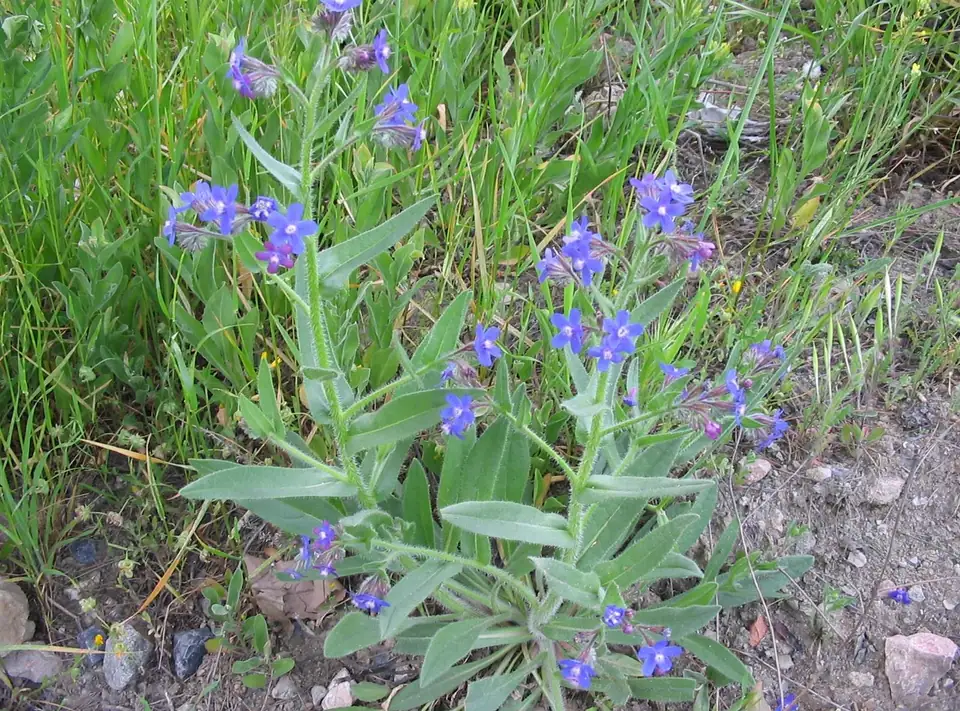
Alkanet is a bristly, short-lived flowering perennial with small bright blue flowers from late spring to mid-summer. [1] It grows best in full sun, prefers moist well-drained soil and tolerates heavy clay. [1] It self-seeds, has a reputation for being weedy and can become invasive under the right conditions. [1]
Alkanet care
How to water Alkanet
Watering
Moist, well-drained soil
What the sources say (1)
It prefers moist, well-drained, soil, but established plants will tolerate drought.Watering notes
Mulching around the plant base helps retain moisture
What the sources say (1)
This plant is not drought tolerant and mulching around the plant base will aid in retaining moisture.How much light Alkanet needs
Full sun, with some afternoon shade during hot summer months
What the sources say (1)
The plant will grow best in full sun, but you should provide some afternoon shade during the hot summer monthsHow much cold Alkanet can take
Hardiness, coldest zone
3a [winter low −40 to −37.2 °C (−40 to −35 °F)]
What the sources say (1)
USDA Plant Hardiness Zone:
3a, 3b, 4a, 4b, 5a, 5b, 6a, 6b, 7a, 7b, 8a, 8bHardiness, warmest zone
8b [winter low −9.4 to −6.7 °C (15 to 20 °F)]
What the sources say (1)
USDA Plant Hardiness Zone:
3a, 3b, 4a, 4b, 5a, 5b, 6a, 6b, 7a, 7b, 8a, 8bHow to propagate Alkanet
Division, root cutting, seed
What the sources say (1)
Recommended Propagation Strategy:
Division
Root Cutting
Seed
Country Or RegionHow to grow Alkanet
The plant
Life cycle
perennial (short-lived)
What the sources say (1)
Anchusa azurea , or Alkanet, is a flowering, bristly, short-lived, perennial. In its native Europe, it is often found on the sides of arable fields, waste places, roadsides and stony hills.Family
Boraginaceae
What the sources say (1)
Genus:
Anchusa
Species:
azurea
Family:
Boraginaceae
Life Cycle:
Perennial
Recommended Propagation Strategy:Mature height
91-152 cm (3-5 ft)
What the sources say (1)
Dimensions:
Height: 3 ft. 0 in. - 5 ft. 0 in.
Width: 1 ft. 0 in. - 2 ft. 0 in.
-
Whole Plant Traits:Mature width
30-61 cm (1-2 ft)
What the sources say (1)
Dimensions:
Height: 3 ft. 0 in. - 5 ft. 0 in.
Width: 1 ft. 0 in. - 2 ft. 0 in.
-
Whole Plant Traits:Pests and diseases
Diseases
crown rot
What the sources say (1)
Insects, Diseases and Other Plant Problems: No significant problems; however, crown rot is an issue for this plant.Alkanet pests and problems
Crown rot
Symptom: Crown rot is an issue for this plant.
What to do: Protect the roots but not the crown with mulch after the bloom season.
What the sources say (2)
No significant problems; however, crown rot is an issue for this plant.
— Anchusa azurea (Alkanet, Anchusa, Italian bugloss) | North Carolina Extension Gardener Plant Toolbox [1] assure that the roots (but not the crown) are protected by mulch.
— Anchusa azurea (Alkanet, Anchusa, Italian bugloss) | North Carolina Extension Gardener Plant Toolbox [1] Self-seeding
Symptom: Self-seeding can lead to an invasion of new plants.
What to do: Deadheading helps eliminate this tendency.
What the sources say (1)
Deadheading will help to eliminate this tendency as well as prolong the bloom period.
— Anchusa azurea (Alkanet, Anchusa, Italian bugloss) | North Carolina Extension Gardener Plant Toolbox [1]
Remedies
Each remedy shows what official sources say about it; traditional remedies without an official source are marked as such. Harmful ones are listed so you know to avoid them.
Treating the plant
self-seeding
deadheading spent flowers Works
How: Deadhead spent flowers to promote new blooms and prevent self-seeding.
Deadheading spent flowers will promote new blooms and prevent them self-seeding
— gardeningchannel.com [2] What the evidence says Deadheading will help to eliminate this tendency as well as prolong the bloom period.
— Anchusa azurea (Alkanet, Anchusa, Italian bugloss) | North Carolina Extension Gardener Plant Toolbox [1]
powdery mildew
spacing plants further apart Works
How: Thin crowded stems in June to improve air flow and reduce powdery mildew; space plants 60-90 cm apart.
Thin crowded stems in June to improve air flow and reduce powder
— nature-and-garden.com [3] What the evidence says Reduce the humidity around your plants by spacing them further apart to increase air flow. Be sure not to over-water as this can lead to higher air humidity as well.
— hort.extension.wisc.edu [4] baking soda and horticultural oil spray Works
Also consider pretesting any product that you decide to use on a small number of leaves or plants before treating a larger area to make sure there are no toxic effects, particularly when treating during warmer weather.
— hort.extension.wisc.edu [4] How: Baking soda (1½ tablespoons) and a light weight (paraffin-based) horticultural oil (3 tablespoons) in water (1 gallon), every seven to 14 days.
A combination of baking soda (1½ tablespoons) and a light weight (i.e., paraffin-based) horticultural oil (3 tablespoons) in water (1 gallon) has also been shown to be effective.
— hort.extension.wisc.edu [4] What the evidence says A combination of baking soda (1½ tablespoons) and a light weight (i.e., paraffin-based) horticultural oil (3 tablespoons) in water (1 gallon) has also been shown to be effective.
— hort.extension.wisc.edu [4]
Getting rid of it
invasive spread
removing spreading plants Not verified
Traditional remedy, not verified by an official source.
How: Remove spreading plants if you do not want them.
Calendar
Pruning
At the end of the season
What the sources say (1)
Cut back the plants at the end of the season and assure that the rootsMonths as given by the sources, which are mostly from the United States (northern hemisphere). In the southern hemisphere they shift by about six months.
Edibility
Reported by the source, quoted verbatim. Do not eat a plant on the basis of this page alone: identification mistakes can be dangerous.
The flowers can be eaten raw and make a decorative addition to the salad bowl, or used as a garnish.
[1]
Indicative values
Values from a secondary source, not checked word for word like the rest of this page. Use them as a starting point.
- Hours of sun
- 6-8 hoursIndicative value, adapt it to your climate · Secondary source
- Soil pH
- 6-7.5Indicative value, adapt it to your climate · Secondary source
- Care level
- MediumIndicative value, adapt it to your climate · Secondary source
- Growth rate
- LowIndicative value, adapt it to your climate · Secondary source
Similar plants
- Bugloss Anchusa capensis
- Abraham Trachystemon orientalis
- Blue Showers Cynoglossum amabile
- Blueweed Echium vulgare
- Borage Borago officinalis
- Clasping Heliotrope Heliotropium amplexicaule
- Comfrey Symphytum grandiflorum
- Comfrey Symphytum officinale
Sources
Every value above is quoted from these documents. Links lead to the original publisher.
- Anchusa azurea (Alkanet, Anchusa, Italian bugloss) | North Carolina Extension Gardener Plant Toolbox · plants.ces.ncsu.edu, consulted
- gardeningchannel.com · gardeningchannel.com
- nature-and-garden.com · nature-and-garden.com
- hort.extension.wisc.edu · hort.extension.wisc.edu
Written by Emilio Marruso · last checked