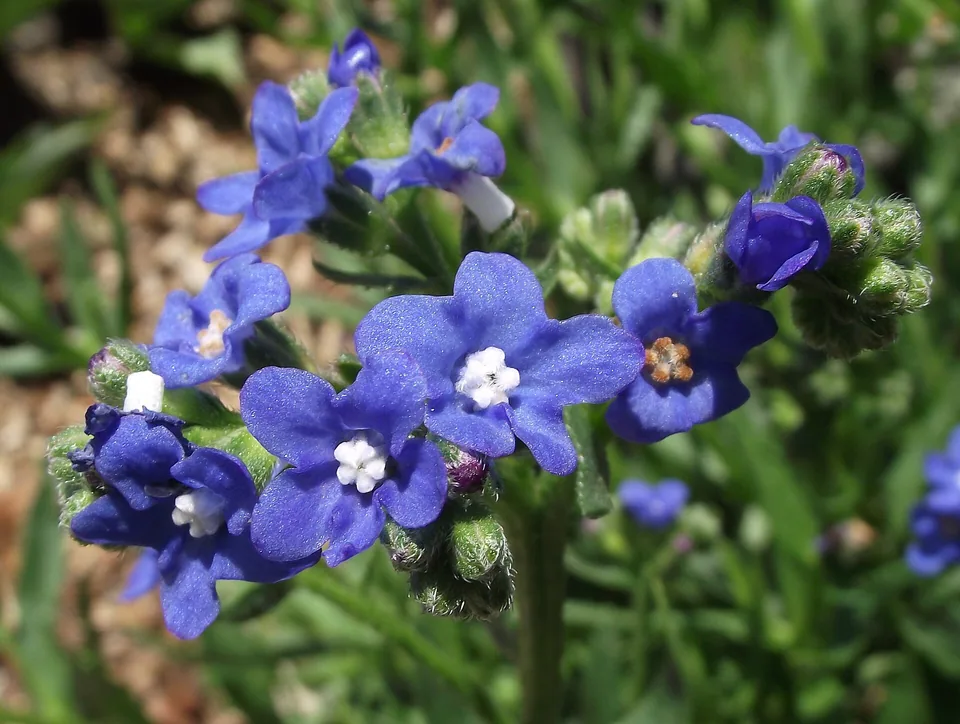


How to Grow and Care for Bugloss
Anchusa capensis
Written by Emilio Marruso · last checked
Toxic to: People · Why
At a glance
This easygoing bloomer is happy in full sun or partial shade, and it grows in containers too. Shear it back 3 inches after each flowering and it will reward you with a second bloom. Even better, its flowers can brighten a salad, and its leaves can be eaten like spinach. Just feed it lightly so it puts its energy into flowers.
- Sun
Full sun to partial shade
What the sources say (1)
Light: Full sun to partial shade
Prefers full sun but tolerates part shade.
— Anchusa capensis (Bugloss, Cape Forget-Me Not, Summer Forget-Me Not) | North Carolina Extension Gardener Plant Toolbox [1] - Cold
Survives winters down to 5 °F (−15 °C)
Hardy in cold winters · USDA 7b · RHS H5 · Z7
What the sources say (2)
Hardiness, coldest zone: 7b [winter low −15 to −12.2 °C (5 to 10 °F)]
USDA Plant Hardiness Zone: 7b, 8a, 8b, 9a, 9b, 10a, 10b
— Anchusa capensis (Bugloss, Cape Forget-Me Not, Summer Forget-Me Not) | North Carolina Extension Gardener Plant Toolbox [1] Hardiness, warmest zone: 10b [winter low 1.7 to 4.4 °C (35 to 40 °F)]
USDA Plant Hardiness Zone: 7b, 8a, 8b, 9a, 9b, 10a, 10b
— Anchusa capensis (Bugloss, Cape Forget-Me Not, Summer Forget-Me Not) | North Carolina Extension Gardener Plant Toolbox [1] - Feeding
Feed lightly: too much fertilizer means leaves instead of flowers
What the sources say (2)
Avoid: Heavy fertilization: feed lightly
Fertilize it lightly or leaf growth is encouraged at the expense of blooms.
— Anchusa capensis (Bugloss, Cape Forget-Me Not, Summer Forget-Me Not) | North Carolina Extension Gardener Plant Toolbox [1] Signs of excess: Leaf growth at the expense of blooms
Fertilize it lightly or leaf growth is encouraged at the expense of blooms.
— Anchusa capensis (Bugloss, Cape Forget-Me Not, Summer Forget-Me Not) | North Carolina Extension Gardener Plant Toolbox [1] - Pruning
Shear back 3 inches after each flowering for a second bloom
What the sources say (1)
Pruning: After each flowering cycle
The coarse bright green foliage can be sheared back about 3 inches after each flowering cycle to encourage a second bloom
— Anchusa capensis (Bugloss, Cape Forget-Me Not, Summer Forget-Me Not) | North Carolina Extension Gardener Plant Toolbox [1] - Harvest
Add the flowers to salads; the leaves can be eaten like spinach
- Watch out
Self-sows where winters are mild and can become weedy
- Size
10 inches to 1 foot wide
What the sources say (1)
Mature width: 25.4-30.48 cm (10 in-1 ft)
Height: 0 ft. 8 in. - 1 ft. 6 in. Width: 0 ft. 10 in. - 1 ft. 0 in.
— Anchusa capensis (Bugloss, Cape Forget-Me Not, Summer Forget-Me Not) | North Carolina Extension Gardener Plant Toolbox [1] - Propagation
Grows from seed
What the sources say (1)
Propagation: Seed
Recommended Propagation Strategy: Seed
— Anchusa capensis (Bugloss, Cape Forget-Me Not, Summer Forget-Me Not) | North Carolina Extension Gardener Plant Toolbox [1] - Containers
Grows in containers too
What the sources say (1)
In containers: Yes
Use in containers or pollinator gardens.
— Anchusa capensis (Bugloss, Cape Forget-Me Not, Summer Forget-Me Not) | North Carolina Extension Gardener Plant Toolbox [1] - Safety
Handle with care: the rough leaves can irritate the skin
Overview
Anchusa capensis is a vigorous biennial from South Africa, grown as an annual for its bright blue summer flowers. [1] It prefers full sun but tolerates part shade, and it suits containers and pollinator gardens. [1] It self-sows readily and can become quite weedy. [1]
This record is incomplete: the sources we read do not cover every field yet.
Not yet covered by our sources: Watering
Bugloss care
How to water Bugloss
Not stated in the sources we read.
How much light Bugloss needs
Full sun to partial shade
What the sources say (1)
Prefers full sun but tolerates part shade.How much cold Bugloss can take
Hardiness, coldest zone
7b [winter low −15 to −12.2 °C (5 to 10 °F)]
What the sources say (1)
USDA Plant Hardiness Zone:
7b, 8a, 8b, 9a, 9b, 10a, 10bHardiness, warmest zone
10b [winter low 1.7 to 4.4 °C (35 to 40 °F)]
What the sources say (1)
USDA Plant Hardiness Zone:
7b, 8a, 8b, 9a, 9b, 10a, 10bWhere to grow Bugloss
Yes
What the sources say (1)
Use in containers or pollinator gardens.How to propagate Bugloss
Seed
What the sources say (1)
Recommended Propagation Strategy:
SeedHow to grow Bugloss
The plant
Life cycle
biennial (used as an annual)
What the sources say (1)
Common bugloss is a vigorous biennial in the Boraginaceae (borage) family native to South Africa.Family
Boraginaceae
What the sources say (1)
Common bugloss is a vigorous biennial in the Boraginaceae (borage) family native to South Africa.Mature height
Mature width
25.4-30.48 cm (10 in-1 ft)
What the sources say (1)
Height: 0 ft. 8 in. - 1 ft. 6 in.
Width: 0 ft. 10 in. - 1 ft. 0 in.Fertilizing
Avoid
Heavy fertilization: feed lightly
What the sources say (1)
Fertilize it lightly or leaf growth is encouraged at the expense of blooms.Signs of excess
Leaf growth at the expense of blooms
What the sources say (1)
Fertilize it lightly or leaf growth is encouraged at the expense of blooms.Bugloss pests and problems
Weediness and self-seeding
Symptom: Self-sows in mild winter areas and can become quite weedy; invasive or on watch lists in some areas.
What to do: Shear back about 3 inches after each flowering cycle to encourage a second bloom; fertilize lightly.
What the sources say (2)
It self-sows in mild winter areas and can become quite weedy.
— Anchusa capensis (Bugloss, Cape Forget-Me Not, Summer Forget-Me Not) | North Carolina Extension Gardener Plant Toolbox [1] In some areas of the county it is invasive or on watch lists.
— Anchusa capensis (Bugloss, Cape Forget-Me Not, Summer Forget-Me Not) | North Carolina Extension Gardener Plant Toolbox [1]
Remedies
Each remedy shows what official sources say about it; traditional remedies without an official source are marked as such. Harmful ones are listed so you know to avoid them.
Treating the plant
self-seeding weediness
deadheading flowers Not verified
Traditional remedy, not verified by an official source.
As both the seeds and the hairs on the stem may prove irritating to the skin be sure to wear gloves whenever handling Anchusa capensis .
— gardenershq.com [3] How: Deadhead the flowers to prevent seed spread, since the plant can spread very easily.
Is Bugloss poisonous?
Reported by the source, quoted verbatim. This is not medical or veterinary advice: if a person or an animal may have eaten this plant, contact a poison control centre or a veterinarian.
Calendar
Pruning
After each flowering cycle
What the sources say (1)
The coarse bright green foliage can be sheared back about 3 inches after each flowering cycle to encourage a second bloomMonths as given by the sources, which are mostly from the United States (northern hemisphere). In the southern hemisphere they shift by about six months.
Edibility
Reported by the source, quoted verbatim. Do not eat a plant on the basis of this page alone: identification mistakes can be dangerous.
Similar plants
- Alkanet Anchusa azurea
- Abraham Trachystemon orientalis
- Blue Showers Cynoglossum amabile
- Blueweed Echium vulgare
- Borage Borago officinalis
- Broad-leaf Waterleaf Hydrophyllum canadense
- Clasping Heliotrope Heliotropium amplexicaule
- Comfrey Symphytum grandiflorum
Sources
Every value above is quoted from these documents. Links lead to the original publisher.
- Anchusa capensis (Bugloss, Cape Forget-Me Not, Summer Forget-Me Not) | North Carolina Extension Gardener Plant Toolbox · plants.ces.ncsu.edu, consulted
- Cape Forget-Me Not - Anchusa capensis | North Carolina Extension Gardener Plant Toolbox · plants.ces.ncsu.edu, consulted
- gardenershq.com · gardenershq.com
Written by Emilio Marruso · last checked