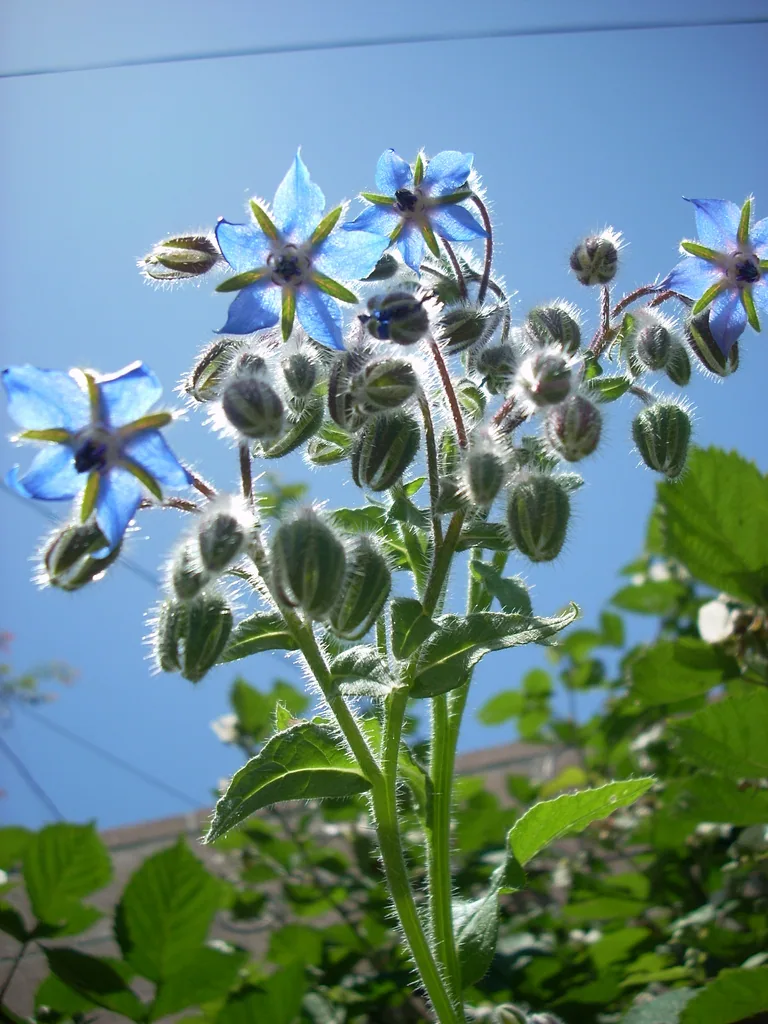


How to Grow and Care for Borage
Borago officinalis
Written by Emilio Marruso · last checked
Toxic to: Cats, Dogs, Horses, People · Why
At a glance
Borage is an annual whose leaves and flowers taste like cucumber, lovely in salads, drinks and desserts. Sow it straight in the garden once frost is past, in full sun, and once settled it is happy in dry soil. Sow again every 4 weeks for a steady supply of fresh leaves, and pick the blossoms as they open.
- Sun
Full sun; it also takes light shade
What the sources say (2)
Light: Full sun; tolerates light shade
This plant grows at its best in full sun but will not be adversely affected by light shade.
— Borago officinalis (Borage, Cool Tankard, Cover Crop, Starflower, Tailwort, Talewort) | North Carolina Extension Gardener Plant Toolbox [1] It prefers a full sun location and once established does well on soils that are dry.
— Borage | Herbs | Illinois Extension | Illinois [5] - Water
Likes dry spots; once settled it does well in dry soil
What the sources say (2)
Watering: Does best in dry places; once established does well on dry soils
It prefers a full sun location and once established does well on soils that are dry.
— Borage | Herbs | Illinois Extension | Illinois [5] This plant does best in dry, sunny places. Although it is difficult to transplant, you can stretch out the harvest by sowing three times at 4-week intervals.
— Borage | University of Maryland Extension [4] - Cold
Survives winters down to −50 °F (−45.6 °C)
Very hardy · USDA 2a · RHS H7 · Z2
What the sources say (2)
Hardiness, coldest zone: 2a [winter low −45.6 to −42.8 °C (−50 to −45 °F)]
USDA Plant Hardiness Zone: 2a, 2b, 3a, 3b, 4a, 4b, 5a, 5b, 6a, 6b, 7a, 7b, 8a, 8b, 9a, 9b, 10a, 10b, 11a, 11b
— Borago officinalis (Borage, Cool Tankard, Cover Crop, Starflower, Tailwort, Talewort) | North Carolina Extension Gardener Plant Toolbox [1] Hardiness, warmest zone: 11b [winter low 7.2 to 10 °C (45 to 50 °F)]
USDA Plant Hardiness Zone: 2a, 2b, 3a, 3b, 4a, 4b, 5a, 5b, 6a, 6b, 7a, 7b, 8a, 8b, 9a, 9b, 10a, 10b, 11a, 11b
— Borago officinalis (Borage, Cool Tankard, Cover Crop, Starflower, Tailwort, Talewort) | North Carolina Extension Gardener Plant Toolbox [1] - Spacing
12 in between plants, 18 in between rows
What the sources say (2)
Spacing: 30.5 cm (12 in) between plants; 45.7 cm (18 in) between rows
Although it is difficult to transplant, you can stretch out the harvest by sowing three times at 4-week intervals. Spacing: 18" between rows and 12" between plants.
— Borage | University of Maryland Extension [4] Row spacing: 45.7 cm (18 in)
you can stretch out the harvest by sowing three times at 4-week intervals. Spacing: 18" between rows and 12" between plants.
— Borage | University of Maryland Extension [4] - Pruning
In midsummer, cut it back by half for new growth in fall
What the sources say (1)
Pruning: Mid-summer (cut the plant back by a half for new growth in the fall)
Cut the plant back by a half in mid-summer for new growth for the fall.
— Borago officinalis (Borage, Cool Tankard, Cover Crop, Starflower, Tailwort, Talewort) | North Carolina Extension Gardener Plant Toolbox [1] - Harvest
Pick flowers as they open; use the cucumber-tasting leaves fresh anytime
What the sources say (3)
Harvest: Pick blossoms as they open; use leaves fresh anytime
Harvesting: Pick blossoms as they open. Use leaves fresh anytime; they are seldom dried.
— Borage | University of Maryland Extension [4] How to harvest: Pick blossoms as they open; use leaves fresh anytime. Both foliage and flowers are harvested for fresh use.
Harvesting: Pick blossoms as they open. Use leaves fresh anytime; they are seldom dried.
— Borage | University of Maryland Extension [4] Both the foliage and flowers can be harvested for fresh use. It is rarely dried.
— Borage | Herbs | Illinois Extension | Illinois [5] - Pests
Powdery mildew can sometimes appear
What the sources say (1)
Diseases: powdery mildew
No specific insect or disease problems although powdery mildew can sometimes occur.
— Borago officinalis (Borage, Cool Tankard, Cover Crop, Starflower, Tailwort, Talewort) | North Carolina Extension Gardener Plant Toolbox [1] - Watch out
Stems are brittle and break in the wind: stake the plant
- Size
2–3 ft tall and 12–16 in wide
What the sources say (3)
Mature height: 60-90 cm (2-3 ft)
beautiful sky-blue flowers in a star shape. The plant grows about 2-3 feet tall.
— Borage | University of Maryland Extension [4] Borage is a coarse textured plant growing to about 2 to 3 feet.
— Borage | Herbs | Illinois Extension | Illinois [5] Mature width: 30-41 cm (1 ft 0 in - 1 ft 4 in)
Height: 1 ft. 7 in. - 3 ft. 2 in. Width: 1 ft. 0 in. - 1 ft. 4 in.
— Borago officinalis (Borage, Cool Tankard, Cover Crop, Starflower, Tailwort, Talewort) | North Carolina Extension Gardener Plant Toolbox [1] - Propagation
From seed, and it reseeds itself
What the sources say (1)
Propagation: Seed (also self-seeding)
For propagating, you can grow this plant from seed: the plant is also self-seeding and will remain in your garden year after year.
— Borago officinalis (Borage, Cool Tankard, Cover Crop, Starflower, Tailwort, Talewort) | North Carolina Extension Gardener Plant Toolbox [1] - Sowing
Sow right in the garden after frost, every 4 weeks; it does not like being transplanted
What the sources say (2)
Sowing: Directly sown in the garden after frost is past (or started indoors); successive sowings at 4-week intervals for a continued supply of fresh foliage
Borage is easily grown from seed started indoors or directly sown in the garden after frost is past.
— Borage | Herbs | Illinois Extension | Illinois [5] If grown for culinary use, successive sowings of seed at four week intervals will result in a good supply of fresh foliage.
— Borage | Herbs | Illinois Extension | Illinois [5] - Containers
Grows in containers too
What the sources say (1)
In containers: Yes
It can be planted in all types of gardens including a vegetable garden, herb garden, wildflower garden, containers and a cottage garden.
— Borago officinalis (Borage, Cool Tankard, Cover Crop, Starflower, Tailwort, Talewort) | North Carolina Extension Gardener Plant Toolbox [1] - Safety
Eat only small amounts, it can harm the liver; hairs may irritate skin; bad for cats, dogs and horses
Overview
Borage is an annual in the Boraginaceae family native to the Mediterranean region, with bright blue star-shaped flowers. [1] It grows at its best in full sun and does well in all types of soil, including nutritionally poor soil. [1] The source text says the plant contains toxins (PAs) that can damage the liver and lungs and should only be used sparingly. [1]
Borage care
How to water Borage
Does best in dry places; once established does well on dry soils
What the sources say (2)
It prefers a full sun location and once established does well on soils that are dry.This plant does best in dry, sunny places. Although it is difficult to transplant, you can stretch out the harvest by sowing three times at 4-week intervals.How much light Borage needs
Full sun; tolerates light shade
What the sources say (2)
This plant grows at its best in full sun but will not be adversely affected by light shade.It prefers a full sun location and once established does well on soils that are dry.How much cold Borage can take
Hardiness, coldest zone
2a [winter low −45.6 to −42.8 °C (−50 to −45 °F)]
What the sources say (1)
USDA Plant Hardiness Zone:
2a, 2b, 3a, 3b, 4a, 4b, 5a, 5b, 6a, 6b, 7a, 7b, 8a, 8b, 9a, 9b, 10a, 10b, 11a, 11bHardiness, warmest zone
11b [winter low 7.2 to 10 °C (45 to 50 °F)]
What the sources say (1)
USDA Plant Hardiness Zone:
2a, 2b, 3a, 3b, 4a, 4b, 5a, 5b, 6a, 6b, 7a, 7b, 8a, 8b, 9a, 9b, 10a, 10b, 11a, 11bWhere to grow Borage
In containers
Yes
What the sources say (1)
It can be planted in all types of gardens including a vegetable garden, herb garden, wildflower garden, containers and a cottage garden.Spacing
30.5 cm (12 in) between plants; 45.7 cm (18 in) between rows
What the sources say (1)
Although it is difficult to transplant, you can stretch out the harvest by sowing three times at 4-week intervals. Spacing: 18" between rows and 12" between plants.How to propagate Borage
Seed (also self-seeding)
What the sources say (1)
For propagating, you can grow this plant from seed: the plant is also self-seeding and will remain in your garden year after year.How to grow Borage
The plant
Life cycle
annual
What the sources say (2)
Starflower is an annual plant in the forget-me-not or Boraginaceae family native to the Mediterranean regionBorage is a decorative annual with coarse, very hairy leaves and stemsFamily
Boraginaceae
What the sources say (1)
Starflower is an annual plant in the forget-me-not or Boraginaceae family native to the Mediterranean regionMature height
60-90 cm (2-3 ft)
Mature width
30-41 cm (1 ft 0 in - 1 ft 4 in)
What the sources say (1)
Height: 1 ft. 7 in. - 3 ft. 2 in. Width: 1 ft. 0 in. - 1 ft. 4 in.Sowing and growth
Row spacing
45.7 cm (18 in)
What the sources say (1)
you can stretch out the harvest by sowing three times at 4-week intervals. Spacing: 18" between rows and 12" between plants.Harvest and storage
How to harvest
Pick blossoms as they open; use leaves fresh anytime. Both foliage and flowers are harvested for fresh use.
Pests and diseases
Diseases
powdery mildew
What the sources say (1)
No specific insect or disease problems although powdery mildew can sometimes occur.Borage pests and problems
Powdery mildew
Symptom: Can sometimes occur
What the sources say (1)
No specific insect or disease problems although powdery mildew can sometimes occur.
— Borago officinalis (Borage, Cool Tankard, Cover Crop, Starflower, Tailwort, Talewort) | North Carolina Extension Gardener Plant Toolbox [1] Brittle stems damaged by wind
Symptom: Plant is brittle and easily damaged by wind
What to do: Staking is suggested
What the sources say (1)
Borage has a tendency to be brittle and is easily damaged by wind so staking is suggested.
— Borage | Herbs | Illinois Extension | Illinois [5] Skin irritation from hairs
Symptom: The harsh hairs on the plant may cause skin irritations in some persons
What to do: Care is suggested when handling the plant during harvest
What the sources say (1)
The harsh hairs on the plant may cause skin irritations in some persons so care is suggested when handling the plant during harvest.
— Borage | Herbs | Illinois Extension | Illinois [5] Difficult to transplant
What to do: Sow in several successive sowings at 4-week intervals to stretch out the harvest
What the sources say (1)
Although it is difficult to transplant, you can stretch out the harvest by sowing three times at 4-week intervals.
— Borage | University of Maryland Extension [4]
Remedies
Each remedy shows what official sources say about it; traditional remedies without an official source are marked as such. Harmful ones are listed so you know to avoid them.
Treating the plant
powdery mildew
baking soda spray Not verified
Traditional remedy, not verified by an official source.
How: A simple solution of baking soda and water sprayed on borage plants helps prevent powdery mildew; it alters the pH on the leaf surface, making it less hospitable for fungal spores.
pests
insecticidal soap Works
How: Organic pest management for borage includes insecticidal soaps.
Organic pest management methods for borage cultivation include using insecticidal soaps, neem oil, or introducing beneficial insects like ladybugs and lacewings.
— mygarden.co.nz [6] What the evidence says insecticidal soap is a safe, effective organic insecticide with minimal environmental impact.
— extension.psu.edu [7] neem oil Partly works
How: Organic pest management for borage includes neem oil.
Organic pest management methods for borage cultivation include using insecticidal soaps, neem oil, or introducing beneficial insects like ladybugs and lacewings.
— mygarden.co.nz [6] What the evidence says Some benefits of neem include low mammalian toxicity and limited persistence in the environment. However, neem oil is not effective against every insect and disease, and often must be frequently reapplied to reach the desired outcome.
— extension.unh.edu [8]
Getting rid of it
self-seeding volunteers
pull by hand Works
The harsh hairs on the plant may cause skin irritations in some persons so care is suggested when handling the plant during harvest.
— Borage | Herbs | Illinois Extension | Illinois [5] How: If self-seeding produces too many plants or in undesirable places, volunteers are easily pulled; wear gloves.
If self-seeding produces too many plants or in undesirable places, volunteers are easily pulled.
— ucanr.edu [9] What the evidence says To control weeds without using manufactured herbicides, the best option is to pull, remove or interfere with weed growth.
— extension.usu.edu [10]
Is Borage toxic to pets?
Reported by the source, quoted verbatim. This is not medical or veterinary advice: if a person or an animal may have eaten this plant, contact a poison control centre or a veterinarian.
Animals
Problems: Poisonous to Humans Problem for Cats Problem for Children Problem for Dogs Problem for Horses
[1]The source flags the risk for this animal but does not explain why.
People
The plant contains toxins (PAs) that can damage the liver and lungs, and are potentially carcinogenic. Should only be used sparingly.
[1]- Poisonous parts
Causes Contact Dermatitis: No Poison Part: Leaves
[1]- Toxic principle
Poison Toxic Principle: Tannins, mucilage Causes Contact Dermatitis: No
[1]- Symptoms
The plant contains toxins (PAs) that can damage the liver and lungs, and are potentially carcinogenic. Should only be used sparingly.
[1]- Severity
This plant has low severity poison characteristics.
[1]
The harsh hairs on the plant may cause skin irritations in some persons so care is suggested when handling the plant during harvest.
[5]
Calendar
Sowing
Directly sown in the garden after frost is past (or started indoors); successive sowings at 4-week intervals for a continued supply of fresh foliage
What the sources say (2)
Borage is easily grown from seed started indoors or directly sown in the garden after frost is past.If grown for culinary use, successive sowings of seed at four week intervals will result in a good supply of fresh foliage.Harvest
Pick blossoms as they open; use leaves fresh anytime
What the sources say (1)
Harvesting: Pick blossoms as they open. Use leaves fresh anytime; they are seldom dried.Pruning
Mid-summer (cut the plant back by a half for new growth in the fall)
What the sources say (1)
Cut the plant back by a half in mid-summer for new growth for the fall.Months as given by the sources, which are mostly from the United States (northern hemisphere). In the southern hemisphere they shift by about six months.
Relative to frost
Less precise estimate: there is no weather station within 300 km.
Find frost dates by ZIP code or city
Sow outdoors: around the last frost
Borage is easily grown from seed started indoors or directly sown in the garden after frost is past.
— Borage | Herbs | Illinois Extension | Illinois [5]
Count from the average frost dates where you live.
Edibility
Reported by the source, quoted verbatim. Do not eat a plant on the basis of this page alone: identification mistakes can be dangerous.
In general, the flowers (used as edible flowers) and leaves (used in salads, teas, and sandwiches) are edible. They should only be usred sparingly as liver damage can occur.
[1]The stems and tender leaves are edible and taste and smell like cucumber although the leaves lose their flavor when they are dried.
[1]The foliage has a cucumber-like flavor that is useful in salads, soups or stews and beverages. The flowers are used as an edible garnish or added to deserts or drinks.
[5]
Indicative values
Values from a secondary source, not checked word for word like the rest of this page. Use them as a starting point.
- Hours of sun
- 5-7 hoursIndicative value, adapt it to your climate · Secondary source
- Drought tolerant
- yesIndicative value, adapt it to your climate · Secondary source
- Soil pH
- 6-7Indicative value, adapt it to your climate · Secondary source
- Care level
- MediumIndicative value, adapt it to your climate · Secondary source
- Growth rate
- LowIndicative value, adapt it to your climate · Secondary source
Similar plants
- Abraham Trachystemon orientalis
- Alkanet Anchusa azurea
- Blue Showers Cynoglossum amabile
- Blueweed Echium vulgare
- Bugloss Anchusa capensis
- Clasping Heliotrope Heliotropium amplexicaule
- Comfrey Symphytum grandiflorum
- Comfrey Symphytum officinale
Sources
Every value above is quoted from these documents. Links lead to the original publisher.
- Borago officinalis (Borage, Cool Tankard, Cover Crop, Starflower, Tailwort, Talewort) | North Carolina Extension Gardener Plant Toolbox · plants.ces.ncsu.edu, consulted
- Borage - Borago officinalis | North Carolina Extension Gardener Plant Toolbox · plants.ces.ncsu.edu, consulted
- Cover Crop - Borago officinalis | North Carolina Extension Gardener Plant Toolbox · plants.ces.ncsu.edu, consulted
- Borage | University of Maryland Extension · extension.umd.edu, consulted
- Borage | Herbs | Illinois Extension | Illinois · extension.illinois.edu, consulted
- mygarden.co.nz · mygarden.co.nz
- extension.psu.edu · extension.psu.edu
- extension.unh.edu · extension.unh.edu
- ucanr.edu · ucanr.edu
- extension.usu.edu · extension.usu.edu
Written by Emilio Marruso · last checked