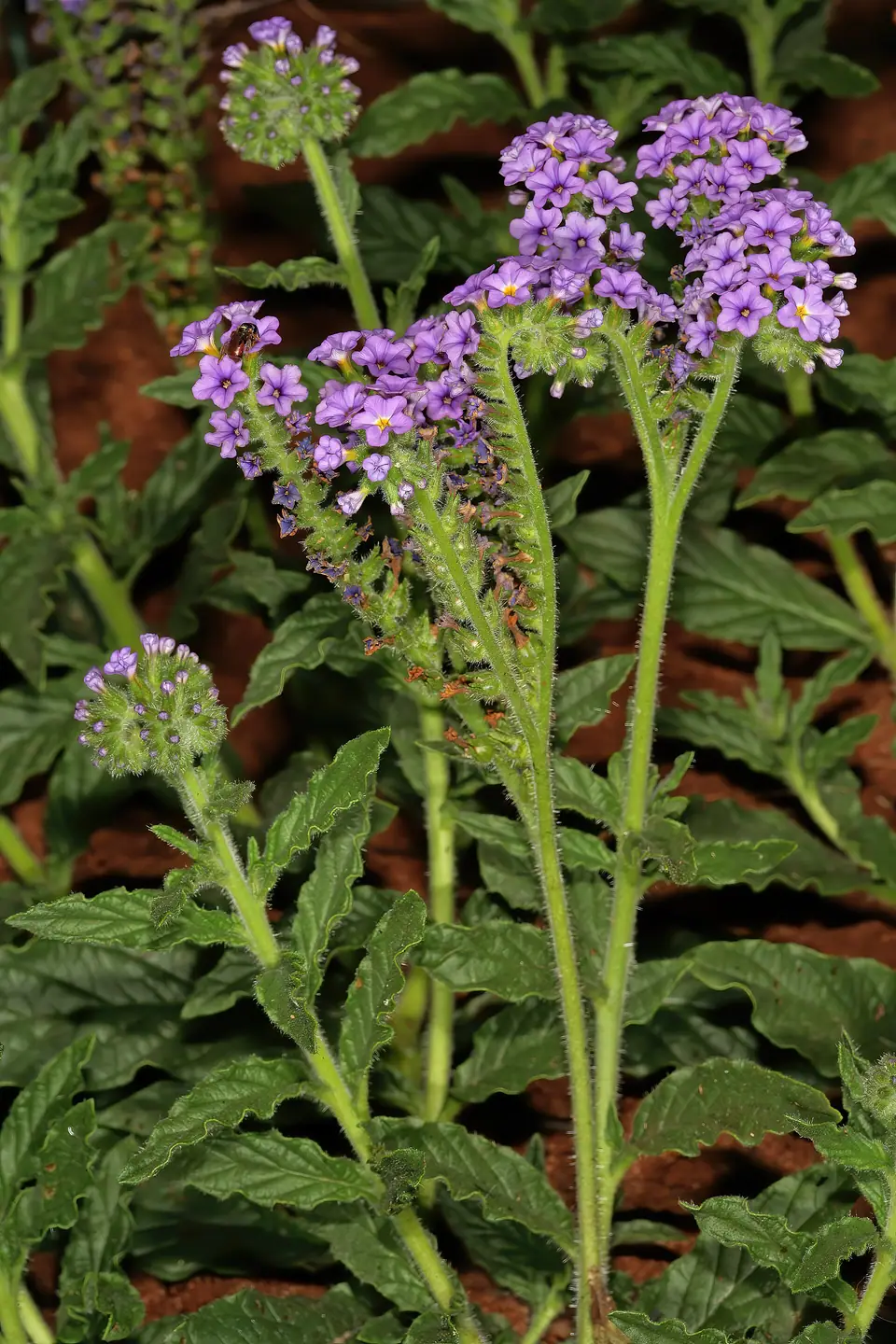
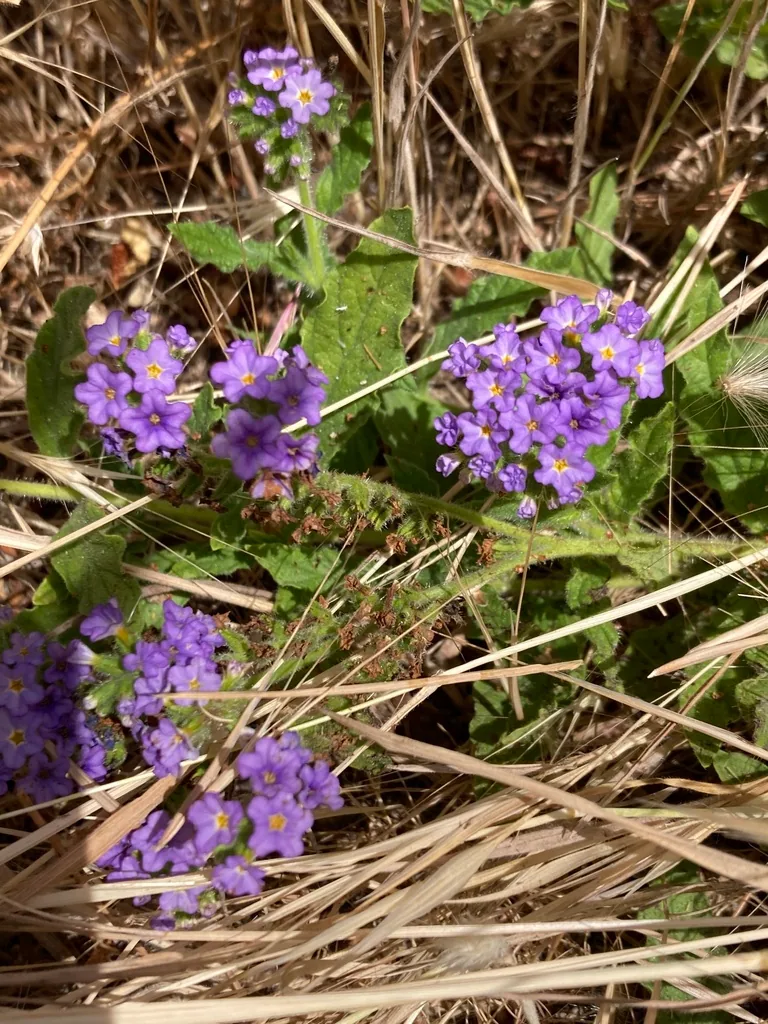

How to Grow and Care for Clasping Heliotrope
Heliotropium amplexicaule
Written by Emilio Marruso · last checked
Toxic to: Cats, Dogs, Horses, Livestock, People · Why
At a glance
Clasping heliotrope is an easygoing perennial that grows happily in full sun or partial shade and handles dry spells once it is established. It spreads 2–3 feet wide, does well in containers, and you can make new plants from divisions or stem cuttings. Just keep it from escaping the garden, since it can spread quickly.
- Sun
Full sun to partial shade
What the sources say (1)
Light: Full sun to partial shade
It prefers full sun to partial shade and well-drained acidic, sandy loam soil and is drought-tolerant once established.
— Heliotropium amplexicaule (Blue Heliotrope, Clasping Heliotrope, Creeping Heliotrope, Summer Heliotrope) | North Carolina Extension Gardener Plant Toolbox [1] - Water
Handles dry spells once it is established
What the sources say (1)
Watering: Drought-tolerant once established
It prefers full sun to partial shade and well-drained acidic, sandy loam soil and is drought-tolerant once established.
— Heliotropium amplexicaule (Blue Heliotrope, Clasping Heliotrope, Creeping Heliotrope, Summer Heliotrope) | North Carolina Extension Gardener Plant Toolbox [1] - Cold
Survives winters down to 0 °F (−17.8 °C)
Hardy in very cold winters · USDA 7a · RHS H6 · Z7
What the sources say (2)
Hardiness, coldest zone: 7a [winter low −17.8 to −15 °C (0 to 5 °F)]
USDA Plant Hardiness Zone: 7a, 7b, 8a, 8b, 9a, 9b
— Heliotropium amplexicaule (Blue Heliotrope, Clasping Heliotrope, Creeping Heliotrope, Summer Heliotrope) | North Carolina Extension Gardener Plant Toolbox [1] Hardiness, warmest zone: 9b [winter low −3.9 to −1.1 °C (25 to 30 °F)]
USDA Plant Hardiness Zone: 7a, 7b, 8a, 8b, 9a, 9b
— Heliotropium amplexicaule (Blue Heliotrope, Clasping Heliotrope, Creeping Heliotrope, Summer Heliotrope) | North Carolina Extension Gardener Plant Toolbox [1] - Pests
Aphids, mealybugs, spider mites, snails and slugs; also powdery mildew and root rot
What the sources say (2)
Pests: aphids, mealybugs, spider mites, snails, slugs, lace bugs
Watch for Aphids, mealybugs, spider mites snails, slugs and lace bugs. Disease include powdery mildew and root rot.
— Heliotropium amplexicaule (Blue Heliotrope, Clasping Heliotrope, Creeping Heliotrope, Summer Heliotrope) | North Carolina Extension Gardener Plant Toolbox [1] Diseases: powdery mildew, root rot
Watch for Aphids, mealybugs, spider mites snails, slugs and lace bugs. Disease include powdery mildew and root rot.
— Heliotropium amplexicaule (Blue Heliotrope, Clasping Heliotrope, Creeping Heliotrope, Summer Heliotrope) | North Carolina Extension Gardener Plant Toolbox [1] - Watch out
It can spread fast and crowd out native plants: don't let it escape the garden
- Size
2–3 ft wide
What the sources say (1)
Mature width: 60.96-91.44 cm (2-3 ft)
Clasping heliotrope grows 1 to 2 feet tall and spreads 2 to 3 feet by rhizomes.
— Heliotropium amplexicaule (Blue Heliotrope, Clasping Heliotrope, Creeping Heliotrope, Summer Heliotrope) | North Carolina Extension Gardener Plant Toolbox [1] - Propagation
By division or stem cuttings
What the sources say (1)
Propagation: Division, stem cutting
Recommended Propagation Strategy: Division Stem Cutting Country Or Region Of Origin:
— Heliotropium amplexicaule (Blue Heliotrope, Clasping Heliotrope, Creeping Heliotrope, Summer Heliotrope) | North Carolina Extension Gardener Plant Toolbox [1] - Containers
Grows in containers too
What the sources say (1)
In containers: Yes
Landscape Location: Container Landscape Theme: Drought Tolerant Garden Rock Garden
— Heliotropium amplexicaule (Blue Heliotrope, Clasping Heliotrope, Creeping Heliotrope, Summer Heliotrope) | North Carolina Extension Gardener Plant Toolbox [1] - Safety
Poisonous to people, cats, dogs, horses and livestock: keep children and pets away
Overview
Clasping heliotrope is a prostrate perennial that spreads by rhizomes and is used as an ornamental groundcover. [1] It is a noxious weed in parts of the world and is toxic to livestock and humans. [1]
This record is incomplete: the sources we read do not cover every field yet.
Not yet covered by our sources: Pruning
Clasping Heliotrope care
How to water Clasping Heliotrope
Drought-tolerant once established
What the sources say (1)
It prefers full sun to partial shade and well-drained acidic, sandy loam soil and is drought-tolerant once established.How much light Clasping Heliotrope needs
Full sun to partial shade
What the sources say (1)
It prefers full sun to partial shade and well-drained acidic, sandy loam soil and is drought-tolerant once established.How much cold Clasping Heliotrope can take
Hardiness, coldest zone
7a [winter low −17.8 to −15 °C (0 to 5 °F)]
What the sources say (1)
USDA Plant Hardiness Zone:
7a, 7b, 8a, 8b, 9a, 9bHardiness, warmest zone
9b [winter low −3.9 to −1.1 °C (25 to 30 °F)]
What the sources say (1)
USDA Plant Hardiness Zone:
7a, 7b, 8a, 8b, 9a, 9bWhere to grow Clasping Heliotrope
Yes
What the sources say (1)
Landscape Location:
Container
Landscape Theme:
Drought Tolerant Garden
Rock GardenHow to propagate Clasping Heliotrope
Division, stem cutting
What the sources say (1)
Recommended Propagation Strategy:
Division
Stem Cutting
Country Or Region Of Origin:How to grow Clasping Heliotrope
The plant
Life cycle
perennial
What the sources say (1)
Clasping heliotrope is a prostrate flowering perennial in the borage family (Boraginaceae) native to South America.Family
Boraginaceae
What the sources say (1)
Clasping heliotrope is a prostrate flowering perennial in the borage family (Boraginaceae) native to South America.Mature height
Mature width
60.96-91.44 cm (2-3 ft)
What the sources say (1)
Clasping heliotrope grows 1 to 2 feet tall and spreads 2 to 3 feet by rhizomes.Pests and diseases
Pests
aphids, mealybugs, spider mites, snails, slugs, lace bugs
What the sources say (1)
Watch for Aphids, mealybugs, spider mites snails, slugs and lace bugs. Disease include powdery mildew and root rot.Diseases
powdery mildew, root rot
What the sources say (1)
Watch for Aphids, mealybugs, spider mites snails, slugs and lace bugs. Disease include powdery mildew and root rot.Clasping Heliotrope pests and problems
Invasive spread
Symptom: It can grow rapidly crowding out native plant.
What to do: Prevent it from escaping the garden.
What the sources say (2)
It can grow rapidly crowding out native plant.
— Heliotropium amplexicaule (Blue Heliotrope, Clasping Heliotrope, Creeping Heliotrope, Summer Heliotrope) | North Carolina Extension Gardener Plant Toolbox [1] keep in mind the invasive qualities of this plant and prevent it from escaping the garden.
— Heliotropium amplexicaule (Blue Heliotrope, Clasping Heliotrope, Creeping Heliotrope, Summer Heliotrope) | North Carolina Extension Gardener Plant Toolbox [1] Pests and diseases
Symptom: Aphids, mealybugs, spider mites snails, slugs and lace bugs; powdery mildew and root rot.
What to do: Not stated.
What the sources say (1)
Watch for Aphids, mealybugs, spider mites snails, slugs and lace bugs. Disease include powdery mildew and root rot.
— Heliotropium amplexicaule (Blue Heliotrope, Clasping Heliotrope, Creeping Heliotrope, Summer Heliotrope) | North Carolina Extension Gardener Plant Toolbox [1]
Remedies
Each remedy shows what official sources say about it; traditional remedies without an official source are marked as such. Harmful ones are listed so you know to avoid them.
Treating the plant
aphids
insecticidal soap spray Works
Regardless of what product is used, be sure to test soap sprays for plant toxicity on a small area of the plant for a couple days prior to widespread use.
— site.extension.uga.edu [4] How: Aphids, whiteflies, thrips, mealybugs, and spider mites are good candidates for soapy water sprays; the soapy water needs to coat the insect body, so turn over leaves or spray from the bottom up.
Aphids, whiteflies, thrips, mealybugs, and spider mites are all good candidates for soapy water sprays.
— site.extension.uga.edu [4] What the evidence says Aphids, whiteflies, thrips, mealybugs, and spider mites are all good candidates for soapy water sprays.
— site.extension.uga.edu [4]
Getting rid of it
blue heliotrope
hand pulling seedlings and small plants Official source, not independently tested
Wear gloves when handling blue heliotrope.
— weeds.dpi.nsw.gov.au [5] Blue heliotrope contains pyrrolizidine alkaloids, which are poisonous to people.
— weeds.dpi.nsw.gov.au [5] How: Easiest when the soil is moist: hold the stem as close as possible to the base, gently tug from side to side to loosen the soil before pulling, and dig out the roots if they break.
Seedlings and small plants can be hand pulled. This is easiest when the soil is moist.
— weeds.dpi.nsw.gov.au [5] digging out larger plants Partly works
Wear gloves when handling blue heliotrope.
— weeds.dpi.nsw.gov.au [5] New blue heliotrope plants can grow from root fragments.
— weeds.dpi.nsw.gov.au [5] How: Larger plants can be dug out; dispose of plant parts carefully.
Larger plants can be dug out, though this is very time-consuming and the roots may be deep.
— weeds.dpi.nsw.gov.au [5] What the evidence says Larger plants can be dug out, though this is very time-consuming and the roots may be deep.
— weeds.dpi.nsw.gov.au [5] competitive perennial pasture and ground cover Partly works
How: Maintain locally adapted perennial pastures and healthy soil, keep ground cover and avoid overgrazing, especially in summer when seedlings sprout.
Establishing and maintaining locally adapted perennial pastures can help out-compete blue heliotrope.
— weeds.dpi.nsw.gov.au [5] What the evidence says Establishing and maintaining locally adapted perennial pastures can help out-compete blue heliotrope.
— weeds.dpi.nsw.gov.au [5] cultivation of seedlings Partly works
When cultivating adult plants, it is best to kill the plants with herbicide prior to cultivation to avoid spreading viable root fragments.
— weeds.dpi.nsw.gov.au [5] How: In spring and summer, cultivation can be used to treat seedlings; do not cultivate seeding plants.
In spring and summer, cultivation can be used to treat seedlings.
— weeds.dpi.nsw.gov.au [5] What the evidence says Cultivation may stimulate the germination of buried seeds and spread root fragments. Do not cultivate seeding plants.
— weeds.dpi.nsw.gov.au [5]
Is Clasping Heliotrope toxic to pets?
Reported by the source, quoted verbatim. This is not medical or veterinary advice: if a person or an animal may have eaten this plant, contact a poison control centre or a veterinarian.
Problems: Poisonous to Humans Problem for Horses Weedy
[1]- Poisonous parts
Poison Part: Flowers Fruits Leaves Roots Sap/Juice Seeds
[1]- Toxic principle
Poison Toxic Principle: Pyrrolizidine alkaloid Causes Contact Dermatitis: No
[1]- Symptoms
Poison Severity: Medium Poison Symptoms: Digestive upset and liver damage
[1]- Severity
This plant has medium severity poison characteristics. See below
[1]
It can invade pastures and is toxic to livestock.
[1]The source flags the risk for this animal but does not explain why.
#problem for cats #problem for children #problem for dogs
[1]The source flags the risk for this animal but does not explain why.
Calendar
Pruning
Not stated in the sources we read.
Months as given by the sources, which are mostly from the United States (northern hemisphere). In the southern hemisphere they shift by about six months.
Similar plants
- Heliotrope Heliotropium arborescens
- Abraham Trachystemon orientalis
- Alkanet Anchusa azurea
- Blue Showers Cynoglossum amabile
- Blueweed Echium vulgare
- Borage Borago officinalis
- Broad-leaf Waterleaf Hydrophyllum canadense
- Bugloss Anchusa capensis
Sources
Every value above is quoted from these documents. Links lead to the original publisher.
- Heliotropium amplexicaule (Blue Heliotrope, Clasping Heliotrope, Creeping Heliotrope, Summer Heliotrope) | North Carolina Extension Gardener Plant Toolbox · plants.ces.ncsu.edu, consulted
- Clasping Heliotrope - Heliotropium amplexicaule | North Carolina Extension Gardener Plant Toolbox · plants.ces.ncsu.edu, consulted
- Heliotropium (Cherry Pie Flower, Garden Heliotrope, Heliotrope, Monkey Tail) | North Carolina Extension Gardener Plant Toolbox · plants.ces.ncsu.edu, consulted
- site.extension.uga.edu · site.extension.uga.edu
- weeds.dpi.nsw.gov.au · weeds.dpi.nsw.gov.au
Written by Emilio Marruso · last checked