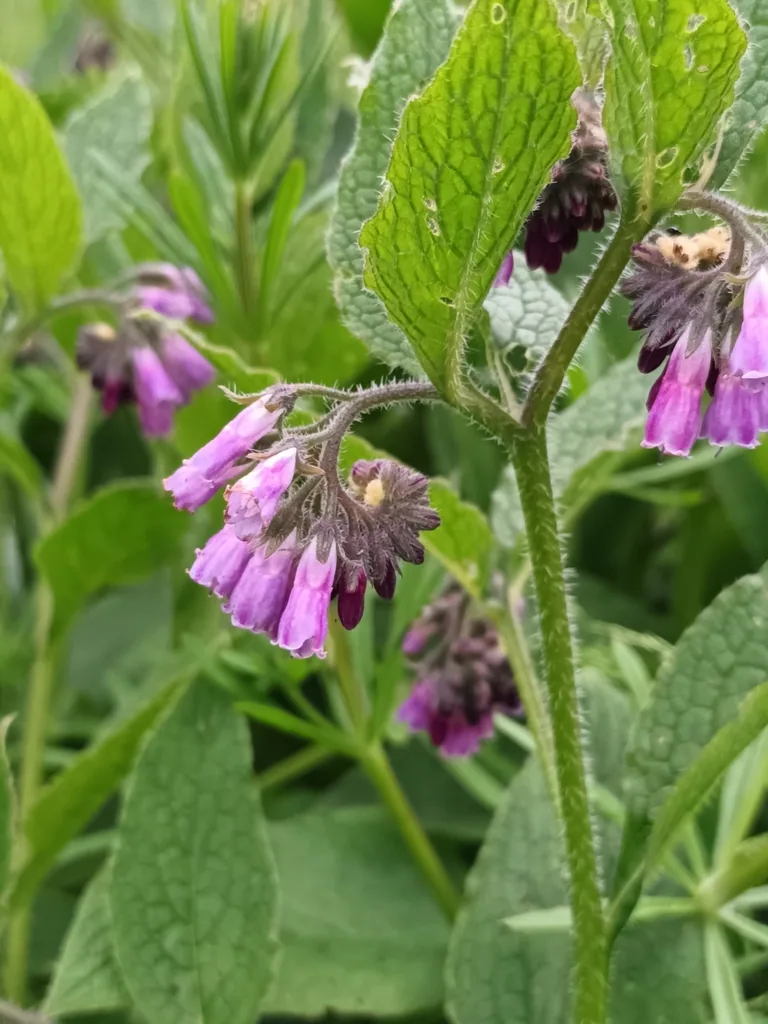
How to Grow and Care for Prickly comfrey
Symphytum asperum
Written by Emilio Marruso · last checked
At a glance
Rough comfrey is an easygoing plant for a lightly shaded corner with moist soil. Its young leaves can be eaten raw or cooked, with a hairy, slightly slippery texture, and in an open, sunny spot it grows well as compost material. Plant it out in late spring or early summer, once the last frosts are over.
- Sun
Some shade; an open, sunny spot if you grow it for compost
What the sources say (4)
Light: Some shade; open sunny site when grown for compost material
general: Tolerates most soils and situations but prefers a moist soil and some shade [1] [10] .
— Prickly Comfrey (Symphytum asperum) — Practical Plants [2] grown for compost material: Best grown in an open sunny site in a deep rich soil if it is being grown for compost material [7] .
— Prickly Comfrey (Symphytum asperum) — Practical Plants [2] Tolerates most soils and situations but prefers a moist soil and some shade [1] [10] .
— Prickly Comfrey (Symphytum asperum) — Practical Plants [2] Best grown in an open sunny site in a deep rich soil if it is being grown for compost material [7] .
— Prickly Comfrey (Symphytum asperum) — Practical Plants [2] - Water
Likes moist soil
What the sources say (1)
Watering: Prefers a moist soil
Tolerates most soils and situations but prefers a moist soil and some shade
— Symphytum asperum - Useful Temperate Plants [1] - Planting
Late spring or early summer, after the last frosts
What the sources say (2)
Planting: Late spring or early summer, after the last expected frosts
Plant them out into their permanent positions in late spring or early summer, after the last expected frosts.
— Prickly Comfrey (Symphytum asperum) — Practical Plants [2] Plants can go outdoors once the danger of frost has passed.
— Symphytum asperum (Prickly Comfrey) - World of Flowering Plants [5] - Harvest
Eat the young leaves raw or cooked; they are hairy and a bit slimy
- Propagation
By seed, division, root cuttings or crown cuttings
What the sources say (4)
Propagation: Seed (needs a chilling winter period to germinate); division; root cuttings; crown cuttings
Comfrey can be grown from seed, but it requires a chilling winter period to germinate.
— Symphytum asperum (Prickly Comfrey) - World of Flowering Plants [5] When starting several plants, it is more common to use root cuttings.
— Symphytum asperum (Prickly Comfrey) - World of Flowering Plants [5] You can also grow Comfrey from crown cuttings, but these will be more expensive.
— Symphytum asperum (Prickly Comfrey) - World of Flowering Plants [5] Division succeeds at almost any time of the year.
— Prickly Comfrey (Symphytum asperum) — Practical Plants [2] - Sowing
Sow in spring or fall in a cold frame, or outdoors in spring; seeds need a winter chill
What the sources say (6)
Sowing: Spring or autumn (in a cold frame); spring for outdoor sowing in situ
Seed - sow spring or autumn in a cold frame.
— Prickly Comfrey (Symphytum asperum) — Practical Plants [2] If you have sufficient seed you can try an outdoor sowing in situ in the spring.
— Prickly Comfrey (Symphytum asperum) — Practical Plants [2] Propagation: Seed (needs a chilling winter period to germinate); division; root cuttings; crown cuttings
Comfrey can be grown from seed, but it requires a chilling winter period to germinate.
— Symphytum asperum (Prickly Comfrey) - World of Flowering Plants [5] When starting several plants, it is more common to use root cuttings.
— Symphytum asperum (Prickly Comfrey) - World of Flowering Plants [5] You can also grow Comfrey from crown cuttings, but these will be more expensive.
— Symphytum asperum (Prickly Comfrey) - World of Flowering Plants [5] Division succeeds at almost any time of the year.
— Prickly Comfrey (Symphytum asperum) — Practical Plants [2]
Overview
Prickly comfrey is a rhizomatous perennial from Asia that grows up to 4 feet (1.2 m) tall. [5] It prefers moist soil and some shade, and can be invasive through self-sown seed. [2]
This record is incomplete: the sources we read do not cover every field yet.
Not yet covered by our sources: Pruning
Prickly comfrey care
How to water Prickly comfrey
Prefers a moist soil
What the sources say (1)
Tolerates most soils and situations but prefers a moist soil and some shadeHow much light Prickly comfrey needs
Some shade; open sunny site when grown for compost material
What each source says
general: Some shade
grown for compost material: Open sunny site
What the sources say (4)
general: Tolerates most soils and situations but prefers a moist soil and some shade [1] [10] .grown for compost material: Best grown in an open sunny site in a deep rich soil if it is being grown for compost material [7] .Tolerates most soils and situations but prefers a moist soil and some shade [1] [10] .Best grown in an open sunny site in a deep rich soil if it is being grown for compost material [7] .How much cold Prickly comfrey can take
Hardiness, coldest zone
The sources give different values depending on region, zone or growing conditions.
What each source says
According to World of Flowering Plants: 4a [winter low −34.4 to −31.7 °C (−30 to −25 °F)]
According to Practical Plants: 5 [winter low −28.9 to −23.3 °C (−20 to −10 °F)]
What the sources say (2)
According to World of Flowering Plants: Hardiness: USDA hardiness zone 4a to 8b: from -30°F (-34.4°C) to 20°F (-6.7°C).According to Practical Plants: Hardiness
Zone 5+Hardiness, warmest zone
8b [winter low −9.4 to −6.7 °C (15 to 20 °F)]
What the sources say (1)
Hardiness: USDA hardiness zone 4a to 8b: from -30°F (-34.4°C) to 20°F (-6.7°C).How to propagate Prickly comfrey
Seed (needs a chilling winter period to germinate); division; root cuttings; crown cuttings
What the sources say (4)
Comfrey can be grown from seed, but it requires a chilling winter period to germinate.When starting several plants, it is more common to use root cuttings.You can also grow Comfrey from crown cuttings, but these will be more expensive.Division succeeds at almost any time of the year.Remedies
The sources we checked give no remedies for this plant.
Calendar
Sowing
Spring or autumn (in a cold frame); spring for outdoor sowing in situ
Planting
Late spring or early summer, after the last expected frosts
What the sources say (2)
Plant them out into their permanent positions in late spring or early summer, after the last expected frosts.Plants can go outdoors once the danger of frost has passed.Pruning
Not stated in the sources we read.
Months as given by the sources, which are mostly from the United States (northern hemisphere). In the southern hemisphere they shift by about six months.
Edibility
Reported by the source, quoted verbatim. Do not eat a plant on the basis of this page alone: identification mistakes can be dangerous.
Young leaves - cooked or raw [6] [10] [12] [14] [11] [13] . The leaf is hairy and the texture is mucilaginous.
[2]
Indicative values
Values from a secondary source, not checked word for word like the rest of this page. Use them as a starting point.
- Life cycle
- Herbaceous PerennialIndicative value, adapt it to your climate · Secondary source
- Mature height
- 61-121.9 cm (2-4 ft)Indicative value, adapt it to your climate · Secondary source
- Drought tolerant
- yesIndicative value, adapt it to your climate · Secondary source
- Soil pH
- 6-7Indicative value, adapt it to your climate · Secondary source
- Care level
- MediumIndicative value, adapt it to your climate · Secondary source
- Growth rate
- LowIndicative value, adapt it to your climate · Secondary source
- Pruning
- AugustIndicative value, adapt it to your climate · Secondary source
Similar plants
- Comfrey Symphytum grandiflorum
- Comfrey Symphytum officinale
- Aaron's Beard Hypericum calycinum
- Abies grandis Abies grandis
- Abraham Trachystemon orientalis
- Abyssinian banana Ensete ventricosum
- Acacia longifolia Acacia longifolia
- Acacia retinodes Acacia retinodes
Sources
Every value above is quoted from these documents. Links lead to the original publisher.
- Symphytum asperum - Useful Temperate Plants · temperate.theferns.info, consulted
- Prickly Comfrey (Symphytum asperum) — Practical Plants · practicalplants.org, consulted
- Flora of New Zealand | Taxon Profile | Symphytum asperum · nzflora.info, consulted
- Rough Comfrey - (Symphytum asperum) - Species - WildBristol.uk · wildbristol.uk, consulted
- Symphytum asperum (Prickly Comfrey) - World of Flowering Plants · worldoffloweringplants.com, consulted
Written by Emilio Marruso · last checked