
Cómo cultivar y cuidar Roble venenoso del Pacífico
Toxicodendron diversilobum
Escrito por Emilio Marruso · última revisión
Tóxica para: Gatos, Perros, Aves, Personas · Por qué
De un vistazo
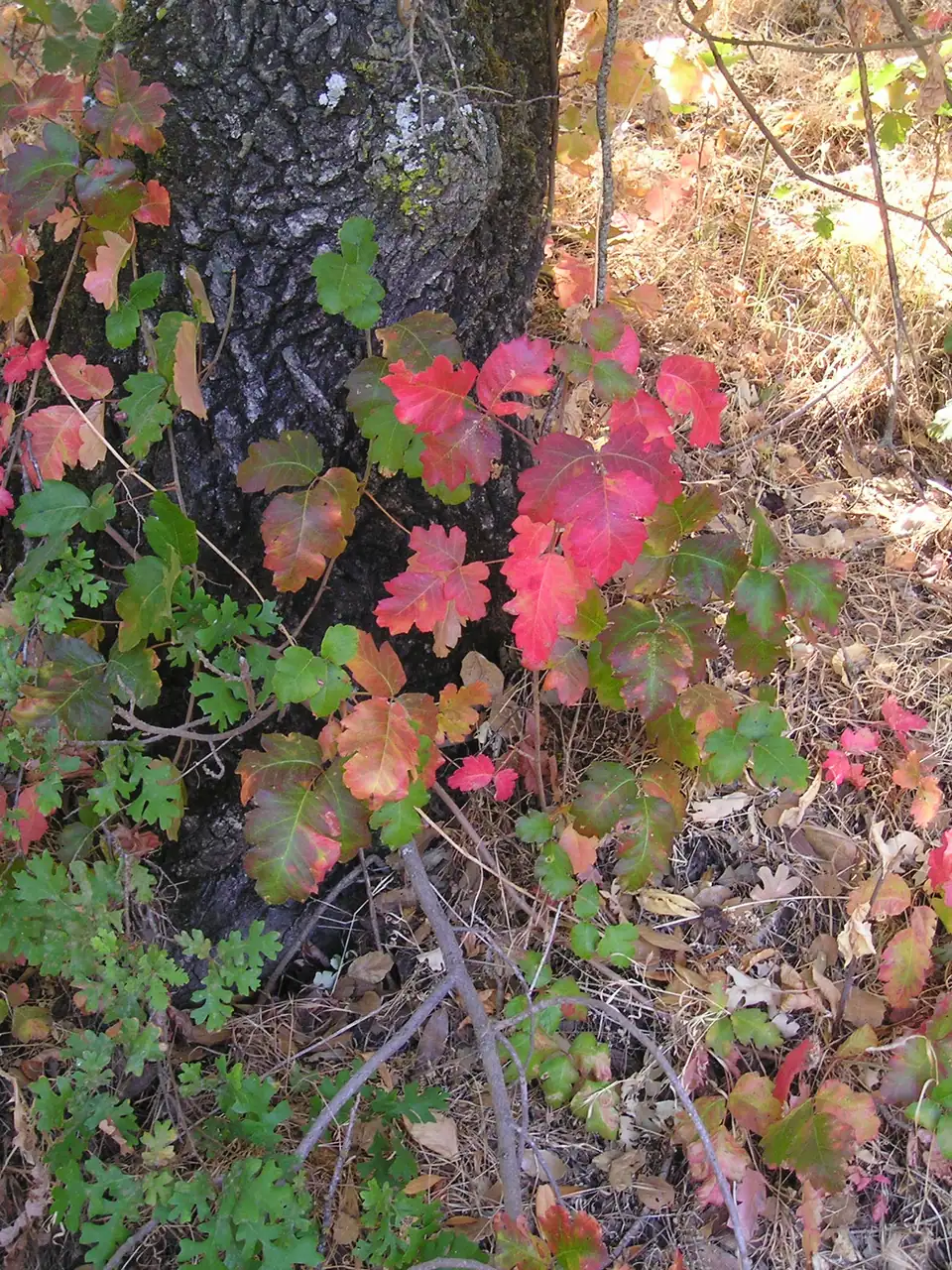
El roble venenoso del Pacífico es una planta adaptable que crece tanto a pleno sol como a la sombra, como arbusto de 0,9 a 3 m o como trepadora capaz de superar los 30 m. Los pájaros comen sus bayas sin sufrir ningún daño. Pero trátala con respeto: su aceite provoca en la mayoría de las personas irritaciones dolorosas con ampollas, así que manipúlala siempre con equipo de protección.
- Sol
Desde pleno sol hasta sombra
Qué dicen las fuentes (1)
Luz: Pleno sol a sombra
In open areas under full sunlight, poison oak forms a dense, leafy shrub usually 1 to 6 feet high. In shaded areas, such as in coastal redwoods and oak woodlands, it grows as a climbing vine
— Poison Oak / Home and Landscape / UC Statewide IPM Program (UC IPM) [2] - Cosecha
Las semillas se recogen a finales de verano
Qué dicen las fuentes (1)
Cosecha: Las semillas se recolectan a fines del verano
Propagule Collection: Collect seeds in late summer.
— Plant Propagation Protocol for Toxicodendron diversilobum [7] - Atención
Arráncala solo con la tierra bien mojada: las raíces que se rompen en suelo seco rebrotan con fuerza
- Tamaño
De 0,9 a 3 m como arbusto; como trepadora puede superar los 30 m
Qué dicen las fuentes (3)
Altura adulta: 91-305 cm (3-10 pies) como arbusto; la forma de enredadera puede superar los 3050 cm (100 pies)
Poisonoak has two distinct forms: an erect shrub, 3 to 10 feet tall, and a climbing vine.
— Virginia Tech Dendrology Fact Sheet [8] Both species grow as shrubs reaching 3 to 10 feet tall in height (Figure 1).
— Pacific poison-oak and western poison-ivy: Identification and management | OSU Extension Service [1] Pacific poison-oak can also grow as a ground vine (Figure 2) or as a woody vine that can coil into and around trees and larger shrubs for over 100 feet
— Pacific poison-oak and western poison-ivy: Identification and management | OSU Extension Service [1] - Multiplicación
Por semilla o por sus tallos subterráneos que se extienden
Qué dicen las fuentes (3)
Propagación: Semilla; rizomas
Both species reproduce by seed and by underground rhizomes.
— Pacific poison-oak and western poison-ivy: Identification and management | OSU Extension Service [1] Plants reproduce by seeds and creeping root systems.
— Weeds: Poison ivy and Poison oak | Hortsense | Washington State University [3] PROPAGATION DETAILS Ecotype: n/a Propagation Goal: Plants Propagation Method: Seed
— Plant Propagation Protocol for Toxicodendron diversilobum [7] - Seguridad
Provoca irritación dolorosa con ampollas en el 85% de las personas y su humo daña los pulmones; usa protección
Resumen
El roble venenoso del Pacífico es un arbusto leñoso caducifolio o una enredadera trepadora originaria del oeste de América del Norte que crece en bosques, chaparral y suelo perturbado. [4][2] Su aceite, la urushiol, causa dermatitis alérgica por contacto en muchas personas. [1][2] Se reproduce por semilla y por raíces rastreras, y las plantas arrancadas vuelven a brotar de los fragmentos de raíz que quedan en el suelo. [3][1]
Citado en inglés, como en la fuente.
Esta ficha está incompleta: las fuentes consultadas aún no cubren todos los campos.
Aún no cubierto por nuestras fuentes: Rusticidad, zona más fría, Rusticidad, zona más cálida
Cuidados
Luz
Pleno sol a sombra
Qué dicen las fuentes (1)
In open areas under full sunlight, poison oak forms a dense, leafy shrub usually 1 to 6 feet high. In shaded areas, such as in coastal redwoods and oak woodlands, it grows as a climbing vineClima y frío
Rusticidad, zona más fría
No figura en las fuentes consultadas.
Rusticidad, zona más cálida
No figura en las fuentes consultadas.
Propagación
Semilla; rizomas
Qué dicen las fuentes (3)
Both species reproduce by seed and by underground rhizomes.Plants reproduce by seeds and creeping root systems.PROPAGATION DETAILS Ecotype: n/a Propagation Goal: Plants Propagation Method: SeedCultivo
La planta
Ciclo de vida
perenne
Qué dicen las fuentes (1)
Poison oak is a long lived woody perennial plant.Familia
Anacardiaceae
Qué dicen las fuentes (1)
is one of several members of the sumac or cashew plant family (Anacardiaceae) that are native to North America and are known to cause contact dermatitis.Altura adulta
91-305 cm (3-10 pies) como arbusto; la forma de enredadera puede superar los 3050 cm (100 pies)
Qué dicen las fuentes (3)
Poisonoak has two distinct forms: an erect shrub, 3 to 10 feet tall, and a climbing vine.Both species grow as shrubs reaching 3 to 10 feet tall in height (Figure 1).Pacific poison-oak can also grow as a ground vine (Figure 2) or as a woody vine that can coil into and around trees and larger shrubs for over 100 feetProblemas
Rebrote después de la eliminación
Síntoma: Las raíces se rompen en el suelo cuando las plantas se arrancan en suelo seco y duro, y los fragmentos brotan vigorosamente
Qué hacer: Las raíces se pueden quitar con mayor facilidad cuando el suelo está completamente mojado
Qué dicen las fuentes (2)
Grubbing or pulling when the soil is dry and hard is almost futile because roots break off in the ground, leaving large pieces that can sprout vigorously later.
— Pacific poison-oak and western poison-ivy: Identification and management | OSU Extension Service [1] Roots can be removed most easily when the soil is thoroughly wet.
— Pacific poison-oak and western poison-ivy: Identification and management | OSU Extension Service [1]
Remedios
Cada remedio indica qué dicen las fuentes oficiales; los remedios tradicionales sin fuente oficial aparecen marcados. Los perjudiciales están para que sepas evitarlos.
Primeros auxilios
Primeros auxilios: no sustituyen al médico
erupción por urushiol
Lava la piel con agua y jabón. Fuente oficial, sin prueba independiente
Seek medical advice through your physician’s office or poison control center, especially if large areas of the skin are exposed, smoke from burning plants is inhaled, or children or other vulnerable populations are involved.
— Pacific poison-oak and western poison-ivy: Identification and management | OSU Extension Service [1] Take care when using home remedies to manage symptoms—many of these techniques have not been proven effective and may worsen the problem.
— Pacific poison-oak and western poison-ivy: Identification and management | OSU Extension Service [1] Cómo: Lava la piel con jabón y agua lo antes posible después de la exposición, cuidando de no extender el aceite a las zonas no expuestas.
Wash your skin with soap and water as soon as possible after exposure. Take care to avoid spreading the oil to new, unexposed areas of your skin.
— Pacific poison-oak and western poison-ivy: Identification and management | OSU Extension Service [1] compresas húmedas o remojo en agua fría Fuente oficial, sin prueba independiente
the rash covers a large portion of the body or is on the face or genitals
— childrensmn.org [9] Take care when using home remedies to manage symptoms—many of these techniques have not been proven effective and may worsen the problem.
— Pacific poison-oak and western poison-ivy: Identification and management | OSU Extension Service [1] Cómo: Usa compresas húmedas o remoja en agua fría para aliviar la picazón.
Relieve the itch by: - Using wet compresses or soaking in cool water.
— Poison Oak / Home and Landscape / UC Statewide IPM Program (UC IPM) [2] avena coloidal o bicarbonato de sodio Fuente oficial, sin prueba independiente
the rash is getting worse despite home treatment
— childrensmn.org [9] Take care when using home remedies to manage symptoms—many of these techniques have not been proven effective and may worsen the problem.
— Pacific poison-oak and western poison-ivy: Identification and management | OSU Extension Service [1] Cómo: Los protectores como el bicarbonato de sodio o la avena coloidal alivian la irritación y el picor leves.
Protectants such as baking soda or colloidal oatmeal relieve minor irritation and itching.
— Poison Oak / Home and Landscape / UC Statewide IPM Program (UC IPM) [2]
Cómo eliminarla
plantas de poison oak
Desentierra las raíces cuando el suelo esté húmedo. Funciona
Persons who are sensitive to urushiol probably should not attempt hand methods of control.
— Pacific poison-oak and western poison-ivy: Identification and management | OSU Extension Service [1] Detached and dried brush can still cause dermatitis, so bury or stack the plant material in an out-of-the-way location or take it to a disposal site.
— Poison Oak / Home and Landscape / UC Statewide IPM Program (UC IPM) [2] Cómo: Desentierra las raíces o arráncalas a mano; las raíces salen con mayor facilidad cuando el suelo está completamente húmedo; usa guantes de vinilo y ropa protectora.
Roots can be removed most easily when the soil is thoroughly wet. Grubbing or pulling when the soil is dry and hard is almost futile because roots break off in the ground, leaving large pieces that can sprout vigorously later.
— Pacific poison-oak and western poison-ivy: Identification and management | OSU Extension Service [1] Qué dicen las pruebas DIGGING OUT POISON OAK WITH HAND TOOLS When handling poison oak use gloves and protective clothing. Dig out individual plants and small patches. Remove the roots. | Does it work? | Effective |
— Poison oak | solvepest [4] pastoreo de cabras y ovejas Funciona en parte
Goats will eat desirable vegetation as well as poison oak.
— Poison oak | solvepest [4] Urushiol may be transferred from animals grazing in or moving through Pacific poison-oak or Western poison-ivy to people who handle these animals.
— Pacific poison-oak and western poison-ivy: Identification and management | OSU Extension Service [1] Cómo: Las cabras y las ovejas pastan la planta; el pastoreo debe continuar intensamente durante varios años.
Goats and sheep are used by land managers to control poison oak.
— Poison oak | solvepest [4] Qué dicen las pruebas grazing will not eliminate these weeds or stop their spread unless it continues intensively for several years.
— Pacific poison-oak and western poison-ivy: Identification and management | OSU Extension Service [1] quemado Perjudicial
Cómo: No se recomienda: al quemarla, el aceite pasa al humo.
Avoid burning poison oak, since it creates a serious health hazard and does not effectively reduce infestations.
— Poison Oak / Home and Landscape / UC Statewide IPM Program (UC IPM) [2] Qué dicen las pruebas Inhalation of smoke in close proximity to burning Pacific poison-oak and western poison-ivy has caused allergic reactions in people who were otherwise considered immune.
— Pacific poison-oak and western poison-ivy: Identification and management | OSU Extension Service [1] siega Perjudicial
Cómo: No recomendado: no es efectivo y puede liberar partículas de aceite en el aire.
Mowing is not an effective method for controlling poison oak. Mowing can release oil particles in the air similar to burning, so mowing is not recommended.
— Poison Oak / Home and Landscape / UC Statewide IPM Program (UC IPM) [2] Qué dicen las pruebas Mowing is not an effective method for controlling poison oak. Mowing can release oil particles in the air similar to burning, so mowing is not recommended.
— Poison Oak / Home and Landscape / UC Statewide IPM Program (UC IPM) [2]
Venenosa para los animales
Según la fuente, citada textualmente. No es un consejo médico ni veterinario: si una persona o un animal pudo haber ingerido esta planta, contacta con un centro de toxicología o con un veterinario.
Animales
Urushiol does not appear to cause serious allergic reactions in cats or dogs.
[2]La fuente señala el riesgo para este animal pero no explica por qué.
while birds and other animals forage on berries without adverse effects.
[2]La fuente señala el riesgo para este animal pero no explica por qué.
Personas
Exposure to urushiol can cause an allergic contact dermatitis reaction that includes painful irritation and blistering of the skin and, if inhaled in smoke, the lungs.
[1]- Partes venenosas
All parts of Pacific poison-oak and western poison-ivy plants (except the pollen) contain an oily substance, urushiol (pronounced: you-ROO-shee-all), that is present throughout the entire year.
[1]- Principio tóxico
The allergy is caused by the plant oil urushiol (pronounced yoo-ROO-shee-all).
[2]- Síntomas
Exposure to urushiol can cause an allergic contact dermatitis reaction that includes painful irritation and blistering of the skin and, if inhaled in smoke, the lungs.
[1]- Gravedad
Adults & Children High Causes skin irritation and rash
[4]
Other Comments: Highly toxic to 85% of all humans, handle with care and use proper equipment.
[7]- Partes venenosas
Flower: Inconspicuous, small and yellow-green, borne in long-stem, hanging clusters, appearing in spring. TOXIC.
[8]
Calendario
Cosecha
Las semillas se recolectan a fines del verano
Qué dicen las fuentes (1)
Propagule Collection: Collect seeds in late summer.Meses tal como los dan las fuentes, en su mayoría de Estados Unidos (hemisferio norte). En el hemisferio sur se desplazan unos seis meses.
Valores orientativos
Valores de una fuente secundaria, no comprobados palabra por palabra como el resto de esta página. Úselos como punto de partida.
- Riego
- PromedioValor orientativo, adáptalo a tu clima · Fuente secundaria
- pH del suelo
- 4-6.5Valor orientativo, adáptalo a tu clima · Fuente secundaria
- Zonas de rusticidad USDA
- 5-9 [mínima invernal de −28,9 a −1,1 °C (de −20 a 30 °F)]Valor orientativo, adáptalo a tu clima · Fuente secundaria
- Nivel de cuidado
- MedioValor orientativo, adáptalo a tu clima · Fuente secundaria
- Crecimiento
- AltaValor orientativo, adáptalo a tu clima · Fuente secundaria
- Poda
- Marzo, abrilValor orientativo, adáptalo a tu clima · Fuente secundaria
Plantas similares
- Roble venenoso Toxicodendron pubescens
- Zumaque venenoso Toxicodendron vernix
- Hiedra venenosa Toxicodendron radicans
- Aguaribay Schinus molle
- Pistacho chino Pistacia chinensis
- Rus Rhus coriaria
- Winged Sumac Rhus copallinum
- Brazilian peppertree Schinus terebinthifolius
Fuentes
Cada valor anterior se cita de estos documentos. Los enlaces llevan al editor original.
- Pacific poison-oak and western poison-ivy: Identification and management | OSU Extension Service · extension.oregonstate.edu, consultado
- Poison Oak / Home and Landscape / UC Statewide IPM Program (UC IPM) · ipm.ucanr.edu, consultado
- Weeds: Poison ivy and Poison oak | Hortsense | Washington State University · hortsense.cahnrs.wsu.edu, consultado
- Poison oak | solvepest · solvepestproblems.oregonstate.edu, consultado
- Poison Oak - CSU Channel Islands · nativeplants.csuci.edu, consultado
- Propagation protocol for poison oak (Toxicodendron diversilobum — Reforestation, Nurseries and Genetics Resources · npn.rngr.net, consultado
- Plant Propagation Protocol for Toxicodendron diversilobum · courses.washington.edu, consultado
- Virginia Tech Dendrology Fact Sheet · dendro.cnre.vt.edu, consultado
- childrensmn.org · childrensmn.org
Escrito por Emilio Marruso · última revisión