
How to Grow and Care for Poison oak
Toxicodendron diversilobum
Written by Emilio Marruso · last checked
Toxic to: Cats, Dogs, Birds, People · Why
At a glance
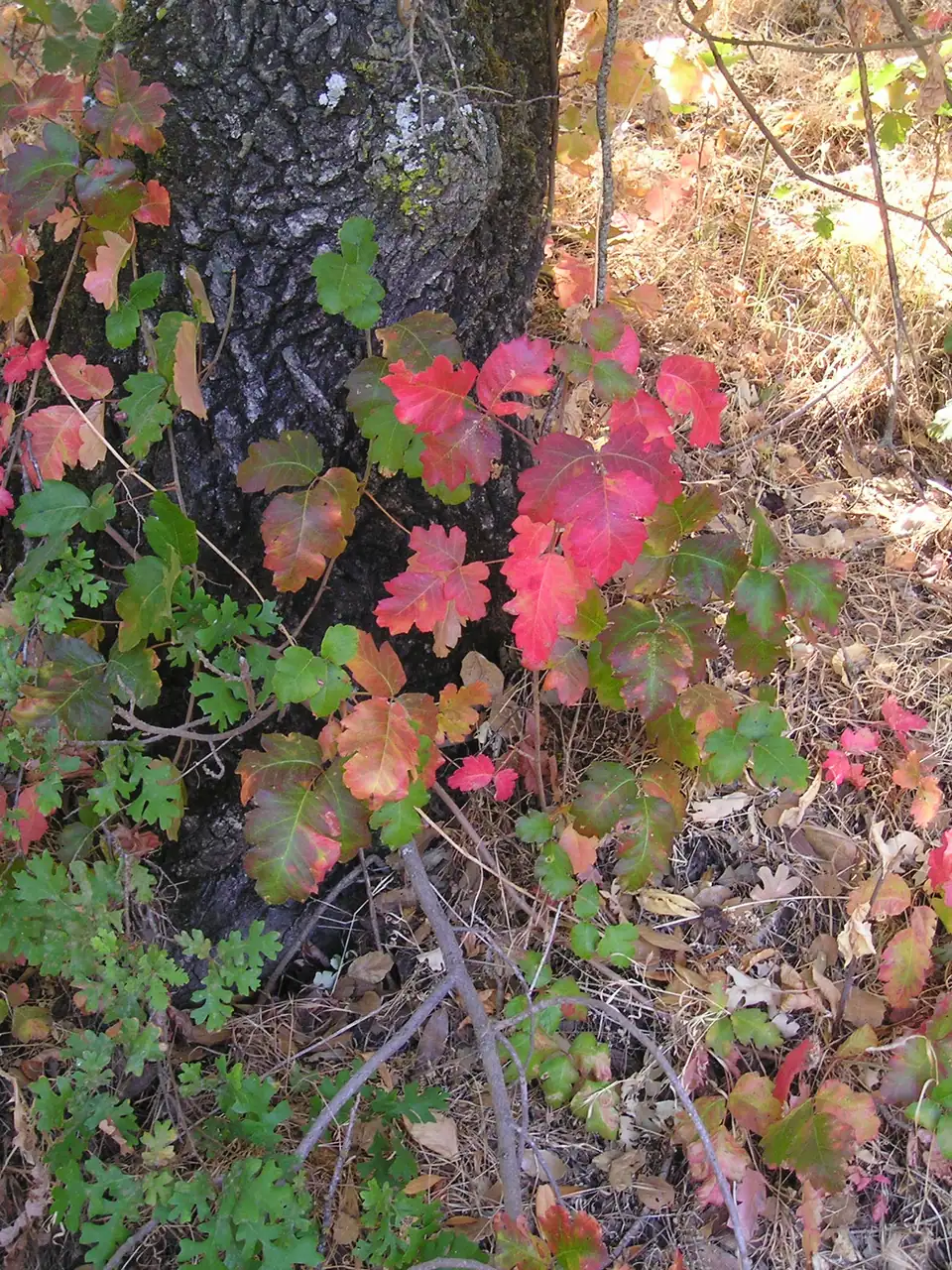
Pacific poison oak is an adaptable plant that grows anywhere from full sun to shade, as a shrub 3 to 10 feet tall or as a vine that can climb past 100 feet. Birds feast on its berries without harm. But treat it with respect: its oil causes painful, blistering rashes in most people, so always handle it with protective gear.
- Sun
Anywhere from full sun to shade
What the sources say (1)
Light: Full sun to shade
In open areas under full sunlight, poison oak forms a dense, leafy shrub usually 1 to 6 feet high. In shaded areas, such as in coastal redwoods and oak woodlands, it grows as a climbing vine
— Poison Oak / Home and Landscape / UC Statewide IPM Program (UC IPM) [2] - Harvest
Seeds are collected in late summer
What the sources say (1)
Harvest: Seeds are collected in late summer
Propagule Collection: Collect seeds in late summer.
— Plant Propagation Protocol for Toxicodendron diversilobum [7] - Watch out
Pull it only when the soil is soaked: roots that break off in dry ground sprout again strongly
- Size
3 to 10 ft tall as a shrub; as a vine it can top 100 ft
What the sources say (3)
Mature height: 91-305 cm (3-10 ft) as a shrub; the vine form can exceed 3050 cm (100 ft)
Poisonoak has two distinct forms: an erect shrub, 3 to 10 feet tall, and a climbing vine.
— Virginia Tech Dendrology Fact Sheet [8] Both species grow as shrubs reaching 3 to 10 feet tall in height (Figure 1).
— Pacific poison-oak and western poison-ivy: Identification and management | OSU Extension Service [1] Pacific poison-oak can also grow as a ground vine (Figure 2) or as a woody vine that can coil into and around trees and larger shrubs for over 100 feet
— Pacific poison-oak and western poison-ivy: Identification and management | OSU Extension Service [1] - Propagation
By seed or by its spreading underground stems
What the sources say (3)
Propagation: Seed; rhizomes
Both species reproduce by seed and by underground rhizomes.
— Pacific poison-oak and western poison-ivy: Identification and management | OSU Extension Service [1] Plants reproduce by seeds and creeping root systems.
— Weeds: Poison ivy and Poison oak | Hortsense | Washington State University [3] PROPAGATION DETAILS Ecotype: n/a Propagation Goal: Plants Propagation Method: Seed
— Plant Propagation Protocol for Toxicodendron diversilobum [7] - Safety
Causes painful, blistering rashes in 85% of people and its smoke harms the lungs; wear protective gear
Overview
Pacific poison oak is a deciduous woody shrub or climbing vine native to western North America that grows in woodlands, chaparral and disturbed ground. [4][2] Its oil, urushiol, causes allergic contact dermatitis in many people. [1][2] It reproduces by seed and by creeping roots, and pulled plants resprout from root pieces left in the ground. [3][1]
This record is incomplete: the sources we read do not cover every field yet.
Not yet covered by our sources: Hardiness, coldest zone, Hardiness, warmest zone
Poison oak care
How much light Poison oak needs
Full sun to shade
What the sources say (1)
In open areas under full sunlight, poison oak forms a dense, leafy shrub usually 1 to 6 feet high. In shaded areas, such as in coastal redwoods and oak woodlands, it grows as a climbing vineHow much cold Poison oak can take
Hardiness, coldest zone
Not stated in the sources we read.
Hardiness, warmest zone
Not stated in the sources we read.
How to propagate Poison oak
Seed; rhizomes
What the sources say (3)
Both species reproduce by seed and by underground rhizomes.Plants reproduce by seeds and creeping root systems.PROPAGATION DETAILS Ecotype: n/a Propagation Goal: Plants Propagation Method: SeedHow to grow Poison oak
The plant
Life cycle
perennial
What the sources say (1)
Poison oak is a long lived woody perennial plant.Family
Anacardiaceae
What the sources say (1)
is one of several members of the sumac or cashew plant family (Anacardiaceae) that are native to North America and are known to cause contact dermatitis.Mature height
91-305 cm (3-10 ft) as a shrub; the vine form can exceed 3050 cm (100 ft)
What the sources say (3)
Poisonoak has two distinct forms: an erect shrub, 3 to 10 feet tall, and a climbing vine.Both species grow as shrubs reaching 3 to 10 feet tall in height (Figure 1).Pacific poison-oak can also grow as a ground vine (Figure 2) or as a woody vine that can coil into and around trees and larger shrubs for over 100 feetPoison oak pests and problems
Resprouting after removal
Symptom: Roots break off in the ground when plants are pulled in dry, hard soil, and the pieces sprout vigorously
What to do: Roots can be removed most easily when the soil is thoroughly wet
What the sources say (2)
Grubbing or pulling when the soil is dry and hard is almost futile because roots break off in the ground, leaving large pieces that can sprout vigorously later.
— Pacific poison-oak and western poison-ivy: Identification and management | OSU Extension Service [1] Roots can be removed most easily when the soil is thoroughly wet.
— Pacific poison-oak and western poison-ivy: Identification and management | OSU Extension Service [1]
Remedies
Each remedy shows what official sources say about it; traditional remedies without an official source are marked as such. Harmful ones are listed so you know to avoid them.
First aid
First aid: not a substitute for a doctor
urushiol rash
washing skin with soap and water Official source, not independently tested
Seek medical advice through your physician’s office or poison control center, especially if large areas of the skin are exposed, smoke from burning plants is inhaled, or children or other vulnerable populations are involved.
— Pacific poison-oak and western poison-ivy: Identification and management | OSU Extension Service [1] Take care when using home remedies to manage symptoms—many of these techniques have not been proven effective and may worsen the problem.
— Pacific poison-oak and western poison-ivy: Identification and management | OSU Extension Service [1] How: Wash the skin with soap and water as soon as possible after exposure, taking care not to spread the oil to unexposed areas.
Wash your skin with soap and water as soon as possible after exposure. Take care to avoid spreading the oil to new, unexposed areas of your skin.
— Pacific poison-oak and western poison-ivy: Identification and management | OSU Extension Service [1] wet compresses or cool water soak Official source, not independently tested
the rash covers a large portion of the body or is on the face or genitals
— childrensmn.org [9] Take care when using home remedies to manage symptoms—many of these techniques have not been proven effective and may worsen the problem.
— Pacific poison-oak and western poison-ivy: Identification and management | OSU Extension Service [1] How: Use wet compresses or soak in cool water to relieve the itch.
Relieve the itch by: - Using wet compresses or soaking in cool water.
— Poison Oak / Home and Landscape / UC Statewide IPM Program (UC IPM) [2] colloidal oatmeal or baking soda Official source, not independently tested
the rash is getting worse despite home treatment
— childrensmn.org [9] Take care when using home remedies to manage symptoms—many of these techniques have not been proven effective and may worsen the problem.
— Pacific poison-oak and western poison-ivy: Identification and management | OSU Extension Service [1] How: Protectants such as baking soda or colloidal oatmeal relieve minor irritation and itching.
Protectants such as baking soda or colloidal oatmeal relieve minor irritation and itching.
— Poison Oak / Home and Landscape / UC Statewide IPM Program (UC IPM) [2]
Getting rid of it
poison oak plants
digging out roots when the soil is wet Works
Persons who are sensitive to urushiol probably should not attempt hand methods of control.
— Pacific poison-oak and western poison-ivy: Identification and management | OSU Extension Service [1] Detached and dried brush can still cause dermatitis, so bury or stack the plant material in an out-of-the-way location or take it to a disposal site.
— Poison Oak / Home and Landscape / UC Statewide IPM Program (UC IPM) [2] How: Dig out the roots or hand pull; roots come out most easily when the soil is thoroughly wet; wear vinyl gloves and protective clothing.
Roots can be removed most easily when the soil is thoroughly wet. Grubbing or pulling when the soil is dry and hard is almost futile because roots break off in the ground, leaving large pieces that can sprout vigorously later.
— Pacific poison-oak and western poison-ivy: Identification and management | OSU Extension Service [1] What the evidence says DIGGING OUT POISON OAK WITH HAND TOOLS When handling poison oak use gloves and protective clothing. Dig out individual plants and small patches. Remove the roots. | Does it work? | Effective |
— Poison oak | solvepest [4] grazing by goats and sheep Partly works
Goats will eat desirable vegetation as well as poison oak.
— Poison oak | solvepest [4] Urushiol may be transferred from animals grazing in or moving through Pacific poison-oak or Western poison-ivy to people who handle these animals.
— Pacific poison-oak and western poison-ivy: Identification and management | OSU Extension Service [1] How: Goats and sheep graze the plant; grazing must continue intensively for several years.
Goats and sheep are used by land managers to control poison oak.
— Poison oak | solvepest [4] What the evidence says grazing will not eliminate these weeds or stop their spread unless it continues intensively for several years.
— Pacific poison-oak and western poison-ivy: Identification and management | OSU Extension Service [1] burning Harmful
How: Not advised: burning releases the oil in the smoke.
Avoid burning poison oak, since it creates a serious health hazard and does not effectively reduce infestations.
— Poison Oak / Home and Landscape / UC Statewide IPM Program (UC IPM) [2] What the evidence says Inhalation of smoke in close proximity to burning Pacific poison-oak and western poison-ivy has caused allergic reactions in people who were otherwise considered immune.
— Pacific poison-oak and western poison-ivy: Identification and management | OSU Extension Service [1] mowing Harmful
How: Not advised: it is not effective and can release oil particles in the air.
Mowing is not an effective method for controlling poison oak. Mowing can release oil particles in the air similar to burning, so mowing is not recommended.
— Poison Oak / Home and Landscape / UC Statewide IPM Program (UC IPM) [2] What the evidence says Mowing is not an effective method for controlling poison oak. Mowing can release oil particles in the air similar to burning, so mowing is not recommended.
— Poison Oak / Home and Landscape / UC Statewide IPM Program (UC IPM) [2]
Is Poison oak toxic to pets?
Reported by the source, quoted verbatim. This is not medical or veterinary advice: if a person or an animal may have eaten this plant, contact a poison control centre or a veterinarian.
Animals
Urushiol does not appear to cause serious allergic reactions in cats or dogs.
[2]The source flags the risk for this animal but does not explain why.
while birds and other animals forage on berries without adverse effects.
[2]The source flags the risk for this animal but does not explain why.
People
Exposure to urushiol can cause an allergic contact dermatitis reaction that includes painful irritation and blistering of the skin and, if inhaled in smoke, the lungs.
[1]- Poisonous parts
All parts of Pacific poison-oak and western poison-ivy plants (except the pollen) contain an oily substance, urushiol (pronounced: you-ROO-shee-all), that is present throughout the entire year.
[1]- Toxic principle
The allergy is caused by the plant oil urushiol (pronounced yoo-ROO-shee-all).
[2]- Symptoms
Exposure to urushiol can cause an allergic contact dermatitis reaction that includes painful irritation and blistering of the skin and, if inhaled in smoke, the lungs.
[1]- Severity
Adults & Children High Causes skin irritation and rash
[4]
Other Comments: Highly toxic to 85% of all humans, handle with care and use proper equipment.
[7]- Poisonous parts
Flower: Inconspicuous, small and yellow-green, borne in long-stem, hanging clusters, appearing in spring. TOXIC.
[8]
Calendar
Harvest
Seeds are collected in late summer
What the sources say (1)
Propagule Collection: Collect seeds in late summer.Months as given by the sources, which are mostly from the United States (northern hemisphere). In the southern hemisphere they shift by about six months.
Indicative values
Values from a secondary source, not checked word for word like the rest of this page. Use them as a starting point.
- Watering
- AverageIndicative value, adapt it to your climate · Secondary source
- Soil pH
- 4-6.5Indicative value, adapt it to your climate · Secondary source
- USDA hardiness zones
- 5-9 [winter low −28.9 to −1.1 °C (−20 to 30 °F)]Indicative value, adapt it to your climate · Secondary source
- Care level
- MediumIndicative value, adapt it to your climate · Secondary source
- Growth rate
- HighIndicative value, adapt it to your climate · Secondary source
- Pruning
- March, AprilIndicative value, adapt it to your climate · Secondary source
Similar plants
- Poison Oak Toxicodendron pubescens
- Poison Sumac Toxicodendron vernix
- Poison Ivy Toxicodendron radicans
- American pepper Schinus molle
- Chinese Pistache Pistacia chinensis
- Sicilian sumac Rhus coriaria
- Winged Sumac Rhus copallinum
- Brazilian peppertree Schinus terebinthifolius
Sources
Every value above is quoted from these documents. Links lead to the original publisher.
- Pacific poison-oak and western poison-ivy: Identification and management | OSU Extension Service · extension.oregonstate.edu, consulted
- Poison Oak / Home and Landscape / UC Statewide IPM Program (UC IPM) · ipm.ucanr.edu, consulted
- Weeds: Poison ivy and Poison oak | Hortsense | Washington State University · hortsense.cahnrs.wsu.edu, consulted
- Poison oak | solvepest · solvepestproblems.oregonstate.edu, consulted
- Poison Oak - CSU Channel Islands · nativeplants.csuci.edu, consulted
- Propagation protocol for poison oak (Toxicodendron diversilobum — Reforestation, Nurseries and Genetics Resources · npn.rngr.net, consulted
- Plant Propagation Protocol for Toxicodendron diversilobum · courses.washington.edu, consulted
- Virginia Tech Dendrology Fact Sheet · dendro.cnre.vt.edu, consulted
- childrensmn.org · childrensmn.org
Written by Emilio Marruso · last checked