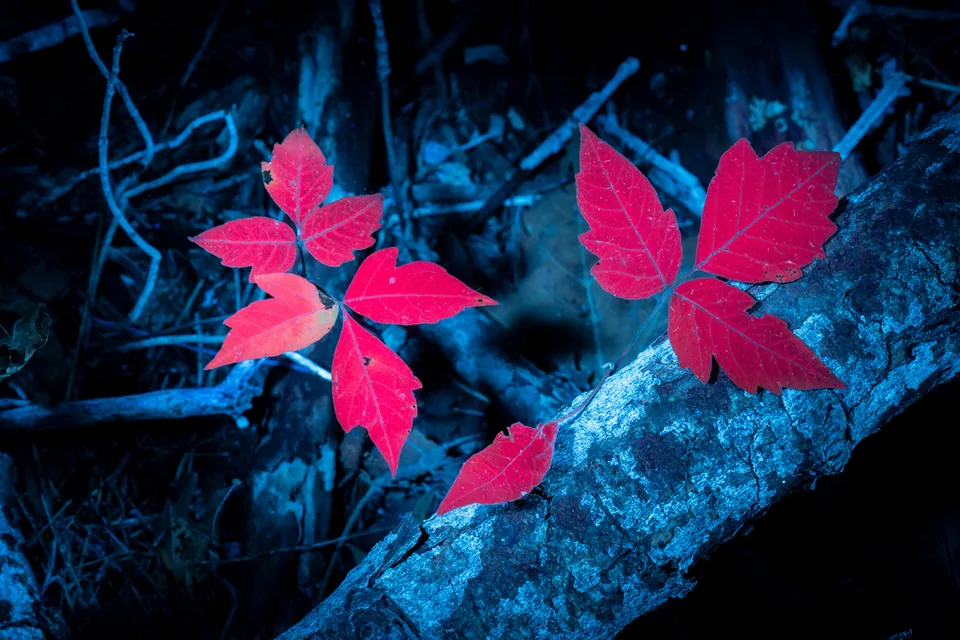
How to Grow and Care for Poison Ivy
Toxicodendron radicans
Written by Emilio Marruso · last checked
Toxic to: People · Why
At a glance
Poison ivy is a tough member of the cashew family that grows in full sun, partial shade or dappled light, and its fruits are a feast for songbirds and woodpeckers. But every part holds an oil that causes severe, long-lasting skin rashes, so admire it from a distance, wear gloves, long sleeves and long pants near it, and never burn it.
- Sun
Full sun, partial shade or dappled light
What the sources say (5)
Light: Full sun, partial shade or dappled sunlight
According to NC State Extension: Dappled Sunlight (Shade through upper canopy all day) Full sun (6 or more hours of direct sunlight a day) Partial Shade (Direct sunlight only part of the day, 2-6 hours)
— Toxicodendron radicans (Eastern Poison Ivy, Poison Ivy, Poison Oak) | North Carolina Extension Gardener Plant Toolbox [1] shrub form: Shrub forms typically develop when grown in full sun.
— Poison Ivy | University of Maryland Extension [5] Dappled Sunlight (Shade through upper canopy all day) Full sun (6 or more hours of direct sunlight a day)
— Toxicodendron radicans (Eastern Poison Ivy, Poison Ivy, Poison Oak) | North Carolina Extension Gardener Plant Toolbox [1] Full sun (6 or more hours of direct sunlight a day) Partial Shade (Direct sunlight only part of the day, 2-6 hours)
— Toxicodendron radicans (Eastern Poison Ivy, Poison Ivy, Poison Oak) | North Carolina Extension Gardener Plant Toolbox [1] In some cases, it also can grow as an upright shrub without support. Shrub forms typically develop when grown in full sun.
— Poison Ivy | University of Maryland Extension [5] - Cold
Survives winters down to −30 °F (−34.4 °C)
Very hardy · USDA 4a · RHS H7 · Z4
What the sources say (2)
Hardiness, coldest zone: 4a [winter low −34.4 to −31.7 °C (−30 to −25 °F)]
4a, 4b, 5a, 5b, 6a, 6b, 7a, 7b, 8a, 8b, 9a, 9b, 10a, 10b
— Toxicodendron radicans (Eastern Poison Ivy, Poison Ivy, Poison Oak) | North Carolina Extension Gardener Plant Toolbox [1] Hardiness, warmest zone: 10b [winter low 1.7 to 4.4 °C (35 to 40 °F)]
4a, 4b, 5a, 5b, 6a, 6b, 7a, 7b, 8a, 8b, 9a, 9b, 10a, 10b
— Toxicodendron radicans (Eastern Poison Ivy, Poison Ivy, Poison Oak) | North Carolina Extension Gardener Plant Toolbox [1] - Harvest
Not for people: its fruits feed songbirds and woodpeckers
- Watch out
Spreads and is hard to remove: roots left behind keep sprouting new plants
- Size
Shrub up to 6 ft; as a vine it climbs 60 to 150 ft
What the sources say (2)
Mature height: shrub form up to 183 cm (6 ft); vine form 18-46 m (60 to 150 ft)
When it grows as a woody shrub, it can reach lengths of 6 feet; when it grows as a vine, it can reach 60 to 150 feet tall and climb high on trees, walls, and fences or trail along the ground.
— Toxicodendron radicans (Eastern Poison Ivy, Poison Ivy, Poison Oak) | North Carolina Extension Gardener Plant Toolbox [1] Mature width: 30-305 cm (1 to 10 ft)
Width: 1 ft. 0 in. - 10 ft. 0 in.
— Toxicodendron radicans (Eastern Poison Ivy, Poison Ivy, Poison Oak) | North Carolina Extension Gardener Plant Toolbox [1] - Propagation
Spreads by seed and by underground stems
What the sources say (1)
Propagation: Seeds; underground rhizomes
Poison ivy grows fairly quickly and propagates itself by underground rhizomes and seeds. Seeds are quickly spread by birds and other animals that eat the small fruits.
— How to Identify and Control Poison Ivy (Toxicodendron radicans) | Home & Garden Information Center [6] - Safety
Every part causes painful skin rashes; never burn it, the smoke is dangerous to breathe
Overview
Eastern poison ivy is a woody perennial vine or small shrub native to North America. [6] All parts of the plant contain urushiol, an oil that causes allergic skin reactions. [6] Smoke from burning the plant can be as toxic as touching it. [1]
This record is incomplete: the sources we read do not cover every field yet.
Not yet covered by our sources: Watering, Pruning
Poison Ivy care
How to water Poison Ivy
Not stated in the sources we read.
How much light Poison Ivy needs
Full sun, partial shade or dappled sunlight
What each source says
According to NC State Extension: Full sun, partial shade or dappled sunlight
shrub form: Full sun
What the sources say (5)
According to NC State Extension: Dappled Sunlight (Shade through upper canopy all day)
Full sun (6 or more hours of direct sunlight a day)
Partial Shade (Direct sunlight only part of the day, 2-6 hours)shrub form: Shrub forms typically develop when grown in full sun.Dappled Sunlight (Shade through upper canopy all day)
Full sun (6 or more hours of direct sunlight a day)Full sun (6 or more hours of direct sunlight a day)
Partial Shade (Direct sunlight only part of the day, 2-6 hours)In some cases, it also can grow as an upright shrub without support. Shrub forms typically develop when grown in full sun.How much cold Poison Ivy can take
Hardiness, coldest zone
4a [winter low −34.4 to −31.7 °C (−30 to −25 °F)]
What the sources say (1)
4a, 4b, 5a, 5b, 6a, 6b, 7a, 7b, 8a, 8b, 9a, 9b, 10a, 10bHardiness, warmest zone
10b [winter low 1.7 to 4.4 °C (35 to 40 °F)]
What the sources say (1)
4a, 4b, 5a, 5b, 6a, 6b, 7a, 7b, 8a, 8b, 9a, 9b, 10a, 10bHow to propagate Poison Ivy
Seeds; underground rhizomes
What the sources say (1)
Poison ivy grows fairly quickly and propagates itself by underground rhizomes and seeds. Seeds are quickly spread by birds and other animals that eat the small fruits.How to grow Poison Ivy
The plant
Life cycle
perennial
What the sources say (2)
Eastern poison ivy ( Toxicodendron radicans ) is a woody, perennial vine or small shrub that can be found in fields, pastures, woodlands, farms, and home landscapes.Begins as an herbaceous perennial and becomes a woody vine. Can also be shrub-like.Family
cashew family
What the sources say (1)
Poison ivy ( Toxicodendron radicans ) is an allergenic plant of the cashew family native to North America.Mature height
shrub form up to 183 cm (6 ft); vine form 18-46 m (60 to 150 ft)
What the sources say (1)
When it grows as a woody shrub, it can reach lengths of 6 feet; when it grows as a vine, it can reach 60 to 150 feet tall and climb high on trees, walls, and fences or trail along the ground.Mature width
30-305 cm (1 to 10 ft)
What the sources say (1)
Width: 1 ft. 0 in. - 10 ft. 0 in.Poison Ivy pests and problems
Allergic contact dermatitis
Symptom: Red, swollen skin, blisters and severe itching within hours of contact; a linear rash appears within 12 to 48 hours in sensitive people
What to do: Washing with running water is recommended; wear long sleeves, long pants and gloves when working around the plant
What the sources say (2)
Touching any part of the poison ivy plant can result in red, swollen skin, blisters, and severe itching within hours of contact.
— Toxicodendron radicans - MREC - UF/IFAS - University of Florida, Institute of Food and Agricultural Sciences - UF/IFAS [4] Washing with running water is recommended. Using soaps that contain emollients or bath oils, such as complexion soaps, can actually spread the irritating oil
— Poison Ivy | University of Maryland Extension [5] Persistent spreading weed
Symptom: Once established it can be hard to eradicate by hand as the vine and root system keep producing plants unless fully removed
What to do: Hand-pull seedlings while wearing protective clothing; glyphosate is the herbicide most commonly used in the landscape
What the sources say (1)
Hand-pull seedlings while wearing protective clothing. Once established, poison ivy can be hard to eradicate by hand
— Toxicodendron radicans - MREC - UF/IFAS - University of Florida, Institute of Food and Agricultural Sciences - UF/IFAS [4]
Remedies
Each remedy shows what official sources say about it; traditional remedies without an official source are marked as such. Harmful ones are listed so you know to avoid them.
Treating the plant
allergic contact dermatitis
washing with running water Works
Unless the oil is removed from the skin within 10 minutes of exposure, a reaction is inevitable in extremely sensitive individuals.
— How to Identify and Control Poison Ivy (Toxicodendron radicans) | Home & Garden Information Center [6] How: Wash the exposed area with running water as soon as possible; the oil penetrates the skin within about ten minutes.
Washing with running water is recommended.
— Poison Ivy | University of Maryland Extension [5] What the evidence says Washing with running water is recommended.
— How to Identify and Control Poison Ivy (Toxicodendron radicans) | Home & Garden Information Center [6] washing with soap and hot water Partly works
How: Wash the area with soap and hot water using a washcloth, rinse and repeat at least three times.
wash the area thoroughly with soap and hot water, using a washcloth. Rinse and repeat at least three times to make sure the oil is gone.
— farmersalmanac.com [7] What the evidence says Washing with running water is recommended. Using soaps that contain emollients or bath oils, such as complexion soaps, can actually spread the irritating oil and make the rash more widespread.
— Poison Ivy | University of Maryland Extension [5] yellow laundry soap Works
How: Wash the skin as soon as possible with old-fashioned yellow laundry soap; also wash any clothing or equipment that touched the plant.
Old-fashioned yellow laundry soap or rubbing alcohol will remove the oils and should stop the further spread of the rash.
— extension.unh.edu [8] What the evidence says Old-fashioned yellow laundry soap or rubbing alcohol will remove the oils and should stop the further spread of the rash.
— extension.unh.edu [8] rubbing alcohol Works
How: Rubbing alcohol can remove the urushiol oil from the skin and other surfaces; carry alcohol wipes when hiking or camping.
Rubbing alcohol can remove the urushiol oil from the skin and other surfaces.
— medicalnewstoday.com [9] What the evidence says Tip: Rubbing alcohol is a better solvent for the oil than water.
— How to Identify and Control Poison Ivy (Toxicodendron radicans) | Home & Garden Information Center [6] dish soap wash Works
How: Wash with a degreasing dish soap to reduce the effect on the skin.
Specialty soaps (like [nome commerciale]) or even a degreasing dish soap (like [nome commerciale]) may also reduce poison ivy’s effect on your skin.
— health.clevelandclinic.org [10] What the evidence says Thoroughly shower (bathing spreads existing oil) with cool-to-warm water and dish detergent to remove any oil from urushiol-laden plant bits that may have dodged the PPE.
— extension.psu.edu [11] baking soda paste Not verified
Traditional remedy, not verified by an official source.
How: Mix three teaspoons of baking soda with one teaspoon of water to make a paste and apply it to the affected areas; for a rash all over the body, add a half cup of baking soda to a tub of warm water and soak.
oatmeal bath Not verified
Traditional remedy, not verified by an official source.
How: Add oatmeal to a lukewarm bath, or apply colloidal oatmeal to the rash.
cold compress Official source, not independently tested
But don’t get your skin too damp, cautions Dr. Ng.
— health.clevelandclinic.org [10] How: Run a clean washcloth under cold water and lay it on the rash; wash the cloth thoroughly after use so as not to spread urushiol.
A simple cold and wet cloth on a poison ivy rash can help tame its itchiness.
— health.clevelandclinic.org [10] apple cider vinegar Not verified
Traditional remedy, not verified by an official source.
Be prepared, though, because the vinegar might make your skin sting a little when you first apply it.
— akhealth.org [12] How: Dab apple cider vinegar on the rash, several times a day if needed.
aloe vera gel Not verified
Traditional remedy, not verified by an official source.
How: Cut open an aloe leaf and apply the gel to the rash.
Getting rid of it
persistent spreading weed
hand pulling Works
Every part of the poison ivy plant, including its roots and underground spreading rhizomes, should be removed because poison ivy readily regrows from even the smallest bits of root. Never compost or burn this plant material.
— extension.psu.edu [11] Do not burn poison ivy because contact with smoke from the burning materials can be just as toxic as touching the plants.
— Toxicodendron radicans (Eastern Poison Ivy, Poison Ivy, Poison Oak) | North Carolina Extension Gardener Plant Toolbox [1] Individual plants can be hand-pulled with extreme care
— extension.unh.edu [8] How: Hand-pull small plants, especially when plants are small and the soil is moist, wearing long sleeves, long pants and protective gloves; remove every part including roots and rhizomes, and bag the plants for the trash.
Hand-pulling is effective for small infestations, especially when plants are small and the soil is moist. Digging is often more successful because poison ivy develops extensive rhizomes.
— extension.psu.edu [11] What the evidence says Hand-pulling is effective for small infestations, especially when plants are small and the soil is moist. Digging is often more successful because poison ivy develops extensive rhizomes.
— extension.psu.edu [11] digging out the roots Works
Every part of the poison ivy plant, including its roots and underground spreading rhizomes, should be removed because poison ivy readily regrows from even the smallest bits of root. Never compost or burn this plant material.
— extension.psu.edu [11] How: Use a digging fork or shovel to remove roots down to several inches; monitor often, as missed root pieces will produce new shoots. Dig up small plants in light infestations.
Use a digging fork or shovel to remove roots down to several inches. Monitor often, as missed root pieces will produce new shoots.
— extension.psu.edu [11] What the evidence says Digging is often more successful because poison ivy develops extensive rhizomes.
— extension.psu.edu [11] repeated cutting and mowing Partly works
Mowing causes leaf pieces laden with urushiol to spread throughout the area. String-trimmers may produce airborne particles of urushiol-containing sap!
— extension.psu.edu [11] How: Repeatedly cut the plants back to ground level, starting early in spring when the leaves unfold, and cut again whenever new growth appears, inspecting every week or two.
Repeatedly cut the plants back to ground level until they eventually starve.
— How to Identify and Control Poison Ivy (Toxicodendron radicans) | Home & Garden Information Center [6] What the evidence says Cutting and mowing provide only temporary suppression. It takes several growing seasons of careful trimming, but eventually, root reserves may be depleted.
— extension.psu.edu [11] window cut on tree vines Official source, not independently tested
Pulling large vines from tree trunks damages the bark and exposes the worker to significant amounts of urushiol.
— extension.psu.edu [11] How: Cut the vines near ground level and again several inches above the first cut, remove the severed section if possible, and let the upper section die naturally.
For poison ivy vines that have climbed on trees, create a "window cut." Cut the vines near ground level and again several inches above the first cut.
— extension.psu.edu [11] wood mulch Partly works
How: Apply 3 to 6 inches of wood mulch to suppress young seedlings.
Mulching can suppress young poison ivy seedlings. Applying 3 to 6 inches of wood mulch can reduce germination and limit growth.
— extension.psu.edu [11] What the evidence says Mulching can suppress young poison ivy seedlings. Applying 3 to 6 inches of wood mulch can reduce germination and limit growth. However, established plants will emerge through the mulch.
— extension.psu.edu [11] smothering with cardboard or black plastic Partly works
How: Cover localized patches with cardboard, landscape fabric or heavy black plastic and leave it in place for an entire growing season or longer; monitor, because poison ivy can emerge through small openings or around the edges.
Smothering with cardboard, landscape fabric, or heavy black plastic works on localized patches.
— extension.psu.edu [11] What the evidence says Smothering with cardboard, landscape fabric, or heavy black plastic works on localized patches. The covering must remain in place for an entire growing season or longer.
— extension.psu.edu [11] goat grazing Partly works
Be aware that goats do not distinguish between plants we consider desirable and those we consider undesirable.
— extension.psu.edu [11] How: Let goats browse the foliage; repeated browsing is required.
Goat grazing is sometimes used to suppress poison ivy. Unlike humans, goats are unaffected by urushiol and readily consume poison ivy foliage, but not the roots.
— extension.psu.edu [11] What the evidence says Goat grazing is sometimes used to suppress poison ivy. Unlike humans, goats are unaffected by urushiol and readily consume poison ivy foliage, but not the roots.
— extension.psu.edu [11] household vinegar spray Not proven
Simply put, kitchen vinegar does not make a good herbicide.
— extension.illinois.edu [13] How: Spray household vinegar on the plant.
The vinegar-and-salt spray below is the closest thing to a kitchen-cabinet alternative.
— farmersalmanac.com [7] What the evidence says Household vinegar (5% acetic acid) may burn very young weed seedlings. Still, it does not provide control of perennial weeds such as poison ivy.
— extension.psu.edu [11] salt, vinegar and dish soap spray Harmful
This will kill any vegetation it touches, so apply it only to the poison ivy.
— farmersalmanac.com [7] Salt is soluble and thus highly mobile in your soil allowing it to spread to areas planted with desirable vegetables and ornamentals, damaging them along with your weeds.
— extension.illinois.edu [13] Detergents can alter soil properties and harm beneficial microorganisms.
— extension.psu.edu [11] How: Combine 1 cup of salt and 1 gallon of vinegar in a pot and heat to dissolve the salt; let it cool, add 8 drops of liquid dish soap and pour into a spray bottle; spray the plant, or pour it on the leaves and roots. Expect it to take a few applications.
combine 1 cup of salt and 1 gallon of vinegar in a pot and heat to dissolve the salt. Let it cool, then add 8 drops of liquid dish soap and pour into a spray bottle.
— farmersalmanac.com [7] What the evidence says Table salt (sodium chloride) is among the most problematic homemade weed-control ingredients. Salt kills plants by disrupting water uptake and causing dehydration. High salt concentrations can prevent future planting and injure nearby trees, shrubs, turfgrass, and flowers.
— extension.psu.edu [11] burning the plant Harmful
Burning poison ivy creates smoke filled with urushiol particles, which will irritate exposed skin and burn the lungs if inhaled.
— extension.psu.edu [11] How: Burning the plant to get rid of it.
Do not burn poison ivy because contact with smoke from the burning materials can be just as toxic as touching the plants.
— Toxicodendron radicans (Eastern Poison Ivy, Poison Ivy, Poison Oak) | North Carolina Extension Gardener Plant Toolbox [1] What the evidence says Do not burn poison ivy because contact with smoke from the burning materials can be just as toxic as touching the plants.
— Toxicodendron radicans (Eastern Poison Ivy, Poison Ivy, Poison Oak) | North Carolina Extension Gardener Plant Toolbox [1]
Is Poison Ivy poisonous?
Reported by the source, quoted verbatim. This is not medical or veterinary advice: if a person or an animal may have eaten this plant, contact a poison control centre or a veterinarian.
All parts of the plant contain a toxic oil called urushiol that causes significant and long-lasting skin irritations (allergic dermatitis) in most human beings.
[1]- Poisonous parts
Poison Part: Bark Flowers Fruits Leaves Roots Sap/Juice Seeds Stems
[1]- Toxic principle
Poison Toxic Principle: Urushiol Causes Contact Dermatitis: Yes
[1]- Symptoms
When urushiols directly come into contact with the skin or are inhaled via smoke, they cause inflammation, itching, and blistering.
[1]- Severity
This plant has high severity poison characteristics. See below
[1]
Do not burn poison ivy because contact with smoke from the burning materials can be just as toxic as touching the plants. Breathing the smoke can be even more hazardous.
[1]
Calendar
Pruning
Not stated in the sources we read.
Months as given by the sources, which are mostly from the United States (northern hemisphere). In the southern hemisphere they shift by about six months.
Edibility
Reported by the source, quoted verbatim. Do not eat a plant on the basis of this page alone: identification mistakes can be dangerous.
Although this plant can cause severe skin irritations on some people, the fruits are readily eaten by songbirds and woodpeckers.
[1]
Indicative values
Values from a secondary source, not checked word for word like the rest of this page. Use them as a starting point.
- Hours of sun
- 6-8 hoursIndicative value, adapt it to your climate · Secondary source
- Watering
- AverageIndicative value, adapt it to your climate · Secondary source
- Drought tolerant
- yesIndicative value, adapt it to your climate · Secondary source
- Soil pH
- 4-6.5Indicative value, adapt it to your climate · Secondary source
- Care level
- MediumIndicative value, adapt it to your climate · Secondary source
- Growth rate
- HighIndicative value, adapt it to your climate · Secondary source
- Pruning
- March, AprilIndicative value, adapt it to your climate · Secondary source
Similar plants
- Poison oak Toxicodendron diversilobum
- Poison Oak Toxicodendron pubescens
- Poison Sumac Toxicodendron vernix
- Abraham Trachystemon orientalis
- Acacia longifolia Acacia longifolia
- Adam's Needle Yucca flaccida
- Afghan Cherry Prunus jacquemontii
- African Blood Lily Scadoxus multiflorus
Sources
Every value above is quoted from these documents. Links lead to the original publisher.
- Toxicodendron radicans (Eastern Poison Ivy, Poison Ivy, Poison Oak) | North Carolina Extension Gardener Plant Toolbox · plants.ces.ncsu.edu, consulted
- Eastern Poison Ivy - Toxicodendron radicans | North Carolina Extension Gardener Plant Toolbox · plants.ces.ncsu.edu, consulted
- Poison Ivy - Toxicodendron radicans | North Carolina Extension Gardener Plant Toolbox · plants.ces.ncsu.edu, consulted
- Toxicodendron radicans - MREC - UF/IFAS - University of Florida, Institute of Food and Agricultural Sciences - UF/IFAS · mrec.ifas.ufl.edu, consulted
- Poison Ivy | University of Maryland Extension · extension.umd.edu, consulted
- How to Identify and Control Poison Ivy (Toxicodendron radicans) | Home & Garden Information Center · hgic.clemson.edu, consulted
- farmersalmanac.com · farmersalmanac.com
- extension.unh.edu · extension.unh.edu
- medicalnewstoday.com · medicalnewstoday.com
- health.clevelandclinic.org · health.clevelandclinic.org
- extension.psu.edu · extension.psu.edu
- akhealth.org · akhealth.org
- extension.illinois.edu · extension.illinois.edu
Written by Emilio Marruso · last checked