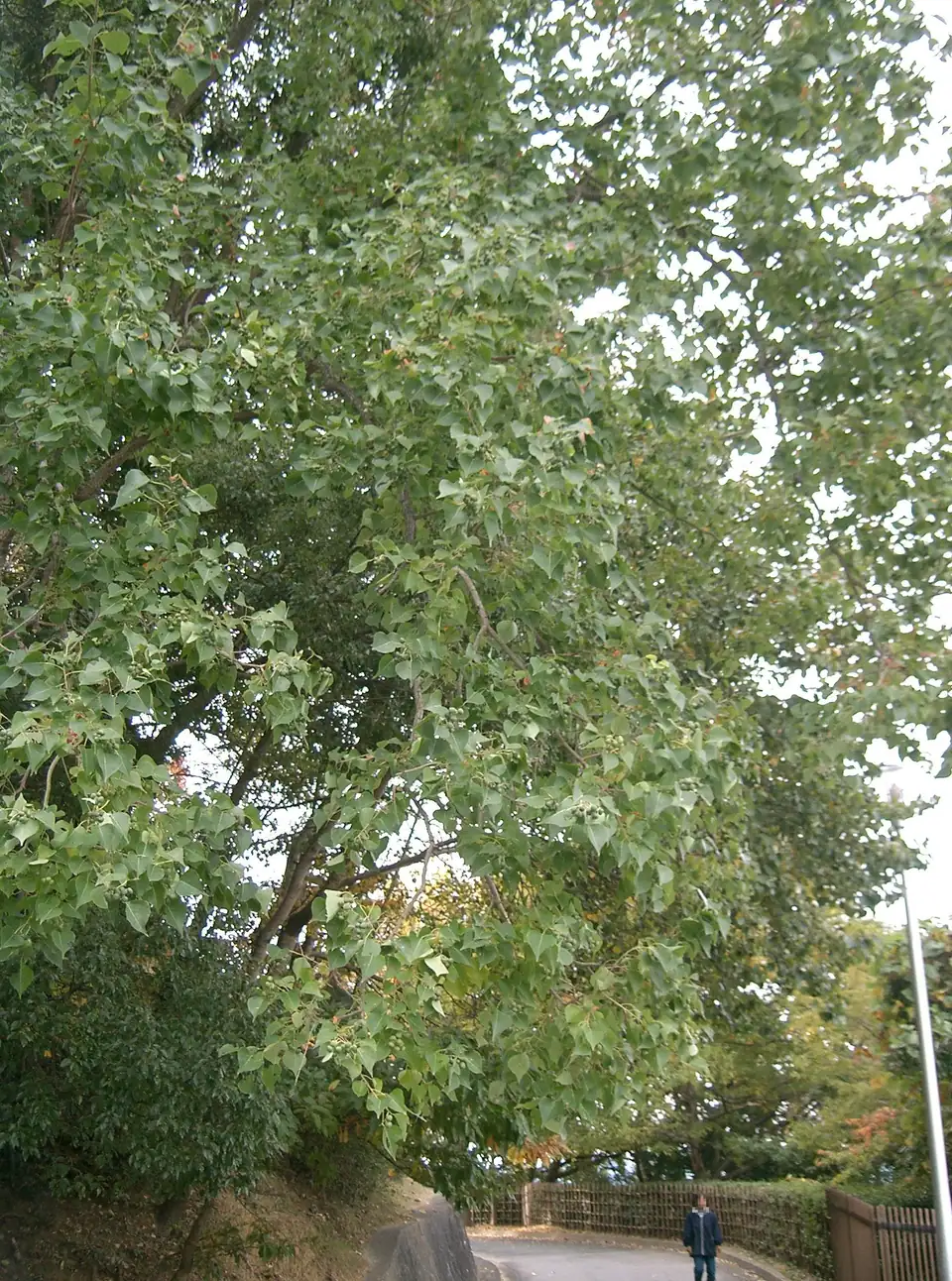


Cómo cultivar y cuidar Árbol de sebo
Triadica sebifera
Escrito por Emilio Marruso · última revisión
Tóxica para: Ganado vacuno, Ovejas, Cabras, Personas · Por qué
De un vistazo
El árbol del sebo chino es poco exigente: prefiere el sol pleno, pero también crece en semisombra y en sombra, y le gusta la tierra húmeda aunque aguanta la sequía. Se convierte en un árbol amplio de 9–12 m de alto y otros tantos de ancho. Antes de plantarlo, ten en cuenta que echa muchos brotes de raíz y es invasor en algunas zonas: un árbol autóctono es una buena alternativa.
- Sol
Mejor a pleno sol, pero también crece en semisombra y en sombra
Qué dicen las fuentes (2)
Luz: Prefiere pleno sol; también crece en semisombra y sombra
It prefers moist soils and full sun and will grow quickly to 40 feet tall and 30 feet wide
— Triadica sebifera (Chinese tallow tree, Popcorn Tree) | North Carolina Extension Gardener Plant Toolbox [1] It is drought and shade tolerant. While limited by cold temperatures, it can tolerate a wide variety of environmental conditions
— Chinese Tallow Tree | Home & Garden Information Center [3] - Riego
Le gusta la tierra húmeda, pero aguanta la sequía
Qué dicen las fuentes (2)
Notas sobre el riego: Prefiere suelos húmedos; tolerante a la sequía
It prefers moist soils and full sun and will grow quickly to 40 feet tall and 30 feet wide
— Triadica sebifera (Chinese tallow tree, Popcorn Tree) | North Carolina Extension Gardener Plant Toolbox [1] It is drought and shade tolerant. While limited by cold temperatures, it can tolerate a wide variety of environmental conditions
— Chinese Tallow Tree | Home & Garden Information Center [3] - Frío
Aguanta inviernos de hasta −12,2 °C (10 °F)
Rústica en inviernos fríos · USDA 8a · RHS H5 · Z8
Qué dicen las fuentes (2)
Rusticidad, zona más fría: 8a [mínima invernal de −12,2 a −9,4 °C (de 10 a 15 °F)]
NC Region: Coastal USDA Plant Hardiness Zone: 8a, 8b, 9a, 9b, 10a, 10b
— Triadica sebifera (Chinese tallow tree, Popcorn Tree) | North Carolina Extension Gardener Plant Toolbox [1] Rusticidad, zona más cálida: 10b [mínima invernal de 1,7 a 4,4 °C (de 35 a 40 °F)]
NC Region: Coastal USDA Plant Hardiness Zone: 8a, 8b, 9a, 9b, 10a, 10b
— Triadica sebifera (Chinese tallow tree, Popcorn Tree) | North Carolina Extension Gardener Plant Toolbox [1] - Atención
Invasor en algunas zonas: echa brotes de raíz y rebrota tras cortarlo; mejor un árbol autóctono
- Tamaño
9–12 m de alto y 9–12 m de ancho
Qué dicen las fuentes (2)
Altura adulta: 914-1219 cm (30-40 pies)
Dimensions: Height: 30 ft. 0 in. - 40 ft. 0 in. Width: 30 ft. 0 in. - 40 ft. 0 in.
— Triadica sebifera (Chinese tallow tree, Popcorn Tree) | North Carolina Extension Gardener Plant Toolbox [1] Anchura adulta: 914-1219 cm (30-40 pies)
Dimensions: Height: 30 ft. 0 in. - 40 ft. 0 in. Width: 30 ft. 0 in. - 40 ft. 0 in.
— Triadica sebifera (Chinese tallow tree, Popcorn Tree) | North Carolina Extension Gardener Plant Toolbox [1] - Multiplicación
Se multiplica por semilla
Qué dicen las fuentes (1)
Propagación: Semilla
Recommended Propagation Strategy: Seed Country Or Region Of Origin: China and Japan
— Triadica sebifera (Chinese tallow tree, Popcorn Tree) | North Carolina Extension Gardener Plant Toolbox [1] - Seguridad
Frutos y hojas provocan náuseas y vómitos y son tóxicos para el ganado; la savia joven irrita la piel
Resumen
El árbol de sebo chino es un árbol caducifolio de rápido crecimiento originario de Asia que se ha vuelto invasivo en el sureste de los Estados Unidos. [1][3] Prefiere suelos húmedos y pleno sol, y tolera la sequía y la sombra. [1][3] Se informa que las hojas y los frutos son tóxicos y causan náuseas y vómitos en los humanos. [2]
Citado en inglés, como en la fuente.
Cuidados
Riego
Prefiere suelos húmedos; tolerante a la sequía
Qué dicen las fuentes (2)
It prefers moist soils and full sun and will grow quickly to 40 feet tall and 30 feet wideIt is drought and shade tolerant. While limited by cold temperatures, it can tolerate a wide variety of environmental conditionsLuz
Prefiere pleno sol; también crece en semisombra y sombra
Qué dicen las fuentes (2)
It prefers moist soils and full sun and will grow quickly to 40 feet tall and 30 feet wideIt is drought and shade tolerant. While limited by cold temperatures, it can tolerate a wide variety of environmental conditionsClima y frío
Rusticidad, zona más fría
8a [mínima invernal de −12,2 a −9,4 °C (de 10 a 15 °F)]
Qué dicen las fuentes (1)
NC Region: Coastal USDA Plant Hardiness Zone: 8a, 8b, 9a, 9b, 10a, 10bRusticidad, zona más cálida
10b [mínima invernal de 1,7 a 4,4 °C (de 35 a 40 °F)]
Qué dicen las fuentes (1)
NC Region: Coastal USDA Plant Hardiness Zone: 8a, 8b, 9a, 9b, 10a, 10bPropagación
Semilla
Qué dicen las fuentes (1)
Recommended Propagation Strategy: Seed Country Or Region Of Origin: China and JapanCultivo
La planta
Familia
Euphorbiaceae
Qué dicen las fuentes (2)
Chinese popcorn tree is a rapidly growing deciduous tree in the Euphorbiaceae (spurge) family native to Asia.Family: Euphorbiaceae
Habit: deciduous tree with a milky sap, grows up to 30 ft tallAltura adulta
914-1219 cm (30-40 pies)
Qué dicen las fuentes (1)
Dimensions:
Height: 30 ft. 0 in. - 40 ft. 0 in.
Width: 30 ft. 0 in. - 40 ft. 0 in.Anchura adulta
914-1219 cm (30-40 pies)
Qué dicen las fuentes (1)
Dimensions:
Height: 30 ft. 0 in. - 40 ft. 0 in.
Width: 30 ft. 0 in. - 40 ft. 0 in.Problemas
Invasividad y brotes de raíces
Síntoma: El árbol se reproduce fácilmente por raíces y está catalogado como invasor en varios estados.
Qué hacer: Se deben considerar alternativas; en jardines domésticos, reemplácelo con árboles nativos.
Qué dicen las fuentes (2)
This tree root suckers easily. It is listed as invasive in FL, AR, CA, OK, TX, NC and GA and alternatives should be considered.
— Triadica sebifera (Chinese tallow tree, Popcorn Tree) | North Carolina Extension Gardener Plant Toolbox [1] Hand pull seedlings. Replace in home landscapes with native trees.
— | Center for Aquatic and Invasive Plants | University of Florida, IFAS [2] Rebrote después del corte
Síntoma: Después del corte, el tocón produce brotes y el árbol continúa creciendo.
Qué hacer: Los brotes también deben cortarse; los métodos químicos son el método de control más confiable y efectivo.
Qué dicen las fuentes (2)
After cutting, the stump will grow sprouts, which must also be cut back, or the tree will continue to grow.
— Chinese Tallow Tree | Home & Garden Information Center [3] Chemical methods are the most reliable and effective method of control.
— Chinese Tallow Tree | Home & Garden Information Center [3]
Remedios
Cada remedio indica qué dicen las fuentes oficiales; los remedios tradicionales sin fuente oficial aparecen marcados. Los perjudiciales están para que sepas evitarlos.
Cómo eliminarla
plántulas invasoras
Arranca las plántulas a mano. Funciona en parte
The sap from young trees can be a skin irritant to humans, and the seeds and leaves are toxic to humans and cattle, causing nausea and vomiting.
— Chinese Tallow Tree | Home & Garden Information Center [3] Cómo: Las plántulas pequeñas se pueden arrancar a mano, pero esto solo puede ser práctico si no hay muchas plántulas en la zona.
Small seedlings can be hand pulled, but this may only be practical if there are not a lot of seedlings in the area.
— Chinese Tallow Tree | Home & Garden Information Center [3] Qué dicen las pruebas Seedlings may be pulled when very small. But hand pulling is not generally an practical option for controlling established tallowtree.
— aces.edu [5] cortando las plántulas con cortacésped Funciona en parte
Because tallowtree rapidly sprouts from the stump and lateral roots, stem densities may increase over time with repeated mowing.
— aces.edu [5] Cómo: Las plántulas se pueden segar o desmenuzar con rastra de discos cuando son pequeñas.
Seedlings can be mowed or disked when small. Burning is also effective for both small and larger trees.
— | Center for Aquatic and Invasive Plants | University of Florida, IFAS [2] Qué dicen las pruebas In pastures, annual mowing has been used to suppress Chinese tallowtree, but it can worsen the problem. Because tallowtree rapidly sprouts from the stump and lateral roots, stem densities may increase over time with repeated mowing.
— aces.edu [5]
rebrote después del corte
talar el árbol Funciona en parte
The sap from young trees can be a skin irritant to humans, and the seeds and leaves are toxic to humans and cattle, causing nausea and vomiting.
— Chinese Tallow Tree | Home & Garden Information Center [3] Cómo: Los árboles maduros deben cortarse con una motosierra, con el corte final lo más cerca del suelo y lo más nivelado posible.
Mature trees should be cut down with a chain saw. The final cut should be made as close to the ground and as level as possible.
— | Center for Aquatic and Invasive Plants | University of Florida, IFAS [2] Qué dicen las pruebas Cutting and removal are not enough to kill a tallow tree. After cutting, the stump will grow sprouts, which must also be cut back, or the tree will continue to grow.
— Chinese Tallow Tree | Home & Garden Information Center [3]
invasividad
Quema prescrita Funciona en parte
Under some conditions, fire can promote the growth of tallowtree seedlings by clearing away competing vegetation and enhancing seed germination.
— aces.edu [5] Cómo: La quema también es efectiva tanto para árboles pequeños como grandes.
Seedlings can be mowed or disked when small. Burning is also effective for both small and larger trees.
— | Center for Aquatic and Invasive Plants | University of Florida, IFAS [2] Qué dicen las pruebas Small seedlings can be killed by fire, while larger trees may be weakened. Burning can encourage sprouting if the entire plant is not killed.
— Chinese Tallow Tree | Home & Garden Information Center [3]
árboles jóvenes invasores
extracción con desmalezadora Funciona en parte
The sap from young trees can be a skin irritant to humans, and the seeds and leaves are toxic to humans and cattle, causing nausea and vomiting.
— Chinese Tallow Tree | Home & Garden Information Center [3] Cómo: El uso de una desmalezadora puede ayudar a extraer árboles jóvenes pequeños.
The use of a weed wrench may help remove small saplings. However, stems originating from lateral roots will break off just below the soil surface, and new sprouts will form near the breakpoint.
— aces.edu [5] Qué dicen las pruebas The use of a weed wrench may help remove small saplings. However, stems originating from lateral roots will break off just below the soil surface, and new sprouts will form near the breakpoint.
— aces.edu [5]
Venenosa para los animales
Según la fuente, citada textualmente. No es un consejo médico ni veterinario: si una persona o un animal pudo haber ingerido esta planta, contacta con un centro de toxicología o con un veterinario.
Animales
Additionally, the leaves and fruit are toxic to cattle and cause nausea and vomiting in humans.
[2]- Partes venenosas
the leaves and fruit are toxic to cattle
[2]
Sheep and goats are known to eat the leaves without ill effects.
[3]La fuente señala el riesgo para este animal pero no explica por qué.
Personas
Poison Severity: Medium Poison Symptoms: Nausea and vomiting. Poison Toxic Principle: Unknown Causes Contact Dermatitis: No Poison Part: Fruits Leaves
[1]The sap from young trees can be a skin irritant to humans, and the seeds and leaves are toxic to humans and cattle, causing nausea and vomiting.
[3]
Valores orientativos
Valores de una fuente secundaria, no comprobados palabra por palabra como el resto de esta página. Úselos como punto de partida.
- Ciclo de vida
- PerenneValor orientativo, adáptalo a tu clima · Fuente secundaria
- Horas de sol
- 6-9 horasValor orientativo, adáptalo a tu clima · Fuente secundaria
- Riego
- PromedioValor orientativo, adáptalo a tu clima · Fuente secundaria
- Resiste la sequía
- SíValor orientativo, adáptalo a tu clima · Fuente secundaria
- pH del suelo
- 5.5-7.5Valor orientativo, adáptalo a tu clima · Fuente secundaria
- Nivel de cuidado
- MedioValor orientativo, adáptalo a tu clima · Fuente secundaria
- Crecimiento
- AltaValor orientativo, adáptalo a tu clima · Fuente secundaria
- Poda
- Febrero, marzo, abrilValor orientativo, adáptalo a tu clima · Fuente secundaria
Plantas similares
- Alabama Croton Croton alabamensis
- Piñón de tempate Jatropha curcas
- Buddha Belly Jatropha podagrica
- Yuca Manihot esculenta
- Ricino Ricinus communis
- Moco de pavo Acalypha hispida
- Copperleaf Acalypha wilkesiana
- Corona de Cristo Euphorbia milii
Fuentes
Cada valor anterior se cita de estos documentos. Los enlaces llevan al editor original.
- Triadica sebifera (Chinese tallow tree, Popcorn Tree) | North Carolina Extension Gardener Plant Toolbox · plants.ces.ncsu.edu, consultado
- | Center for Aquatic and Invasive Plants | University of Florida, IFAS · plant-directory.ifas.ufl.edu, consultado
- Chinese Tallow Tree | Home & Garden Information Center · hgic.clemson.edu, consultado
- Popcorn Tree - Triadica sebifera | North Carolina Extension Gardener Plant Toolbox · plants.ces.ncsu.edu, consultado
- aces.edu · aces.edu
Escrito por Emilio Marruso · última revisión