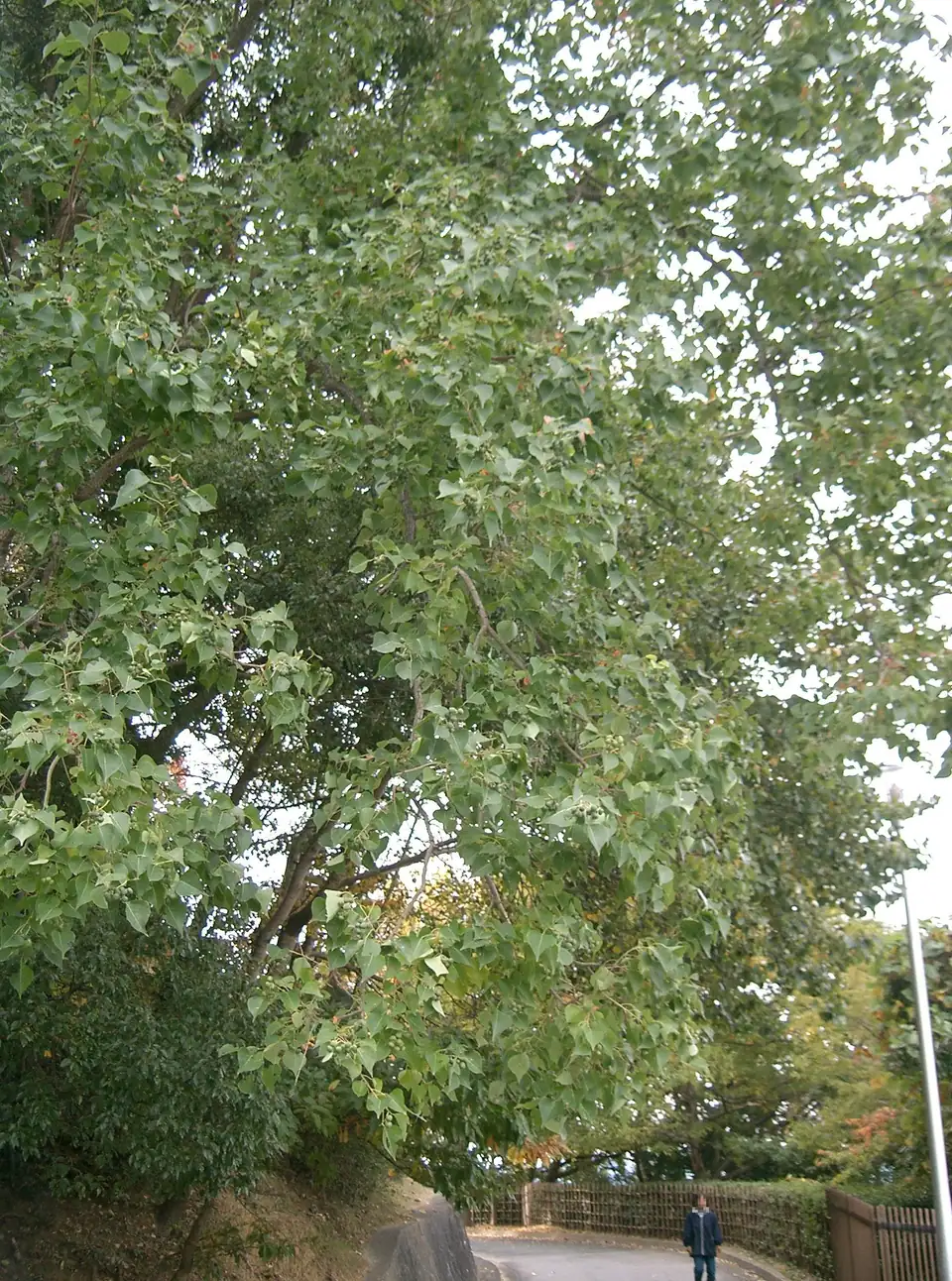


How to Grow and Care for Chinese tallow tree
Triadica sebifera
Written by Emilio Marruso · last checked
Toxic to: Cattle, Sheep, Goats, People · Why
At a glance
The Chinese tallow tree is easygoing: it prefers full sun but also grows in partial shade and shade, and it likes moist soil while still handling drought. It becomes a broad tree 30–40 ft tall and just as wide. Before you plant it, know that it suckers easily and is invasive in some areas, so a native tree is a wise alternative.
- Sun
Best in full sun, but also grows in partial shade and shade
What the sources say (2)
Light: Full sun preferred; also grows in partial shade and shade
It prefers moist soils and full sun and will grow quickly to 40 feet tall and 30 feet wide
— Triadica sebifera (Chinese tallow tree, Popcorn Tree) | North Carolina Extension Gardener Plant Toolbox [1] It is drought and shade tolerant. While limited by cold temperatures, it can tolerate a wide variety of environmental conditions
— Chinese Tallow Tree | Home & Garden Information Center [3] - Water
Likes moist soil, but tolerates drought
What the sources say (2)
Watering notes: Prefers moist soils; drought tolerant
It prefers moist soils and full sun and will grow quickly to 40 feet tall and 30 feet wide
— Triadica sebifera (Chinese tallow tree, Popcorn Tree) | North Carolina Extension Gardener Plant Toolbox [1] It is drought and shade tolerant. While limited by cold temperatures, it can tolerate a wide variety of environmental conditions
— Chinese Tallow Tree | Home & Garden Information Center [3] - Cold
Survives winters down to 10 °F (−12.2 °C)
Hardy in cold winters · USDA 8a · RHS H5 · Z8
What the sources say (2)
Hardiness, coldest zone: 8a [winter low −12.2 to −9.4 °C (10 to 15 °F)]
NC Region: Coastal USDA Plant Hardiness Zone: 8a, 8b, 9a, 9b, 10a, 10b
— Triadica sebifera (Chinese tallow tree, Popcorn Tree) | North Carolina Extension Gardener Plant Toolbox [1] Hardiness, warmest zone: 10b [winter low 1.7 to 4.4 °C (35 to 40 °F)]
NC Region: Coastal USDA Plant Hardiness Zone: 8a, 8b, 9a, 9b, 10a, 10b
— Triadica sebifera (Chinese tallow tree, Popcorn Tree) | North Carolina Extension Gardener Plant Toolbox [1] - Watch out
Invasive in some areas: it suckers from the roots and resprouts after cutting; consider a native tree
- Size
30–40 ft tall and 30–40 ft wide
What the sources say (2)
Mature height: 914-1219 cm (30-40 ft)
Dimensions: Height: 30 ft. 0 in. - 40 ft. 0 in. Width: 30 ft. 0 in. - 40 ft. 0 in.
— Triadica sebifera (Chinese tallow tree, Popcorn Tree) | North Carolina Extension Gardener Plant Toolbox [1] Mature width: 914-1219 cm (30-40 ft)
Dimensions: Height: 30 ft. 0 in. - 40 ft. 0 in. Width: 30 ft. 0 in. - 40 ft. 0 in.
— Triadica sebifera (Chinese tallow tree, Popcorn Tree) | North Carolina Extension Gardener Plant Toolbox [1] - Propagation
Grows from seed
What the sources say (1)
Propagation: Seed
Recommended Propagation Strategy: Seed Country Or Region Of Origin: China and Japan
— Triadica sebifera (Chinese tallow tree, Popcorn Tree) | North Carolina Extension Gardener Plant Toolbox [1] - Safety
Fruits and leaves cause nausea and vomiting and are toxic to cattle; young trees' sap can irritate skin
Overview
Chinese tallow tree is a fast-growing deciduous tree native to Asia that has become invasive in the southeastern United States. [1][3] It prefers moist soils and full sun, and is tolerant of drought and shade. [1][3] The leaves and fruit are reported as toxic, causing nausea and vomiting in humans. [2]
Chinese tallow tree care
How to water Chinese tallow tree
Prefers moist soils; drought tolerant
What the sources say (2)
It prefers moist soils and full sun and will grow quickly to 40 feet tall and 30 feet wideIt is drought and shade tolerant. While limited by cold temperatures, it can tolerate a wide variety of environmental conditionsHow much light Chinese tallow tree needs
Full sun preferred; also grows in partial shade and shade
What the sources say (2)
It prefers moist soils and full sun and will grow quickly to 40 feet tall and 30 feet wideIt is drought and shade tolerant. While limited by cold temperatures, it can tolerate a wide variety of environmental conditionsHow much cold Chinese tallow tree can take
Hardiness, coldest zone
8a [winter low −12.2 to −9.4 °C (10 to 15 °F)]
What the sources say (1)
NC Region: Coastal USDA Plant Hardiness Zone: 8a, 8b, 9a, 9b, 10a, 10bHardiness, warmest zone
10b [winter low 1.7 to 4.4 °C (35 to 40 °F)]
What the sources say (1)
NC Region: Coastal USDA Plant Hardiness Zone: 8a, 8b, 9a, 9b, 10a, 10bHow to propagate Chinese tallow tree
Seed
What the sources say (1)
Recommended Propagation Strategy: Seed Country Or Region Of Origin: China and JapanHow to grow Chinese tallow tree
The plant
Family
Euphorbiaceae
What the sources say (2)
Chinese popcorn tree is a rapidly growing deciduous tree in the Euphorbiaceae (spurge) family native to Asia.Family: Euphorbiaceae
Habit: deciduous tree with a milky sap, grows up to 30 ft tallMature height
914-1219 cm (30-40 ft)
What the sources say (1)
Dimensions:
Height: 30 ft. 0 in. - 40 ft. 0 in.
Width: 30 ft. 0 in. - 40 ft. 0 in.Mature width
914-1219 cm (30-40 ft)
What the sources say (1)
Dimensions:
Height: 30 ft. 0 in. - 40 ft. 0 in.
Width: 30 ft. 0 in. - 40 ft. 0 in.Chinese tallow tree pests and problems
Invasiveness and root suckering
Symptom: The tree root suckers easily and is listed as invasive in several states.
What to do: Alternatives should be considered; in home landscapes replace it with native trees.
What the sources say (2)
This tree root suckers easily. It is listed as invasive in FL, AR, CA, OK, TX, NC and GA and alternatives should be considered.
— Triadica sebifera (Chinese tallow tree, Popcorn Tree) | North Carolina Extension Gardener Plant Toolbox [1] Hand pull seedlings. Replace in home landscapes with native trees.
— | Center for Aquatic and Invasive Plants | University of Florida, IFAS [2] Resprouting after cutting
Symptom: After cutting, the stump grows sprouts and the tree continues to grow.
What to do: Sprouts must also be cut back; chemical methods are the most reliable and effective method of control.
What the sources say (2)
After cutting, the stump will grow sprouts, which must also be cut back, or the tree will continue to grow.
— Chinese Tallow Tree | Home & Garden Information Center [3] Chemical methods are the most reliable and effective method of control.
— Chinese Tallow Tree | Home & Garden Information Center [3]
Remedies
Each remedy shows what official sources say about it; traditional remedies without an official source are marked as such. Harmful ones are listed so you know to avoid them.
Getting rid of it
invasive seedlings
hand pulling seedlings Partly works
The sap from young trees can be a skin irritant to humans, and the seeds and leaves are toxic to humans and cattle, causing nausea and vomiting.
— Chinese Tallow Tree | Home & Garden Information Center [3] How: Small seedlings can be hand pulled, but this may only be practical if there are not a lot of seedlings in the area.
Small seedlings can be hand pulled, but this may only be practical if there are not a lot of seedlings in the area.
— Chinese Tallow Tree | Home & Garden Information Center [3] What the evidence says Seedlings may be pulled when very small. But hand pulling is not generally an practical option for controlling established tallowtree.
— aces.edu [5] mowing seedlings Partly works
Because tallowtree rapidly sprouts from the stump and lateral roots, stem densities may increase over time with repeated mowing.
— aces.edu [5] How: Seedlings can be mowed or disked when small.
Seedlings can be mowed or disked when small. Burning is also effective for both small and larger trees.
— | Center for Aquatic and Invasive Plants | University of Florida, IFAS [2] What the evidence says In pastures, annual mowing has been used to suppress Chinese tallowtree, but it can worsen the problem. Because tallowtree rapidly sprouts from the stump and lateral roots, stem densities may increase over time with repeated mowing.
— aces.edu [5]
resprouting after cutting
cutting down the tree Partly works
The sap from young trees can be a skin irritant to humans, and the seeds and leaves are toxic to humans and cattle, causing nausea and vomiting.
— Chinese Tallow Tree | Home & Garden Information Center [3] How: Mature trees should be cut down with a chain saw, with the final cut as close to the ground and as level as possible.
Mature trees should be cut down with a chain saw. The final cut should be made as close to the ground and as level as possible.
— | Center for Aquatic and Invasive Plants | University of Florida, IFAS [2] What the evidence says Cutting and removal are not enough to kill a tallow tree. After cutting, the stump will grow sprouts, which must also be cut back, or the tree will continue to grow.
— Chinese Tallow Tree | Home & Garden Information Center [3]
invasiveness
prescribed burning Partly works
Under some conditions, fire can promote the growth of tallowtree seedlings by clearing away competing vegetation and enhancing seed germination.
— aces.edu [5] How: Burning is also effective for both small and larger trees.
Seedlings can be mowed or disked when small. Burning is also effective for both small and larger trees.
— | Center for Aquatic and Invasive Plants | University of Florida, IFAS [2] What the evidence says Small seedlings can be killed by fire, while larger trees may be weakened. Burning can encourage sprouting if the entire plant is not killed.
— Chinese Tallow Tree | Home & Garden Information Center [3]
invasive saplings
weed wrench removal Partly works
The sap from young trees can be a skin irritant to humans, and the seeds and leaves are toxic to humans and cattle, causing nausea and vomiting.
— Chinese Tallow Tree | Home & Garden Information Center [3] How: The use of a weed wrench may help remove small saplings.
The use of a weed wrench may help remove small saplings. However, stems originating from lateral roots will break off just below the soil surface, and new sprouts will form near the breakpoint.
— aces.edu [5] What the evidence says The use of a weed wrench may help remove small saplings. However, stems originating from lateral roots will break off just below the soil surface, and new sprouts will form near the breakpoint.
— aces.edu [5]
Is Chinese tallow tree toxic to pets?
Reported by the source, quoted verbatim. This is not medical or veterinary advice: if a person or an animal may have eaten this plant, contact a poison control centre or a veterinarian.
Animals
Additionally, the leaves and fruit are toxic to cattle and cause nausea and vomiting in humans.
[2]- Poisonous parts
the leaves and fruit are toxic to cattle
[2]
Sheep and goats are known to eat the leaves without ill effects.
[3]The source flags the risk for this animal but does not explain why.
People
Poison Severity: Medium Poison Symptoms: Nausea and vomiting. Poison Toxic Principle: Unknown Causes Contact Dermatitis: No Poison Part: Fruits Leaves
[1]The sap from young trees can be a skin irritant to humans, and the seeds and leaves are toxic to humans and cattle, causing nausea and vomiting.
[3]
Indicative values
Values from a secondary source, not checked word for word like the rest of this page. Use them as a starting point.
- Life cycle
- PerennialIndicative value, adapt it to your climate · Secondary source
- Hours of sun
- 6-9 hoursIndicative value, adapt it to your climate · Secondary source
- Watering
- AverageIndicative value, adapt it to your climate · Secondary source
- Drought tolerant
- yesIndicative value, adapt it to your climate · Secondary source
- Soil pH
- 5.5-7.5Indicative value, adapt it to your climate · Secondary source
- Care level
- MediumIndicative value, adapt it to your climate · Secondary source
- Growth rate
- HighIndicative value, adapt it to your climate · Secondary source
- Pruning
- February, March, AprilIndicative value, adapt it to your climate · Secondary source
Similar plants
- Alabama Croton Croton alabamensis
- Barbados nut Jatropha curcas
- Buddha Belly Jatropha podagrica
- Cassava Manihot esculenta
- Castor Bean Ricinus communis
- Chenille Plant Acalypha hispida
- Copperleaf Acalypha wilkesiana
- Crown of Thorns Euphorbia milii
Sources
Every value above is quoted from these documents. Links lead to the original publisher.
- Triadica sebifera (Chinese tallow tree, Popcorn Tree) | North Carolina Extension Gardener Plant Toolbox · plants.ces.ncsu.edu, consulted
- | Center for Aquatic and Invasive Plants | University of Florida, IFAS · plant-directory.ifas.ufl.edu, consulted
- Chinese Tallow Tree | Home & Garden Information Center · hgic.clemson.edu, consulted
- Popcorn Tree - Triadica sebifera | North Carolina Extension Gardener Plant Toolbox · plants.ces.ncsu.edu, consulted
- aces.edu · aces.edu
Written by Emilio Marruso · last checked