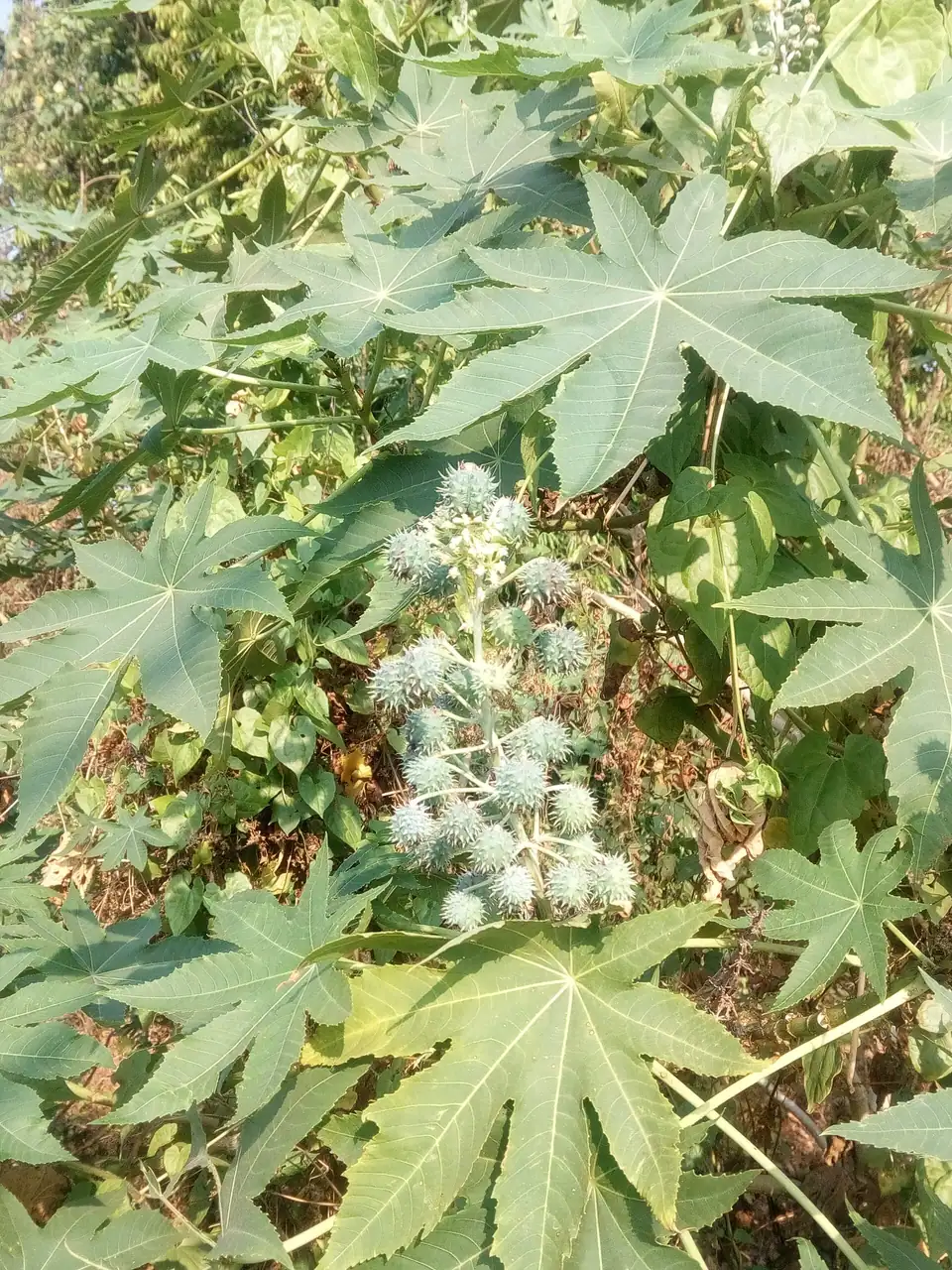


How to Grow and Care for Castor Bean
Ricinus communis
Written by Emilio Marruso · last checked
Toxic to: Cats, Dogs, Horses, Livestock, People · Why
At a glance
Castor bean is a fast-growing showpiece that can reach 6–10 ft tall, perfect for a bold, sunny corner. Sow the seeds right in the garden in late spring and give it plenty of water while it's young; once settled, it tolerates drought. Just plant it where children and pets can't reach, because its seeds are extremely toxic.
- Sun
Full sun: 6 or more hours a day
What the sources say (1)
Light: Full sun (6 or more hours of direct sunlight a day)
Light: Full sun (6 or more hours of direct sunlight a day) Soil Texture: Loam
— Ricinus communis (African Wonder Tree, Castor Bean, Castor Bean Plant, Castor Oil Plant, Castor-oil Plant, Mole Bean Plant) | North Carolina Extension Gardener Plant Toolbox [1] - Water
Plenty of water while young; once settled it tolerates drought
What the sources say (3)
Watering: Provide plenty of water; once established, plants tolerate drought
Provide plenty of water and fertilizer to achieve the largest size.
— Castor Bean, Ricinus communis – Wisconsin Horticulture [2] Once established, plants will tolerate drought. Wind can shred the leaves
— Castor Bean, Ricinus communis – Wisconsin Horticulture [2] Watering notes: Low drought tolerance until well established
Plant in full sun in rich moist soils. Fertilize regularly for the best growth. Pruning may be necessary to shape the plant. Plants will have low drought tolerance until well established.
— Ricinus communis (African Wonder Tree, Castor Bean, Castor Bean Plant, Castor Oil Plant, Castor-oil Plant, Mole Bean Plant) | North Carolina Extension Gardener Plant Toolbox [1] - Cold
Survives winters down to 20 °F (−6.7 °C)
Hardy in average winters · USDA 9a · RHS H4 · Z9
What the sources say (2)
Hardiness, coldest zone: 9a [winter low −6.7 to −3.9 °C (20 to 25 °F)]
Available Space To Plant: 3 feet-6 feet 6-feet-12 feet USDA Plant Hardiness Zone: 9a, 9b, 10a, 10b, 11a, 11b
— Ricinus communis (African Wonder Tree, Castor Bean, Castor Bean Plant, Castor Oil Plant, Castor-oil Plant, Mole Bean Plant) | North Carolina Extension Gardener Plant Toolbox [1] Hardiness, warmest zone: 11b [winter low 7.2 to 10 °C (45 to 50 °F)]
Available Space To Plant: 3 feet-6 feet 6-feet-12 feet USDA Plant Hardiness Zone: 9a, 9b, 10a, 10b, 11a, 11b
— Ricinus communis (African Wonder Tree, Castor Bean, Castor Bean Plant, Castor Oil Plant, Castor-oil Plant, Mole Bean Plant) | North Carolina Extension Gardener Plant Toolbox [1] - Spacing
4 ft between plants
What the sources say (1)
Spacing: 121.9 cm (4 ft)
Place the plants outdoors in full sun and deep, rich soil about 4 feet apart.
— Castor Bean, Ricinus communis – Wisconsin Horticulture [2] - Planting
Move seedlings outdoors once the weather warms
What the sources say (1)
Planting: Transplant outdoors when the weather warms
(6-8 weeks before the average last frost) and transplanted outdoors when the weather warms.
— Castor Bean, Ricinus communis – Wisconsin Horticulture [2] - Feeding
Feed regularly for the best growth and the biggest plants
What the sources say (2)
How often: Regularly, for the best growth and the largest size
Plant in full sun in rich moist soils. Fertilize regularly for the best growth.
— Ricinus communis (African Wonder Tree, Castor Bean, Castor Bean Plant, Castor Oil Plant, Castor-oil Plant, Mole Bean Plant) | North Carolina Extension Gardener Plant Toolbox [1] Provide plenty of water and fertilizer to achieve the largest size.
— Castor Bean, Ricinus communis – Wisconsin Horticulture [2] - Pests
Spider mites, mainly on plants stressed by drought
What the sources say (2)
Pests: spider mites
The castor bean has no serious insects or disease problems. Spider mites occasionally attack drought-stressed plants.
— Ricinus communis (African Wonder Tree, Castor Bean, Castor Bean Plant, Castor Oil Plant, Castor-oil Plant, Mole Bean Plant) | North Carolina Extension Gardener Plant Toolbox [1] Castor bean has few pests, although spider mites can sometimes be a problem in hot, dry weather.
— Castor Bean, Ricinus communis – Wisconsin Horticulture [2] - Watch out
Reseeds freely and can turn weedy: pinch off small seed pods; shelter and stake it against wind
- Size
6–10 ft tall and 2–4 ft wide
What the sources say (4)
Mature height: 183-305 cm (6-10 ft)
: In suitable climates, it can grow to 40 feet tall, developing woody stems over a few years.
— Castor Bean, Ricinus communis – Wisconsin Horticulture [2] annual or herbaceous perennial shrub or small tree, usually up to 6 to 10 feet tall and 2 to 4 feet wide
— Ricinus communis (African Wonder Tree, Castor Bean, Castor Bean Plant, Castor Oil Plant, Castor-oil Plant, Mole Bean Plant) | North Carolina Extension Gardener Plant Toolbox [1] Because of its rapid, vigorous growth, it is easily grown as a warm season annual in cold climates, where it usually grows 6-10 feet in a single growing season
— Castor Bean, Ricinus communis – Wisconsin Horticulture [2] Mature width: 61-122 cm (2-4 ft)
annual or herbaceous perennial shrub or small tree, usually up to 6 to 10 feet tall and 2 to 4 feet wide
— Ricinus communis (African Wonder Tree, Castor Bean, Castor Bean Plant, Castor Oil Plant, Castor-oil Plant, Mole Bean Plant) | North Carolina Extension Gardener Plant Toolbox [1] - Propagation
By seed
What the sources say (1)
Propagation: Seed
Recommended Propagation Strategy: Seed Country Or Region Of Origin: Northeastern Africa
— Ricinus communis (African Wonder Tree, Castor Bean, Castor Bean Plant, Castor Oil Plant, Castor-oil Plant, Mole Bean Plant) | North Carolina Extension Gardener Plant Toolbox [1] - Sowing
Sow 1–1½ in deep in late spring, or indoors 6–8 weeks before last frost; sprouts in 1–3 weeks
What the sources say (4)
Sowing: Sow directly in the garden in late spring, or start indoors 6-8 weeks before the average last frost
when grown as an ornamental: castor bean seed can be planted directly in the garden in late spring, or started indoors
— Castor Bean, Ricinus communis – Wisconsin Horticulture [2] castor bean seed can be planted directly in the garden in late spring, or started indoors earlier (6-8 weeks before the average last frost)
— Castor Bean, Ricinus communis – Wisconsin Horticulture [2] Sowing depth: 2.5-3.8 cm (1-1½ in)
Nick or scarify the seeds or soak overnight for better germination . Sow the seeds 1-1½ inches deep.
— Castor Bean, Ricinus communis – Wisconsin Horticulture [2] Days to germination: 7-21 (1-3 weeks)
Sow the seeds 1-1½ inches deep. Seedlings should start coming up in 1-3 weeks.
— Castor Bean, Ricinus communis – Wisconsin Horticulture [2] - Containers
Grows in containers too
What the sources say (1)
In containers: Yes
or can be grown in large containers on patios. Castor bean combines well with cannas
— Castor Bean, Ricinus communis – Wisconsin Horticulture [2] - Safety
Extremely toxic: a few seeds can kill, and the leaves irritate skin; keep away from kids and pets
Overview
Castor bean is a fast-growing large shrub or small tree, grown as a warm season annual in colder climates. [2] It needs full sun and plenty of water while growing, and tolerates drought once established. [2] All parts of the plant are toxic, and the seeds are extremely toxic. [2]
This record is incomplete: the sources we read do not cover every field yet.
Not yet covered by our sources: Pruning
Castor Bean care
How to water Castor Bean
Watering
Provide plenty of water; once established, plants tolerate drought
Watering notes
Low drought tolerance until well established
What the sources say (1)
Plant in full sun in rich moist soils. Fertilize regularly for the best growth. Pruning may be necessary to shape the plant. Plants will have low drought tolerance until well established.How much light Castor Bean needs
Full sun (6 or more hours of direct sunlight a day)
What the sources say (1)
Light:
Full sun (6 or more hours of direct sunlight a day)
Soil Texture:
LoamHow much cold Castor Bean can take
Hardiness, coldest zone
9a [winter low −6.7 to −3.9 °C (20 to 25 °F)]
What the sources say (1)
Available Space To Plant:
3 feet-6 feet
6-feet-12 feet
USDA Plant Hardiness Zone:
9a, 9b, 10a, 10b, 11a, 11bHardiness, warmest zone
11b [winter low 7.2 to 10 °C (45 to 50 °F)]
What the sources say (1)
Available Space To Plant:
3 feet-6 feet
6-feet-12 feet
USDA Plant Hardiness Zone:
9a, 9b, 10a, 10b, 11a, 11bWhere to grow Castor Bean
In containers
Yes
What the sources say (1)
or can be grown in large containers on patios. Castor bean combines well with cannasSpacing
121.9 cm (4 ft)
What the sources say (1)
Place the plants outdoors in full sun and deep, rich soil about 4 feet apart.How to propagate Castor Bean
Seed
What the sources say (1)
Recommended Propagation Strategy:
Seed
Country Or Region Of Origin:
Northeastern AfricaHow to grow Castor Bean
The plant
Life cycle
perennial
What each source says
:
:
What the sources say (4)
: In colder climates, it is a warm weather annual that readily reseeds itself.: Because of its rapid, vigorous growth, it is easily grown as a warm season annual in cold climates, where it usually grows 6-10 feet in a single growing seasonCastor bean is a fast-growing tender perennial large shrub or small tree.It is an herbaceous perennial in winter hardy zones 9 to 11.Family
Euphorbiaceae
What the sources say (1)
It is a member of the Euphorbiaceae or spurge family.Mature height
183-305 cm (6-10 ft)
What each source says
:
What the sources say (3)
: In suitable climates, it can grow to 40 feet tall, developing woody stems over a few years.annual or herbaceous perennial shrub or small tree, usually up to 6 to 10 feet tall and 2 to 4 feet wideBecause of its rapid, vigorous growth, it is easily grown as a warm season annual in cold climates, where it usually grows 6-10 feet in a single growing seasonMature width
61-122 cm (2-4 ft)
What the sources say (1)
annual or herbaceous perennial shrub or small tree, usually up to 6 to 10 feet tall and 2 to 4 feet wideSowing and growth
Days to germination
7-21 (1-3 weeks)
What the sources say (1)
Sow the seeds 1-1½ inches deep. Seedlings should start coming up in 1-3 weeks.Sowing depth
2.5-3.8 cm (1-1½ in)
What the sources say (1)
Nick or scarify the seeds or soak overnight for better germination . Sow the seeds 1-1½ inches deep.Pests and diseases
Pests
spider mites
What the sources say (2)
The castor bean has no serious insects or disease problems. Spider mites occasionally attack drought-stressed plants.Castor bean has few pests, although spider mites can sometimes be a problem in hot, dry weather.Fertilizing
How often
Regularly, for the best growth and the largest size
What the sources say (2)
Plant in full sun in rich moist soils. Fertilize regularly for the best growth.Provide plenty of water and fertilizer to achieve the largest size.Castor Bean pests and problems
Spider mites
Symptom: Attack drought-stressed plants.
What the sources say (1)
The castor bean has no serious insects or disease problems. Spider mites occasionally attack drought-stressed plants.
— Ricinus communis (African Wonder Tree, Castor Bean, Castor Bean Plant, Castor Oil Plant, Castor-oil Plant, Mole Bean Plant) | North Carolina Extension Gardener Plant Toolbox [1] Wind damage and toppling
Symptom: Not wind resistant and easily blown over; wind can shred the leaves.
What to do: Place in a protected spot and stake if top heavy.
What the sources say (2)
This shrub is not wind resistant and is easily blown over. Staking may be required.
— Ricinus communis (African Wonder Tree, Castor Bean, Castor Bean Plant, Castor Oil Plant, Castor-oil Plant, Mole Bean Plant) | North Carolina Extension Gardener Plant Toolbox [1] Wind can shred the leaves, so they should be placed in a protected spot if possible.
— Castor Bean, Ricinus communis – Wisconsin Horticulture [2] Invasiveness
Symptom: Produces many seeds and readily reseeds itself; weedy in many areas.
What to do: Plant with purpose and maintain the area to prevent invasiveness; seed capsules may be pinched off when small.
What the sources say (2)
Plant with purpose and maintain the area to prevent invasiveness.
— Ricinus communis (African Wonder Tree, Castor Bean, Castor Bean Plant, Castor Oil Plant, Castor-oil Plant, Mole Bean Plant) | North Carolina Extension Gardener Plant Toolbox [1] the seed capsules may be pinched off when they are small to remove the poisonous seeds from the plant
— Ricinus communis (African Wonder Tree, Castor Bean, Castor Bean Plant, Castor Oil Plant, Castor-oil Plant, Mole Bean Plant) | North Carolina Extension Gardener Plant Toolbox [1]
Remedies
Each remedy shows what official sources say about it; traditional remedies without an official source are marked as such. Harmful ones are listed so you know to avoid them.
Treating the plant
aphids
strong water blast Not verified
Traditional remedy, not verified by an official source.
How: Wash the aphids off the plant with a strong blast of water and repeat the process until the pests are gone. Ladybugs eat aphids.
insecticidal soap spray Works
Beneficial insects such as ladybugs eat aphids, which are pests. Therefore, using a product that may harm beneficial insects is not a good choice.
— extension.psu.edu [6] How: Apply directly to the affected areas of the plant, including the undersides of leaves; repeat every 7-10 days until the infestation is under control.
Aphids can be treated with insecticidal soap or neem oil. These products should be applied directly to the affected areas of the plant, including the undersides of leaves.
— livetoplant.com [4] What the evidence says For example, insecticidal soap is a safe, effective organic insecticide with minimal environmental impact.
— extension.psu.edu [5]
spider mites
insecticidal soap spray Works
Beneficial insects such as ladybugs eat aphids, which are pests. Therefore, using a product that may harm beneficial insects is not a good choice.
— extension.psu.edu [6] How: Apply directly to the affected areas of the plant, including the undersides of leaves; repeat every 7-10 days until the infestation is under control.
Spider mites can be treated with insecticidal soap or neem oil. These products should be applied directly to the affected areas of the plant, including the undersides of leaves.
— livetoplant.com [4] What the evidence says For example, insecticidal soap is a safe, effective organic insecticide with minimal environmental impact.
— extension.psu.edu [5]
thrips
insecticidal soap spray Works
Beneficial insects such as ladybugs eat aphids, which are pests. Therefore, using a product that may harm beneficial insects is not a good choice.
— extension.psu.edu [6] How: Mix two tablespoons of insecticidal soap with one gallon of water, spray on the plant and repeat every seven days until the thrips are gone.
Insecticidal soap is another natural remedy that can be effective against thrips. Mix two tablespoons of insecticidal soap with one gallon of water and spray the solution on your castor bean plant.
— livetoplant.com [7] What the evidence says For example, insecticidal soap is a safe, effective organic insecticide with minimal environmental impact.
— extension.psu.edu [5] neem oil spray Not verified
Traditional remedy, not verified by an official source.
Despite these being biological pesticides, it is important to read the directions on the label and wear safety equipment.
— extension.illinois.edu [8] How: Mix one tablespoon of neem oil with one gallon of water, spray on the plant and repeat every seven days until the thrips are gone.
yellow sticky traps Not verified
Traditional remedy, not verified by an official source.
How: Hang yellow sticky traps near the plant to trap adult thrips and replace them every seven days until the thrips are gone.
Is Castor Bean toxic to pets?
Reported by the source, quoted verbatim. This is not medical or veterinary advice: if a person or an animal may have eaten this plant, contact a poison control centre or a veterinarian.
Animals
Problems: Poisonous to Humans Problem for Cats Problem for Children Problem for Dogs Problem for Horses
[1]- Poisonous parts
Every part of the plant is poisonous if ingested.
[1]- Toxic principle
The castor bean contains a highly poisonous substance known as ricin that when inhaled or ingested can be lethal to humans and animals.
[1]- Symptoms
progressive central nervous system depression and fever, convulsions, coma; may be fatal; severe allergic reaction in certain individuals following skin contact with broken seeds. May also be fatal to livestock and pets.
[1]
Livestock and poultry can also be affected if they consume seeds or meal from the seeds. Although it is a very potent poison
[2]
People
Castor Bean is an exotic ornamental, semi-woody, fast-growing, large shrub or small tree that is extremely toxic to humans. It can be fatal if only a few seeds are ingested and also causes contact dermatitis when the foliage is handled.
[1]- Poisonous parts
Causes Contact Dermatitis: Yes Poison Part: Flowers Leaves Sap/Juice Seeds
[1]- Toxic principle
Poison Toxic Principle: Ricin, a phytotoxalbumin, plus ricinine, an alkaloid
[1]- Symptoms
Immediate or delayed nausea, vomiting, abdominal pain, bloody diarrhea, weakness, colic, depression, loss of appetite, trembling, sweating, loss of coordination, difficulty breathing, sweating, progressive central nervous system depression and fever, convulsions, coma; may be fatal; severe allergic reaction
[1]- Severity
Poison Severity: High Poison Symptoms: The seeds can the toxin ricin.
[1]
The toxin in castor seeds is ricin (RYE-sin), one of the deadliest natural poisons. Ingestion can cause vomiting, severe abdominal pain, diarrhea, convulsions, and death
[2]
Calendar
Sowing
Sow directly in the garden in late spring, or start indoors 6-8 weeks before the average last frost
What each source says
when grown as an ornamental: Sow directly in the garden in late spring, or start indoors 6-8 weeks before the average last frost
What the sources say (2)
when grown as an ornamental: castor bean seed can be planted directly in the garden in late spring, or started indoorscastor bean seed can be planted directly in the garden in late spring, or started indoors earlier (6-8 weeks before the average last frost)Planting
Transplant outdoors when the weather warms
What the sources say (1)
(6-8 weeks before the average last frost) and transplanted outdoors when the weather warms.Pruning
Not stated in the sources we read.
Months as given by the sources, which are mostly from the United States (northern hemisphere). In the southern hemisphere they shift by about six months.
Relative to frost
Less precise estimate: there is no weather station within 300 km.
Find frost dates by ZIP code or city
Sow indoors: 6 to 8 weeks before the last frost
or started indoors earlier (6-8 weeks before the average last frost) and transplanted outdoors when the weather warms.
— Castor Bean, Ricinus communis – Wisconsin Horticulture [2]
Count from the average frost dates where you live.
Edibility
Reported by the source, quoted verbatim. Do not eat a plant on the basis of this page alone: identification mistakes can be dangerous.
Indicative values
Values from a secondary source, not checked word for word like the rest of this page. Use them as a starting point.
- Hours of sun
- 6-8 hoursIndicative value, adapt it to your climate · Secondary source
- Drought tolerant
- yesIndicative value, adapt it to your climate · Secondary source
- Soil pH
- 6-7Indicative value, adapt it to your climate · Secondary source
- Care level
- MediumIndicative value, adapt it to your climate · Secondary source
- Growth rate
- HighIndicative value, adapt it to your climate · Secondary source
- Pruning
- February, March, AprilIndicative value, adapt it to your climate · Secondary source
Similar plants
- Barbados nut Jatropha curcas
- Buddha Belly Jatropha podagrica
- Cassava Manihot esculenta
- Chenille Plant Acalypha hispida
- Chinese tallow tree Triadica sebifera
- Copperleaf Acalypha wilkesiana
- Crown of Thorns Euphorbia milii
- Cushion Spurge Euphorbia epithymoides
Sources
Every value above is quoted from these documents. Links lead to the original publisher.
- Ricinus communis (African Wonder Tree, Castor Bean, Castor Bean Plant, Castor Oil Plant, Castor-oil Plant, Mole Bean Plant) | North Carolina Extension Gardener Plant Toolbox · plants.ces.ncsu.edu, consulted
- Castor Bean, Ricinus communis – Wisconsin Horticulture · hort.extension.wisc.edu, consulted
- Castor Oil Plant - Ricinus communis | North Carolina Extension Gardener Plant Toolbox · plants.ces.ncsu.edu, consulted
- livetoplant.com · livetoplant.com
- extension.psu.edu · extension.psu.edu
- extension.psu.edu · extension.psu.edu
- livetoplant.com · livetoplant.com
- extension.illinois.edu · extension.illinois.edu
Written by Emilio Marruso · last checked