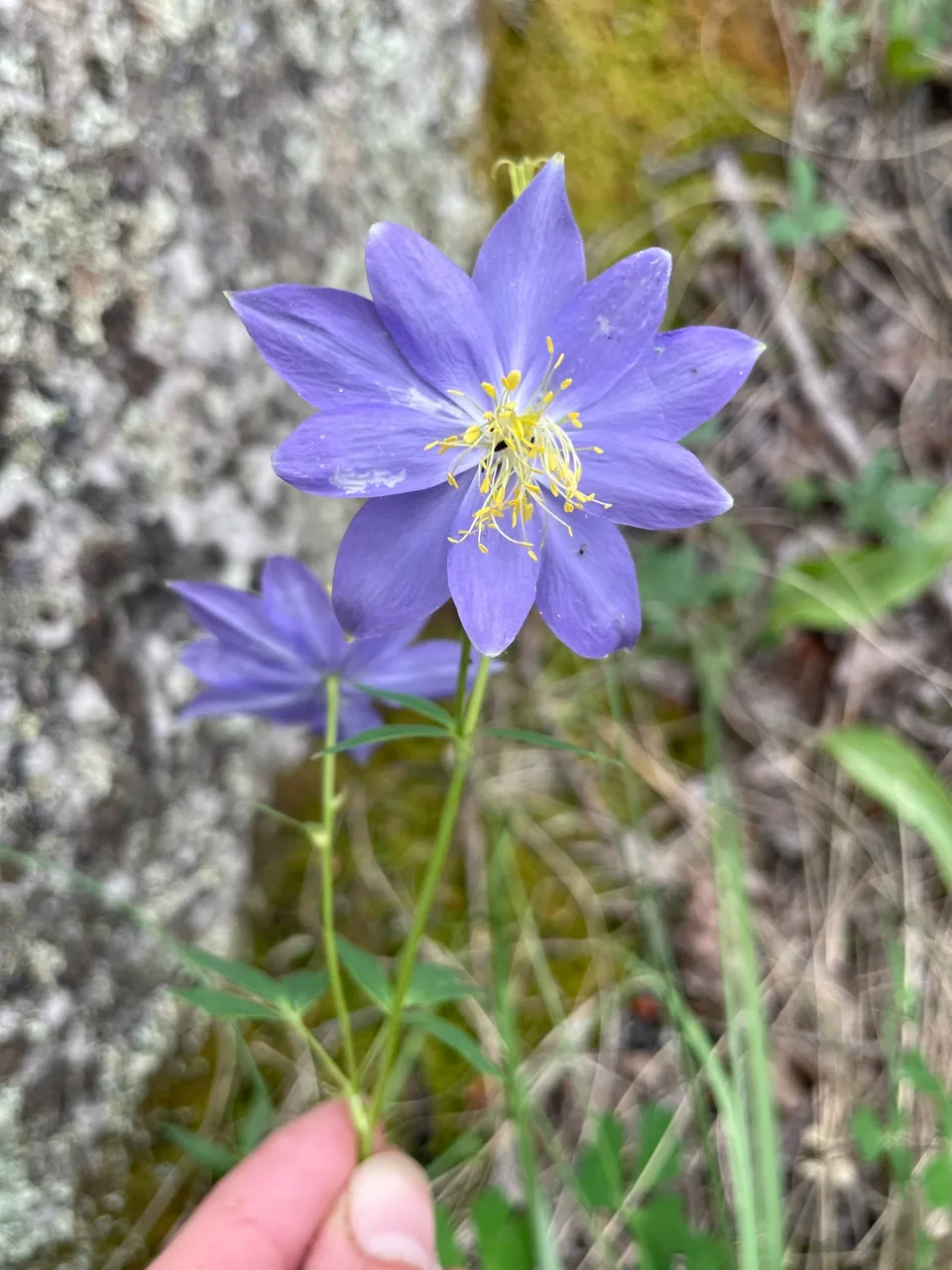
How to Grow and Care for Columbine
Aquilegia caerulea
Written by Emilio Marruso · last checked
Toxic to: People · Why
At a glance
This columbine is a perennial that comes back year after year, growing 1–2 ft tall and wide, with flowers rich in nectar. Give it moist but not wet soil and a little compost in spring, then plant seedlings out in late spring or early summer. You can start it from seed or divide it in spring.
- Water
Water moderately: keep the soil moist but not wet
What the sources say (2)
Watering: Moderate; moist but not wet soil
Shade tolerance light shade Water moderate Hardiness Zone 3+ Soil textures sandy, loamy Soil
— Rocky Mountain Columbine (Aquilegia caerulea) — Practical Plants [6] Succeeds in ordinary garden soil, preferring a moist but not wet soil and a sheltered sunny position[ 1 Title RHS Dictionary of
— Aquilegia caerulea - Useful Temperate Plants [3] - Planting
Plant seedlings out in late spring or early summer
What the sources say (1)
Planting: Late spring or early summer (seedlings)
Plant out in late spring or early summer.
— Aquilegia caerulea - Useful Temperate Plants [3] - Feeding
Compost or all-purpose fertilizer in spring; again if you like when buds form
What the sources say (3)
When: In spring as the leaves begin to emerge; a second application when the flower buds are forming
will respond well to a fertilizer application in spring as the leaves begin to emerge. Utilize an all-purpose, complete fertilizer of your choice. A second application can be made when the flower buds are forming.
— All About Columbine | Yard and Garden [1] Natural fertilizers: Compost worked into the soil
Amend soils with compost to help provide the moisture-rich but well-drained soils columbine thrives in.
— All About Columbine | Yard and Garden [1] Mineral fertilizers: All-purpose, complete fertilizer
Columbine loves a bit of fertilizer and will respond well to a fertilizer application in spring as the leaves begin to emerge. Utilize an all-purpose, complete fertilizer of your choice.
— All About Columbine | Yard and Garden [1] - Pests
Aphids, spider mites, borers and leafminers; watch out for crown rot
What the sources say (3)
Pests: aphids, spider mites, columbine borers, columbine leafminer
Occasionally, plants may see aphids, spider mites, or columbine borers, but these issues rarely cause notable problems.
— All About Columbine | Yard and Garden [1] The one consistent pest problem noticed in the home garden is the columbine leafminer that disfigures the leaves.
— All About Columbine | Yard and Garden [1] Diseases: crown rot
Crown rot is possible in poorly drained soils, so plant in better-draining soils should this issue develop.
— All About Columbine | Yard and Garden [1] - Size
1–2 ft tall and 1–2 ft wide
What the sources say (2)
Mature height: 30.5-61 cm (1-2 ft)
Colorado Columbine is a bushy, clump-forming perennial, 1-2 feet tall and 1-2 feet wide, growing from a taproot. It blooms April-July.
— Colorado Columbine | USU [4] Mature width: 30.5-61 cm (1-2 ft)
Colorado Columbine is a bushy, clump-forming perennial, 1-2 feet tall and 1-2 feet wide, growing from a taproot. It blooms April-July.
— Colorado Columbine | USU [4] - Propagation
Grow it from seed or divide the plant in spring
What the sources say (2)
Propagation: Seed; division in spring
Seed - best sown as soon as it is ripe in a cold frame. The seed can be slow to germinate[ 200 Title The
— Aquilegia caerulea - Useful Temperate Plants [3] Division in spring [4] . ## Cultivation This section contains
— Rocky Mountain Columbine (Aquilegia caerulea) — Practical Plants [6] - Sowing
Sow fresh seed as soon as it is ripe, or stored seed in late winter
What the sources say (2)
Sowing: As soon as the seed is ripe (cold frame); stored seed in late winter; indoors in winter for spring germination
Seed - best sown as soon as it is ripe in a cold frame. The seed can be slow to germinate[ 200 Title The
— Aquilegia caerulea - Useful Temperate Plants [3] Propagation Starting with fresh seed, sow indoors in winter for spring germination.
— Rocky Mountain columbine - Fine Gardening [7] - Safety
All parts are poisonous if eaten
Overview
Rocky Mountain columbine is a perennial native to the Rocky Mountains and the state flower of Colorado. [4][5] One source states that all parts of the plant are poisonous if ingested. [4]
This record is incomplete: the sources we read do not cover every field yet.
Not yet covered by our sources: Pruning
Columbine care
How to water Columbine
Moderate; moist but not wet soil
What the sources say (2)
Shade tolerance
light shade
Water
moderate
Hardiness
Zone 3+
Soil textures
sandy, loamy
SoilSucceeds in ordinary garden soil, preferring a moist but not wet soil and a sheltered sunny position[ 1 Title
RHS Dictionary ofHow much light Columbine needs
The sources disagree:
It prefers rich, moist soils with light to moderate shade.
[4]
How much cold Columbine can take
Hardiness, coldest zone
The sources give different values depending on region, zone or growing conditions.
What each source says
According to Practical Plants: 3 [winter low −40 to −34.4 °C (−40 to −30 °F)]
According to Fine Gardening: 4 [winter low −34.4 to −28.9 °C (−30 to −20 °F)]
Hardiness, warmest zone
7 [winter low −17.8 to −12.2 °C (0 to 10 °F)]
What the sources say (1)
Zones :
4, 5, 6, 7
-
CharacteristicsHow to propagate Columbine
Seed; division in spring
What the sources say (2)
Seed - best sown as soon as it is ripe in a cold frame. The seed can be slow to germinate[ 200 Title
TheDivision in spring [4] .
## Cultivation
This section containsHow to grow Columbine
The plant
Life cycle
perennial
What the sources say (1)
Colorado Columbine is a bushy, clump-forming perennial, 1-2 feet tall and 1-2 feet wide, growing from a taproot. It blooms April-July.Family
Ranunculaceae
What the sources say (1)
perennial plants in the hellebore family (Ranunculaceae) that are found in meadows, woodlands, and at higher altitudes throughout the Northern hemisphere.Mature height
30.5-61 cm (1-2 ft)
What the sources say (1)
Colorado Columbine is a bushy, clump-forming perennial, 1-2 feet tall and 1-2 feet wide, growing from a taproot. It blooms April-July.Mature width
30.5-61 cm (1-2 ft)
What the sources say (1)
Colorado Columbine is a bushy, clump-forming perennial, 1-2 feet tall and 1-2 feet wide, growing from a taproot. It blooms April-July.Pests and diseases
Pests
aphids, spider mites, columbine borers, columbine leafminer
What the sources say (2)
Occasionally, plants may see aphids, spider mites, or columbine borers, but these issues rarely cause notable problems.The one consistent pest problem noticed in the home garden is the columbine leafminer that disfigures the leaves.Diseases
crown rot
What the sources say (1)
Crown rot is possible in poorly drained soils, so plant in better-draining soils should this issue develop.Fertilizing
When
In spring as the leaves begin to emerge; a second application when the flower buds are forming
What the sources say (1)
will respond well to a fertilizer application in spring as the leaves begin to emerge. Utilize an all-purpose, complete fertilizer of your choice. A second application can be made when the flower buds are forming.How often
Once in spring, with an optional second application at bud formation
What the sources say (1)
will respond well to a fertilizer application in spring as the leaves begin to emerge. Utilize an all-purpose, complete fertilizer of your choice. A second application can be made when the flower buds are forming.Natural fertilizers
Compost worked into the soil
What the sources say (1)
Amend soils with compost to help provide the moisture-rich but well-drained soils columbine thrives in.Mineral fertilizers
All-purpose, complete fertilizer
What the sources say (1)
Columbine loves a bit of fertilizer and will respond well to a fertilizer application in spring as the leaves begin to emerge. Utilize an all-purpose, complete fertilizer of your choice.Columbine pests and problems
Powdery mildew
What the sources say (1)
Problems Powdery mildew, rust, aphids, leaf miners, caterpillars.
— Rocky Mountain columbine - Fine Gardening [7] Rust
What the sources say (1)
Problems Powdery mildew, rust, aphids, leaf miners, caterpillars.
— Rocky Mountain columbine - Fine Gardening [7] Aphids
What the sources say (1)
Problems Powdery mildew, rust, aphids, leaf miners, caterpillars.
— Rocky Mountain columbine - Fine Gardening [7] Leaf miners
What the sources say (1)
Problems Powdery mildew, rust, aphids, leaf miners, caterpillars.
— Rocky Mountain columbine - Fine Gardening [7] Caterpillars
What the sources say (1)
Problems Powdery mildew, rust, aphids, leaf miners, caterpillars.
— Rocky Mountain columbine - Fine Gardening [7]
Remedies
Each remedy shows what official sources say about it; traditional remedies without an official source are marked as such. Harmful ones are listed so you know to avoid them.
Treating the plant
leaf miners
cutting the plant to the ground after flowering Partly works
This should only be done if you really cannot tolerate the damage!
— All About Columbine | Yard and Garden [1] How: Cut the whole plant down to the ground after it finishes flowering; the leaf miner larvae are gone by the time the second new growth begins.
In spring, leaf miners tunnel through the surface of the leaves, leaving unsightly foliage. To remedy this, cut the whole plant down to the ground after they finish flowering.
— rainyside.com [8] What the evidence says The practical control is to ignore them, but if you must do something, the foliage can be trimmed back to the base after flowering, and a new, fresh mound of leaves will appear.
— All About Columbine | Yard and Garden [1]
Is Columbine poisonous?
Reported by the source, quoted verbatim. This is not medical or veterinary advice: if a person or an animal may have eaten this plant, contact a poison control centre or a veterinarian.
Calendar
Sowing
As soon as the seed is ripe (cold frame); stored seed in late winter; indoors in winter for spring germination
What the sources say (2)
Seed - best sown as soon as it is ripe in a cold frame. The seed can be slow to germinate[ 200 Title
ThePropagation Starting with fresh seed, sow indoors in winter for spring germination.Planting
Late spring or early summer (seedlings)
What the sources say (1)
Plant out in late spring or early summer.Pruning
Not stated in the sources we read.
Months as given by the sources, which are mostly from the United States (northern hemisphere). In the southern hemisphere they shift by about six months.
Edibility
Reported by the source, quoted verbatim. Do not eat a plant on the basis of this page alone: identification mistakes can be dangerous.
Flowers - raw. Rich in nectar, they have a sweet taste[ 172 Title Discovering Wild Plants
[3]
Indicative values
Values from a secondary source, not checked word for word like the rest of this page. Use them as a starting point.
- Hours of sun
- 4-6 hoursIndicative value, adapt it to your climate · Secondary source
- Soil pH
- 6-7Indicative value, adapt it to your climate · Secondary source
- Care level
- MediumIndicative value, adapt it to your climate · Secondary source
- Growth rate
- LowIndicative value, adapt it to your climate · Secondary source
- Pruning
- February, March, April, May, May, June, July, AugustIndicative value, adapt it to your climate · Secondary source
Similar plants
- Columbine Aquilegia canadensis
- Columbine Aquilegia viridiflora
- Fan columbine Aquilegia flabellata
- Golden Columbine Aquilegia chrysantha
- Utah Columbine Aquilegia scopulorum
- Alpine Columbine Aquilegia alpina
- Common columbine Aquilegia vulgaris
- Dark Columbine Aquilegia atrata
Sources
Every value above is quoted from these documents. Links lead to the original publisher.
- All About Columbine | Yard and Garden · yardandgarden.extension.iastate.edu, consulted
- Aquilegia (Columbine) | North Carolina Extension Gardener Plant Toolbox · plants.ces.ncsu.edu, consulted
- Aquilegia caerulea - Useful Temperate Plants · temperate.theferns.info, consulted
- Colorado Columbine | USU · extension.usu.edu, consulted
- Aquilegia coerulea, Colorado blue columbine · fs.usda.gov, consulted
- Rocky Mountain Columbine (Aquilegia caerulea) — Practical Plants · practicalplants.org, consulted
- Rocky Mountain columbine - Fine Gardening · finegardening.com, consulted
- rainyside.com · rainyside.com
Written by Emilio Marruso · last checked