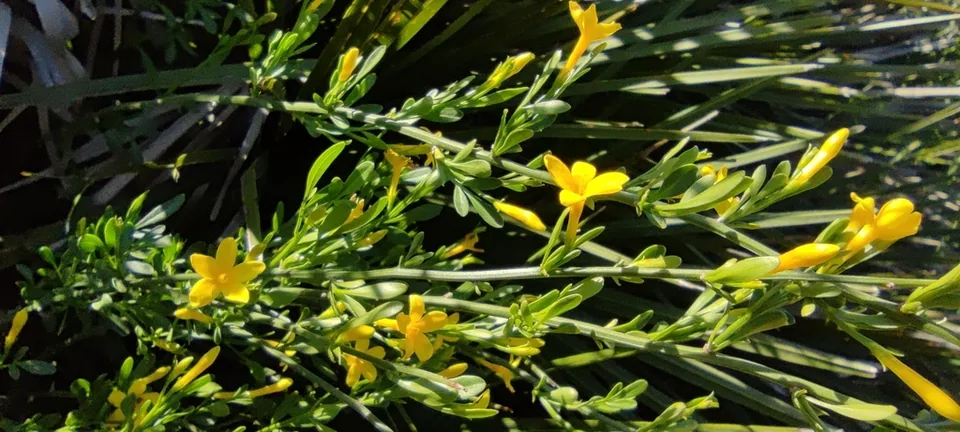
How to Grow and Care for Common Yellow Jasmine
Chrysojasminum fruticans
Written by Emilio Marruso · last checked
Not toxic to cats and dogs, according to the sources · Sources
At a glance
This wild jasmine is an easygoing perennial that grows 3 to 6 feet tall and is happy in full sun or partial shade. Give it fertile, moist, well-drained soil and it is generally free of serious pests and diseases. Even better, it is non-toxic to cats, dogs and horses, so your animals can safely share the garden with it.
- Sun
Full sun to partial shade
What the sources say (1)
Light: Full sun to partial shade
This shrub grows best in fertile, moist, well-drained soil in full sun or partial shade.
— Chrysojasminum fruticans (Common Yellow Jasmine, Wild Jasmine) | North Carolina Extension Gardener Plant Toolbox [1] - Water
Keep the soil moist, but make sure water drains away well
What the sources say (1)
Watering notes: Fertile, moist, well-drained soil
This shrub grows best in fertile, moist, well-drained soil in full sun or partial shade.
— Chrysojasminum fruticans (Common Yellow Jasmine, Wild Jasmine) | North Carolina Extension Gardener Plant Toolbox [1] - Cold
Survives winters down to 0 °F (−17.8 °C)
Hardy in very cold winters · USDA 7a · RHS H6 · Z7
What the sources say (2)
Hardiness, coldest zone: 7a [winter low −17.8 to −15 °C (0 to 5 °F)]
USDA Plant Hardiness Zone: 7a, 7b, 8a, 8b, 9a, 9b, 10a, 10b, 11a, 11b
— Chrysojasminum fruticans (Common Yellow Jasmine, Wild Jasmine) | North Carolina Extension Gardener Plant Toolbox [1] Hardiness, warmest zone: 11b [winter low 7.2 to 10 °C (45 to 50 °F)]
USDA Plant Hardiness Zone: 7a, 7b, 8a, 8b, 9a, 9b, 10a, 10b, 11a, 11b
— Chrysojasminum fruticans (Common Yellow Jasmine, Wild Jasmine) | North Carolina Extension Gardener Plant Toolbox [1] - Soil
Fertile, well-drained soil, pH 6.0–8.0
What the sources say (3)
Watering notes: Fertile, moist, well-drained soil
This shrub grows best in fertile, moist, well-drained soil in full sun or partial shade.
— Chrysojasminum fruticans (Common Yellow Jasmine, Wild Jasmine) | North Carolina Extension Gardener Plant Toolbox [1] Soil pH, minimum: 6.0
Soil pH: Neutral (6.0-8.0) Soil Drainage: Good Drainage
— Chrysojasminum fruticans (Common Yellow Jasmine, Wild Jasmine) | North Carolina Extension Gardener Plant Toolbox [1] Soil pH, maximum: 8.0
Soil pH: Neutral (6.0-8.0) Soil Drainage: Good Drainage
— Chrysojasminum fruticans (Common Yellow Jasmine, Wild Jasmine) | North Carolina Extension Gardener Plant Toolbox [1] - Pests
Aphids, scale insects and mealybugs may show up, but serious problems are rare
What the sources say (1)
Pests: aphids, scale insects, mealybugs
Generally free of serious pests and diseases. Insect pests may include aphids, scale insects and mealybugs.
— Chrysojasminum fruticans (Common Yellow Jasmine, Wild Jasmine) | North Carolina Extension Gardener Plant Toolbox [1] - Size
3 to 6 ft tall
What the sources say (1)
Mature height: 91-183 cm (3 to 6 feet)
At 3 to 6 feet in height, it is perfect for borders and foundation plantings.
— Chrysojasminum fruticans (Common Yellow Jasmine, Wild Jasmine) | North Carolina Extension Gardener Plant Toolbox [1] - Safety
Not toxic to cats, dogs or horses
Overview
Common yellow jasmine is a small evergreen or semi-evergreen shrub with yellow, slightly fragrant flowers in spring and early autumn. [1] It grows best in fertile, moist, well-drained soil in full sun or partial shade. [1]
This record is incomplete: the sources we read do not cover every field yet.
Not yet covered by our sources: Watering, Pruning, Propagation
Common Yellow Jasmine care
How to water Common Yellow Jasmine
Watering
Not stated in the sources we read.
Watering notes
Fertile, moist, well-drained soil
What the sources say (1)
This shrub grows best in fertile, moist, well-drained soil in full sun or partial shade.How much light Common Yellow Jasmine needs
Full sun to partial shade
What the sources say (1)
This shrub grows best in fertile, moist, well-drained soil in full sun or partial shade.How much cold Common Yellow Jasmine can take
Hardiness, coldest zone
7a [winter low −17.8 to −15 °C (0 to 5 °F)]
What the sources say (1)
USDA Plant Hardiness Zone:
7a, 7b, 8a, 8b, 9a, 9b, 10a, 10b, 11a, 11bHardiness, warmest zone
11b [winter low 7.2 to 10 °C (45 to 50 °F)]
What the sources say (1)
USDA Plant Hardiness Zone:
7a, 7b, 8a, 8b, 9a, 9b, 10a, 10b, 11a, 11bBest soil for Common Yellow Jasmine
Soil pH, minimum
6.0
What the sources say (1)
Soil pH:
Neutral (6.0-8.0)
Soil Drainage:
Good DrainageSoil pH, maximum
8.0
What the sources say (1)
Soil pH:
Neutral (6.0-8.0)
Soil Drainage:
Good DrainageHow to propagate Common Yellow Jasmine
Not stated in the sources we read.
How to grow Common Yellow Jasmine
The plant
Life cycle
perennial
What the sources say (1)
Family:
Oleaceae
Life Cycle:
Perennial
Woody
Country Or Region Of Origin:
Mediterranean to Northern IranFamily
Oleaceae
What the sources say (1)
Family:
Oleaceae
Life Cycle:
Perennial
Woody
Country Or Region Of Origin:
Mediterranean to Northern IranMature height
91-183 cm (3 to 6 feet)
What the sources say (1)
At 3 to 6 feet in height, it is perfect for borders and foundation plantings.Pests and diseases
Pests
aphids, scale insects, mealybugs
What the sources say (1)
Generally free of serious pests and diseases. Insect pests may include aphids, scale insects and mealybugs.Common Yellow Jasmine pests and problems
Aphids, scale insects and mealybugs
Symptom: Insect pests may include aphids, scale insects and mealybugs.
What to do: Generally free of serious pests and diseases.
What the sources say (1)
Generally free of serious pests and diseases. Insect pests may include aphids, scale insects and mealybugs.
— Chrysojasminum fruticans (Common Yellow Jasmine, Wild Jasmine) | North Carolina Extension Gardener Plant Toolbox [1]
Remedies
Each remedy shows what official sources say about it; traditional remedies without an official source are marked as such. Harmful ones are listed so you know to avoid them.
Treating the plant
aphids, scale insects and mealybugs
insecticidal soap Works
Make sure to test the soap and alcohol mixtures on a small portion of the plant prior to full application because some plants may be sensitive to soap or alcohol.
— planttalk.colostate.edu [4] How: Shower the infested plant with warm water, then apply to the upper and lower surfaces of leaves and stems; repeat applications will be needed.
Give insect ridden plants a shower with warm water. Then apply insecticidal soap or Neem to the upper and lower surfaces of the leaves and stems. This will kill aphids, mites and the immature stages of the other pests. Repeat applications will be needed.
— melindamyers.com [2] What the evidence says insecticidal soap is a safe, effective organic insecticide with minimal environmental impact.
— extension.psu.edu [3] neem Not verified
Traditional remedy, not verified by an official source.
How: Shower the infested plant with warm water, then apply to the upper and lower surfaces of leaves and stems; repeat applications will be needed.
mealybugs
rubbing alcohol Official source, not independently tested
Make sure to test the soap and alcohol mixtures on a small portion of the plant prior to full application because some plants may be sensitive to soap or alcohol.
— planttalk.colostate.edu [4] How: For small infestations, dab the insects with a cotton swab dipped in rubbing alcohol and repeat every week until the bugs are gone.
For smaller infestations, dab the insects with a cotton swab dipped in rubbing alcohol. Repeat this procedure every week until the bugs are gone.
— planttalk.colostate.edu [4]
Is Common Yellow Jasmine poisonous?
Reported by the source, quoted verbatim. This is not medical or veterinary advice: if a person or an animal may have eaten this plant, contact a poison control centre or a veterinarian.
#non-toxic for cats #non-toxic for horses #non-toxic for dogs
[1]The source flags the risk for this animal but does not explain why.
Calendar
Pruning
Not stated in the sources we read.
Months as given by the sources, which are mostly from the United States (northern hemisphere). In the southern hemisphere they shift by about six months.
Similar plants
- Italian Yellow Jasmine Chrysojasminum humile
- Amur privet Ligustrum amurense
- Black ash Fraxinus nigra
- Blue Ash Fraxinus quadrangulata
- Chinese Fringetree Chionanthus retusus
- Chinese Privet Ligustrum sinense
- Common Jasmine Jasminum officinale
- Delavay Tea Olive Osmanthus delavayi
Sources
Every value above is quoted from these documents. Links lead to the original publisher.
- Chrysojasminum fruticans (Common Yellow Jasmine, Wild Jasmine) | North Carolina Extension Gardener Plant Toolbox · plants.ces.ncsu.edu, consulted
- melindamyers.com · melindamyers.com
- extension.psu.edu · extension.psu.edu
- planttalk.colostate.edu · planttalk.colostate.edu
Written by Emilio Marruso · last checked