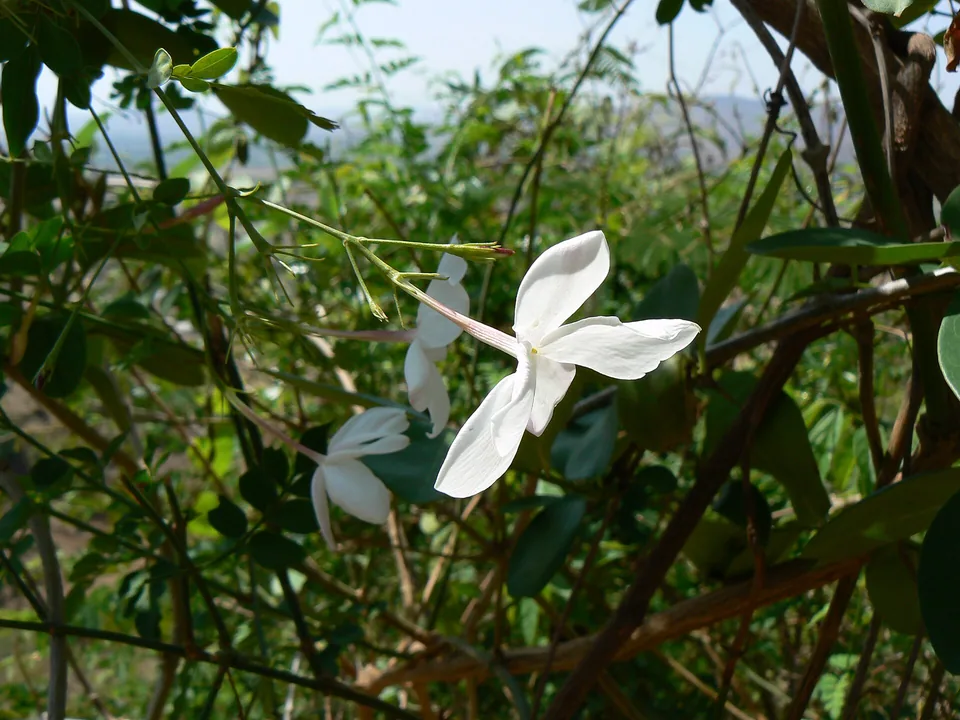


How to Grow and Care for Common Jasmine
Jasminum officinale
Written by Emilio Marruso · last checked
Not toxic to cats and dogs, according to the sources · Sources
At a glance
Jasmine is an easygoing perennial that grows happily in full sun or partial shade and tolerates drought. Give it a light, well-drained soil rich in organic matter, and it can spread up to 15 feet wide. It grows in containers and even indoors, it is safe for cats, dogs and horses, and butterflies love it.
- Sun
Full sun to partial shade
What the sources say (1)
Light: Full sun to partial shade
Jasmine grows in full sun to partial shade and is drought and pollution tolerant.
— Jasminum officinale (Common Jasmine, Poet's Jasmine, True Jasmine) | North Carolina Extension Gardener Plant Toolbox [1] - Water
Tolerates drought
What the sources say (1)
Watering: Drought tolerant
Jasmine grows in full sun to partial shade and is drought and pollution tolerant.
— Jasminum officinale (Common Jasmine, Poet's Jasmine, True Jasmine) | North Carolina Extension Gardener Plant Toolbox [1] - Cold
Survives winters down to 5 °F (−15 °C)
Hardy in cold winters · USDA 7b · RHS H5 · Z7
What the sources say (2)
Hardiness, coldest zone: 7b [winter low −15 to −12.2 °C (5 to 10 °F)]
USDA Plant Hardiness Zone: 7b, 8a, 8b, 9a, 9b, 10a, 10b
— Jasminum officinale (Common Jasmine, Poet's Jasmine, True Jasmine) | North Carolina Extension Gardener Plant Toolbox [1] Hardiness, warmest zone: 10b [winter low 1.7 to 4.4 °C (35 to 40 °F)]
USDA Plant Hardiness Zone: 7b, 8a, 8b, 9a, 9b, 10a, 10b
— Jasminum officinale (Common Jasmine, Poet's Jasmine, True Jasmine) | North Carolina Extension Gardener Plant Toolbox [1] - Soil
Light, moist, well-drained soil rich in organic matter
What the sources say (1)
Watering notes: Prefers a moist, well-drained, light soil enriched with organic matter
This vigorous plant prefers a moist, well-drained, light soil enriched with organic matter, but they tolerate average soil.
— Jasminum officinale (Common Jasmine, Poet's Jasmine, True Jasmine) | North Carolina Extension Gardener Plant Toolbox [1] - Pruning
Prune after the flowers fade
What the sources say (1)
Pruning: After the blooms fade
the plant responds well to severe pruning after the blooms fade.
— Jasminum officinale (Common Jasmine, Poet's Jasmine, True Jasmine) | North Carolina Extension Gardener Plant Toolbox [1] - Pests
Few serious problems; watch for scale, mealybugs, aphids and whiteflies
What the sources say (1)
Pests: scale, mealybugs, aphids, whitefly
Common jasmine has few serious insect or disease problems. Monitor for scale mealy bugs, and aphids. Houseplants are occasionally be troubled by indoor plant issues as scale or whitefly
— Jasminum officinale (Common Jasmine, Poet's Jasmine, True Jasmine) | North Carolina Extension Gardener Plant Toolbox [1] - Size
Up to 15 ft wide
What the sources say (1)
Mature width: up to 457 cm (15 ft)
Common jasmine can reach as much as 40 feet and spread to as much as 15 feet.
— Jasminum officinale (Common Jasmine, Poet's Jasmine, True Jasmine) | North Carolina Extension Gardener Plant Toolbox [1] - Containers
Grows in containers and indoors too
What the sources say (2)
In containers: Yes
This Jasmine is not cold tolerant beyond zone 7, but can be grown as a container plant and brought inside to over-winter.
— Jasminum officinale (Common Jasmine, Poet's Jasmine, True Jasmine) | North Carolina Extension Gardener Plant Toolbox [1] Indoors: Yes
If grown indoors, it will require hard pruning and a trellis or support.
— Jasminum officinale (Common Jasmine, Poet's Jasmine, True Jasmine) | North Carolina Extension Gardener Plant Toolbox [1] - Safety
Not toxic to cats, dogs or horses
Overview
Common jasmine is a perennial twining vine that grows in full sun to partial shade. [1] It prefers moist, well-drained, light soil and responds well to severe pruning after the blooms fade. [1] It can be grown as a container plant and brought inside to over-winter. [1]
This record is incomplete: the sources we read do not cover every field yet.
Not yet covered by our sources: Propagation
Common Jasmine care
How to water Common Jasmine
Watering
Drought tolerant
What the sources say (1)
Jasmine grows in full sun to partial shade and is drought and pollution tolerant.Watering notes
Prefers a moist, well-drained, light soil enriched with organic matter
What the sources say (1)
This vigorous plant prefers a moist, well-drained, light soil enriched with organic matter, but they tolerate average soil.How much light Common Jasmine needs
Full sun to partial shade
What the sources say (1)
Jasmine grows in full sun to partial shade and is drought and pollution tolerant.How much cold Common Jasmine can take
Hardiness, coldest zone
7b [winter low −15 to −12.2 °C (5 to 10 °F)]
What the sources say (1)
USDA Plant Hardiness Zone:
7b, 8a, 8b, 9a, 9b, 10a, 10bHardiness, warmest zone
10b [winter low 1.7 to 4.4 °C (35 to 40 °F)]
What the sources say (1)
USDA Plant Hardiness Zone:
7b, 8a, 8b, 9a, 9b, 10a, 10bWhere to grow Common Jasmine
Indoors
Yes
What the sources say (1)
If grown indoors, it will require hard pruning and a trellis or support.In containers
Yes
What the sources say (1)
This Jasmine is not cold tolerant beyond zone 7, but can be grown as a container plant and brought inside to over-winter.How to propagate Common Jasmine
Not stated in the sources we read.
How to grow Common Jasmine
The plant
Life cycle
perennial
What the sources say (1)
Common jasmine is an evergreen, perennial vine in the olive family (Oleaceae).Family
Oleaceae
What the sources say (1)
Common jasmine is an evergreen, perennial vine in the olive family (Oleaceae).Mature height
Mature width
up to 457 cm (15 ft)
What the sources say (1)
Common jasmine can reach as much as 40 feet and spread to as much as 15 feet.Pests and diseases
Pests
scale, mealybugs, aphids, whitefly
What the sources say (1)
Common jasmine has few serious insect or disease problems. Monitor for scale mealy bugs, and aphids. Houseplants are occasionally be troubled by indoor plant issues as scale or whiteflyCommon Jasmine pests and problems
Scale, mealybugs and aphids
Symptom: Few serious insect or disease problems; scale, mealybugs and aphids are to be monitored
What to do: Monitor the plants
What the sources say (1)
Common jasmine has few serious insect or disease problems. Monitor for scale mealy bugs, and aphids.
— Jasminum officinale (Common Jasmine, Poet's Jasmine, True Jasmine) | North Carolina Extension Gardener Plant Toolbox [1] Indoor scale and whitefly
Symptom: Houseplants are occasionally troubled by scale or whitefly
What the sources say (1)
Houseplants are occasionally be troubled by indoor plant issues as scale or whitefly
— Jasminum officinale (Common Jasmine, Poet's Jasmine, True Jasmine) | North Carolina Extension Gardener Plant Toolbox [1]
Remedies
Each remedy shows what official sources say about it; traditional remedies without an official source are marked as such. Harmful ones are listed so you know to avoid them.
Treating the plant
sap-sucking insects
dish soap and water spray Not proven
How: A soapy solution of water and dish soap; try non-toxic methods initially.
A soapy solution of water and dish soap can clog up most pests' breathing areas and kill a large amount of the population.
— gardeningknowhow.com [4] What the evidence says Despite being made of common household materials like dish soap and vinegar and having seemingly fewer risks, these concoctions may have unforeseen consequences and cannot be relied upon to have the same effectiveness as a registered pesticide.
— extension.unh.edu [5]
aphids
warm water shower then insecticidal soap Works
How: Shower the plant with warm water, then apply insecticidal soap to the upper and lower surfaces of leaves and stems; repeat applications will be needed.
Give insect ridden plants a shower with warm water. Then apply insecticidal soap or Neem to the upper and lower surfaces of the leaves and stems.
— melindamyers.com [6] What the evidence says If aphids are the culprit, they can be controlled with a strong spray of water, insecticidal soap or Malathion.
— uaex.uada.edu [7]
scale
removing adult scale Not verified
Traditional remedy, not verified by an official source.
How: Remove the hard shell-like structures, the adult scale insects, found on leaves and stems.
Is Common Jasmine poisonous?
Reported by the source, quoted verbatim. This is not medical or veterinary advice: if a person or an animal may have eaten this plant, contact a poison control centre or a veterinarian.
#butterfly friendly #non-toxic for cats #non-toxic for horses #non-toxic for dogs #container plant
[1]The source flags the risk for this animal but does not explain why.
Calendar
Pruning
After the blooms fade
What the sources say (1)
the plant responds well to severe pruning after the blooms fade.Months as given by the sources, which are mostly from the United States (northern hemisphere). In the southern hemisphere they shift by about six months.
Indicative values
Values from a secondary source, not checked word for word like the rest of this page. Use them as a starting point.
- Hours of sun
- 6-8 hoursIndicative value, adapt it to your climate · Secondary source
- Drought tolerant
- yesIndicative value, adapt it to your climate · Secondary source
- Soil pH
- 6-7Indicative value, adapt it to your climate · Secondary source
- Care level
- MediumIndicative value, adapt it to your climate · Secondary source
- Growth rate
- HighIndicative value, adapt it to your climate · Secondary source
- Propagation
- Stem Propagation, Layering Propagation, Grafting Propagation, Division, Seed PropagationIndicative value, adapt it to your climate · Secondary source
Similar plants
- Red Jasmine Jasminum beesianum
- Winter Jasmine Jasminum nudiflorum
- Jasminum sambac Jasminum sambac
- Pink Jasmine Jasminum polyanthum
- Amur privet Ligustrum amurense
- Black ash Fraxinus nigra
- Blue Ash Fraxinus quadrangulata
- Chinese Fringetree Chionanthus retusus
Sources
Every value above is quoted from these documents. Links lead to the original publisher.
- Jasminum officinale (Common Jasmine, Poet's Jasmine, True Jasmine) | North Carolina Extension Gardener Plant Toolbox · plants.ces.ncsu.edu, consulted
- Common Jasmine - Jasminum officinale | North Carolina Extension Gardener Plant Toolbox · plants.ces.ncsu.edu, consulted
- Jasmine | Home & Garden Information Center · hgic.clemson.edu, consulted
- gardeningknowhow.com · gardeningknowhow.com
- extension.unh.edu · extension.unh.edu
- melindamyers.com · melindamyers.com
- uaex.uada.edu · uaex.uada.edu
Written by Emilio Marruso · last checked