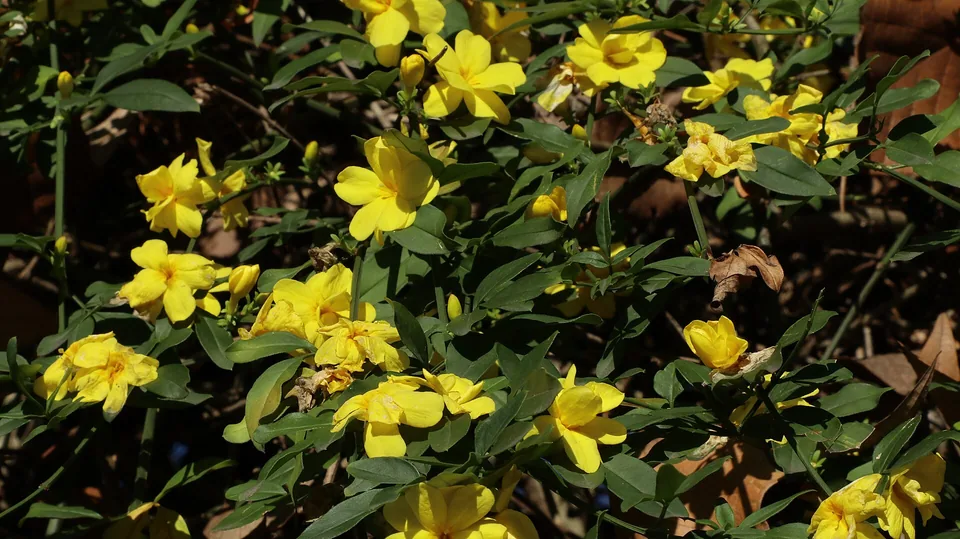


How to Grow and Care for Winter Jasmine
Jasminum nudiflorum
Written by Emilio Marruso · last checked
Not toxic to cats and dogs, according to the sources · Sources
At a glance
Winter jasmine is an easygoing shrub that grows fast and handles dry spells well once established. It's happy in full sun or partial shade, has few serious pest problems, and is safe around cats, dogs and horses. Its arching branches even root on their own where they touch the soil, so one plant can easily become many.
- Sun
Full sun to partial shade
What the sources say (2)
Light: Full sun to partial shade
Winter jasmine prefers full sun to partial shade. It will grow in heavy shade, but the floral display will be reduced.
— Jasminum nudiflorum (Winter-flowered Jasmine, Winter Jasmine) | North Carolina Extension Gardener Plant Toolbox [1] Plant in well-drained soil in full sun to light shade.
— Winter Jasmine | Home & Garden Information Center [3] - Water
Handles dry spells once it is established
What the sources say (1)
Watering: Drought tolerant once established
It also tolerates our summer heat and is drought tolerant once established.
— Winter Jasmine | Home & Garden Information Center [3] - Cold
Survives winters down to −10 °F (−23.3 °C)
Very hardy · USDA 6a · RHS H7 · Z6
What the sources say (2)
Hardiness, coldest zone: 6a [winter low −23.3 to −20.6 °C (−10 to −5 °F)]
USDA Plant Hardiness Zone: 6a, 6b, 7a, 7b, 8a, 8b, 9a, 9b, 10a, 10b
— Jasminum nudiflorum (Winter-flowered Jasmine, Winter Jasmine) | North Carolina Extension Gardener Plant Toolbox [1] Hardiness, warmest zone: 10b [winter low 1.7 to 4.4 °C (35 to 40 °F)]
USDA Plant Hardiness Zone: 6a, 6b, 7a, 7b, 8a, 8b, 9a, 9b, 10a, 10b
— Jasminum nudiflorum (Winter-flowered Jasmine, Winter Jasmine) | North Carolina Extension Gardener Plant Toolbox [1] - Pruning
Prune after flowering, before new growth begins
What the sources say (3)
Pruning: After flowering, before new growth begins
It can be rejuvenated by severe pruning after flowering.
— Jasminum nudiflorum (Winter-flowered Jasmine, Winter Jasmine) | North Carolina Extension Gardener Plant Toolbox [1] If pruning is needed or desired, prune in the spring after the floral display has ended.
— Winter Jasmine | Home & Garden Information Center [3] it should be cut back to shoe-top height every three or four years after the blooms finish, but before new growth begins.
— Winter Jasmine [4] - Pests
Few serious problems; watch for Japanese beetles, mealybugs and aphids
What the sources say (1)
Pests: Japanese beetles, mealybugs, aphids
Winter jasmine has few serious insect or disease problems. Monitor for Japanese beetles, mealy bugs, and aphids.
— Jasminum nudiflorum (Winter-flowered Jasmine, Winter Jasmine) | North Carolina Extension Gardener Plant Toolbox [1] - Watch out
Grows fast and spreads into messy clumps; cut it back hard after flowering to renew it
- Size
3–4 ft tall and up to 7 ft wide; trained as a vine, 10–15 ft tall
What the sources say (4)
Mature height: 91-122 cm (3-4 ft)
grown as a vine: 305-457 cm (10-15 ft): Winter jasmine grows up to 4 feet tall. If it is grown as a vine, it will reach 10 to 15 feet tall and 3 to 6 feet wide.
— Jasminum nudiflorum (Winter-flowered Jasmine, Winter Jasmine) | North Carolina Extension Gardener Plant Toolbox [1] Left to its own devices, it is a sprawling, mounding shrub that reaches 3 to 4 feet tall and up to 7 feet wide.
— Winter Jasmine | Home & Garden Information Center [3] Mature width: up to 213 cm (7 ft)
grown as a vine: 91-183 cm (3-6 ft): Winter jasmine grows up to 4 feet tall. If it is grown as a vine, it will reach 10 to 15 feet tall and 3 to 6 feet wide.
— Jasminum nudiflorum (Winter-flowered Jasmine, Winter Jasmine) | North Carolina Extension Gardener Plant Toolbox [1] Left to its own devices, it is a sprawling, mounding shrub that reaches 3 to 4 feet tall and up to 7 feet wide.
— Winter Jasmine | Home & Garden Information Center [3] - Propagation
Arching branches root by themselves where they touch the soil
What the sources say (2)
Propagation: Arching branches root where they touch the soil
This plant roots easily where arching branches touch the soil.
— Jasminum nudiflorum (Winter-flowered Jasmine, Winter Jasmine) | North Carolina Extension Gardener Plant Toolbox [1] The arching branches will root when they contact the ground making it an excellent plant for slope stabilization.
— Winter Jasmine | Home & Garden Information Center [3] - Safety
Not toxic to cats, dogs or horses
Overview
Jasminum nudiflorum is a sprawling deciduous shrub native to Tibet and central China that blooms in winter before the leaves appear. [1] It prefers full sun to partial shade and well-drained soils, and tolerates drought once established. [1][3] Its arching branches root where they touch the soil, and it is pruned after flowering. [1][3]
Winter Jasmine care
How to water Winter Jasmine
Drought tolerant once established
What the sources say (1)
It also tolerates our summer heat and is drought tolerant once established.How much light Winter Jasmine needs
Full sun to partial shade
What the sources say (2)
Winter jasmine prefers full sun to partial shade. It will grow in heavy shade, but the floral display will be reduced.Plant in well-drained soil in full sun to light shade.How much cold Winter Jasmine can take
Hardiness, coldest zone
6a [winter low −23.3 to −20.6 °C (−10 to −5 °F)]
What the sources say (1)
USDA Plant Hardiness Zone:
6a, 6b, 7a, 7b, 8a, 8b, 9a, 9b, 10a, 10bHardiness, warmest zone
10b [winter low 1.7 to 4.4 °C (35 to 40 °F)]
What the sources say (1)
USDA Plant Hardiness Zone:
6a, 6b, 7a, 7b, 8a, 8b, 9a, 9b, 10a, 10bHow to propagate Winter Jasmine
Arching branches root where they touch the soil
What the sources say (2)
This plant roots easily where arching branches touch the soil.The arching branches will root when they contact the ground making it an excellent plant for slope stabilization.How to grow Winter Jasmine
The plant
Life cycle
perennial
What the sources say (1)
Winter jasmine is a sprawling, deciduous, perennial shrub in the olive family (Oleaceae).Family
Oleaceae
What the sources say (1)
Winter jasmine is a sprawling, deciduous, perennial shrub in the olive family (Oleaceae).Mature height
91-122 cm (3-4 ft)
What each source says
grown as a vine: 305-457 cm (10-15 ft):
What the sources say (2)
grown as a vine: 305-457 cm (10-15 ft): Winter jasmine grows up to 4 feet tall. If it is grown as a vine, it will reach 10 to 15 feet tall and 3 to 6 feet wide.Left to its own devices, it is a sprawling, mounding shrub that reaches 3 to 4 feet tall and up to 7 feet wide.Mature width
up to 213 cm (7 ft)
What each source says
grown as a vine: 91-183 cm (3-6 ft):
What the sources say (2)
grown as a vine: 91-183 cm (3-6 ft): Winter jasmine grows up to 4 feet tall. If it is grown as a vine, it will reach 10 to 15 feet tall and 3 to 6 feet wide.Left to its own devices, it is a sprawling, mounding shrub that reaches 3 to 4 feet tall and up to 7 feet wide.Pests and diseases
Pests
Japanese beetles, mealybugs, aphids
What the sources say (1)
Winter jasmine has few serious insect or disease problems. Monitor for Japanese beetles, mealy bugs, and aphids.Winter Jasmine pests and problems
Japanese beetles, mealy bugs and aphids
Symptom: Few serious insect or disease problems; pests to monitor
What to do: Monitor for Japanese beetles, mealy bugs, and aphids
What the sources say (1)
Winter jasmine has few serious insect or disease problems. Monitor for Japanese beetles, mealy bugs, and aphids.
— Jasminum nudiflorum (Winter-flowered Jasmine, Winter Jasmine) | North Carolina Extension Gardener Plant Toolbox [1] Messy colonies if unpruned
Symptom: Cane-like, rapid growth creates colonies that look messy if unpruned
What to do: Rejuvenate by severe pruning after flowering
What the sources say (1)
The cane-like, rapid growth creates colonies that look messy if unpruned. It can be rejuvenated by severe pruning after flowering.
— Jasminum nudiflorum (Winter-flowered Jasmine, Winter Jasmine) | North Carolina Extension Gardener Plant Toolbox [1]
Remedies
Each remedy shows what official sources say about it; traditional remedies without an official source are marked as such. Harmful ones are listed so you know to avoid them.
Treating the plant
sucking and foliar pests
horticultural soap spray Works
How: Treat at the first signs of damage, or preemptively in early spring at bud break.
Most foliar pests can be combated with horticultural soap or oil. Treat at the first signs of damage or for preemptive measures in early spring at bud break.
— gardeningknowhow.com [5] What the evidence says For example, insecticidal soap is a safe, effective organic insecticide with minimal environmental impact.
— extension.psu.edu [6]
leaf spot
pruning weak or dying branches Not verified
Traditional remedy, not verified by an official source.
How: To prevent leaf spot from returning the following year, fertilize appropriately in spring and prune to remove weak or dying branches.
Is Winter Jasmine poisonous?
Reported by the source, quoted verbatim. This is not medical or veterinary advice: if a person or an animal may have eaten this plant, contact a poison control centre or a veterinarian.
#fast growing #non-toxic for cats #non-toxic for horses #non-toxic for dogs
[1]The source flags the risk for this animal but does not explain why.
Calendar
Pruning
After flowering, before new growth begins
What the sources say (3)
It can be rejuvenated by severe pruning after flowering.If pruning is needed or desired, prune in the spring after the floral display has ended.it should be cut back to shoe-top height
every three or four years after the blooms finish, but before new growth begins.Months as given by the sources, which are mostly from the United States (northern hemisphere). In the southern hemisphere they shift by about six months.
Indicative values
Values from a secondary source, not checked word for word like the rest of this page. Use them as a starting point.
- Drought tolerant
- yesIndicative value, adapt it to your climate · Secondary source
- Soil
- Well-drainedIndicative value, adapt it to your climate · Secondary source
- Soil pH
- 6-7.5Indicative value, adapt it to your climate · Secondary source
- Care level
- MediumIndicative value, adapt it to your climate · Secondary source
- Growth rate
- ModerateIndicative value, adapt it to your climate · Secondary source
Similar plants
- Common Jasmine Jasminum officinale
- Red Jasmine Jasminum beesianum
- Jasminum sambac Jasminum sambac
- Pink Jasmine Jasminum polyanthum
- Amur privet Ligustrum amurense
- Black ash Fraxinus nigra
- Blue Ash Fraxinus quadrangulata
- Chinese Fringetree Chionanthus retusus
Sources
Every value above is quoted from these documents. Links lead to the original publisher.
- Jasminum nudiflorum (Winter-flowered Jasmine, Winter Jasmine) | North Carolina Extension Gardener Plant Toolbox · plants.ces.ncsu.edu, consulted
- Winter Jasmine - Jasminum nudiflorum | North Carolina Extension Gardener Plant Toolbox · plants.ces.ncsu.edu, consulted
- Winter Jasmine | Home & Garden Information Center · hgic.clemson.edu, consulted
- Winter Jasmine · uaex.uada.edu, consulted
- gardeningknowhow.com · gardeningknowhow.com
- extension.psu.edu · extension.psu.edu
Written by Emilio Marruso · last checked