
How to Grow and Care for Pink Jasmine
Jasminum polyanthum
Written by Emilio Marruso · last checked
Toxic to: People · Why
At a glance
This jasmine is happy in dappled shade and grows in containers, even indoors. Plant it from May to September and prune it after flowering. Keep it warm, above 55 °F (13 °C), because it can only take a very light frost. And good news for families: no toxic effects have been reported for people.
- Sun
Dappled shade, with filtered light
What the sources say (1)
Light: Dappled shade
Sun Exposure: Dappled shade | Aspect: South facing, west facing
— Jasminum polyanthum | BBC Gardeners World Magazine [5] - Cold
Only takes a very light frost: keep it above 55 °F (13 °C)
- Planting
Plant from May to September
What the sources say (2)
Planting: May to September
According to BBC Gardeners' World (UK): | | Jan | Feb | Mar | Apr | May | Jun | Jul | Aug | Sep | Oct | Nov | Dec | Plant | | | | | yes | yes | yes | yes | yes | | |
— Jasminum polyanthum | BBC Gardeners World Magazine [5] | | Jan | Feb | Mar | Apr | May | Jun | Jul | Aug | Sep | Oct | Nov | Dec | Plant | | | | | yes | yes | yes | yes | yes | | |
— Jasminum polyanthum | BBC Gardeners World Magazine [5] - Pruning
Prune after flowering
What the sources say (1)
Pruning: After flowering
Cut back after flowering to keep growth in check.
— Jasminum polyanthum | BBC Gardeners World Magazine [5] - Watch out
Can turn invasive, climbing into trees and blocking light; dig out young plants that escape
- Containers
Grows in containers, indoors too
What the sources say (2)
In containers: Yes
Plant tender jasmines (such as J. polyanthum ) in containers and keep indoors in a warm, bright spot.
— How to grow jasmine / RHS Growing Guide [6] Indoors: Yes
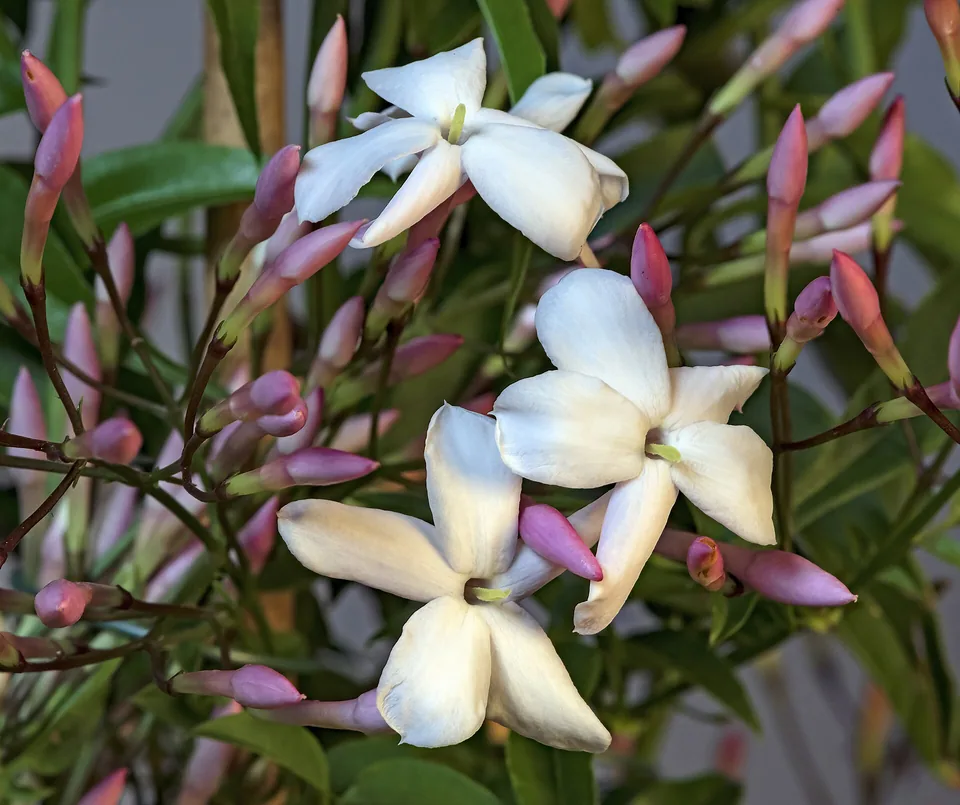
Chinese jasmine ( J. polyanthum ), a tender houseplant with highly fragrant, white flowers, opening from pink buds, in late winter and spring
— How to grow jasmine / RHS Growing Guide [6] - Safety
No toxic effects reported for people
Overview
Pink jasmine is a vigorous evergreen twining climber with highly fragrant white flowers that open from pink buds. [6][3] It is tender: it is grown in containers kept indoors in a warm, bright spot, moved outside in summer, and kept consistently above 13 C (55 F). [6] It has escaped cultivation and is treated as an invasive weed in parts of Australia and New Zealand. [2][3]
This record is incomplete: the sources we read do not cover every field yet.
Not yet covered by our sources: Watering, Hardiness, coldest zone, Hardiness, warmest zone, Propagation
Pink Jasmine care
How to water Pink Jasmine
Not stated in the sources we read.
How much light Pink Jasmine needs
Dappled shade
What the sources say (1)
Sun Exposure:
Dappled shade
|
Aspect:
South facing, west facingHow much cold Pink Jasmine can take
Hardiness, coldest zone
Not stated in the sources we read.
Hardiness, warmest zone
Not stated in the sources we read.
Where to grow Pink Jasmine
Indoors
Yes
What the sources say (1)
Chinese jasmine ( J. polyanthum ), a tender houseplant with highly fragrant, white flowers, opening from pink buds, in late winter and springIn containers
Yes
What the sources say (1)
Plant tender jasmines (such as J. polyanthum ) in containers and keep indoors in a warm, bright spot.How to propagate Pink Jasmine
Not stated in the sources we read.
How to grow Pink Jasmine
Fertilizing
When
The sources give different values depending on region, zone or growing conditions.
What each source says
in the ground: Organic mulch in autumn
What the sources say (1)
in the ground: With jasmines growing in the ground, apply a generous mulch of organic matter , such as well-rotted garden compost , over the area the roots are growing in during autumn.How often
The sources give different values depending on region, zone or growing conditions.
What each source says
in the ground: No feeding needed; a yearly mulch is enough
What the sources say (1)
in the ground: Jasmines in the ground shouldn't need feeding. Annual mulching should be sufficient.Natural fertilizers
The sources give different values depending on region, zone or growing conditions.
What each source says
in the ground: A generous mulch of organic matter such as well-rotted garden compost over the root area in autumn
What the sources say (1)
in the ground: With jasmines growing in the ground, apply a generous mulch of organic matter , such as well-rotted garden compost , over the area the roots are growing in during autumn.Mineral fertilizers
The sources give different values depending on region, zone or growing conditions.
What each source says
in containers: High-potassium liquid feed to boost flowering
What the sources say (1)
in containers: To boost flowering, feed plants growing in containers with a high-potassium liquid feed (such as tomato fertiliser), following the manufacturers instructionsPink Jasmine pests and problems
Invasive spread outside cultivation
Symptom: It climbs into the tree canopy, covers vegetation at all levels and blocks light
What to do: Small plants can be dug out, removing as much of the plant as possible
Frost damage
Symptom: Intolerant of more than a few degrees of frost
What to do: Keep consistently warm, above 13 C (55 F)
What the sources say (2)
J. polyanthum is intolerant of more than a few degrees of frost and only grows vigorously in warm areas.
— Jasminum polyanthum Franch. - Flora of New Zealand Series [4] Tender jasmines, such as Jasminum polyanthum , need to be kept consistently warm, above 13˚C (55˚F).
— How to grow jasmine / RHS Growing Guide [6]
Remedies
Each remedy shows what official sources say about it; traditional remedies without an official source are marked as such. Harmful ones are listed so you know to avoid them.
Getting rid of it
invasive spread
hand removal Not verified
Traditional remedy, not verified by an official source.
How: For a small amount of white jasmine, hand removal is best, making sure all stem and root fragments are dug out.
Is Pink Jasmine poisonous?
Reported by the source, quoted verbatim. This is not medical or veterinary advice: if a person or an animal may have eaten this plant, contact a poison control centre or a veterinarian.
has no toxic effects reported.
[5]
Calendar
May to September
What each source says
According to BBC Gardeners' World (UK): May to September
What the sources say (2)
According to BBC Gardeners' World (UK): | | Jan | Feb | Mar | Apr | May | Jun | Jul | Aug | Sep | Oct | Nov | Dec
| Plant | | | | | yes | yes | yes | yes | yes | | | | | Jan | Feb | Mar | Apr | May | Jun | Jul | Aug | Sep | Oct | Nov | Dec
| Plant | | | | | yes | yes | yes | yes | yes | | | After flowering
What the sources say (1)
Cut back after flowering to keep growth in check.Months as given by the sources, which are mostly from the United States (northern hemisphere). In the southern hemisphere they shift by about six months.
Indicative values
Values from a secondary source, not checked word for word like the rest of this page. Use them as a starting point.
- Life cycle
- PerennialIndicative value, adapt it to your climate · Secondary source
- Hours of sun
- 5-6 hoursIndicative value, adapt it to your climate · Secondary source
- Watering
- AverageIndicative value, adapt it to your climate · Secondary source
- Drought tolerant
- yesIndicative value, adapt it to your climate · Secondary source
- Soil pH
- 6-7Indicative value, adapt it to your climate · Secondary source
- Growth rate
- HighIndicative value, adapt it to your climate · Secondary source
- Propagation
- Stem Propagation, Layering Propagation, Grafting Propagation, Division, Seed PropagationIndicative value, adapt it to your climate · Secondary source
- Pests
- VirusIndicative value, adapt it to your climate · Secondary source
Similar plants
- Common Jasmine Jasminum officinale
- Red Jasmine Jasminum beesianum
- Winter Jasmine Jasminum nudiflorum
- Jasminum sambac Jasminum sambac
- Abies grandis Abies grandis
- Acanthus hungaricus Acanthus hungaricus
- Achlys triphylla Achlys triphylla
- Aconite Aconitum napellus
Sources
Every value above is quoted from these documents. Links lead to the original publisher.
- Jasminum polyanthum - Trees and Shrubs Online · treesandshrubsonline.org, consulted
- NSW WeedWise · weeds.dpi.nsw.gov.au, consulted
- Jasminum polyanthum: Fragrant plants: Featured plants: Biology Building Greenhouse: Indiana University Bloomington · greenhouse.biology.indiana.edu, consulted
- Jasminum polyanthum Franch. - Flora of New Zealand Series · floraseries.landcareresearch.co.nz, consulted
- Jasminum polyanthum | BBC Gardeners World Magazine · gardenersworld.com, consulted
- How to grow jasmine / RHS Growing Guide · rhs.org.uk, consulted
- How to Grow Jasmine · harvesttotable.com, consulted
- indoor jasmine plant care – Elisabeth C. Miller Library · depts.washington.edu, consulted
- rhs.org.uk · rhs.org.uk
Written by Emilio Marruso · last checked