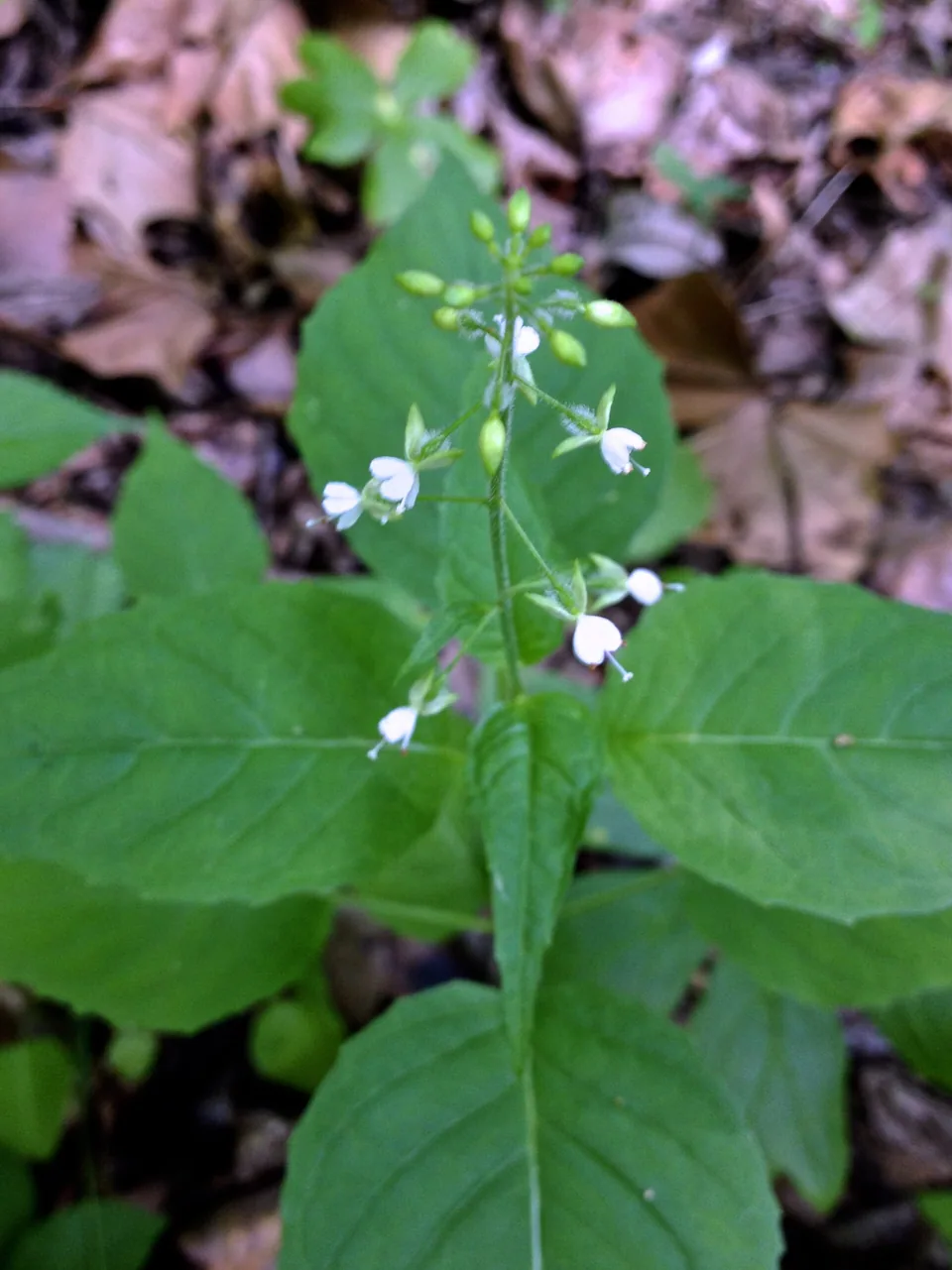


How to Grow and Care for Broadleaf Enchanter's Nightshade
Circaea canadensis
Written by Emilio Marruso · last checked
At a glance
This perennial brings life to shady corners: it grows happily in dappled sunlight or partial shade, in rich soil that stays moist to medium-dry. It reaches 1 to 2 feet tall and spreads easily, so a few plants soon fill a spot. You can start it from seed or divide it and share pieces with friends.
- Sun
Dappled sunlight to partial shade
What the sources say (2)
Light: Dappled sunlight to partial shade
Light: Dappled Sunlight (Shade through upper canopy all day) Partial Shade (Direct sunlight only part of the day, 2-6 hours)
— Circaea canadensis (Broadleaf Enchanter's Nightshade, Canada Enchanter's-Nightshade, Enchanters Nightshade) | North Carolina Extension Gardener Plant Toolbox [1] Prefers dappled sunlight or medium shade and grows in rich, moist, to medium-dry, organically rich to loamy soils.
— Circaea canadensis (Broadleaf Enchanter's Nightshade, Canada Enchanter's-Nightshade, Enchanters Nightshade) | North Carolina Extension Gardener Plant Toolbox [1] - Water
Likes soil that stays moist to medium-dry
What the sources say (1)
Watering notes: Grows in rich, moist to medium-dry, organically rich to loamy soils
Prefers dappled sunlight or medium shade and grows in rich, moist, to medium-dry, organically rich to loamy soils.
— Circaea canadensis (Broadleaf Enchanter's Nightshade, Canada Enchanter's-Nightshade, Enchanters Nightshade) | North Carolina Extension Gardener Plant Toolbox [1] - Cold
Survives winters down to −20 °F (−28.9 °C)
Very hardy · USDA 5a · RHS H7 · Z5
What the sources say (2)
Hardiness, coldest zone: 5a [winter low −28.9 to −26.1 °C (−20 to −15 °F)]
USDA Plant Hardiness Zone: 5a, 5b, 6a, 6b, 7a, 7b, 8a, 8b, 9a, 9b
— Circaea canadensis (Broadleaf Enchanter's Nightshade, Canada Enchanter's-Nightshade, Enchanters Nightshade) | North Carolina Extension Gardener Plant Toolbox [1] Hardiness, warmest zone: 9b [winter low −3.9 to −1.1 °C (25 to 30 °F)]
USDA Plant Hardiness Zone: 5a, 5b, 6a, 6b, 7a, 7b, 8a, 8b, 9a, 9b
— Circaea canadensis (Broadleaf Enchanter's Nightshade, Canada Enchanter's-Nightshade, Enchanters Nightshade) | North Carolina Extension Gardener Plant Toolbox [1] - Soil
Rich, loamy soil full of organic matter
What the sources say (1)
Watering notes: Grows in rich, moist to medium-dry, organically rich to loamy soils
Prefers dappled sunlight or medium shade and grows in rich, moist, to medium-dry, organically rich to loamy soils.
— Circaea canadensis (Broadleaf Enchanter's Nightshade, Canada Enchanter's-Nightshade, Enchanters Nightshade) | North Carolina Extension Gardener Plant Toolbox [1] - Pests
Caterpillars, beetles and sawflies may chew the leaves
What the sources say (1)
Pests: caterpillars, beetles, sawflies
Caterpillars, beetles, and sawflies chew on the foliage. Deer will sometimes browse the leaves.
— Circaea canadensis (Broadleaf Enchanter's Nightshade, Canada Enchanter's-Nightshade, Enchanters Nightshade) | North Carolina Extension Gardener Plant Toolbox [1] - Watch out
Spreads easily: you may need to keep it in check
- Size
1 to 2 ft tall
What the sources say (1)
Mature height: 30.48-60.96 cm (1-2 ft)
It grows 1 to 2 feet tall and has a green, unbranched main stem.
— Circaea canadensis (Broadleaf Enchanter's Nightshade, Canada Enchanter's-Nightshade, Enchanters Nightshade) | North Carolina Extension Gardener Plant Toolbox [1] - Propagation
Grow new plants by dividing clumps or from seed
What the sources say (1)
Propagation: Division, seed
Life Cycle: Perennial Recommended Propagation Strategy: Division Seed
— Circaea canadensis (Broadleaf Enchanter's Nightshade, Canada Enchanter's-Nightshade, Enchanters Nightshade) | North Carolina Extension Gardener Plant Toolbox [1]
Overview
Broadleaf enchanter's nightshade is a native herbaceous perennial wildflower of moist, shaded woods. [1] It prefers dappled sunlight or medium shade and rich, moist soils. [1] It spreads easily and may need to be controlled in the garden. [1]
This record is incomplete: the sources we read do not cover every field yet.
Not yet covered by our sources: Watering, Pruning
Broadleaf Enchanter's Nightshade care
How to water Broadleaf Enchanter's Nightshade
Watering
Not stated in the sources we read.
Watering notes
Grows in rich, moist to medium-dry, organically rich to loamy soils
What the sources say (1)
Prefers dappled sunlight or medium shade and grows in rich, moist, to medium-dry, organically rich to loamy soils.How much light Broadleaf Enchanter's Nightshade needs
Dappled sunlight to partial shade
What the sources say (2)
Light:
Dappled Sunlight (Shade through upper canopy all day)
Partial Shade (Direct sunlight only part of the day, 2-6 hours)Prefers dappled sunlight or medium shade and grows in rich, moist, to medium-dry, organically rich to loamy soils.How much cold Broadleaf Enchanter's Nightshade can take
Hardiness, coldest zone
5a [winter low −28.9 to −26.1 °C (−20 to −15 °F)]
What the sources say (1)
USDA Plant Hardiness Zone:
5a, 5b, 6a, 6b, 7a, 7b, 8a, 8b, 9a, 9bHardiness, warmest zone
9b [winter low −3.9 to −1.1 °C (25 to 30 °F)]
What the sources say (1)
USDA Plant Hardiness Zone:
5a, 5b, 6a, 6b, 7a, 7b, 8a, 8b, 9a, 9bHow to propagate Broadleaf Enchanter's Nightshade
Division, seed
What the sources say (1)
Life Cycle:
Perennial
Recommended Propagation Strategy:
Division
SeedHow to grow Broadleaf Enchanter's Nightshade
The plant
Life cycle
perennial
What the sources say (1)
Life Cycle:
Perennial
Recommended Propagation Strategy:
Division
SeedFamily
Onagraceae
What the sources say (1)
is a native herbaceous perennial wildflower in the evening primrose family (Onagraceae), native of European Russia to North Central JapanMature height
30.48-60.96 cm (1-2 ft)
What the sources say (1)
It grows 1 to 2 feet tall and has a green, unbranched main stem.Pests and diseases
Pests
caterpillars, beetles, sawflies
What the sources say (1)
Caterpillars, beetles, and sawflies chew on the foliage. Deer will sometimes browse the leaves.Broadleaf Enchanter's Nightshade pests and problems
Foliage chewers
Symptom: Caterpillars, beetles, and sawflies chew on the foliage
What the sources say (1)
Caterpillars, beetles, and sawflies chew on the foliage.
— Circaea canadensis (Broadleaf Enchanter's Nightshade, Canada Enchanter's-Nightshade, Enchanters Nightshade) | North Carolina Extension Gardener Plant Toolbox [1] Vigorous spread
Symptom: Plant can easily spread
What to do: May need to be controlled
What the sources say (1)
This plant can easily spread and may need to be controlled.
— Circaea canadensis (Broadleaf Enchanter's Nightshade, Canada Enchanter's-Nightshade, Enchanters Nightshade) | North Carolina Extension Gardener Plant Toolbox [1]
Remedies
Each remedy shows what official sources say about it; traditional remedies without an official source are marked as such. Harmful ones are listed so you know to avoid them.
Treating the plant
foliage chewers
handpicking into soapy water Official source, not independently tested
How: Hand pick pests; knock beetles off into a pan of soapy water to drown.
Instead, you can hand pick (remove) any pest found; some beetles are quite easy to dispatch by knocking them off into a pan of soapy water to drown
— ask.extension.org [2]
sawflies
picking larvae into soapy water Official source, not independently tested
How: Pick off sawfly larvae by hand and drop them into a container of soapy water.
You can simply pick off sawfly larvae by hand and drop them into a container of soapy water to kill them.
— extension.umd.edu [3] forceful water spray Works
How: Knock small sawflies off with a forceful spray of water.
A forceful spray of water can knock small sawflies off of a plant; the dislodged insects cannot climb back onto the plant.
— extension.umd.edu [3] What the evidence says A forceful spray of water can knock small sawflies off of a plant; the dislodged insects cannot climb back onto the plant.
— extension.umd.edu [3]
Getting rid of it
enchanter’s nightshade
forking out plants Official source, not independently tested
Don’t add enchanter’s nightshade roots, rhizomes or seeds to your home compost bin, as it may not reach high enough temperatures to kill them.
— rhs.org.uk [4] How: Use a hand fork or border fork to lift and remove plants and their roots; check regularly for regrowth. Avoid unnecessary soil disturbance.
use a hand fork or border fork to lift and remove individual plants and their roots.
— rhs.org.uk [4] hoeing seedlings Official source, not independently tested
Don’t add enchanter’s nightshade roots, rhizomes or seeds to your home compost bin, as it may not reach high enough temperatures to kill them.
— rhs.org.uk [4] How: Hoe emerging seedlings on a warm, dry or windy day so exposed roots dry out; do not hoe established plants.
hoe emerging seedlings on a warm, dry or windy day, so exposed roots dry out quickly.
— rhs.org.uk [4] deadheading flower spikes Official source, not independently tested
How: Snip off fading flower spikes to prevent self-seeding.
Deadhead existing plants – snip off fading flower spikes to prevent them self-seeding.
— rhs.org.uk [4]
Calendar
Pruning
Not stated in the sources we read.
Months as given by the sources, which are mostly from the United States (northern hemisphere). In the southern hemisphere they shift by about six months.
Indicative values
Values from a secondary source, not checked word for word like the rest of this page. Use them as a starting point.
- Hours of sun
- 6-8 hoursIndicative value, adapt it to your climate · Secondary source · Data for the variety Circaea canadensis subsp. canadensis
- Watering
- AverageIndicative value, adapt it to your climate · Secondary source · Data for the variety Circaea canadensis subsp. canadensis
- Soil pH
- 5.5-7Indicative value, adapt it to your climate · Secondary source · Data for the variety Circaea canadensis subsp. canadensis
- Care level
- MediumIndicative value, adapt it to your climate · Secondary source · Data for the variety Circaea canadensis subsp. canadensis
- Growth rate
- LowIndicative value, adapt it to your climate · Secondary source · Data for the variety Circaea canadensis subsp. canadensis
- Pruning
- February, March, AprilIndicative value, adapt it to your climate · Secondary source · Data for the variety Circaea canadensis subsp. canadensis
Similar plants
- Bigfruit evening primrose Oenothera macrocarpa
- Fireweed Epilobium angustifolium
- Fringed Willowherb Epilobium ciliatum
- Hardy Fushia Fuchsia magellanica
- Seedbox Ludwigia alternifolia
- Showy Evening Primrose Oenothera speciosa
- Marsh Purslane Ludwigia palustris
- Mosaic Plant Ludwigia sedoides
Sources
Every value above is quoted from these documents. Links lead to the original publisher.
- Circaea canadensis (Broadleaf Enchanter's Nightshade, Canada Enchanter's-Nightshade, Enchanters Nightshade) | North Carolina Extension Gardener Plant Toolbox · plants.ces.ncsu.edu, consulted
- ask.extension.org · ask.extension.org
- extension.umd.edu · extension.umd.edu
- rhs.org.uk · rhs.org.uk
Written by Emilio Marruso · last checked