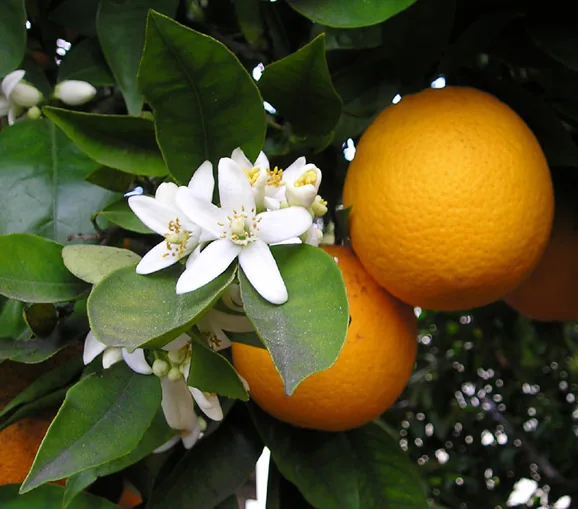


How to Grow and Care for Sweet orange
Citrus × sinensis
Written by Emilio Marruso · last checked
Toxic to: Cats, Dogs, Horses, People · Why
At a glance
An orange tree fills its branches with sweet, fragrant fruit you can pick in winter and spring, and even its flowers can be made into a tea. Give it full sun, at least 6 hours a day, and keep it moist without overwatering. One tree is enough to bear fruit, and it grows happily in a container too.
- Sun
Full sun: at least 6 hours a day
What the sources say (1)
Light: Full sun (6 or more hours of direct sunlight a day)
Full sun (6 or more hours of direct sunlight a day)
— Citrus x sinensis (Navel Orange, Orange, Sweet Orange) | North Carolina Extension Gardener Plant Toolbox [1] - Water
Handles drought but thrives when kept moist; don't overwater
What the sources say (1)
Watering: Drought tolerant but flourishes when kept moist; do not overwater
It is drought tolerant but flourishes when kept moist. Do not overwater.
— Citrus x sinensis (Navel Orange, Orange, Sweet Orange) | North Carolina Extension Gardener Plant Toolbox [1] - Cold
Survives winters down to 20 °F (−6.7 °C)
Hardy in average winters · USDA 9a · RHS H4 · Z9
What the sources say (2)
Hardiness, coldest zone: 9a [winter low −6.7 to −3.9 °C (20 to 25 °F)]
USDA Plant Hardiness Zone: 9a, 9b, 10a, 10b, 11a, 11b
— Citrus x sinensis (Navel Orange, Orange, Sweet Orange) | North Carolina Extension Gardener Plant Toolbox [1] Hardiness, warmest zone: 11b [winter low 7.2 to 10 °C (45 to 50 °F)]
USDA Plant Hardiness Zone: 9a, 9b, 10a, 10b, 11a, 11b
— Citrus x sinensis (Navel Orange, Orange, Sweet Orange) | North Carolina Extension Gardener Plant Toolbox [1] - Feeding
Feed 2 or 3 times a year, from late winter to early summer; never feed late in the season
What the sources say (6)
When: Late winter just before bloom (January–February), then in spring and early summer up to June
Nitrogen should be applied in January or February just prior to bloom. The second application then can be applied in May and perhaps a third in June.
— [2] For oranges, tangerines, and grapefruit, apply ⅓ of the recommended range of fertilizer in January-February, ⅓ in March-April and ⅓ in May-June.
— [3] How often: Two or three applications a year
Suggested application rates of nitrogen (Divide into 2 or 3 applications)
— [2] For oranges, tangerines, and grapefruit, apply ⅓ of the recommended range of fertilizer in January-February, ⅓ in March-April and ⅓ in May-June.
— [3] Avoid: Late-season fertilization and overfertilizing
Avoid late-season fertilization as it may affect fruit quality, delay fruit coloring, and make the rind rough.
— [2] Be careful not to overfertilize as this will cause excessive new growth, which makes trees susceptible to other disorders such as bacterial blast.
— [2] - Pruning
Prune after the fruit ripens; cut back hard only one weak branch a year
What the sources say (3)
Pruning: After the fruit has ripened
It is recommended that all pruning occur after the fruit has ripened.
— Citrus x sinensis (Navel Orange, Orange, Sweet Orange) | North Carolina Extension Gardener Plant Toolbox [1] Hard pruning: Hard prune only a single unproductive or leggy branch per year, and only on healthy plants.
If your plant develops an unproductive or very leggy branch, you can hard prune it to encourage new growth
— [5] only attempt this on plants that are healthy and otherwise growing well, and don't hard prune more than one branch per year.
— [5] - Harvest
Pick sweet oranges in winter and spring; the flowers make a tea
What the sources say (1)
Harvest: Spring, Winter (Display/Harvest Time)
Display/Harvest Time: Spring Winter Fruit Type: Berry Fruit Length:
— Citrus x sinensis (Navel Orange, Orange, Sweet Orange) | North Carolina Extension Gardener Plant Toolbox [1] - Pollination
One tree is enough: it sets fruit with its own pollen
What the sources say (3)
Fruit set: Self-fertile: sets fruit with its own pollen
Citrus plants are self-fertile, meaning you only need one plant to produce fruit.
— [5] Most Citrus species are self-pollinating. Tangerines are the exception as they require cross-pollination
— [6] What it needs: One plant is enough to produce fruit.
Citrus plants are self-fertile, meaning you only need one plant to produce fruit.
— [5] - Pests
Scale insects, mealybugs, whiteflies, aphids and rust mites; greasy spot and canker
What the sources say (2)
Pests: citrus rust mite, citrus snow scale, purple scale, Florida red scale, mealybugs, whiteflies, aphids, fruit flies
There are many insects which could affect sweet orange. They include citrus rust mite, citrus snow scale, purple scale, Florida red scale, mealybugs, whiteflies, aphids, and fruit flies.
— Citrus x sinensis (Navel Orange, Orange, Sweet Orange) | North Carolina Extension Gardener Plant Toolbox [1] Diseases: greasy spot, stem-end rot, sweet orange scab, citrus canker, citrus greening disease
Diseases include greasy spot, stem-end rot, sweet orange scab, citrus canker, and citrus greening disease.
— Citrus x sinensis (Navel Orange, Orange, Sweet Orange) | North Carolina Extension Gardener Plant Toolbox [1] - Size
8 to 30 ft tall and 8 to 15 ft wide
What the sources say (2)
Mature height: 244 cm (8 ft) to 914 cm (30 ft)
Height: 8 ft. 0 in. - 30 ft. 0 in. Width: 8 ft. 0 in. - 15 ft. 0 in.
— Citrus x sinensis (Navel Orange, Orange, Sweet Orange) | North Carolina Extension Gardener Plant Toolbox [1] Mature width: 244 cm (8 ft) to 457 cm (15 ft)
Height: 8 ft. 0 in. - 30 ft. 0 in. Width: 8 ft. 0 in. - 15 ft. 0 in.
— Citrus x sinensis (Navel Orange, Orange, Sweet Orange) | North Carolina Extension Gardener Plant Toolbox [1] - Propagation
By grafting, leaf cuttings or seed
What the sources say (1)
Propagation: Grafting, leaf cutting, seed
Life Cycle: Woody Recommended Propagation Strategy: Grafting Leaf Cutting Seed
— Citrus x sinensis (Navel Orange, Orange, Sweet Orange) | North Carolina Extension Gardener Plant Toolbox [1] - Containers
Grows in containers and indoors; potted trees need less fertilizer
What the sources say (6)
In containers: Yes
It is not cold hardy so in cooler zones it can be grown in a container that can be overwintered indoors.
— Citrus x sinensis (Navel Orange, Orange, Sweet Orange) | North Carolina Extension Gardener Plant Toolbox [1] Indoors: Yes
#acidic soils tolerant #fragrant flowers #houseplant #frost tender #orange fruits #hortcontest
— Citrus x sinensis (Navel Orange, Orange, Sweet Orange) | North Carolina Extension Gardener Plant Toolbox [1] Mineral fertilizers: Nitrogen fertilizer: first year 14.8 mL three times a year per tree; then actual nitrogen per tree per year of 113 g (second year), 227 g (third), 340 g (fourth) and 454 g from the fifth year
dwarf trees and trees in containers: Avoid late-season fertilization as it may affect fruit quality, delay fruit coloring, and make the rind rough. Dwarf plants or trees in containers with restricted root space may require less fertilizer.
— [2] young trees: Cover young trees with insect screening and use a citrus specific fertilizer on a regular basis.
— [4] 1st year : 1 tablespoon nitrogen fertilizer 3 times per year, per tree. - 2nd year : 0.25 lb actual nitrogen per tree
— [2] 3rd year : 0.5lb actual nitrogen per tree - 4th year : 0.75lb actual nitrogen per tree - 5th year :1 lb actual nitrogen each year
— [2] - Safety
Eat only the fruit: peel and leaves can irritate skin and harm cats, dogs and horses
Overview
Sweet orange is an evergreen tree grown for its edible orange fruits. [1] It is frost tender and requires direct sunlight. [1] In cooler zones it can be grown in a container and overwintered indoors. [1]
This record is incomplete: the sources we read do not cover every field yet.
Not yet covered by our sources: Planting, Spacing
Sweet orange care
How to water Sweet orange
Drought tolerant but flourishes when kept moist; do not overwater
What the sources say (1)
It is drought tolerant but flourishes when kept moist. Do not overwater.How much light Sweet orange needs
Full sun (6 or more hours of direct sunlight a day)
What the sources say (1)
Full sun (6 or more hours of direct sunlight a day)How much cold Sweet orange can take
Hardiness, coldest zone
9a [winter low −6.7 to −3.9 °C (20 to 25 °F)]
What the sources say (1)
USDA Plant Hardiness Zone:
9a, 9b, 10a, 10b, 11a, 11bHardiness, warmest zone
11b [winter low 7.2 to 10 °C (45 to 50 °F)]
What the sources say (1)
USDA Plant Hardiness Zone:
9a, 9b, 10a, 10b, 11a, 11bWhere to grow Sweet orange
Indoors
Yes
What the sources say (1)
#acidic soils tolerant #fragrant flowers #houseplant #frost tender #orange fruits #hortcontestIn containers
Yes
What the sources say (1)
It is not cold hardy so in cooler zones it can be grown in a container that can be overwintered indoors.Spacing
Not stated in the sources we read.
How to propagate Sweet orange
Grafting, leaf cutting, seed
What the sources say (1)
Life Cycle:
Woody
Recommended Propagation Strategy:
Grafting
Leaf Cutting
SeedHow to grow Sweet orange
The plant
Life cycle
perennial
What the sources say (1)
Plant Type:
Edible
Houseplant
Perennial
Tree
Woody Plant Leaf Characteristics:
Broadleaf EvergreenFamily
Rutaceae
What the sources say (1)
Sweet orange is an evergreen tree in the Rutaceae family that grows up to 30 feet tall in tropical, sub-tropical climatesMature height
244 cm (8 ft) to 914 cm (30 ft)
What the sources say (1)
Height: 8 ft. 0 in. - 30 ft. 0 in.
Width: 8 ft. 0 in. - 15 ft. 0 in.Mature width
244 cm (8 ft) to 457 cm (15 ft)
What the sources say (1)
Height: 8 ft. 0 in. - 30 ft. 0 in.
Width: 8 ft. 0 in. - 15 ft. 0 in.Pests and diseases
Pests
citrus rust mite, citrus snow scale, purple scale, Florida red scale, mealybugs, whiteflies, aphids, fruit flies
What the sources say (1)
There are many insects which could affect sweet orange. They include citrus rust mite, citrus snow scale, purple scale, Florida red scale, mealybugs, whiteflies, aphids, and fruit flies.Diseases
greasy spot, stem-end rot, sweet orange scab, citrus canker, citrus greening disease
What the sources say (1)
Diseases include greasy spot, stem-end rot, sweet orange scab, citrus canker, and citrus greening disease.Fertilizing
When
Late winter just before bloom (January–February), then in spring and early summer up to June
What the sources say (2)
Nitrogen should be applied in January or February just prior to bloom. The second application then can be applied in May and perhaps a third in June.For oranges, tangerines, and grapefruit, apply ⅓ of the recommended range of fertilizer in January-February, ⅓ in March-April and ⅓ in May-June.How often
Two or three applications a year
Natural fertilizers
Composted cow manure (45.4 kg [100 lb] a year supplies 454 g of nitrogen), blood meal or other manures, applied in fall under the canopy
What the sources say (1)
1 pound of actual nitrogen equals about 5 lb of ammonium sulfate per year, or 100 lb of composted cow manure each year. Organic fertilizers such as manure, bloodmeal, etc. could be applied in the fall under the tree canopy.Mineral fertilizers
Nitrogen fertilizer: first year 14.8 mL three times a year per tree; then actual nitrogen per tree per year of 113 g (second year), 227 g (third), 340 g (fourth) and 454 g from the fifth year
What each source says
dwarf trees and trees in containers: Less fertilizer
young trees: Citrus-specific fertilizer on a regular basis
What the sources say (4)
dwarf trees and trees in containers: Avoid late-season fertilization as it may affect fruit quality, delay fruit coloring, and make the rind rough. Dwarf plants or trees in containers with restricted root space may require less fertilizer.young trees: Cover young trees with insect screening and use a citrus specific fertilizer on a regular basis.1st year : 1 tablespoon nitrogen fertilizer 3 times per year, per tree. - 2nd year : 0.25 lb actual nitrogen per tree3rd year : 0.5lb actual nitrogen per tree - 4th year : 0.75lb actual nitrogen per tree - 5th year :1 lb actual nitrogen each yearMicronutrients
Zinc and iron: chelated micronutrient foliar spray as new growth emerges in spring, or zinc sulfate and iron sulfate to the soil
What the sources say (2)
Citrus occasionally suffers from micronutrient deficiencies such as zinc or iron. These deficiencies can be corrected by applying a foliar application of a liquid chelated micronutrient solution as the new growth emerges in the spring.You can also apply micronutrients in the sulfated form, such as zinc sulfate or iron sulfate, to the soil.Avoid
Late-season fertilization and overfertilizing
What the sources say (2)
Avoid late-season fertilization as it may affect fruit quality, delay fruit coloring, and make the rind rough.Be careful not to overfertilize as this will cause excessive new growth, which makes trees susceptible to other disorders such as bacterial blast.Signs of excess
Excessive new growth, susceptible to disorders such as bacterial blast; late feeding gives poorer fruit quality, delayed coloring and a rough rind
What the sources say (2)
Be careful not to overfertilize as this will cause excessive new growth, which makes trees susceptible to other disorders such as bacterial blast.Avoid late-season fertilization as it may affect fruit quality, delay fruit coloring, and make the rind rough.Pollination
Fruit set
Self-fertile: sets fruit with its own pollen
What it needs
One plant is enough to produce fruit.
What the sources say (1)
Citrus plants are self-fertile, meaning you only need one plant to produce fruit.Pollinators
honey bees, bumble bees
What the sources say (1)
Their fragrant flowers attract pollinators, such as honey bees and bumble bees.Pruning
Flowering wood
Flowers on new wood (this year's growth)
What the sources say (2)
Flowering and fruiting on sweet orange trees occurs on new wood and you don't want to cut flowers that are your future fruits.Citrus plants flower on the tips of new sideshoots, so take care not to overprune, as plants will become very bushy and bear little fruit.When to prune
After the fruit has ripened; on plants in containers, thin overcrowded branches in February and cut strongly growing new shoots back to within the crown over summer.
What the sources say (3)
It is recommended that all pruning occur after the fruit has ripened.In February – thin out any overcrowded branches and remove wayward shoots that spoil the shape of the plant.Over summer – prune back any strongly growing new shoots to within the crown to encourage branchingHard pruning
Hard prune only a single unproductive or leggy branch per year, and only on healthy plants.
Sweet orange pests and problems
Pests and diseases
Symptom: Citrus rust mite, scales, mealybugs, whiteflies, aphids and fruit flies; greasy spot, stem-end rot, scab, canker and greening disease.
What to do: Not given beyond a link to a Clemson citrus pest factsheet.
What the sources say (1)
There are many insects which could affect sweet orange. They include citrus rust mite, citrus snow scale, purple scale, Florida red scale, mealybugs, whiteflies, aphids, and fruit flies.
— Citrus x sinensis (Navel Orange, Orange, Sweet Orange) | North Carolina Extension Gardener Plant Toolbox [1]
Remedies
Each remedy shows what official sources say about it; traditional remedies without an official source are marked as such. Harmful ones are listed so you know to avoid them.
Treating the plant
aphids
soapy water spray Works
Be aware that the products suggested to be combined in these home remedies may include additives that could harm the environment.
— extension.psu.edu [8] How: Spray with a mild soap solution: one tablespoon of liquid dish washing detergent in one gallon of water; hosing the plant off with water also works.
Hose off with water or spray with a mild soap solution (mix one tablespoon of liquid dish washing detergent in one gallon of water).
— extension.arizona.edu [7] What the evidence says Hose off with water or spray with a mild soap solution (mix one tablespoon of liquid dish washing detergent in one gallon of water).
— extension.arizona.edu [7] hosing off with water Works
How: A high-pressure spray of water from the garden hose dislodges small pests such as mites and aphids; for spider mites direct the spray upward toward the undersides of the foliage.
A high-pressure spray of water from the garden hose can be used to dislodge small pests, such as mites and aphids.
— hgic.clemson.edu [9] What the evidence says A high-pressure spray of water from the garden hose can be used to dislodge small pests, such as mites and aphids.
— hgic.clemson.edu [9]
sooty mold
mild soap solution wash Works
Be aware that the products suggested to be combined in these home remedies may include additives that could harm the environment.
— extension.psu.edu [8] How: Prevent insect feeding, then use a mild soap solution to wash away the sooty mold.
Prevent insect feeding. Use a mild soap solution to wash away sooty mold.
— extension.arizona.edu [7] What the evidence says Prevent insect feeding. Use a mild soap solution to wash away sooty mold.
— extension.arizona.edu [7]
orange dog caterpillar
hand-picking caterpillars Works
How: Hand-pick the caterpillars that chew the leaves.
Hand-pick caterpillars or spray with Bacillus thuringiensis (BT). Leaf-Cutter Bees are beneficial, no controls are necessary or recommended.
— extension.arizona.edu [7] What the evidence says Hand-pick caterpillars or spray with Bacillus thuringiensis (BT). Leaf-Cutter Bees are beneficial, no controls are necessary or recommended.
— extension.arizona.edu [7]
sharpshooters
garlic spray Not verified
Traditional remedy, not verified by an official source.
How: Use garlic spray to repel sharpshooters.
aluminum foil over the soil Not verified
Traditional remedy, not verified by an official source.
How: Put aluminum foil over the soil under the tree to confuse insects.
Is Sweet orange toxic to pets?
Reported by the source, quoted verbatim. This is not medical or veterinary advice: if a person or an animal may have eaten this plant, contact a poison control centre or a veterinarian.
Animals
#problem for horses #problem for dogs #problem for cats #contact dermatitis #wet soils intolerant
[1]The source flags the risk for this animal but does not explain why.
People
Calendar
Planting
Not stated in the sources we read.
Harvest
Spring, Winter (Display/Harvest Time)
What the sources say (1)
Display/Harvest Time:
Spring
Winter
Fruit Type:
Berry
Fruit Length:Pruning
After the fruit has ripened
What the sources say (1)
It is recommended that all pruning occur after the fruit has ripened.Months as given by the sources, which are mostly from the United States (northern hemisphere). In the southern hemisphere they shift by about six months.
Edibility
Reported by the source, quoted verbatim. Do not eat a plant on the basis of this page alone: identification mistakes can be dangerous.
Indicative values
Values from a secondary source, not checked word for word like the rest of this page. Use them as a starting point.
- Hours of sun
- 6-8 hoursIndicative value, adapt it to your climate · Secondary source · Data for the variety Citrus sinensis 'Moro'
- Soil pH
- 6-7.5Indicative value, adapt it to your climate · Secondary source · Data for the variety Citrus sinensis 'Moro'
- Care level
- MediumIndicative value, adapt it to your climate · Secondary source · Data for the variety Citrus sinensis 'Moro'
- Growth rate
- HighIndicative value, adapt it to your climate · Secondary source · Data for the variety Citrus sinensis 'Moro'
Similar plants
- Bitter orange Citrus × aurantium
- Lemon Citrus limon
- Hardy orange Citrus trifoliata
- Meyer lemon Citrus meyeri
- Pomelo Citrus maxima
- Curry tree Murraya koenigii
- Amur Cork Tree Phellodendron amurense
- Bee-Bee Tree Tetradium daniellii
Sources
Every value above is quoted from these documents. Links lead to the original publisher.
- Citrus x sinensis (Navel Orange, Orange, Sweet Orange) | North Carolina Extension Gardener Plant Toolbox · plants.ces.ncsu.edu, consulted
- ipm.ucanr.edu · ipm.ucanr.edu
- extension.arizona.edu · extension.arizona.edu
- blogs.ifas.ufl.edu · blogs.ifas.ufl.edu
- rhs.org.uk · rhs.org.uk
- hgic.clemson.edu · hgic.clemson.edu
- extension.arizona.edu · extension.arizona.edu
- extension.psu.edu · extension.psu.edu
- hgic.clemson.edu · hgic.clemson.edu
Written by Emilio Marruso · last checked