How to Grow and Care for Cleavers
Galium aparine
Written by Emilio Marruso · last checked
Toxic to: People · Why
At a glance
Cleavers is an easy annual for shady corners: it likes full to part shade and loose, moist soil. Sow it right where it will grow as soon as the seed ripens in late summer, or in spring. In spring, pick the tender young shoot tips and leaves to eat raw or cooked, and roast the dried fruits as a coffee substitute.
- Sun
Full to part shade; full sun scorches it
What the sources say (3)
Light: Full to part shade
It prefers moist, fertile soil in full to part shade, though it can be found in sunny sites.
— Getting the Best of Catchweed Bedstraw [4] Watering: Prefers a loose, moist soil; tolerates dry soils but scorches in full sun
Prefers a loose moist leafy soil in some shade
— Goosegrass (Galium aparine) — Practical Plants [8] Plants tolerate dry soils, but they quickly become scorched when growing in full sun
— Goosegrass (Galium aparine) — Practical Plants [8] - Water
Likes moist soil but puts up with dry soil
What the sources say (2)
Watering: Prefers a loose, moist soil; tolerates dry soils but scorches in full sun
Prefers a loose moist leafy soil in some shade
— Goosegrass (Galium aparine) — Practical Plants [8] Plants tolerate dry soils, but they quickly become scorched when growing in full sun
— Goosegrass (Galium aparine) — Practical Plants [8] - Soil
Loose, moist soil
What the sources say (2)
Watering: Prefers a loose, moist soil; tolerates dry soils but scorches in full sun
Prefers a loose moist leafy soil in some shade
— Goosegrass (Galium aparine) — Practical Plants [8] Plants tolerate dry soils, but they quickly become scorched when growing in full sun
— Goosegrass (Galium aparine) — Practical Plants [8] - Harvest
In spring, eat young shoot tips and leaves raw or cooked; roasted dried fruits make a coffee substitute
What the sources say (1)
Harvest: Spring (young shoot tips)
they are best used in the spring
— Goosegrass (Galium aparine) — Practical Plants [8] - Watch out
It sprawls over other plants: pull it while small, before it flowers; roots left behind can regrow
What the sources say (3)
Root system: Shallow root system with a slender, branching taproot, weakly attached to the stem (roots left behind when pulling can regrow)
G. aparine has a shallow root system, with a branching taproot.
— Catchweed Bedstraw, Galium aparine – Wisconsin Horticulture [2] Catchweed bedstraw is a weakly erect to sprawling plant from a slender taproot.
— Weeds: Catchweed bedstraw | Hortsense | Washington State University [3] As it ages, the root system becomes stronger than the weak attachment of the stem to the root.
— Getting the Best of Catchweed Bedstraw [4] - Size
Up to 6 ft, scrambling over other plants
What the sources say (2)
Mature height: up to 182.88 cm (6 ft), scrambling over other plants
The plant can grow up to 6 feet, but with its weak stem, it cannot stand up on its own, thus clambering over other vegetation.
— Galium aparine (Catchweed Bedstraw, Cleavers, Goosegrass, Stickyweed, Sticky willy, Velcro plant) | North Carolina Extension Gardener Plant Toolbox [1] Even though a mature specimen can reach six feet, its stems are fragile.
— Getting the Best of Catchweed Bedstraw [4] - Propagation
By seed
- Sowing
Sow in place as soon as the seed ripens in late summer, or in spring
What the sources say (2)
Sowing: Best sown in situ as soon as the seed is ripe in late summer; also in spring
Seed - best sown in situ as soon as the seed is ripe in late summer
— Goosegrass (Galium aparine) — Practical Plants [8] The seed can also be sown in spring though it may be very slow to germinate
— Goosegrass (Galium aparine) — Practical Plants [8] - Safety
The sap can irritate the skin of sensitive people
Overview
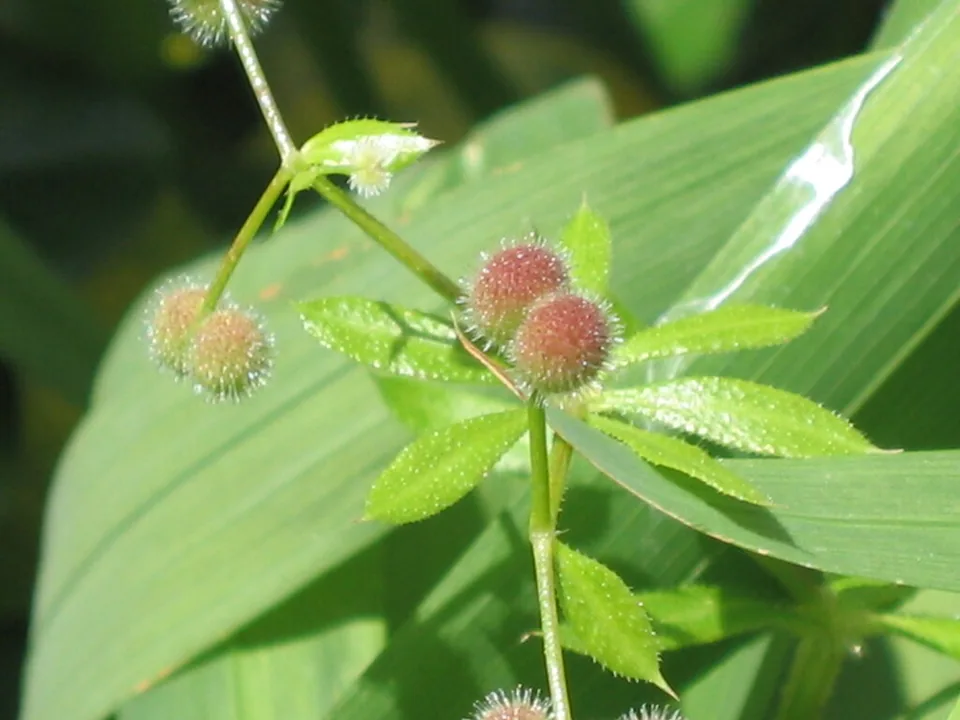
Galium aparine is an annual weed of the madder family with hooked hairs that cling to clothing and animal fur. [2] It prefers moist, fertile soil in full to part shade, and is controlled by pulling or hoeing while small, before seed production. [4][2] The young leaves can be eaten raw or cooked, and the roasted fruits make a coffee substitute. [2]
This record is incomplete: the sources we read do not cover every field yet.
Not yet covered by our sources: Hardiness, coldest zone, Hardiness, warmest zone
Cleavers care
How to water Cleavers
Prefers a loose, moist soil; tolerates dry soils but scorches in full sun
How much light Cleavers needs
Full to part shade
What the sources say (1)
It prefers moist, fertile soil in full to part shade, though it can be found in sunny sites.How much cold Cleavers can take
Hardiness, coldest zone
Not stated in the sources we read.
Hardiness, warmest zone
Not stated in the sources we read.
How to propagate Cleavers
How to grow Cleavers
The plant
Life cycle
annual
What the sources say (2)
Galium aparine is a distinctive herbaceous annual weed with a number of common names including cleavers, bedstraw, catchweed bedstraw, grip grass, stickywilly, and others.Galium aparine is an easily identifiable, annual, and native weed of Pennsylvania.Family
Rubiaceae
What the sources say (1)
This fast-growing plant in the madder famliy (Rubiaceae), native to the northern hemisphere (North America and Eurasia), occurs in all US states except HawaiiMature height
up to 182.88 cm (6 ft), scrambling over other plants
What the sources say (2)
The plant can grow up to 6 feet, but with its weak stem, it cannot stand up on its own, thus clambering over other vegetation.Even though a mature specimen can reach six feet, its stems are fragile.Roots
Root system
Shallow root system with a slender, branching taproot, weakly attached to the stem (roots left behind when pulling can regrow)
What the sources say (3)
G. aparine has a shallow root system, with a branching taproot.Catchweed bedstraw is a weakly erect to sprawling plant from a slender taproot.As it ages, the root system becomes stronger than the weak attachment of the stem to the root.Cleavers pests and problems
Crop and garden infestation
Symptom: Plants tangle with crops at harvest and sprawl over other plants
What to do: Pull or hoe out while small, before flowering and seed production
What the sources say (2)
It causes problems in crops during harvesting when bedstraw becomes tangled with the crop or equipment.
— Catchweed Bedstraw, Galium aparine – Wisconsin Horticulture [2] Catchweed bedstraw is not difficult to control if pulled or hoed out while small, before flowering and seed production commences
— Catchweed Bedstraw, Galium aparine – Wisconsin Horticulture [2]
Remedies
Each remedy shows what official sources say about it; traditional remedies without an official source are marked as such. Harmful ones are listed so you know to avoid them.
First aid
First aid: not a substitute for a doctor
skin irritation
wash skin with plenty of water Official source, not independently tested
How: wash the area with a lot of water to remove traces of the irritant and avoid further exposure
Often, treatment includes washing the area with a lot of water to get rid of any traces of the irritant that are still on the skin.
— medlineplus.gov [9]
Getting rid of it
weed infestation
hand pulling Works
Be careful to get all the roots lest they regrow. Wear gloves. Use a hoe.
— Getting the Best of Catchweed Bedstraw [4] How: pull out seedlings regularly, before they set seed; mature plants can be removed in one pull by the main stem, or lifted whole by the roots with a hand fork
Pull or fork out plants – pull out seedlings regularly, before they have a chance to set seed.
— rhs.org.uk [10] What the evidence says Hand hoeing or weed pulling can be very effective, especially in the early spring when soil is damp.
— ipm.ucanr.edu [11] hoeing Works
How: carefully hoe beds and borders to remove seedlings before they flower and set seed, on a dry, sunny day so uprooted plants shrivel and die
Do this on a dry, sunny day, so any uprooted plants shrivel and die rather than re-rooting.
— rhs.org.uk [10] What the evidence says Cultivation (rototilling or hoeing) will effectively eliminate plants.
— Weeds: Catchweed bedstraw | Hortsense | Washington State University [3] mulch layer Partly works
How: apply a mulch in early spring, using bulky organic matter such as bark chips in a layer around 8cm (3in) deep
apply a mulch to your soil in early spring to smother new seedlings and prevent further seed germinating.
— rhs.org.uk [10] What the evidence says Installing and maintaining mulch (e.g. bark, wood chips, leaf litter, gravel, weed tarps, etc.) can reduce seedling emergence and eases the removal of plants that do become established.
— ipm.ucanr.edu [11] cutting stems short Not proven
How: cutting the plants to 2 to 3 inches
Cutting catchweed bedstraw to 2 to 3 inches usually is not effective and has been reported to actually increase biomass production up to 30% compared to uncut plants.
— ipm.ucanr.edu [11] What the evidence says Cutting catchweed bedstraw to 2 to 3 inches usually is not effective and has been reported to actually increase biomass production up to 30% compared to uncut plants.
— ipm.ucanr.edu [11] sowing grass and wildflower mixture Partly works
How: sow a grass and wildflower mixture to outcompete the weed
The growth of cleavers in headlands is suppressed by sowing a grass and wildflower mixture.
— gardenorganic.org.uk [12] What the evidence says The growth of bedstraw can be suppressed by sowing a competitive crop such as a grass and wildflower mixture in some parks or other nonagricultural areas.
— ipm.ucanr.edu [11]
weed seeds
hot composting Not verified
Traditional remedy, not verified by an official source.
How: seeds in a compost heap die when temperatures exceed 50°C for two weeks
Is Cleavers poisonous?
Reported by the source, quoted verbatim. This is not medical or veterinary advice: if a person or an animal may have eaten this plant, contact a poison control centre or a veterinarian.
Calendar
Sowing
Best sown in situ as soon as the seed is ripe in late summer; also in spring
Harvest
Spring (young shoot tips)
What the sources say (1)
they are best used in the springMonths as given by the sources, which are mostly from the United States (northern hemisphere). In the southern hemisphere they shift by about six months.
Edibility
Reported by the source, quoted verbatim. Do not eat a plant on the basis of this page alone: identification mistakes can be dangerous.
Similar plants
- Sweet Woodruff Galium odoratum
- Lady's Bedstraw Galium verum
- Buttonbush Cephalanthus occidentalis
- Buttonweed Diodia virginiana
- Azure Bluet Houstonia caerulea
- Chinese Buttonbush Adina rubella
- Coffee Coffea arabica
- Firebush Hamelia patens
Sources
Every value above is quoted from these documents. Links lead to the original publisher.
- Galium aparine (Catchweed Bedstraw, Cleavers, Goosegrass, Stickyweed, Sticky willy, Velcro plant) | North Carolina Extension Gardener Plant Toolbox · plants.ces.ncsu.edu, consulted
- Catchweed Bedstraw, Galium aparine – Wisconsin Horticulture · hort.extension.wisc.edu, consulted
- Weeds: Catchweed bedstraw | Hortsense | Washington State University · hortsense.cahnrs.wsu.edu, consulted
- Getting the Best of Catchweed Bedstraw · extension.psu.edu, consulted
- Weed of the Month: Cleavers - Brooklyn Botanic Garden · bbg.org, consulted
- · naturblick.museumfuernaturkunde.berlin, consulted
- Galium aparine | CLIMBERS · climbers.lsa.umich.edu, consulted
- Goosegrass (Galium aparine) — Practical Plants · practicalplants.org, consulted
- medlineplus.gov · medlineplus.gov
- rhs.org.uk · rhs.org.uk
- ipm.ucanr.edu · ipm.ucanr.edu
- gardenorganic.org.uk · gardenorganic.org.uk
Written by Emilio Marruso · last checked