
How to Grow and Care for Twinberry honeysuckle
Lonicera involucrata
Written by Emilio Marruso · last checked
Toxic to: Animals, People · Why
At a glance
This perennial from the honeysuckle family is happy in sun or partial shade and loves wet or moist spots, yet it adapts to drier sites too. Plant it in late spring or early summer, mulch it with compost or leaf mould, and it asks for little else: feed it only if the leaves turn yellow and growth is poor.
- Sun
Sun to partial shade
- Water
Loves wet or moist soil but adapts to drier sites; moisture matters most
What the sources say (3)
Watering: Does well in wet or moist situations, adapts to drier sites
Does well in wet or moist situations, but adapts to drier sites.
— Lonicera involucrata | Landscape Plants | Oregon State University [1] Main limiting factor is moisture.
— Plant Data Sheet [2] Watering notes: Moisture is the main limiting factor
Main limiting factor is moisture.
— Plant Data Sheet [2] - Cold
Survives winters down to −30 °F (−34.4 °C)
Very hardy · USDA 4 · RHS H7 · Z4
What the sources say (1)
Hardiness, coldest zone: 4 [winter low −34.4 to −28.9 °C (−30 to −20 °F)]
Hardy to USDA Zone 4
— Lonicera involucrata | Landscape Plants | Oregon State University [1] - Planting
Plant in late spring or early summer
What the sources say (1)
Planting: Late spring or early summer
plant directly into permanent positions in late spring or early summer.
— Plant Data Sheet [2] - Feeding
Once a year in spring, only if leaves are yellow and growth is poor; a compost mulch helps
What the sources say (4)
When: Spring, only if the leaves are yellow and growth is poor
Feed once a year in spring if the leaves are yellow and growth is poor - Apply a general fertiliser,
— [7] How often: Once a year, only when needed
Feed once a year in spring if the leaves are yellow and growth is poor - Apply a general fertiliser,
— [7] - Propagation
From seed that needs a cold spell, or hardwood cuttings taken November to mid-January
What the sources say (2)
Propagation: Seed (cold stratification required) and hardwood cuttings taken between November and mid-January
Seed, cuttings.
— Plant Data Sheet [2] Cuttings: Collect hardwood cuttings .5 inch in diameter and at least 10 inches long with 5 or more nodes, between November and mid-January before any sign of budbreak
— Plant Data Sheet [2] - Sowing
Sow the seeds as soon as they are ripe, in a cold frame
What the sources say (2)
- Safety
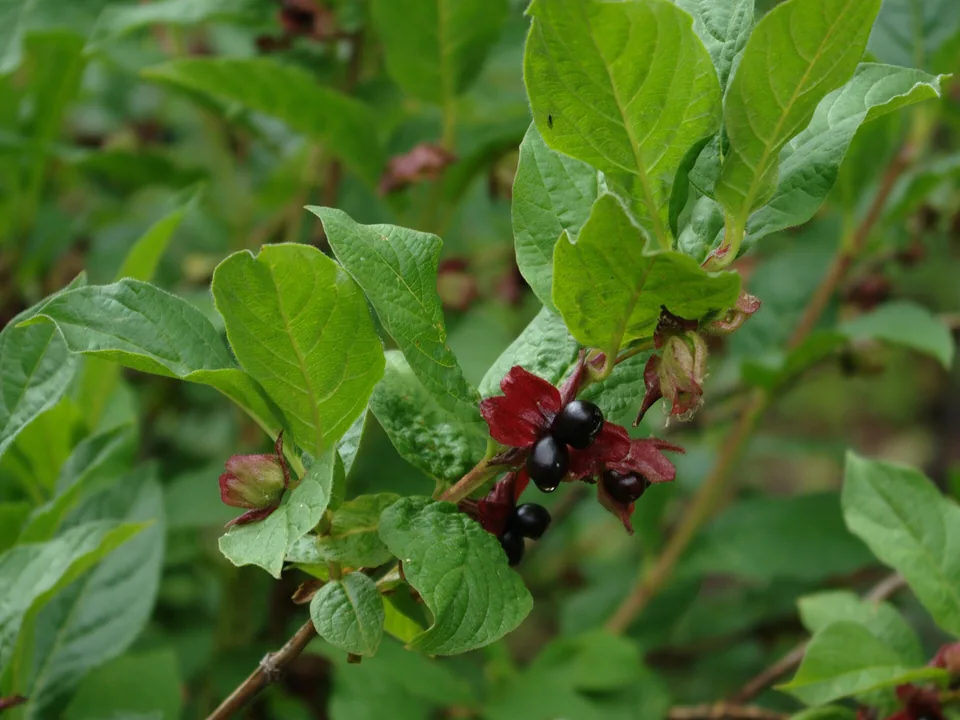
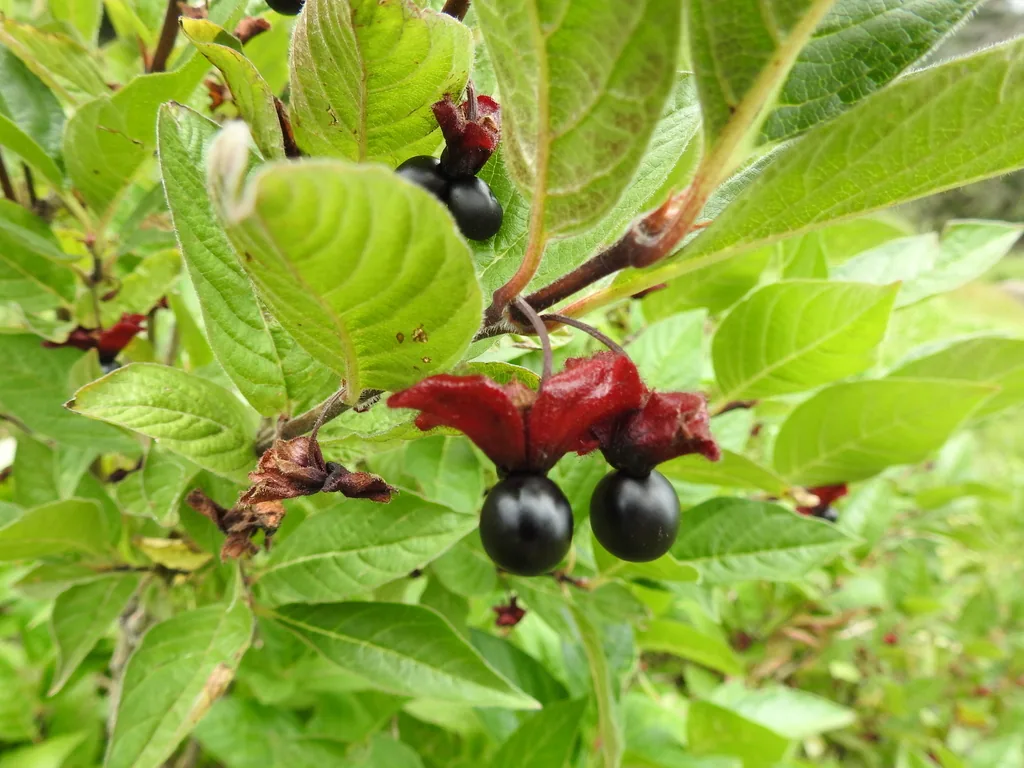
Don't eat the black berries: they taste very bad and may be poisonous; toxic to some animals
Overview
Twinberry is a deciduous shrub native to western North America, 0.5-4 m [1.6–13.1 ft] tall, with paired yellow flowers between bracts and paired dark purple to black berries. [1] It grows in sun to partial shade and does well in wet or moist situations but adapts to drier sites. [1] Its berries are considered unpalatable or even poisonous. [5]
This record is incomplete: the sources we read do not cover every field yet.
Not yet covered by our sources: Hardiness, warmest zone, Pruning
Twinberry honeysuckle care
Measurements in square brackets are our conversion into the other unit system; the quoted text is unchanged.
How to water Twinberry honeysuckle
Watering
Does well in wet or moist situations, adapts to drier sites
Watering notes
Moisture is the main limiting factor
What the sources say (1)
Main limiting factor is moisture.How much light Twinberry honeysuckle needs
How much cold Twinberry honeysuckle can take
Hardiness, coldest zone
4 [winter low −34.4 to −28.9 °C (−30 to −20 °F)]
What the sources say (1)
Hardy to USDA Zone 4Hardiness, warmest zone
Not stated in the sources we read.
How to propagate Twinberry honeysuckle
Seed (cold stratification required) and hardwood cuttings taken between November and mid-January
How to grow Twinberry honeysuckle
The plant
Life cycle
perennial
What the sources say (1)
Plant type: Shrub
Growing Season: Warm
Life Cycle: Perennial
Cover: ModerateFamily
Caprifoliaceae
What the sources say (1)
twinberry Caprifoliaceae Lonicera
involucrata (Richardson) Banks ex Spreng.Fertilizing
When
Spring, only if the leaves are yellow and growth is poor
What the sources say (1)
Feed once a year in spring if the leaves are yellow and growth is poor
- Apply a general fertiliser,How often
Once a year, only when needed
What the sources say (1)
Feed once a year in spring if the leaves are yellow and growth is poor
- Apply a general fertiliser,Natural fertilizers
Mulch of leaf mould, garden compost or well-rotted manure
Mineral fertilizers
General-purpose fertilizer
What the sources say (1)
Feed once a year in spring if the leaves are yellow and growth is poor
- Apply a general fertiliser,Signs of deficiency
Yellow leaves and poor growth
What the sources say (1)
Feed once a year in spring if the leaves are yellow and growth is poor
- Apply a general fertiliser,Remedies
Each remedy shows what official sources say about it; traditional remedies without an official source are marked as such. Harmful ones are listed so you know to avoid them.
Treating the plant
powdery mildew
picking off affected leaves and raking fallen leaves Partly works
How: carefully picking off affected leaves as soon as symptoms are evident and raking and removing fallen leaves
Disease can be minimized by carefully picking off affected leaves as soon as symptoms are evident and by raking and removing fallen leaves to reduce the amount of overwintering inoculum.
— portal.ct.gov [8] What the evidence says Disease can be minimized by carefully picking off affected leaves as soon as symptoms are evident and by raking and removing fallen leaves to reduce the amount of overwintering inoculum.
— portal.ct.gov [8]
leaf blight
pruning and destroying infected branches Partly works
How: pruning and destroying infected branches, raking and removing all fallen leaves and fruit
Pruning and destroying infected branches is helpful as is raking and removing all fallen leaves and fruit.
— portal.ct.gov [8] What the evidence says Pruning and destroying infected branches is helpful as is raking and removing all fallen leaves and fruit.
— portal.ct.gov [8]
aphids
insecticidal soap spray Works
How: sprays of insecticidal soap if necessary
If necessary, sprays of ultrafine horticultural oil, insecticidal soap or malathion, which are among the compounds registered for use against this pest in Connecticut, will control these aphids.
— portal.ct.gov [8] What the evidence says If necessary, sprays of ultrafine horticultural oil, insecticidal soap or malathion, which are among the compounds registered for use against this pest in Connecticut, will control these aphids.
— portal.ct.gov [8] horticultural oil spray Works
How: sprays of ultrafine horticultural oil if necessary
If necessary, sprays of ultrafine horticultural oil, insecticidal soap or malathion, which are among the compounds registered for use against this pest in Connecticut, will control these aphids.
— portal.ct.gov [8] What the evidence says If necessary, sprays of ultrafine horticultural oil, insecticidal soap or malathion, which are among the compounds registered for use against this pest in Connecticut, will control these aphids.
— portal.ct.gov [8]
hornworms
bacillus thuringiensis spray Official source, not independently tested
How: spray with Bacillus thuringiensis var. kurstaki when the caterpillars are young
If needed, spray with Bacillus thuringiensis var. kurstaki when the caterpillars are young
— portal.ct.gov [8]
crown gall
removing infected plants Official source, not independently tested
How: roguing and removing infected plants
Roguing and removing infected plants helps to prevent spread of the bacterium to nearby healthy plants.
— portal.ct.gov [8]
Is Twinberry honeysuckle toxic to pets?
Reported by the source, quoted verbatim. This is not medical or veterinary advice: if a person or an animal may have eaten this plant, contact a poison control centre or a veterinarian.
Animals
Commerical Availability: Yes Warning Toxic for some animals
[3]The source flags the risk for this animal but does not explain why.
People
Calendar
Sowing
As soon as ripe, in cold frames
What each source says
Marin County, California (nursery protocol): June 15
Planting
Late spring or early summer
What the sources say (1)
plant directly into permanent positions in late spring or early summer.Pruning
Not stated in the sources we read.
Months as given by the sources, which are mostly from the United States (northern hemisphere). In the southern hemisphere they shift by about six months.
Indicative values
Values from a secondary source, not checked word for word like the rest of this page. Use them as a starting point.
- Hours of sun
- 6-8 hoursIndicative value, adapt it to your climate · Secondary source
- Soil
- Sandy Loamy Clay Humus RockyIndicative value, adapt it to your climate · Secondary source
- Soil pH
- 5.5-7.5Indicative value, adapt it to your climate · Secondary source
- Care level
- MediumIndicative value, adapt it to your climate · Secondary source
- Growth rate
- HighIndicative value, adapt it to your climate · Secondary source
- Pruning
- February, March, April, March, April, May, June, July, August, SeptemberIndicative value, adapt it to your climate · Secondary source
- Pests
- Leaf miner insect, Virus, Drought resistantIndicative value, adapt it to your climate · Secondary source
Similar plants
- Alpine honeysuckle Lonicera alpigena
- Dwarf honeysuckle Lonicera xylosteum
- European Honeysuckle Lonicera periclymenum
- Grape Honysuckle Lonicera reticulata
- Honeysuckle Lonicera japonica
- Honeysuckle Lonicera sempervirens
- Italian woodbine Lonicera caprifolium
- Limber Honeysuckle Lonicera dioica
Sources
Every value above is quoted from these documents. Links lead to the original publisher.
- Lonicera involucrata | Landscape Plants | Oregon State University · landscapeplants.oregonstate.edu, consulted
- Plant Data Sheet · depts.washington.edu, consulted
- danielle_test | USU · extension.usu.edu, consulted
- Virginia Tech Dendrology Fact Sheet · dendro.cnre.vt.edu, consulted
- Lonicera involucrata - Trees and Shrubs Online · treesandshrubsonline.org, consulted
- Caprifoliaceae (Lonicera) — Reforestation, Nurseries and Genetics Resources · rngr.net, consulted
- rhs.org.uk · rhs.org.uk
- portal.ct.gov · portal.ct.gov
Written by Emilio Marruso · last checked