
How to Grow and Care for Morrow's honeysuckle
Lonicera morrowii
Written by Emilio Marruso · last checked
Toxic to: People · Why
At a glance
Morrow's honeysuckle is a generous shrub that grows 6–8 ft tall and up to 8 ft wide, happy in full sun or partial shade. Give it moist, well-drained soil, trim it right after flowering, and you can even start new plants from cuttings or seed. Just remember that its fruit is poisonous, so enjoy it with your eyes, not your mouth.
- Sun
Full sun to partial shade
- Water
Keep the soil moist but never soggy
What the sources say (1)
Watering: Prefers moist, well-drained soil
prefers loamy, well-drained, moist soil
— Plant Database [2] - Cold
Survives winters down to −30 °F (−34.4 °C)
Very hardy · USDA 4 · RHS H7 · Z4
What the sources say (1)
Hardiness, coldest zone: 4 [winter low −34.4 to −28.9 °C (−30 to −20 °F)]
hardy to zone 4, and warmer parts of zone
— Plant Database [2] - Soil
Moist, well-drained soil
What the sources say (1)
Watering: Prefers moist, well-drained soil
prefers loamy, well-drained, moist soil
— Plant Database [2] - Pruning
Prune right after flowering
What the sources say (1)
Pruning: After flowering
prune after flowering
— Plant Database [2] - Pests
Watch for fall webworms, powdery mildew and leaf spot
- Size
6–8 ft tall and up to 8 ft wide
What the sources say (2)
Mature height: 180-245 cm (6-8 ft)
a deciduous shrub - 6' to 8' tall - an equal or greater width
— Plant Database [2] Mature width: up to 245 cm (8 ft)
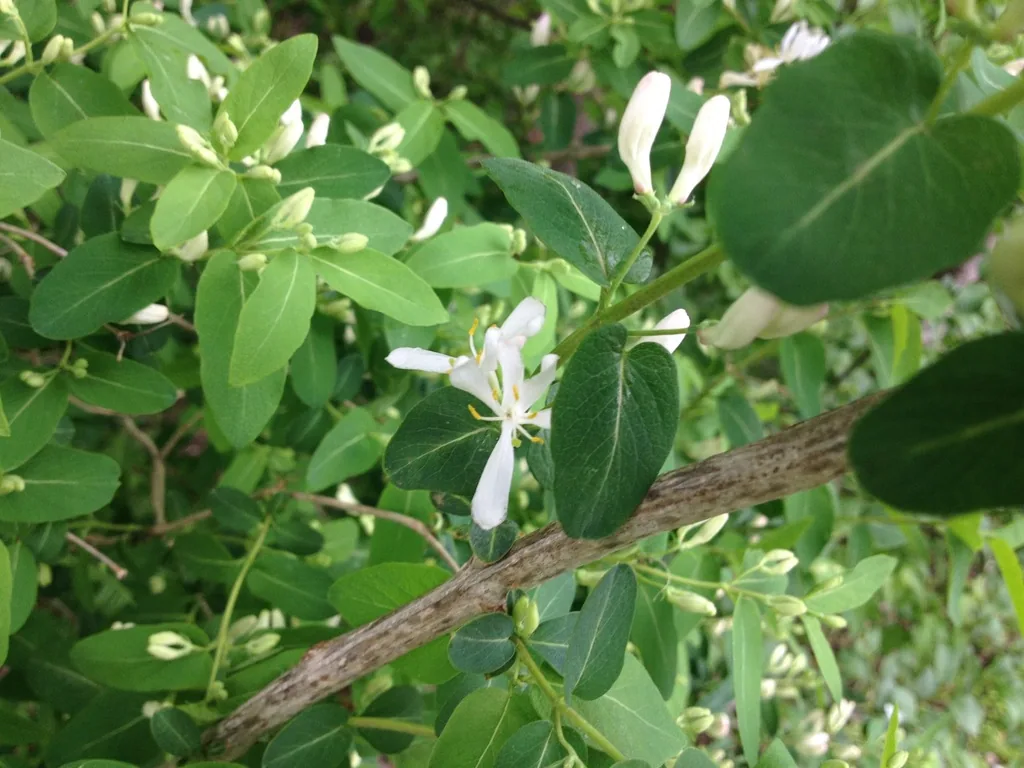
Form: An erect shrub, multi-stemmed shrub which forms a wide, round crown, up to 8 feet tall and wide.
— Virginia Tech Dendrology Fact Sheet [3] - Propagation
Start new plants from cuttings or seed
What the sources say (1)
Propagation: Cuttings; seed
Propagation - by cuttings - by seed
— Plant Database [2] - Safety
The fruit is poisonous: do not eat it
Overview
Morrow's honeysuckle is a deciduous shrub that is a restricted noxious weed in Minnesota. [1] It grows in full sun to partial shade and is pruned after flowering. [2] The fruit is reported as poisonous. [5]
This record is incomplete: the sources we read do not cover every field yet.
Not yet covered by our sources: Hardiness, warmest zone
Morrow's honeysuckle care
How to water Morrow's honeysuckle
Prefers moist, well-drained soil
What the sources say (1)
prefers loamy, well-drained, moist soilHow much light Morrow's honeysuckle needs
Full sun to partial shade
What each source says
According to Minnesota Department of Agriculture: Full sun to shade
How much cold Morrow's honeysuckle can take
Hardiness, coldest zone
4 [winter low −34.4 to −28.9 °C (−30 to −20 °F)]
What the sources say (1)
hardy to zone 4, and warmer parts of zoneHardiness, warmest zone
Not stated in the sources we read.
How to propagate Morrow's honeysuckle
Cuttings; seed
What the sources say (1)
Propagation
- by cuttings
- by seedHow to grow Morrow's honeysuckle
The plant
Family
Caprifoliaceae
What the sources say (1)
Morrow honeysuckle Caprifoliaceae Lonicera
morrowii A. Gray
symbol: LOMO2Mature height
180-245 cm (6-8 ft)
What the sources say (1)
a deciduous shrub
- 6' to 8' tall
- an equal or greater widthMature width
up to 245 cm (8 ft)
What the sources say (1)
Form: An erect shrub, multi-stemmed shrub which forms a wide, round crown, up to 8 feet tall and wide.Pests and diseases
Pests
fall webworms
What the sources say (1)
- powdery mildew
- leaf spot
- fall webwormsDiseases
powdery mildew, leaf spot
What the sources say (1)
- powdery mildew
- leaf spot
- fall webwormsRemedies
Each remedy shows what official sources say about it; traditional remedies without an official source are marked as such. Harmful ones are listed so you know to avoid them.
First aid
First aid: not a substitute for a doctor
berry ingestion
wash hands, wipe out mouth, give a drink Official source, not independently tested
If you have any questions about plants or berries, call the Missouri Poison Center at 1-800-222-1222.
— missouripoisoncenter.org [8] How: For a child who has ingested a berry or part of a plant, wash their hands, wipe out their mouth, and give them something to drink.
If you have a child who has ingested a berry or part of a plant, wash their hands, wipe out their mouth, and give them something to drink.
— missouripoisoncenter.org [8]
Treating the plant
leaf blight
pruning and destroying infected branches Works
How: Prune and destroy infected branches and rake and remove all fallen leaves and fruit.
Pruning and destroying infected branches is helpful as is raking and removing all fallen leaves and fruit.
— portal.ct.gov [9] What the evidence says Pruning and destroying infected branches is helpful as is raking and removing all fallen leaves and fruit.
— portal.ct.gov [9]
powdery mildew
picking off affected leaves Partly works
How: Carefully pick off affected leaves as soon as symptoms are evident and rake and remove fallen leaves.
Disease can be minimized by carefully picking off affected leaves as soon as symptoms are evident and by raking and removing fallen leaves to reduce the amount of overwintering inoculum.
— portal.ct.gov [9] What the evidence says Disease can be minimized by carefully picking off affected leaves as soon as symptoms are evident and by raking and removing fallen leaves to reduce the amount of overwintering inoculum.
— portal.ct.gov [9]
honeysuckle aphids
insecticidal soap spray Works
How: Spray insecticidal soap on the aphids if necessary.
If necessary, sprays of ultrafine horticultural oil, insecticidal soap or malathion, which are among the compounds registered for use against this pest in Connecticut, will control these aphids.
— portal.ct.gov [9] What the evidence says If necessary, sprays of ultrafine horticultural oil, insecticidal soap or malathion, which are among the compounds registered for use against this pest in Connecticut, will control these aphids.
— portal.ct.gov [9] ultrafine horticultural oil spray Works
How: Spray ultrafine horticultural oil on the aphids if necessary.
If necessary, sprays of ultrafine horticultural oil, insecticidal soap or malathion, which are among the compounds registered for use against this pest in Connecticut, will control these aphids.
— portal.ct.gov [9] What the evidence says If necessary, sprays of ultrafine horticultural oil, insecticidal soap or malathion, which are among the compounds registered for use against this pest in Connecticut, will control these aphids.
— portal.ct.gov [9]
crown gall
removing infected plants Official source, not independently tested
How: Rogue and remove infected plants to prevent spread to nearby healthy plants.
Roguing and removing infected plants helps to prevent spread of the bacterium to nearby healthy plants.
— portal.ct.gov [9]
Getting rid of it
bush honeysuckle seedlings
hand pulling Official source, not independently tested
Open soil and remaining root stocks will result in rapid re-invasion or re-sprouting of honeysuckles and other exotic species.
— mdc.mo.gov [11] How: Remove seedlings by hand, in early spring or late fall, minimizing soil disturbance.
Seedlings can be removed by hand, particularly if done in early spring or late fall when other plants are dormant but honeysuckles have leaves to mark their seedlings.
— cipwg.uconn.edu [10] hand pulling in moist soil Official source, not independently tested
How: Pull seedlings when soils are moist, removing all of the root.
Seedlings may be hand-pulled when soils are moist. All of the root should be removed or re-sprouting will occur.
— mdc.mo.gov [11]
established bush honeysuckle
grubbing out the whole plant Official source, not independently tested
How: Use a digging tool to remove the entire plant, including all roots, and bag all plant parts including fruits.
A digging tool may be used to remove the entire plant, including all roots. Any portions of the root system not removed will potentially re-sprout.
— cipwg.uconn.edu [10]
mature bush honeysuckle
cutting mature plants Partly works
How: Cut mature plants; it may temporarily reduce seed sources.
Cutting of mature plants is not an effective means of control because re-sprouting will occur. However it may temporarily reduce seed sources.
— cipwg.uconn.edu [10] What the evidence says Cutting of mature plants is not an effective means of control because re-sprouting will occur. However it may temporarily reduce seed sources.
— cipwg.uconn.edu [10]
Is Morrow's honeysuckle poisonous?
Reported by the source, quoted verbatim. This is not medical or veterinary advice: if a person or an animal may have eaten this plant, contact a poison control centre or a veterinarian.
Calendar
Months as given by the sources, which are mostly from the United States (northern hemisphere). In the southern hemisphere they shift by about six months.
Indicative values
Values from a secondary source, not checked word for word like the rest of this page. Use them as a starting point.
- Life cycle
- PerennialIndicative value, adapt it to your climate · Secondary source
- Drought tolerant
- yesIndicative value, adapt it to your climate · Secondary source
- Soil pH
- 6-7.5Indicative value, adapt it to your climate · Secondary source
- Care level
- MediumIndicative value, adapt it to your climate · Secondary source
- Growth rate
- LowIndicative value, adapt it to your climate · Secondary source
Similar plants
- Alpine honeysuckle Lonicera alpigena
- Dwarf honeysuckle Lonicera xylosteum
- European Honeysuckle Lonicera periclymenum
- Grape Honysuckle Lonicera reticulata
- Honeysuckle Lonicera japonica
- Honeysuckle Lonicera sempervirens
- Italian woodbine Lonicera caprifolium
- Limber Honeysuckle Lonicera dioica
Sources
Every value above is quoted from these documents. Links lead to the original publisher.
- Honeysuckles · extension.umn.edu, consulted
- Plant Database · plantdatabase.uconn.edu, consulted
- Virginia Tech Dendrology Fact Sheet · dendro.cnre.vt.edu, consulted
- PRINTED REFERENCES · hort.extension.wisc.edu, consulted
- Lonicera morrowii - Useful Temperate Plants · temperate.theferns.info, consulted
- Lonicera morrowii - Trees and Shrubs Online · treesandshrubsonline.org, consulted
- Morrow's Honeysuckle | Minnesota Department of Agriculture · mda.state.mn.us, consulted
- missouripoisoncenter.org · missouripoisoncenter.org
- portal.ct.gov · portal.ct.gov
- cipwg.uconn.edu · cipwg.uconn.edu
- mdc.mo.gov · mdc.mo.gov
Written by Emilio Marruso · last checked