
How to Grow and Care for Cheeseweed mallow
Malva parviflora
Written by Emilio Marruso · last checked
At a glance
Little mallow is an annual that asks for a sunny spot, and you sow it right where it will grow in early spring. Its leaves have a mild, pleasant flavor and make a good stand-in for lettuce in salads, raw or cooked. Even the young seeds are edible: they make a creamy soup that resembles pea soup.
- Sun
Give it a sunny spot
What the sources say (1)
Light: Sunny position
though it prefers a reasonably well-drained and moderately fertile soil in a sunny position
— Malva parviflora - Useful Temperate Plants [4] - Harvest
Eat the leaves raw or cooked, like lettuce; young seeds make a creamy soup
- Watch out
It can spread as a weed: hoe or pull out young plants you don't want
- Propagation
Grows from seed
- Sowing
Sow in early spring, right where it will grow
What the sources say (1)
Sowing: Early spring, in situ
Seed - sow early spring in situ. Germination should take place within 2 weeks.
— Malva parviflora - Useful Temperate Plants [4]
Overview
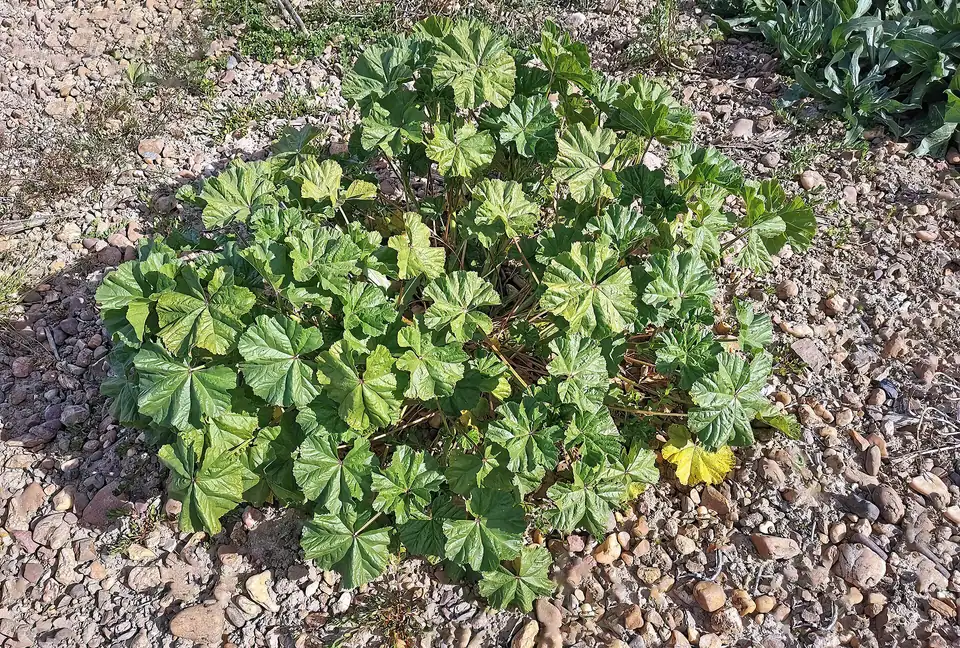
Little mallow (Malva parviflora) is an annual with an appearance similar to common mallow. [1] In California it flowers from March to September. [1] Its leaves are eaten raw or cooked as a potherb. [3]
This record is incomplete: the sources we read do not cover every field yet.
Not yet covered by our sources: Hardiness, coldest zone, Hardiness, warmest zone
Cheeseweed mallow care
How much light Cheeseweed mallow needs
Sunny position
What the sources say (1)
though it prefers a reasonably well-drained and moderately fertile soil in a sunny positionHow much cold Cheeseweed mallow can take
Hardiness, coldest zone
Not stated in the sources we read.
Hardiness, warmest zone
Not stated in the sources we read.
How to propagate Cheeseweed mallow
How to grow Cheeseweed mallow
The plant
Life cycle
annual
What the sources say (1)
These annuals begin growing with the first rains in the fall and quickly develop a deep taproot that becomes woody and makes the plant very difficult to remove by hand or even with tools.Family
Malvaceae
What the sources say (1)
Family: MALVACEAE Genus: Malva Catalan common name: Malva. Malva de fulla petita. Vauma.Cheeseweed mallow pests and problems
Weed in crops, gardens and landscapes
Symptom: Mallow growing in landscape beds and turf impacts the aesthetic value of the area, while high numbers or large plants can decrease crop yields.
What to do: Mallows are best controlled mechanically by hoeing or pulling out young plants.
What the sources say (1)
Mallows are best controlled mechanically by hoeing or pulling out young plants.
— Mallows / Home and Landscape / UC Statewide IPM Program (UC IPM) [1]
Remedies
Each remedy shows what official sources say about it; traditional remedies without an official source are marked as such. Harmful ones are listed so you know to avoid them.
Treating the plant
Getting rid of it
little mallow
pulling young plants Works
How: Pull out young plants, best when they have four or fewer true leaves, before they seed.
Mallow control in home gardens and landscapes is best accomplished by pulling out young plants. Because of the rapid development of the long tap root, this is best accomplished when the plant has four or fewer true leaves.
— ipm.ucanr.edu [10] What the evidence says Mallows are best controlled mechanically by hoeing or pulling out young plants. Young mallow can also be killed by cutting them off at the crown, but older plants may resprout from the crown.
— ipm.ucanr.edu [10] hoeing Works
How: Hoe young plants.
Mallows are best controlled mechanically by hoeing or pulling out young plants. Young mallow can also be killed by cutting them off at the crown, but older plants may resprout from the crown.
— ipm.ucanr.edu [10] What the evidence says Mallows are best controlled mechanically by hoeing or pulling out young plants. Young mallow can also be killed by cutting them off at the crown, but older plants may resprout from the crown.
— ipm.ucanr.edu [10] cutting off at the crown Partly works
How: Cut young plants off at the crown; older plants may resprout from the crown.
Mallows are best controlled mechanically by hoeing or pulling out young plants. Young mallow can also be killed by cutting them off at the crown, but older plants may resprout from the crown.
— ipm.ucanr.edu [10] What the evidence says Mallows are best controlled mechanically by hoeing or pulling out young plants. Young mallow can also be killed by cutting them off at the crown, but older plants may resprout from the crown.
— ipm.ucanr.edu [10] organic mulch Partly works
However, the mulch must be maintained to ensure that it remains at the needed depth. Otherwise, the seedling can push through the mulch and become established.
— ipm.ucanr.edu [10] How: Apply at least 3 inches of organic mulch such as bark or wood chips and keep it at that depth.
At least 3 inches of organic mulch, such as bark or wood chips, will make it physically difficult for the seedling to emerge and will screen out the amount of light that mallow requires to effectively sprout.
— ipm.ucanr.edu [10] What the evidence says However, the mulch must be maintained to ensure that it remains at the needed depth. Otherwise, the seedling can push through the mulch and become established.
— ipm.ucanr.edu [10] planting competitive plants Partly works
How: Plant competitive desirable plants whose shade reduces germination and growth of seedlings.
Cultural control can be done by planting competitive desirable plants in areas where mallow is a problem. The shade provided by these plants will reduce germination and growth of mallow seedlings.
— ipm.ucanr.edu [10] What the evidence says Cultural control can be done by planting competitive desirable plants in areas where mallow is a problem. The shade provided by these plants will reduce germination and growth of mallow seedlings.
— ipm.ucanr.edu [10] mowing Not proven
How: Mowing.
Mowing is not an effective method of control because the plants have viable buds on the stems below the height of the mower blade.
— ipm.ucanr.edu [10] What the evidence says Mowing is not an effective method of control because the plants have viable buds on the stems below the height of the mower blade.
— ipm.ucanr.edu [10] solarization Not proven
How: Soil solarization.
Solarization is not effective for mallow control, nor is flaming.
— ipm.ucanr.edu [10] What the evidence says Solarization is not effective for mallow control, nor is flaming.
— ipm.ucanr.edu [10] flaming Not proven
How: Flaming.
Solarization is not effective for mallow control, nor is flaming.
— ipm.ucanr.edu [10] What the evidence says Solarization is not effective for mallow control, nor is flaming.
— ipm.ucanr.edu [10]
Calendar
Sowing
Early spring, in situ
What the sources say (1)
Seed - sow early spring in situ. Germination should take place within 2 weeks.Months as given by the sources, which are mostly from the United States (northern hemisphere). In the southern hemisphere they shift by about six months.
Edibility
Reported by the source, quoted verbatim. Do not eat a plant on the basis of this page alone: identification mistakes can be dangerous.
Similar plants
- Bull mallow Malva nicaeensis
- Common mallow Malva sylvestris
- Musk Mallow Malva moschata
- Tree Mallow Malva arborea
- Tree Mallow Malva trimestris
- Cluster mallow Malva verticillata
- Mallow Malva neglecta
- Cranberry Hibiscus Hibiscus acetosella
Sources
Every value above is quoted from these documents. Links lead to the original publisher.
- Mallows / Home and Landscape / UC Statewide IPM Program (UC IPM) · ipm.ucanr.edu, consulted
- Malva parviflora - Calflora · calflora.org, consulted
- Cheeseweed (Malva parviflora) — Practical Plants · practicalplants.org, consulted
- Malva parviflora - Useful Temperate Plants · temperate.theferns.info, consulted
- Malva parviflora • New Zealand Plant Conservation Network · nzpcn.org.nz, consulted
- · cretanflora.com, consulted
- Malva parviflora L. - Herbari Virtual del Mediterrani Occidental · herbarivirtual.uib.cat, consulted
- VicFlora: Malva parviflora · vicflora.rbg.vic.gov.au, consulted
- pnwhandbooks.org · pnwhandbooks.org
- ipm.ucanr.edu · ipm.ucanr.edu
Written by Emilio Marruso · last checked