How to Grow and Care for Common mallow
Malva sylvestris
Written by Emilio Marruso · last checked
At a glance
Common mallow is a generous plant: its leaves, shoots, flowers and seeds can all be eaten, raw or cooked. It grows happily in full sun or partial shade, in soil from pH 5.5 to 8, and once settled it handles some drought. Plant it in spring, trim the branch tips for a bushier plant, and pick the flowers as they open.
- Sun
Full sun to partial shade
What the sources say (2)
Light: Full sun to partial shade
USDA Hardiness Zone: 5 to 8 AHS Heat Zone: Not defined for this plant Light Range: Part Sun to Full Sun
— Malva sylvestris ( Mallow ) - Professional Gardening Tips [4] When fully rooted in the pots, plant outside in field in semi-shade or sunny settings.
— Malva sylvestris [2] - Water
Water regularly, more for young plants and in long dry spells; handles some drought once settled
What the sources say (2)
Watering: Moderate to regular watering; tolerates some drought once established
It is a pretty drought-tolerant plant once established.
— How To Take Care Of A Malva Sylvestris Plant [5] Watering notes: Young plants need plenty of water; intensify watering at transplanting and during persistent drought
Spacing should be at least 2 feet apart for container-grown plants. Plantlings need plenty of water.
— How To Take Care Of A Malva Sylvestris Plant [5] - Soil
Grows in soil from pH 5.5 to 8
- Planting
Plant in spring
What the sources say (2)
- Pruning
When it reaches 1 foot tall and while blooming, trim the branch tips for a bushier plant
What the sources say (1)
Pruning: During the blooming season and when plants reach 30 cm (1 foot) in height: trim branch ends for bushier growth
During the blooming season and when plants reach 1 foot in height, trim the ends of the branches to increase bushy growth.
— How To Take Care Of A Malva Sylvestris Plant [5] - Harvest
Leaves, shoots, flowers and seeds are edible; pick flowers as they open, seeds July to September
What the sources say (1)
Harvest: Seeds: July to September; flowers are harvested in stages as they open
Malva sylvestris flower in June to September and seeds are normally harvested in July to September, either the first or second year.
— Malva sylvestris [2] - Pests
Rust can weaken the plants; rotate where you grow it
- Propagation
From seed; lightly scratching the seed coat helps it sprout
What the sources say (1)
Propagation: Seed (scarification can help germination)
Scarification of the seed can be advantageous for germination.
— Malva sylvestris [2]
Overview
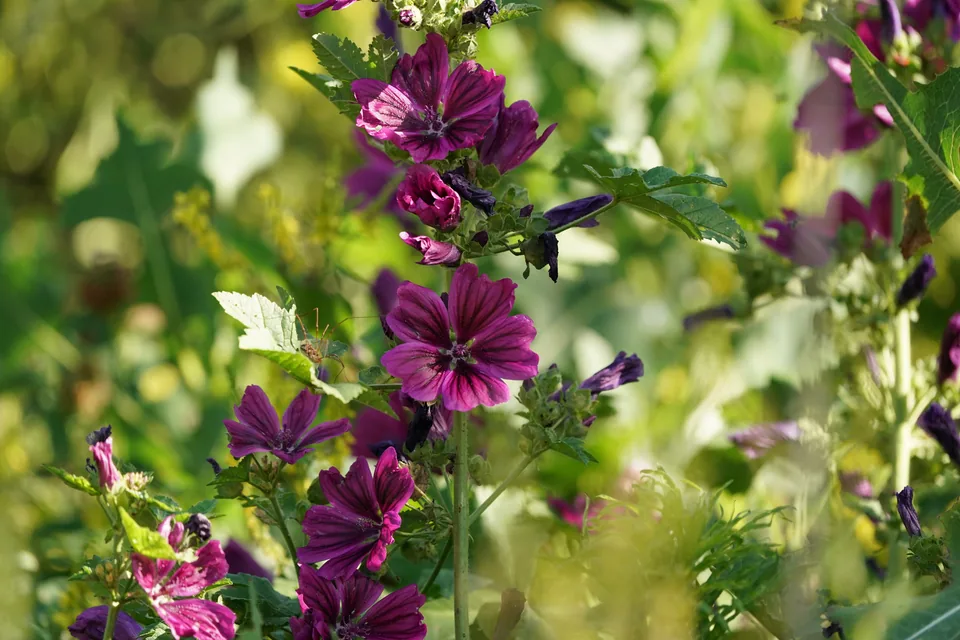
Common mallow is a biennial or perennial that grows to about 80-120 cm [31–47 in] and is cultivated for its pink-purple striped flowers. [2] It grows in full sun to part sun in well-drained soil and is prone to rust. [4][2] Leaves, shoots, flowers and seeds are edible raw or cooked. [2]
This record is incomplete: the sources we read do not cover every field yet.
Not yet covered by our sources: Hardiness, warmest zone
Common mallow care
Measurements in square brackets are our conversion into the other unit system; the quoted text is unchanged.
How to water Common mallow
Watering
Moderate to regular watering; tolerates some drought once established
What the sources say (1)
It is a pretty drought-tolerant plant once established.Watering notes
Young plants need plenty of water; intensify watering at transplanting and during persistent drought
What the sources say (1)
Spacing should be at least 2 feet apart for container-grown plants. Plantlings need plenty of water.How much light Common mallow needs
Full sun to partial shade
How much cold Common mallow can take
Hardiness, coldest zone
The sources give different values depending on region, zone or growing conditions.
What each source says
According to Backyard Gardener: 5 [winter low −28.9 to −23.3 °C (−20 to −10 °F)]
zones 4 to 8: 4 [winter low −34.4 to −28.9 °C (−30 to −20 °F)]
What the sources say (3)
According to Backyard Gardener: USDA Hardiness Zone:
5 to 8
AHS Heat Zone:
Not defined for this plant
Light Range:
Part Sun to Full Sunzones 4 to 8: Considered an annual in zones 4 to 8, this plant does self-seed, so to some it might be considered a perennial or biennial.USDA Hardiness Zone:
5 to 8
AHS Heat Zone:
Not defined for this plant
Light Range:
Part Sun to Full SunHardiness, warmest zone
Not stated in the sources we read.
Best soil for Common mallow
Soil pH, minimum
5.5
What the sources say (1)
Light Range:
Part Sun to Full Sun
pH Range:
5.5 to 8
Soil pH, maximum
8
What the sources say (1)
Light Range:
Part Sun to Full Sun
pH Range:
5.5 to 8
Where to grow Common mallow
The sources give different values depending on region, zone or growing conditions.
What each source says
container-grown plants: At least 61 cm (2 ft)
How to propagate Common mallow
Seed (scarification can help germination)
What the sources say (1)
Scarification of the seed can be advantageous for germination.How to grow Common mallow
The plant
Family
Malvaceae
What the sources say (1)
Family:
MALVACEAE
Genus:
Malva
Catalan common name:
Malva. Vauma.
Spanish common name:
Malva silvestre.Common mallow pests and problems
Rust
Symptom: Weakened plants and, in difficult cases, damaged seeds
What to do: Use a suitable crop rotation
Remedies
The sources we checked give no remedies for this plant.
Calendar
Sowing
The sources give different values depending on region, zone or growing conditions.
What each source says
According to NordGen (tray): Early April
Planting
Spring
Harvest
Seeds: July to September; flowers are harvested in stages as they open
What the sources say (1)
Malva sylvestris flower in June to September and seeds are normally harvested in July to September, either the first or second year.Pruning
During the blooming season and when plants reach 30 cm (1 foot) in height: trim branch ends for bushier growth
What the sources say (1)
During the blooming season and when plants reach 1 foot in height, trim the ends of the branches to increase bushy growth.Months as given by the sources, which are mostly from the United States (northern hemisphere). In the southern hemisphere they shift by about six months.
Edibility
Reported by the source, quoted verbatim. Do not eat a plant on the basis of this page alone: identification mistakes can be dangerous.
Both leaves, shoots, flowers and seeds can be eaten, either raw or cooked.
[2]
Indicative values
Values from a secondary source, not checked word for word like the rest of this page. Use them as a starting point.
- Life cycle
- Herbaceous PerennialIndicative value, adapt it to your climate · Secondary source
- Mature height
- 61-121.9 cm (2-4 ft)Indicative value, adapt it to your climate · Secondary source
- Hours of sun
- 6-8 hoursIndicative value, adapt it to your climate · Secondary source
- Drought tolerant
- yesIndicative value, adapt it to your climate · Secondary source
- Care level
- MediumIndicative value, adapt it to your climate · Secondary source
- Growth rate
- LowIndicative value, adapt it to your climate · Secondary source
Similar plants
- Musk Mallow Malva moschata
- Tree Mallow Malva arborea
- Tree Mallow Malva trimestris
- Bull mallow Malva nicaeensis
- Cheeseweed mallow Malva parviflora
- Cluster mallow Malva verticillata
- Mallow Malva neglecta
- African Baobab Adansonia digitata
Sources
Every value above is quoted from these documents. Links lead to the original publisher.
- Malva sylvestris L. - Herbari Virtual del Mediterrani Occidental · herbarivirtual.uib.cat, consulted
- Malva sylvestris · nordgen.org, consulted
- Malva sylvestris - Useful Temperate Plants · temperate.theferns.info, consulted
- Malva sylvestris ( Mallow ) - Professional Gardening Tips · backyardgardener.com, consulted
- How To Take Care Of A Malva Sylvestris Plant · gardenguides.com, consulted
- Malva sylvestris · publication.nordgen.org, consulted
Written by Emilio Marruso · last checked