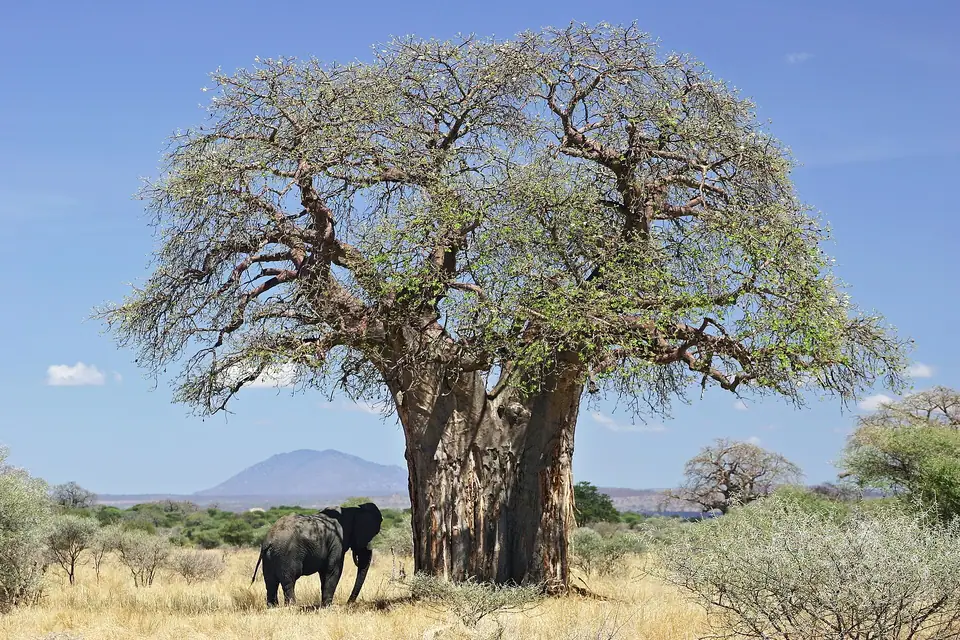
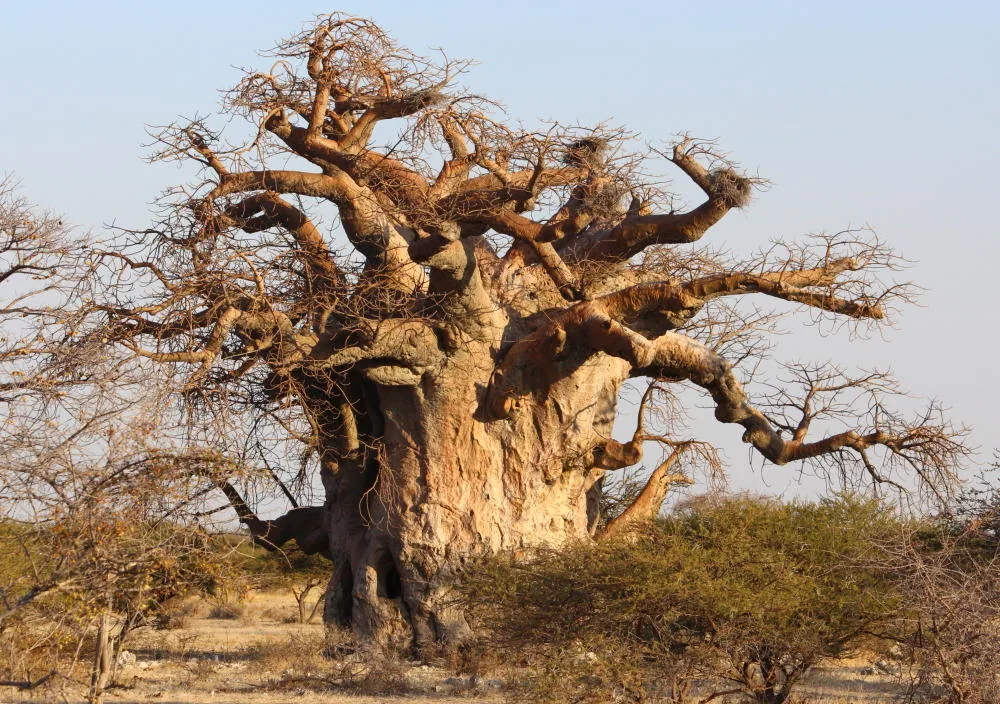

How to Grow and Care for African Baobab
Adansonia digitata
Written by Emilio Marruso · last checked
At a glance
The baobab is a plant you can taste: its leaves are cooked as a vegetable, its white fruit pulp soaked in water makes a refreshing lemonade-like drink, and its roasted seeds stand in for coffee. Give it full sun and well-drained soil, sow it in spring or summer, and water it only while it is in leaf.
- Sun
Full sun
What the sources say (1)
Light: Full sun
They like full sun, so select a sunny place away from buildings as the roots grow very wide.
— Grow your own baobab - Baobab Foundation [6] - Water
Water only while it has leaves; stop in winter when bare. In early spring weekly, then more as leaves grow
What the sources say (2)
Watering: Water seedlings only while in leaf, stop when leafless in winter; in early spring water once a week, then more frequently as leaves grow
Watering: Water your seedling only when it has leaves. As soon as it loses its leaves in the winter you can stop watering.
— Grow your own baobab - Baobab Foundation [6] Initially water only once a week, until the plant has more leaves and then more frequently.
— Grow your own baobab - Baobab Foundation [6] - Cold
Survives winters down to 35 °F (1.7 °C)
Tender: needs a frost-free greenhouse · USDA 10b · RHS H2 · Z10
What the sources say (2)
Hardiness, coldest zone: 10b [winter low 1.7 to 4.4 °C (35 to 40 °F)]
It grows best in USDA Plant Hardiness Zones 10b to 11b, with average minimum winter temperatures ranging from 35°F to 50°F
— Adansonia digitata (African Baobab) - World of Succulents [8] Hardiness, warmest zone: 11b [winter low 7.2 to 10 °C (45 to 50 °F)]
It grows best in USDA Plant Hardiness Zones 10b to 11b, with average minimum winter temperatures ranging from 35°F to 50°F
— Adansonia digitata (African Baobab) - World of Succulents [8] - Soil
Well-drained soil
What the sources say (1)
Watering notes: Overwatering a leafless or small-leaved seedling can cause root rot; soil must be well drained
If you over water the seedlings while it is leafless or when the leaves are still small this can cause root rot and the plant will die.
— Grow your own baobab - Baobab Foundation [6] - Harvest
Leaves cooked as a vegetable, fruit pulp for a lemonade-like drink, roasted seeds instead of coffee
- Pests
Too much water on a bare or small-leaved seedling rots the roots
What the sources say (1)
Watering notes: Overwatering a leafless or small-leaved seedling can cause root rot; soil must be well drained
If you over water the seedlings while it is leafless or when the leaves are still small this can cause root rot and the plant will die.
— Grow your own baobab - Baobab Foundation [6] - Propagation
From seed
- Sowing
Sow in spring or summer
What the sources say (2)
Sowing: Spring or summer
For best results, sow the seeds in spring or summer in a container with a well-draining seed-starting mix.
— Adansonia digitata (African Baobab) - World of Succulents [8] so the best time of the year to plant them will be in the middle of your summer season.
— Grow your own baobab - Baobab Foundation [6] - Containers
Grows in containers too
What the sources say (1)
In containers: Yes
Saplings can be effectively grown in containers or tubs for many
— Adansonia digitata [4] - Safety
Not toxic to people or pets
Overview
African baobab is a deciduous tree native to semi-arid sub-Saharan Africa. [8] It needs full sun and a site away from buildings because the roots grow very wide. [6] Seedlings are watered only while in leaf, and overwatering a leafless seedling can cause root rot. [6]
This record is incomplete: the sources we read do not cover every field yet.
Not yet covered by our sources: Pruning
African Baobab care
How to water African Baobab
Watering
Water seedlings only while in leaf, stop when leafless in winter; in early spring water once a week, then more frequently as leaves grow
What the sources say (2)
Watering: Water your seedling only when it has leaves. As soon as it loses its leaves in the winter you can stop watering.Initially water only once a week, until the plant has more leaves and then more frequently.Watering notes
Overwatering a leafless or small-leaved seedling can cause root rot; soil must be well drained
What the sources say (1)
If you over water the seedlings while it is leafless or when the leaves are still small this can cause root rot and the plant will die.How much light African Baobab needs
Full sun
What the sources say (1)
They like full sun, so select a sunny place away from buildings as the roots grow very wide.How much cold African Baobab can take
Hardiness, coldest zone
10b [winter low 1.7 to 4.4 °C (35 to 40 °F)]
What the sources say (1)
It grows best in USDA Plant Hardiness Zones 10b to 11b, with average minimum winter temperatures ranging from 35°F to 50°FHardiness, warmest zone
11b [winter low 7.2 to 10 °C (45 to 50 °F)]
What the sources say (1)
It grows best in USDA Plant Hardiness Zones 10b to 11b, with average minimum winter temperatures ranging from 35°F to 50°FWhere to grow African Baobab
Yes
What the sources say (1)
Saplings can be effectively grown in containers or tubs for manyHow to propagate African Baobab
How to grow African Baobab
The plant
Family
Malvaceae
What the sources say (1)
Pronunciation: ad-an-SOH-nee-uh dig-ee-TAH-tuh Family: Malvaceae, formerly Bombacaceae Genus: Adansonia Type: BroadleafMature height
The sources disagree:
Fertilizing
Natural fertilizers
The sources give different values depending on region, zone or growing conditions.
What each source says
seedlings in nursery pots (research trial): Compost is not required at the seedling stage
seedlings in nursery pots (research trial): Cow-dung compost gave no significant improvement in early growth
What the sources say (2)
seedlings in nursery pots (research trial): This study shows that A. digitata as a deciduous plant with a lifespan reaching 1500 years, does not require compost application in the seedling stage of the plantseedlings in nursery pots (research trial): Based on the result of this finding,the compost produced with cow dung indicates no significant improvement in the early growth performance of A. digitata.African Baobab pests and problems
Root rot from overwatering
Symptom: Plant dies if a leafless or small-leaved seedling is overwatered
What to do: Water only while the seedling has leaves; stop watering when it loses its leaves in winter
What the sources say (1)
If you over water the seedlings while it is leafless or when the leaves are still small this can cause root rot and the plant will die.
— Grow your own baobab - Baobab Foundation [6]
Remedies
The sources we checked give no remedies for this plant.
Is African Baobab poisonous?
Reported by the source, quoted verbatim. This is not medical or veterinary advice: if a person or an animal may have eaten this plant, contact a poison control centre or a veterinarian.
The leaves, roots, flowers, fruit pulp, and seeds are all edible and non-toxic for people and pets.
[8]
Calendar
Sowing
Spring or summer
What the sources say (2)
For best results, sow the seeds in spring or summer in a container with a well-draining seed-starting mix.so the best time of the year to plant them will be in the middle of your summer season.Pruning
Not stated in the sources we read.
Months as given by the sources, which are mostly from the United States (northern hemisphere). In the southern hemisphere they shift by about six months.
Edibility
Reported by the source, quoted verbatim. Do not eat a plant on the basis of this page alone: identification mistakes can be dangerous.
They are cooked fresh as a vegetable or dried and crushed for later use by local people.
[3]It is this white powdery substance which is soaked in water to provide a refreshing drink somewhat reminiscent of lemonade.
[3]The seeds are also edible and can also be roasted for use as a coffee substitute.
[3]
Indicative values
Values from a secondary source, not checked word for word like the rest of this page. Use them as a starting point.
- Life cycle
- PerennialIndicative value, adapt it to your climate · Secondary source
- Drought tolerant
- yesIndicative value, adapt it to your climate · Secondary source
- Soil pH
- 6-7.5Indicative value, adapt it to your climate · Secondary source
- Care level
- ModerateIndicative value, adapt it to your climate · Secondary source
- Growth rate
- LowIndicative value, adapt it to your climate · Secondary source
- Pruning
- August, September, OctoberIndicative value, adapt it to your climate · Secondary source
Similar plants
- Bastardcedar Guazuma ulmifolia
- Bigleaf Linden Tilia platyphyllos
- Brazilian Bellflower Callianthe megapotamica
- Cape Mallow Anisodontea capensis
- Chinese Hibiscus Hibiscus × rosa-sinensis
- Common mallow Malva sylvestris
- Cranberry Hibiscus Hibiscus acetosella
- Flower of an hour Hibiscus trionum
Sources
Every value above is quoted from these documents. Links lead to the original publisher.
- A Horticulture Information article from the Wisconsin Master Gardener website, posted 16 Feb 2007 · mastergardener.extension.wisc.edu, consulted
- Adansonia digitata | Landscape Plants | Oregon State University · landscapeplants.oregonstate.edu, consulted
- Adansonia digitata - Plant Detail - Tropical Plants Database - NTBG Database · ntbg.org, consulted
- Adansonia digitata · plantzafrica.com, consulted
- ADANSONIA DIGITATA · apps.worldagroforestry.org, consulted
- Grow your own baobab - Baobab Foundation · baobabfoundation.co.za, consulted
- Adansonia za Baillon | ISI 2006 · media.huntington.org, consulted
- Adansonia digitata (African Baobab) - World of Succulents · worldofsucculents.com, consulted
- fjs.fudutsinma.edu.ng · fjs.fudutsinma.edu.ng
Written by Emilio Marruso · last checked