
How to Grow and Care for Cape Mallow
Anisodontea capensis
Written by Emilio Marruso · last checked
At a glance
Cape mallow is an easygoing shrub for sunny spots: it likes full sun to partial shade, ideally morning sun with some afternoon shade. Once settled in, it needs only modest watering, so it fits right into a drought-tolerant garden. Give it good drainage, a light trim at the start of spring, and enjoy a plant 2–4 ft tall and wide.
- Sun
Full sun to partial shade; best with morning sun and afternoon shade
What the sources say (2)
Light: Full sun to partial shade; morning sun and afternoon partial shade preferred
Cape Mallows prefer morning sun and partial shade in the afternoon.
— Anisodontea capensis (African Mallow, Cape Mallow, Dwarf Pink Hibiscus) | North Carolina Extension Gardener Plant Toolbox [1] Full sun (6 or more hours of direct sunlight a day) Partial Shade (Direct sunlight only part of the day, 2-6 hours)
— Anisodontea capensis (African Mallow, Cape Mallow, Dwarf Pink Hibiscus) | North Carolina Extension Gardener Plant Toolbox [1] - Water
Little water once settled in; fine in a dry garden, but needs good drainage
What the sources say (2)
Watering: Modest water requirements once established; suited to a drought-tolerant garden
Once established, modest water requirements make it a colorful addition to a drought-tolerant garden.
— Anisodontea capensis (African Mallow, Cape Mallow, Dwarf Pink Hibiscus) | North Carolina Extension Gardener Plant Toolbox [1] Watering notes: Needs good drainage
This plant is not picky about soil but it does need good drainage.
— Anisodontea capensis (African Mallow, Cape Mallow, Dwarf Pink Hibiscus) | North Carolina Extension Gardener Plant Toolbox [1] - Cold
Survives winters down to 10 °F (−12.2 °C)
Hardy in cold winters · USDA 8a · RHS H5 · Z8
What the sources say (2)
Hardiness, coldest zone: 8a [winter low −12.2 to −9.4 °C (10 to 15 °F)]
8a, 8b, 9a, 9b, 10a, 10b, 11a, 11b
— Anisodontea capensis (African Mallow, Cape Mallow, Dwarf Pink Hibiscus) | North Carolina Extension Gardener Plant Toolbox [1] Hardiness, warmest zone: 11b [winter low 7.2 to 10 °C (45 to 50 °F)]
8a, 8b, 9a, 9b, 10a, 10b, 11a, 11b
— Anisodontea capensis (African Mallow, Cape Mallow, Dwarf Pink Hibiscus) | North Carolina Extension Gardener Plant Toolbox [1] - Pruning
Prune at the beginning of spring
What the sources say (1)
Pruning: Beginning of spring
Prune at the beginning of spring to encourage blooming and to maintain a bushier shape.
— Anisodontea capensis (African Mallow, Cape Mallow, Dwarf Pink Hibiscus) | North Carolina Extension Gardener Plant Toolbox [1] - Pests
Watch for aphids, spider mites, whiteflies and mallow rust
What the sources say (2)
Pests: aphids, spider mites, whiteflies
May be susceptible to Puccinia malvacearum (mallow rust). Watch for aphids, spider mites, and whiteflies.
— Anisodontea capensis (African Mallow, Cape Mallow, Dwarf Pink Hibiscus) | North Carolina Extension Gardener Plant Toolbox [1] Diseases: mallow rust (Puccinia malvacearum)
May be susceptible to Puccinia malvacearum (mallow rust). Watch for aphids, spider mites, and whiteflies.
— Anisodontea capensis (African Mallow, Cape Mallow, Dwarf Pink Hibiscus) | North Carolina Extension Gardener Plant Toolbox [1] - Size
2–4 ft tall and 2–4 ft wide
What the sources say (2)
Mature height: 61-122 cm (2-4 ft)
Dimensions: Height: 2 ft. 0 in. - 4 ft. 0 in. Width: 2 ft. 0 in. - 4 ft. 0 in.
— Anisodontea capensis (African Mallow, Cape Mallow, Dwarf Pink Hibiscus) | North Carolina Extension Gardener Plant Toolbox [1] Mature width: 61-122 cm (2-4 ft)
Dimensions: Height: 2 ft. 0 in. - 4 ft. 0 in. Width: 2 ft. 0 in. - 4 ft. 0 in.
— Anisodontea capensis (African Mallow, Cape Mallow, Dwarf Pink Hibiscus) | North Carolina Extension Gardener Plant Toolbox [1] - Propagation
Grow new plants from stem cuttings
What the sources say (1)
Propagation: Stem cuttings
Recommended Propagation Strategy: Seed Stem Cutting
— Anisodontea capensis (African Mallow, Cape Mallow, Dwarf Pink Hibiscus) | North Carolina Extension Gardener Plant Toolbox [1]
Overview
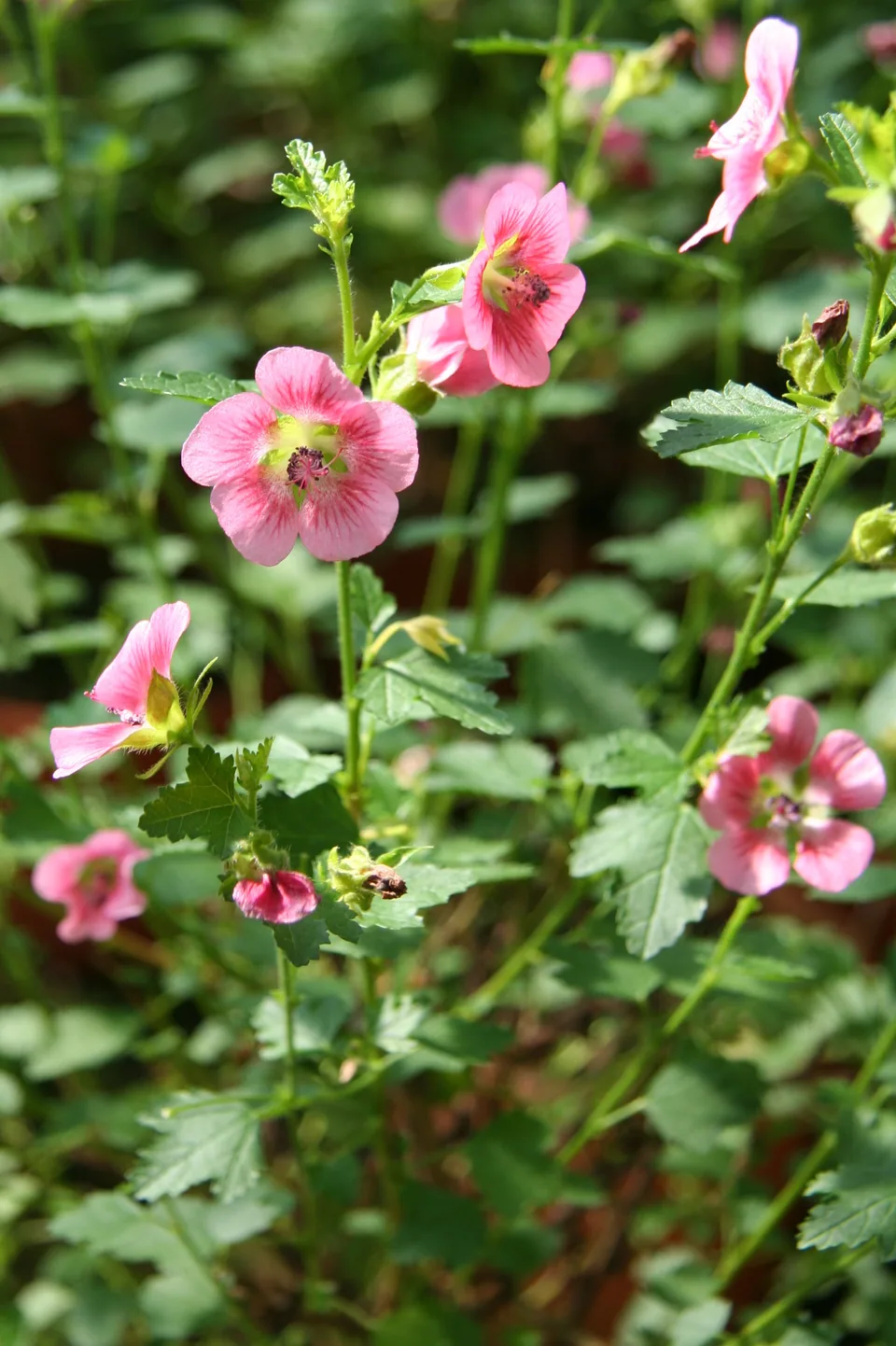
Cape mallow is an upright evergreen subshrub with small pink to dark purple hibiscus-like flowers from spring until frost. [1] It needs good drainage and has modest water requirements once established, preferring morning sun and afternoon partial shade. [1] It is pruned at the beginning of spring and is propagated by stem cuttings. [1]
Cape Mallow care
How to water Cape Mallow
Watering
Modest water requirements once established; suited to a drought-tolerant garden
What the sources say (1)
Once established, modest water requirements make it a colorful addition to a drought-tolerant garden.Watering notes
Needs good drainage
What the sources say (1)
This plant is not picky about soil but it does need good drainage.How much light Cape Mallow needs
Full sun to partial shade; morning sun and afternoon partial shade preferred
What the sources say (2)
Cape Mallows prefer morning sun and partial shade in the afternoon.Full sun (6 or more hours of direct sunlight a day)
Partial Shade (Direct sunlight only part of the day, 2-6 hours)How much cold Cape Mallow can take
Hardiness, coldest zone
8a [winter low −12.2 to −9.4 °C (10 to 15 °F)]
What the sources say (1)
8a, 8b, 9a, 9b, 10a, 10b, 11a, 11bHardiness, warmest zone
11b [winter low 7.2 to 10 °C (45 to 50 °F)]
What the sources say (1)
8a, 8b, 9a, 9b, 10a, 10b, 11a, 11bHow to propagate Cape Mallow
Stem cuttings
What the sources say (1)
Recommended Propagation Strategy:
Seed
Stem CuttingHow to grow Cape Mallow
The plant
Life cycle
annual, perennial
What the sources say (1)
Family:
Malvaceae
Life Cycle:
Annual
Perennial
Recommended Propagation Strategy:Family
Malvaceae
What the sources say (1)
Family:
Malvaceae
Life Cycle:
Annual
Perennial
Recommended Propagation Strategy:Mature height
61-122 cm (2-4 ft)
What the sources say (1)
Dimensions:
Height: 2 ft. 0 in. - 4 ft. 0 in.
Width: 2 ft. 0 in. - 4 ft. 0 in.Mature width
61-122 cm (2-4 ft)
What the sources say (1)
Dimensions:
Height: 2 ft. 0 in. - 4 ft. 0 in.
Width: 2 ft. 0 in. - 4 ft. 0 in.Pests and diseases
Pests
aphids, spider mites, whiteflies
What the sources say (1)
May be susceptible to Puccinia malvacearum (mallow rust). Watch for aphids, spider mites, and whiteflies.Diseases
mallow rust (Puccinia malvacearum)
What the sources say (1)
May be susceptible to Puccinia malvacearum (mallow rust). Watch for aphids, spider mites, and whiteflies.Cape Mallow pests and problems
Mallow rust
Symptom: May be susceptible to Puccinia malvacearum (mallow rust)
What the sources say (1)
May be susceptible to Puccinia malvacearum (mallow rust). Watch for aphids, spider mites, and whiteflies.
— Anisodontea capensis (African Mallow, Cape Mallow, Dwarf Pink Hibiscus) | North Carolina Extension Gardener Plant Toolbox [1] Aphids, spider mites and whiteflies
Symptom: Watch for aphids, spider mites, and whiteflies
What the sources say (1)
May be susceptible to Puccinia malvacearum (mallow rust). Watch for aphids, spider mites, and whiteflies.
— Anisodontea capensis (African Mallow, Cape Mallow, Dwarf Pink Hibiscus) | North Carolina Extension Gardener Plant Toolbox [1]
Remedies
Each remedy shows what official sources say about it; traditional remedies without an official source are marked as such. Harmful ones are listed so you know to avoid them.
Treating the plant
mallow rust
removing nearby mallow weeds Official source, not independently tested
In most situations, these good gardening practices alone will not control rust completely.
— yardandgarden.extension.iastate.edu [5] How: Control mallow weeds in the vicinity, because the rust fungus can also infect common mallow.
The hollyhock rust fungus can also infect the common mallow weed, so weed control in the vicinity is important.
— yardandgarden.extension.iastate.edu [5]
Calendar
Pruning
Beginning of spring
What the sources say (1)
Prune at the beginning of spring to encourage blooming and to maintain a bushier shape.Months as given by the sources, which are mostly from the United States (northern hemisphere). In the southern hemisphere they shift by about six months.
Similar plants
- African Baobab Adansonia digitata
- Bastardcedar Guazuma ulmifolia
- Bigleaf Linden Tilia platyphyllos
- Brazilian Bellflower Callianthe megapotamica
- Chinese Hibiscus Hibiscus × rosa-sinensis
- Common mallow Malva sylvestris
- Cranberry Hibiscus Hibiscus acetosella
- Flower of an hour Hibiscus trionum
Sources
Every value above is quoted from these documents. Links lead to the original publisher.
- Anisodontea capensis (African Mallow, Cape Mallow, Dwarf Pink Hibiscus) | North Carolina Extension Gardener Plant Toolbox · plants.ces.ncsu.edu, consulted
- Anisodontea (African Mallow, Cape African Queen, Cape Mallow) | North Carolina Extension Gardener Plant Toolbox · plants.ces.ncsu.edu, consulted
- Cape Mallow - Anisodontea | North Carolina Extension Gardener Plant Toolbox · plants.ces.ncsu.edu, consulted
- Find a Plant | North Carolina Extension Gardener Plant Toolbox · plants.ces.ncsu.edu, consulted
- yardandgarden.extension.iastate.edu · yardandgarden.extension.iastate.edu
Written by Emilio Marruso · last checked