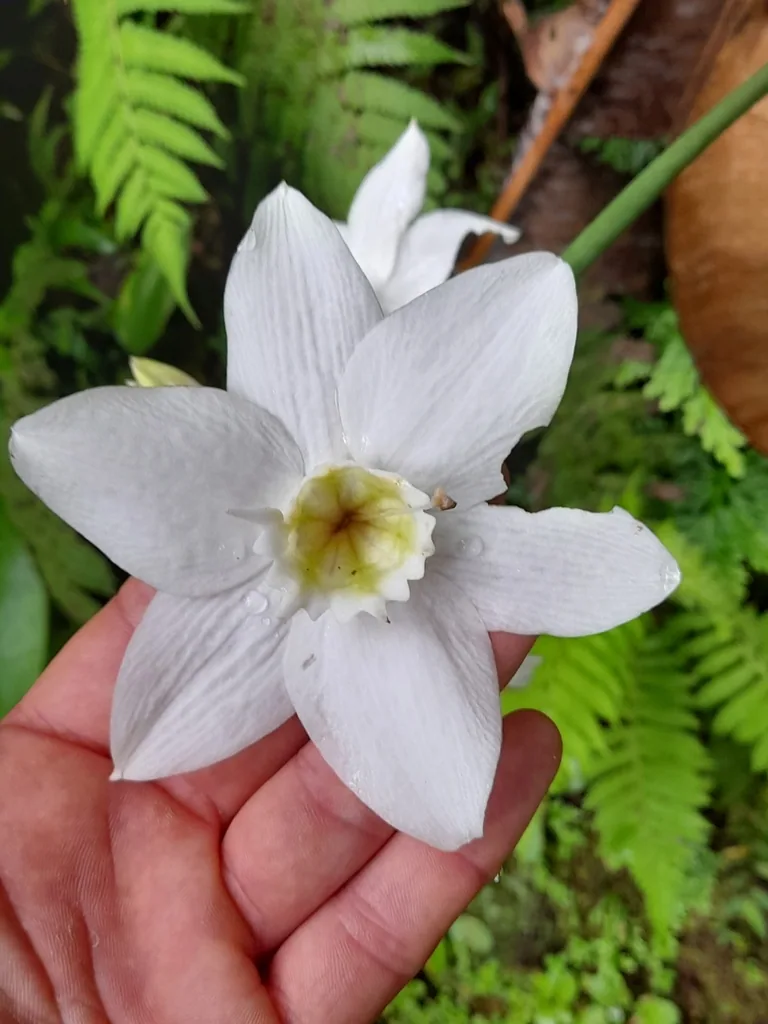
How to Grow and Care for Amazon Lily
Urceolina amazonica
Written by Emilio Marruso · last checked
At a glance
This bulb plant is happy in bright shade and grows well indoors or in a pot, reaching 18–24 inches tall and wide. Keep its well-drained soil evenly moist, and try this simple trick: cut back on water for one month, then water again when new growth appears to enjoy extra rounds of blooms. Just keep it warm, above 68 °F.
- Sun
Bright shade or dappled light, half sun and half shade
What the sources say (1)
Light: 50% dappled or bright shade
Prefers 50% dappled or bright shade. Place the
— Urceolina amazonica (Amazon Lily) | North Carolina Extension Gardener Plant Toolbox [1] - Water
Keep the soil evenly moist; water less for a month, then resume at new growth for more blooms
What the sources say (2)
Watering: Well-drained, evenly moist soil
with well-drained evenly moist soil. They flower best
— Urceolina amazonica (Amazon Lily) | North Carolina Extension Gardener Plant Toolbox [1] Watering notes: Cutting back on water for one month, then resuming watering when new growth appears, induces extra blooming cycles
Normally blooms in winter but can be a seasonal bloomer 2-3 times a year by cutting back on water for one month. When new growth appears, resume watering.
— Urceolina amazonica (Amazon Lily) | North Carolina Extension Gardener Plant Toolbox [1] - Cold
Survives winters down to 30 °F (−1.1 °C)
Half hardy: mild winters or an unheated greenhouse · USDA 10a · RHS H3 · Z10
What the sources say (2)
Hardiness, coldest zone: 10a [winter low −1.1 to 1.7 °C (30 to 35 °F)]
USDA Plant Hardiness Zone: 10a, 10b, 11a, 11b
— Urceolina amazonica (Amazon Lily) | North Carolina Extension Gardener Plant Toolbox [1] Hardiness, warmest zone: 11b [winter low 7.2 to 10 °C (45 to 50 °F)]
USDA Plant Hardiness Zone: 10a, 10b, 11a, 11b
— Urceolina amazonica (Amazon Lily) | North Carolina Extension Gardener Plant Toolbox [1] - Soil
Soil that drains well
What the sources say (1)
Watering: Well-drained, evenly moist soil
with well-drained evenly moist soil. They flower best
— Urceolina amazonica (Amazon Lily) | North Carolina Extension Gardener Plant Toolbox [1] - Watch out
Very sensitive to cold: it can be damaged below 68 °F (20 °C)
- Size
18–24 in tall and wide
What the sources say (2)
Mature height: 45.72-60.96 cm (1.5-2 ft)
Height: 1 ft. 6 in. - 2 ft. 0 in.
— Urceolina amazonica (Amazon Lily) | North Carolina Extension Gardener Plant Toolbox [1] Mature width: 45.72-60.96 cm (1.5-2 ft)
Width: 1 ft. 6 in. - 2 ft. 0 in.
— Urceolina amazonica (Amazon Lily) | North Carolina Extension Gardener Plant Toolbox [1] - Propagation
Store the bulbs in peat at 68 °F (20 °C)
What the sources say (1)
Storage: store bulbs in peat at 20 C (68 F)
Store bulbs in peat at 68 degrees F (20 degrees C).
— Urceolina amazonica (Amazon Lily) | North Carolina Extension Gardener Plant Toolbox [1] - Containers
Grows well in pots and indoors
What the sources say (2)
In containers: Yes
A tropical evergreen bulb with hosta-like leaves; fragrant; can be grown in containers.
— Urceolina amazonica (Amazon Lily) | North Carolina Extension Gardener Plant Toolbox [1] Indoors: Yes
Landscape Location: Container Houseplants Patio Resistance To Challenges:
— Urceolina amazonica (Amazon Lily) | North Carolina Extension Gardener Plant Toolbox [1]
Overview
Urceolina amazonica is a tropical evergreen bulb with fragrant flowers that can be grown in containers. [1] It prefers dappled or bright shade and is frost tender. [1]
This record is incomplete: the sources we read do not cover every field yet.
Not yet covered by our sources: Pruning, Propagation
Amazon Lily care
How to water Amazon Lily
Watering
Well-drained, evenly moist soil
What the sources say (1)
with well-drained evenly moist soil. They flower bestWatering notes
Cutting back on water for one month, then resuming watering when new growth appears, induces extra blooming cycles
What the sources say (1)
Normally blooms in winter but can be a seasonal bloomer 2-3 times a year by cutting back on water for one month. When new growth appears, resume watering.How much light Amazon Lily needs
50% dappled or bright shade
What the sources say (1)
Prefers 50% dappled or bright shade. Place theHow much cold Amazon Lily can take
Hardiness, coldest zone
10a [winter low −1.1 to 1.7 °C (30 to 35 °F)]
What the sources say (1)
USDA Plant Hardiness Zone:
10a, 10b, 11a, 11bHardiness, warmest zone
11b [winter low 7.2 to 10 °C (45 to 50 °F)]
What the sources say (1)
USDA Plant Hardiness Zone:
10a, 10b, 11a, 11bWhere to grow Amazon Lily
Indoors
Yes
What the sources say (1)
Landscape Location:
Container
Houseplants
Patio
Resistance To Challenges:In containers
Yes
What the sources say (1)
A tropical evergreen bulb with hosta-like leaves; fragrant; can be grown in containers.How to propagate Amazon Lily
Not stated in the sources we read.
How to grow Amazon Lily
The plant
Family
Amaryllidaceae
What the sources say (1)
Attributes: Genus: Urceolina Species: amazonica Family: Amaryllidaceae Life Cycle: BulbMature height
45.72-60.96 cm (1.5-2 ft)
What the sources say (1)
Height: 1 ft. 6 in. - 2 ft. 0 in.Mature width
45.72-60.96 cm (1.5-2 ft)
What the sources say (1)
Width: 1 ft. 6 in. - 2 ft. 0 in.Harvest and storage
Storage
store bulbs in peat at 20 C (68 F)
What the sources say (1)
Store bulbs in peat at 68 degrees F (20 degrees C).Amazon Lily pests and problems
Cold injury
Symptom: Plants are frost tender and can be injured below 68 degrees F (20 degrees C).
What the sources say (1)
They are frost tender and can be injured below 68 degrees F (20 degrees C)
— Urceolina amazonica (Amazon Lily) | North Carolina Extension Gardener Plant Toolbox [1]
Remedies
Each remedy shows what official sources say about it; traditional remedies without an official source are marked as such. Harmful ones are listed so you know to avoid them.
Treating the plant
bulb mites
hot water dip for bulbs Works
Discard heavily infested bulbs. Handle bulbs carefully, as even slight injuries create entry points for bulb mites.
— hgic.clemson.edu [2] How: Dip cured bulbs in 120 F water for 2 minutes.
Dipping cured bulbs in 120 °F water for 2 minutes can kill mites.
— hgic.clemson.edu [2] What the evidence says Dipping cured bulbs in 120 °F water for 2 minutes can kill mites.
— hgic.clemson.edu [2]
spider mites
washing with soapy water and soft brush Works
How: Wash plants with soapy water (2 teaspoons mild detergent per gallon of water) and a soft brush, washing the undersides of leaves.
Wash plants with soapy water (2 teaspoons mild detergent per gallon of water) and a soft brush, making sure to wash the undersides of leaves.
— extension.missouri.edu [3] What the evidence says Wash plants with soapy water (2 teaspoons mild detergent per gallon of water) and a soft brush, making sure to wash the undersides of leaves.
— extension.missouri.edu [3] forceful spray of water Works
How: Hose the plant with a forceful spray of water.
Hosing tough plants with a forceful spray of water knocks off mites and destroys their webs.
— extension.missouri.edu [3] What the evidence says Hosing tough plants with a forceful spray of water knocks off mites and destroys their webs.
— extension.missouri.edu [3]
mealybugs
dabbing with alcohol on a cotton swab Partly works
How: Dab the visible insects with alcohol on a cotton swab.
A few mealybugs found on a plant can be killed by dabbing the visible insects with alcohol on a cotton swab (alcohol dissolves the wax around the insect and its egg masses and kills them).
— extension.missouri.edu [3] What the evidence says A few mealybugs found on a plant can be killed by dabbing the visible insects with alcohol on a cotton swab (alcohol dissolves the wax around the insect and its egg masses and kills them).
— extension.missouri.edu [3]
scale insects
rubbing off by hand or with alcohol-dipped swab Partly works
How: Rub scales off plants by hand using garden gloves, a toothbrush or a dry or alcohol-dipped cotton swab.
Scales can be rubbed off plants by hand using garden gloves, a toothbrush or a dry or alcohol-dipped cotton swab. However, this treatment may not be adequate when scale are present in large numbers.
— extension.missouri.edu [3] What the evidence says Scales can be rubbed off plants by hand using garden gloves, a toothbrush or a dry or alcohol-dipped cotton swab. However, this treatment may not be adequate when scale are present in large numbers.
— extension.missouri.edu [3]
Calendar
Pruning
Not stated in the sources we read.
Months as given by the sources, which are mostly from the United States (northern hemisphere). In the southern hemisphere they shift by about six months.
Indicative values
Values from a secondary source, not checked word for word like the rest of this page. Use them as a starting point.
- Life cycle
- PerennialIndicative value, adapt it to your climate · Secondary source
- Soil pH
- 5.5-6.5Indicative value, adapt it to your climate · Secondary source
- Care level
- HighIndicative value, adapt it to your climate · Secondary source
- Growth rate
- HighIndicative value, adapt it to your climate · Secondary source
- Pruning
- February, March, April, MayIndicative value, adapt it to your climate · Secondary source
- Propagation
- Division, Cormlet Propagation, Seed Propagation, Tissue CultureIndicative value, adapt it to your climate · Secondary source
Similar plants
- African Blood Lily Scadoxus multiflorus
- Aztec Lily Zephyranthes formosissima
- Coastal Spiderlily Hymenocallis crassifolia
- Findern Flower Narcissus poeticus
- Garlic Chives Allium tuberosum
- Jonquil Narcissus jonquilla
- Lily Leek Allium moly
- Nodding Onion Allium cernuum
Sources
Every value above is quoted from these documents. Links lead to the original publisher.
- Urceolina amazonica (Amazon Lily) | North Carolina Extension Gardener Plant Toolbox · plants.ces.ncsu.edu, consulted
- hgic.clemson.edu · hgic.clemson.edu
- extension.missouri.edu · extension.missouri.edu
Written by Emilio Marruso · last checked