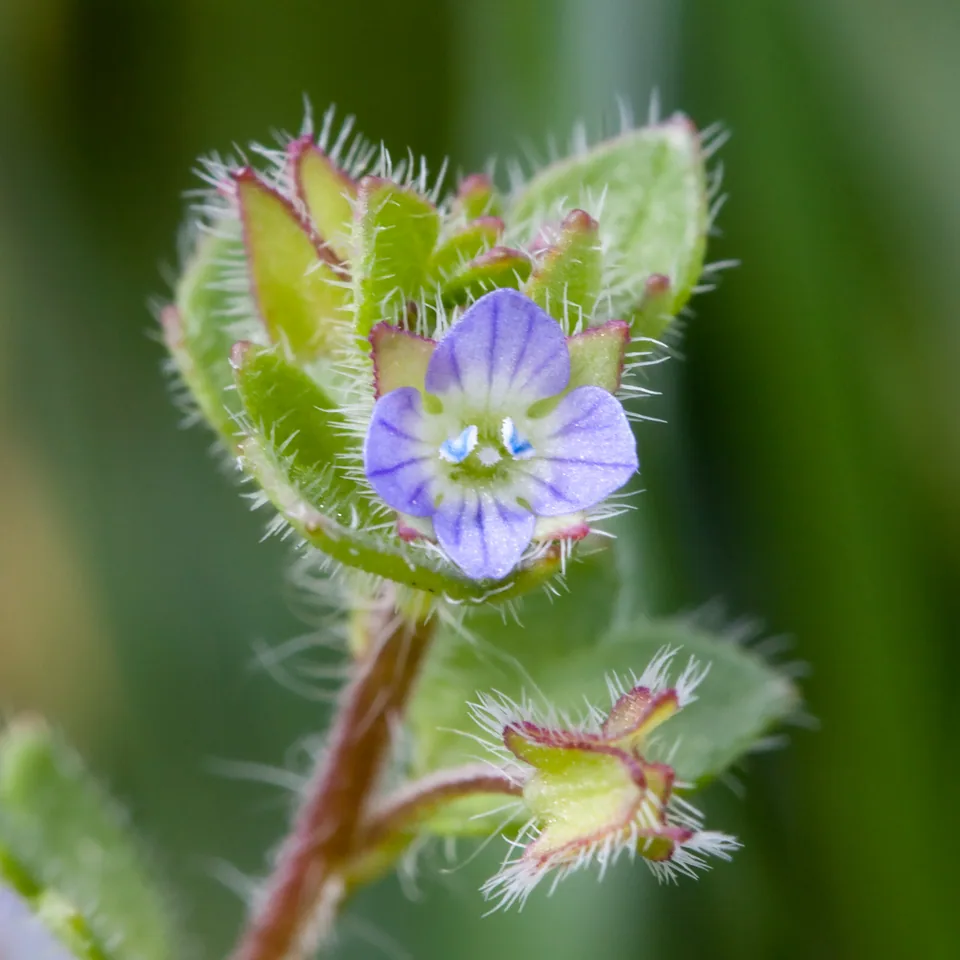


How to Grow and Care for Ivyleaf speedwell
Veronica hederifolia
Written by Emilio Marruso · last checked
At a glance
Ivy-leaved speedwell is a winter annual from the plantain family that asks for very little: full sun and moist soil that drains well. It grows so willingly that it quickly moves into thin lawns, especially where the soil stays moist. Give it its own patch, and keep your lawn thick and healthy so it stays right where you want it.
- Sun
Full sun
What the sources say (1)
Light: Full sun
It grows in the full sun in moist, well-drained soil and can be found in lawns, gardens, roadsides and other disturbed areas.
— Veronica hederifolia (Ivyleaf speedwell, Ivy leaved speedwell, Ivy-leaved Speedwell) | North Carolina Extension Gardener Plant Toolbox [1] - Water
Keep the soil moist, but make sure it drains well
What the sources say (1)
Watering: Moist, well-drained soil
It grows in the full sun in moist, well-drained soil and can be found in lawns, gardens, roadsides and other disturbed areas.
— Veronica hederifolia (Ivyleaf speedwell, Ivy leaved speedwell, Ivy-leaved Speedwell) | North Carolina Extension Gardener Plant Toolbox [1] - Watch out
It quickly invades thin lawns; a thick, healthy lawn keeps it out
Overview
Ivyleaf speedwell is a cool-weather annual weed that sprawls and forms low mats. [1] It grows in full sun in moist, well-drained soil and appears in lawns, gardens and roadsides. [1] A dense, vigorous turf is the best way to reduce its encroachment. [3]
This record is incomplete: the sources we read do not cover every field yet.
Not yet covered by our sources: Hardiness, coldest zone, Hardiness, warmest zone, Propagation
Ivyleaf speedwell care
How to water Ivyleaf speedwell
Moist, well-drained soil
What the sources say (1)
It grows in the full sun in moist, well-drained soil and can be found in lawns, gardens, roadsides and other disturbed areas.How much light Ivyleaf speedwell needs
Full sun
What the sources say (1)
It grows in the full sun in moist, well-drained soil and can be found in lawns, gardens, roadsides and other disturbed areas.How much cold Ivyleaf speedwell can take
Hardiness, coldest zone
Not stated in the sources we read.
Hardiness, warmest zone
Not stated in the sources we read.
How to propagate Ivyleaf speedwell
Not stated in the sources we read.
How to grow Ivyleaf speedwell
The plant
Life cycle
winter annual
What the sources say (1)
Ivyleaf speedwell ( Veronica hederifolia ) is a common North Carolina winter annual weed found in open fields and grassy areas along roadsides.Family
Plantaginaceae
What the sources say (1)
Ivy-leaved Speedwell is a cool-weather annual weed native to Eurasia in the Plantaginaceae (plantain) family.Ivyleaf speedwell pests and problems
Invasion of thin turf
Symptom: Winter annual weeds quickly invade thin turf areas, especially where there is good soil moisture; shade may also encourage growth.
What to do: A dense, vigorous turf is the best way to reduce the encroachment of this weed: select adapted turfgrass cultivars, then fertilize, mow and water properly.
What the sources say (2)
They quickly invade thin turf areas especially where there is good soil moisture.
— Ivyleaf Speedwell | NC State Extension Publications [3] A dense, vigorous turf is the best way to reduce the encroachment of this weed. First, select adapted turfgrass cultivars for your area and then properly fertilize, mow, and water to encourage dense growth.
— Ivyleaf Speedwell | NC State Extension Publications [3]
Remedies
Each remedy shows what official sources say about it; traditional remedies without an official source are marked as such. Harmful ones are listed so you know to avoid them.
Getting rid of it
ivy-leaved speedwell in borders
pulling or forking out by hand Partly works
How: Grasp all the sprawling stems together and pull to remove the bulk of the weed; if the stems have rooted along their length, pull out their roots too, or insert a hand fork under the base of the weed and lift it from the soil.
grasp all the sprawling stems together and pull to remove the bulk of the weed. If the stems have rooted along their length, make sure to pull out their roots too.
— rhs.org.uk [4] What the evidence says Pulling up or digging out individual plants is a viable option for scattered plants in a garden bed or a small area of lawn (when the plants are not yet abundant), but would not be practical for heavier infestations.
— extension.umd.edu [5]
ivy-leaved speedwell seedlings
hoeing Works
How: If seedlings appear, hoe regularly to stop them becoming established, on a dry, sunny day so uprooted plants shrivel and die rather than re-rooting.
hoe regularly to stop them becoming established. Do this on a dry, sunny day so uprooted plants shrivel and die, rather than re-rooting.
— rhs.org.uk [4] What the evidence says Cultivation (rototilling or hoeing) will effectively eliminate plants.
— hortsense.cahnrs.wsu.edu [6] bark mulch Official source, not independently tested
How: Apply a mulch to the soil in early spring to smother emerging seedlings.
apply a mulch to your soil in early spring to smother emerging seedlings.
— rhs.org.uk [4]
ivy-leaved speedwell in lawns
digging out patches and reseeding Partly works
How: Dig out the patch using a sharp spade and repair the lawn by re-seeding.
if you have the odd patch of speedwell in an otherwise healthy lawn, dig it out using a sharp spade and repair the lawn by re-seeding.
— rhs.org.uk [4] What the evidence says Pulling up or digging out individual plants is a viable option for scattered plants in a garden bed or a small area of lawn (when the plants are not yet abundant), but would not be practical for heavier infestations.
— extension.umd.edu [5] raising the mowing height Official source, not independently tested
How: Leave grass slightly longer than normal to smother the weed and reduce its spread.
Raise the cutting height on your mower – leave grass slightly longer than normal to smother the weed and reduce its spread.
— rhs.org.uk [4]
Similar plants
- Birdeye Speedwell Veronica persica
- Garden speedwell Veronica longifolia
- Speedwell Veronica arvensis
- Thyme-leaved Speedwell Veronica serpyllifolia
- Veronica Veronica peduncularis
- Speedwell Veronica spicata
- Veronica gentianoides Veronica gentianoides
- Blue Toadflax Linaria canadensis
Sources
Every value above is quoted from these documents. Links lead to the original publisher.
- Veronica hederifolia (Ivyleaf speedwell, Ivy leaved speedwell, Ivy-leaved Speedwell) | North Carolina Extension Gardener Plant Toolbox · plants.ces.ncsu.edu, consulted
- Ivyleaf speedwell - Veronica hederifolia | North Carolina Extension Gardener Plant Toolbox · plants.ces.ncsu.edu, consulted
- Ivyleaf Speedwell | NC State Extension Publications · content.ces.ncsu.edu, consulted
- rhs.org.uk · rhs.org.uk
- extension.umd.edu · extension.umd.edu
- hortsense.cahnrs.wsu.edu · hortsense.cahnrs.wsu.edu
Written by Emilio Marruso · last checked