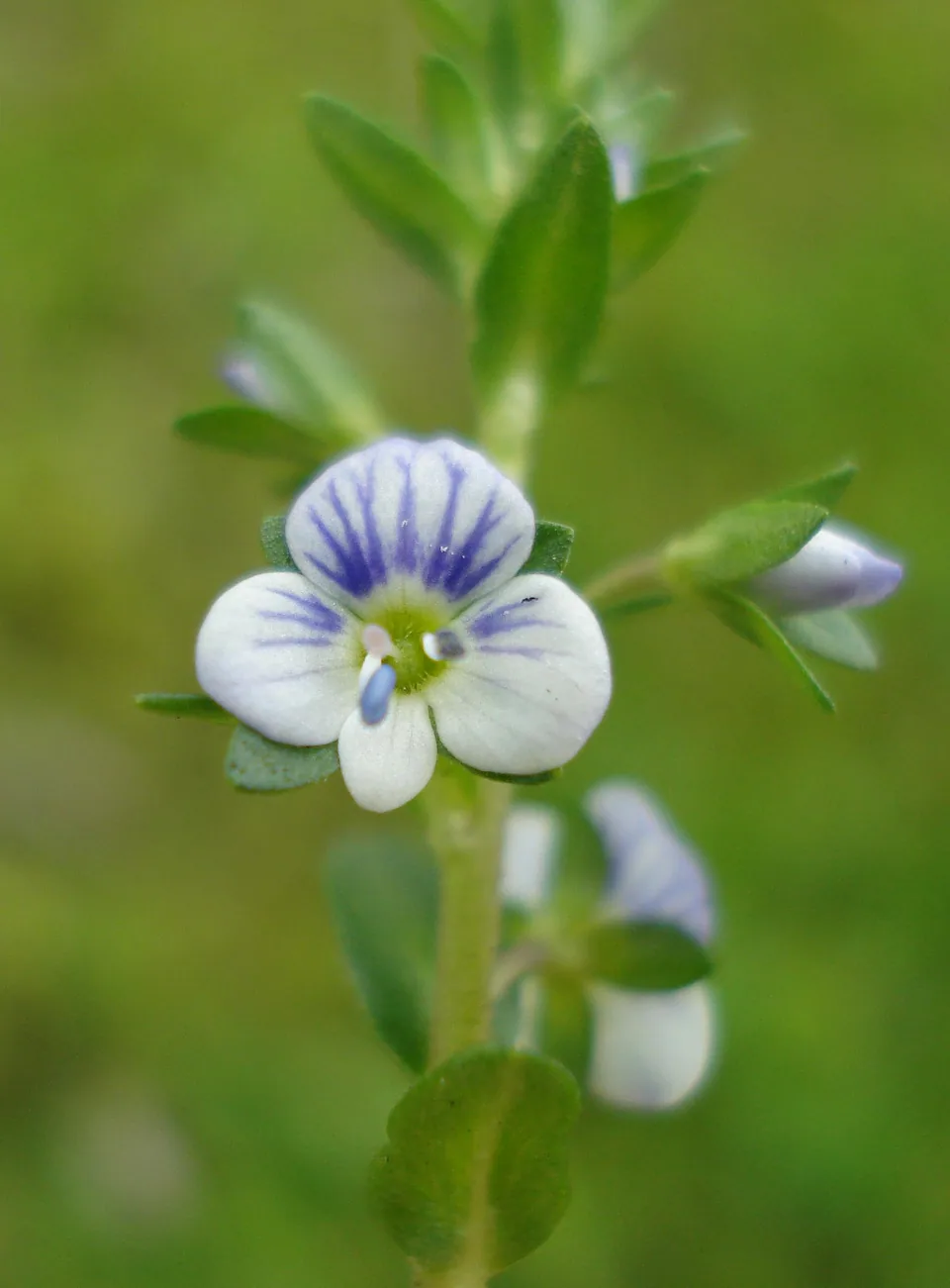


How to Grow and Care for Thyme-leaved Speedwell
Veronica serpyllifolia
Written by Emilio Marruso · last checked
At a glance
This little speedwell is an easygoing perennial that stays low, just 6 inches to 1 foot tall, while spreading 1 to 3 feet wide. It is happy in full sun or partial shade and accepts almost any soil, as long as it drains well. It flowers in spring, and you can start new plants from seed, division or root cuttings.
- Sun
Full sun to partial shade
What the sources say (2)
Light: Full sun to partial shade
Plant in full sun to partial shade. It withstands a wide variety of soil types
— Veronica serpyllifolia (Thymeleaf Speedwell, Thyme-leaved Speedwell, Thyme Speedwell) | North Carolina Extension Gardener Plant Toolbox [1] Light: Full sun (6 or more hours of direct sunlight a day) Partial Shade (Direct sunlight only part of the day, 2-6 hours)
— Veronica serpyllifolia (Thymeleaf Speedwell, Thyme-leaved Speedwell, Thyme Speedwell) | North Carolina Extension Gardener Plant Toolbox [1] - Cold
Survives winters down to −40 °F (−40 °C)
Very hardy · USDA 3a · RHS H7 · Z3
What the sources say (2)
Hardiness, coldest zone: 3a [winter low −40 to −37.2 °C (−40 to −35 °F)]
USDA Plant Hardiness Zone: 3a, 3b, 4a, 4b, 5a, 5b, 6a, 6b, 7a, 7b, 8a, 8b
— Veronica serpyllifolia (Thymeleaf Speedwell, Thyme-leaved Speedwell, Thyme Speedwell) | North Carolina Extension Gardener Plant Toolbox [1] Hardiness, warmest zone: 8b [winter low −9.4 to −6.7 °C (15 to 20 °F)]
USDA Plant Hardiness Zone: 3a, 3b, 4a, 4b, 5a, 5b, 6a, 6b, 7a, 7b, 8a, 8b
— Veronica serpyllifolia (Thymeleaf Speedwell, Thyme-leaved Speedwell, Thyme Speedwell) | North Carolina Extension Gardener Plant Toolbox [1] - Soil
Almost any soil, as long as it drains well
What the sources say (1)
Watering notes: Withstands a wide variety of soil types as long as the soil is well-drained
Plant in full sun to partial shade. It withstands a wide variety of soil types as long as the soil is well-drained.
— Veronica serpyllifolia (Thymeleaf Speedwell, Thyme-leaved Speedwell, Thyme Speedwell) | North Carolina Extension Gardener Plant Toolbox [1] - Watch out
Can become a lawn weed in thin, shady grass; a thick, well-mowed lawn keeps it out
- Size
6 inches to 1 foot tall, 1 to 3 feet wide
What the sources say (2)
Mature height: 15.24-30.48 cm (6 in - 1 ft)
Dimensions: Height: 0 ft. 6 in. - 1 ft. 0 in. Width: 1 ft. 0 in. - 3 ft. 0 in.
— Veronica serpyllifolia (Thymeleaf Speedwell, Thyme-leaved Speedwell, Thyme Speedwell) | North Carolina Extension Gardener Plant Toolbox [1] Mature width: 30.48-91.44 cm (1-3 ft)
Dimensions: Height: 0 ft. 6 in. - 1 ft. 0 in. Width: 1 ft. 0 in. - 3 ft. 0 in.
— Veronica serpyllifolia (Thymeleaf Speedwell, Thyme-leaved Speedwell, Thyme Speedwell) | North Carolina Extension Gardener Plant Toolbox [1] - Propagation
From seed, division or root cuttings
What the sources say (2)
Propagation: Seed, division, root cutting
Plants can be grown from seed or division. Divide plants every few seasons in the fall
— Veronica serpyllifolia (Thymeleaf Speedwell, Thyme-leaved Speedwell, Thyme Speedwell) | North Carolina Extension Gardener Plant Toolbox [1] Recommended Propagation Strategy: Division Root Cutting Seed Country Or Region Of Origin:
— Veronica serpyllifolia (Thymeleaf Speedwell, Thyme-leaved Speedwell, Thyme Speedwell) | North Carolina Extension Gardener Plant Toolbox [1]
Overview
Thyme-leaved speedwell is a perennial of the plantain family that grows in full sun to partial shade. [1] It is treated as a weed of home lawns, parks, and institutional grounds, often in moist soils and shaded areas with thin turf. [2] Its occurrence can be reduced by improving turf density through fertilization, regular mowing, and well-adapted turfgrasses. [2]
Thyme-leaved Speedwell care
How to water Thyme-leaved Speedwell
Withstands a wide variety of soil types as long as the soil is well-drained
What the sources say (1)
Plant in full sun to partial shade. It withstands a wide variety of soil types as long as the soil is well-drained.How much light Thyme-leaved Speedwell needs
Full sun to partial shade
What the sources say (2)
Plant in full sun to partial shade. It withstands a wide variety of soil typesLight:
Full sun (6 or more hours of direct sunlight a day)
Partial Shade (Direct sunlight only part of the day, 2-6 hours)How much cold Thyme-leaved Speedwell can take
Hardiness, coldest zone
3a [winter low −40 to −37.2 °C (−40 to −35 °F)]
What the sources say (1)
USDA Plant Hardiness Zone:
3a, 3b, 4a, 4b, 5a, 5b, 6a, 6b, 7a, 7b, 8a, 8bHardiness, warmest zone
8b [winter low −9.4 to −6.7 °C (15 to 20 °F)]
What the sources say (1)
USDA Plant Hardiness Zone:
3a, 3b, 4a, 4b, 5a, 5b, 6a, 6b, 7a, 7b, 8a, 8bHow to propagate Thyme-leaved Speedwell
Seed, division, root cutting
What the sources say (2)
Plants can be grown from seed or division. Divide plants every few seasons in the fallRecommended Propagation Strategy:
Division
Root Cutting
Seed
Country Or Region Of Origin:How to grow Thyme-leaved Speedwell
The plant
Life cycle
perennial
What the sources say (1)
Thyme-leaved Speedwell is a perennial in the plantain family.Family
Plantaginaceae
What the sources say (1)
Thyme-leaf speedwell ( Veronica serpyllifolia L.) is a member of the plantain family (Plantaginaceae) and is classified as a perennial.Mature height
15.24-30.48 cm (6 in - 1 ft)
What the sources say (1)
Dimensions: Height: 0 ft. 6 in. - 1 ft. 0 in. Width: 1 ft. 0 in. - 3 ft. 0 in.Mature width
30.48-91.44 cm (1-3 ft)
What the sources say (1)
Dimensions: Height: 0 ft. 6 in. - 1 ft. 0 in. Width: 1 ft. 0 in. - 3 ft. 0 in.Thyme-leaved Speedwell pests and problems
Lawn weed
Symptom: Diffuse patches, most conspicuous when flowering in spring, in thin turf and shade
What to do: Improve turf density through fertilization, regular mowing, and well-adapted turfgrasses; labeled preemergence and postemergence herbicides can suppress or control it
What the sources say (2)
It tends to grow in diffuse patches and is most conspicuous when flowering during spring.
— Lawn and Turfgrass Weeds: Thyme-leaf Speedwell [2] This weed can be suppressed or controlled with various preemergence and postemergence herbicides.
— Lawn and Turfgrass Weeds: Thyme-leaf Speedwell [2]
Remedies
Each remedy shows what official sources say about it; traditional remedies without an official source are marked as such. Harmful ones are listed so you know to avoid them.
Getting rid of it
weeds
hand pulling Partly works
How: Grasp all the sprawling stems together and pull; if the stems have rooted along their length, pull out their roots too. Or insert a hand fork under the base of the weed and lift it from the soil.
Pull or fork out mature plants – grasp all the sprawling stems together and pull to remove the bulk of the weed. If the stems have rooted along their length, make sure to pull out their roots too.
— rhs.org.uk [3] What the evidence says Pulling up or digging out individual plants is a viable option for scattered plants in a garden bed or a small area of lawn (when the plants are not yet abundant), but would not be practical for heavier infestations.
— extension.umd.edu [4] bark mulch Official source, not independently tested
How: Apply a bulky organic mulch such as bark chips in a thick layer around 8cm (3in) deep in early spring.
Smother seedlings – apply a mulch to your soil in early spring to smother emerging seedlings.
— rhs.org.uk [3]
lawn weed
raising the mowing height Partly works
How: Leave grass slightly longer than normal to smother the weed and reduce its spread.
Raise the cutting height on your mower – leave grass slightly longer than normal to smother the weed and reduce its spread.
— rhs.org.uk [3] What the evidence says The occurrence of thyme-leaf speedwell can be reduced by improving turf density through fertilization, regular mowing, and the use of turfgrasses well-adapted to site conditions.
— Lawn and Turfgrass Weeds: Thyme-leaf Speedwell [2]
Similar plants
- Birdeye Speedwell Veronica persica
- Garden speedwell Veronica longifolia
- Ivyleaf speedwell Veronica hederifolia
- Speedwell Veronica arvensis
- Veronica Veronica peduncularis
- Speedwell Veronica spicata
- Veronica gentianoides Veronica gentianoides
- Angelonia Angelonia angustifolia
Sources
Every value above is quoted from these documents. Links lead to the original publisher.
- Veronica serpyllifolia (Thymeleaf Speedwell, Thyme-leaved Speedwell, Thyme Speedwell) | North Carolina Extension Gardener Plant Toolbox · plants.ces.ncsu.edu, consulted
- Lawn and Turfgrass Weeds: Thyme-leaf Speedwell · extension.psu.edu, consulted
- rhs.org.uk · rhs.org.uk
- extension.umd.edu · extension.umd.edu
Written by Emilio Marruso · last checked