Cómo cultivar y cuidar Sisal
Agave sisalana
Escrito por Emilio Marruso · última revisión
Tóxica para: Animales, Personas · Por qué
De un vistazo
El sisal es una planta resistente y sencilla: dale sol pleno o semisombra y riégala solo cuando la tierra se haya secado. Plantado en el suelo y ya asentado, necesita poco riego o ninguno, e incluso puede crecer en interior. A los 2–4 años ya puedes cosecharlo para obtener fibra, todo un premio a la paciencia.
- Sol
Sol pleno o semisombra
- Riego
Riega y deja secar; en invierno, solo lo justo para que las hojas no se arruguen
Qué dicen las fuentes (3)
Riego: Riega y luego deja secar antes de volver a regar
Plants should be watered and allowed to dry before watering again.
— Agave sisalana [6] Notas sobre el riego: En invierno riega solo lo suficiente para evitar que las hojas se arruguen; las plantas cultivadas en tierra son más tolerantes a la sequía y necesitan poco o ningún riego una vez establecidas
During the winter months, only water enough to keep the leaves from shriveling.
— Agave sisalana [6] Little if any irrigation is needed to maintain the plant once established.
— Agave sisalana [6] - Frío
Aguanta inviernos de hasta −3,9 °C (25 °F)
Semirrústica: inviernos suaves o invernadero sin calefacción · USDA 9b · RHS H3 · Z9
Qué dicen las fuentes (2)
Rusticidad, zona más fría: 9b [mínima invernal de −3,9 a −1,1 °C (de 25 a 30 °F)]
Hardiness: USDA hardiness zones 9b to 11b: from 25°F (-3.9°C) to 50°F (10°C).
— Agave sisalana (Sisal) - World of Succulents [4] Rusticidad, zona más cálida: 11b [mínima invernal de 7,2 a 10 °C (de 45 a 50 °F)]
Hardiness: USDA hardiness zones 9b to 11b: from 25°F (-3.9°C) to 50°F (10°C).
— Agave sisalana (Sisal) - World of Succulents [4] - Cosecha
Se cosecha para fibra a los 2–4 años de plantarlo
Qué dicen las fuentes (1)
Cosecha: 2-4 años después de la plantación, para fibra
Harvest can begin 2-4 years after planting, depending on temperature, and can continue up to about the 7-12th or even 20th year.
— View crop [8] - Atención
Las hojas acaban en una espina afilada; puedes quitarla para proteger a personas y animales
- Multiplicación
Se multiplica por bulbilos e hijuelos
- Maceta
Puede cultivarse en interior
Qué dicen las fuentes (1)
En interior: Sí
When grown as a houseplant, the temperature should never drop below 10
— Agave sisalana [6] - Seguridad
La savia cruda irrita la piel y los ojos; las espinas pueden herir a niños pequeños y mascotas
Resumen
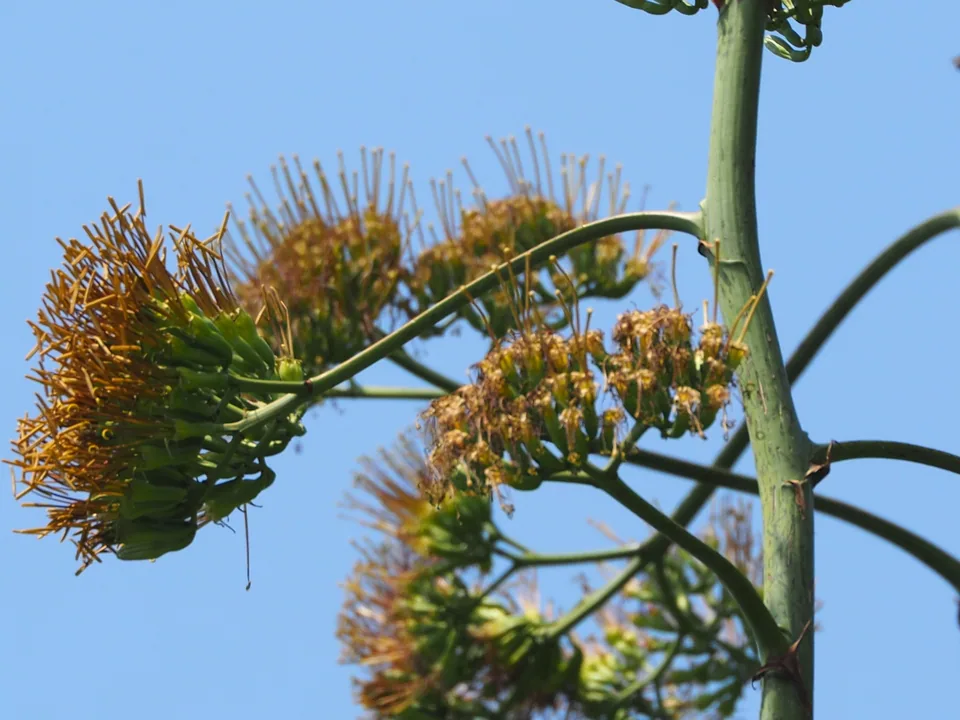
El sisal es una suculenta que forma rosetas, cultivada tanto como ornamental como por sus fibras foliares. [7] Sus flores no producen semillas, sino bulbilos, que se utilizan para la propagación. [4] La savia cruda es corrosiva y altamente irritante para los ojos y la piel. [6]
Citado en inglés, como en la fuente.
Esta ficha está incompleta: las fuentes consultadas aún no cubren todos los campos.
Aún no cubierto por nuestras fuentes: Poda
Cuidados
Riego
Riego
Riega y luego deja secar antes de volver a regar
Qué dicen las fuentes (1)
Plants should be watered and allowed to dry before watering again.Notas sobre el riego
En invierno riega solo lo suficiente para evitar que las hojas se arruguen; las plantas cultivadas en tierra son más tolerantes a la sequía y necesitan poco o ningún riego una vez establecidas
Luz
Clima y frío
Rusticidad, zona más fría
9b [mínima invernal de −3,9 a −1,1 °C (de 25 a 30 °F)]
Qué dicen las fuentes (1)
Hardiness: USDA hardiness zones 9b to 11b: from 25°F (-3.9°C) to 50°F (10°C).Rusticidad, zona más cálida
11b [mínima invernal de 7,2 a 10 °C (de 45 a 50 °F)]
Qué dicen las fuentes (1)
Hardiness: USDA hardiness zones 9b to 11b: from 25°F (-3.9°C) to 50°F (10°C).Dónde cultivarla
Sí
Qué dicen las fuentes (1)
When grown as a houseplant, the temperature should never drop below 10Propagación
Cultivo
La planta
Familia
Agavaceae
Qué dicen las fuentes (1)
Family:
AGAVACEAE
Genus:
Agave
Province distribution:
Balearic Islands.Problemas
Puntas de hojas afiladas
Síntoma: Las heridas por punción de la espina terminal aguda pueden infectarse e inflamarse
Qué hacer: La espina aguda en la punta de la hoja a veces se elimina para proteger a personas y animales
Qué dicen las fuentes (1)
Infection and inflammation of puncture wounds caused by the sharp leaf tips near bone have resulted in a granuloma reaction resembling a neoplasm. The sharp spine at the tip of its toothed leaves is sometime removed to protect people and animals.
— Agave sisalana [6]
Remedios
Cada remedio indica qué dicen las fuentes oficiales; los remedios tradicionales sin fuente oficial aparecen marcados. Los perjudiciales están para que sepas evitarlos.
Primeros auxilios
Primeros auxilios: no sustituyen al médico
savia irritante en la piel (dermatitis por contacto)
Lava la piel con abundante agua Fuente oficial, sin prueba independiente
The sap of many agave species can be irritating to skin, so wear gloves when handling and planting your agave.
— gardeningsolutions.ifas.ufl.edu [10] Contact your provider if: - You have symptoms of contact dermatitis.
— medlineplus.gov [9] Cómo: Lava la zona con mucha agua para eliminar cualquier rastro del irritante que quede en la piel y evita más exposición.
Often, treatment includes washing the area with a lot of water to get rid of any traces of the irritant that are still on the skin. You should avoid further exposure to the substance.
— medlineplus.gov [9]
Venenosa para los animales
Según la fuente, citada textualmente. No es un consejo médico ni veterinario: si una persona o un animal pudo haber ingerido esta planta, contacta con un centro de toxicología o con un veterinario.
Animales
They have irritating sap and sometimes very sharp thorns that can injure small children and even pets.
[4]- Partes venenosas
They have irritating sap and sometimes very sharp thorns that can injure small children and even pets.
[4]
Personas
Toxic properties: The raw sap of the plant is corrosive and highly irritating to the eyes and skin.
[6]- Partes venenosas
The raw sap of the plant is corrosive and highly irritating to the eyes and skin.
[6]- Principio tóxico
Calcium oxalate needles in the sap are thought to be the cause of irritation and swelling of the tissues of the mouth and throat when ingested.
[6]- Síntomas
Skin contact with the sap from the cut leaves produces immediate burning, redness, itching and swelling
[6]
Calendario
Cosecha
2-4 años después de la plantación, para fibra
Qué dicen las fuentes (1)
Harvest can begin 2-4 years after planting, depending on temperature, and can continue up to about the 7-12th or even 20th year.Poda
No figura en las fuentes consultadas.
Meses tal como los dan las fuentes, en su mayoría de Estados Unidos (hemisferio norte). En el hemisferio sur se desplazan unos seis meses.
Plantas similares
- Agave ovatifolia Agave ovatifolia
- American Agave Agave virginica
- Maguey pulquero Agave salmiana
- Coastal agave Agave shawii
- Henequén Agave fourcroydes
- Mezcal Agave parryi
- Anteriormente Polianthes tuberosa Agave amica
- Agave amarillo Agave americana
Fuentes
Cada valor anterior se cita de estos documentos. Los enlaces llevan al editor original.
- Ethnobotanical Plant Agave sisalana | Dr. Duke's Phytochemical and Ethnobotanical Databases · phytochem.nal.usda.gov, consultado
- Agave sisalana Perrine - Herbari Virtual del Mediterrani Occidental · herbarivirtual.uib.cat, consultado
- Agave sisalana / [Species detail] / Plant Atlas · florida.plantatlas.usf.edu, consultado
- Agave sisalana (Sisal) - World of Succulents · worldofsucculents.com, consultado
- Sisal (Agave sisalana) · desert-tropicals.com, consultado
- Agave sisalana · llifle.com, consultado
- Agave sisalana, sisal · americansouthwest.net, consultado
- View crop · ecocrop.apps.fao.org, consultado
- medlineplus.gov · medlineplus.gov
- gardeningsolutions.ifas.ufl.edu · gardeningsolutions.ifas.ufl.edu
Escrito por Emilio Marruso · última revisión