How to Grow and Care for Sisal
Agave sisalana
Written by Emilio Marruso · last checked
Toxic to: Animals, People · Why
At a glance
Sisal is a tough, easygoing plant: give it full sun or partial shade and water only once the soil has dried out. Planted in the ground and well established, it needs little if any extra watering, and it can even grow indoors. In 2–4 years it's ready to harvest for fiber, a rewarding plant for patient gardeners.
- Sun
Full sun to partial shade
- Water
Water, then let it dry out; in winter just enough to keep the leaves from shriveling
What the sources say (3)
Watering: Water, then allow to dry before watering again
Plants should be watered and allowed to dry before watering again.
— Agave sisalana [6] Watering notes: In winter water only enough to keep the leaves from shriveling; ground-grown plants are more drought tolerant and need little if any irrigation once established
During the winter months, only water enough to keep the leaves from shriveling.
— Agave sisalana [6] Little if any irrigation is needed to maintain the plant once established.
— Agave sisalana [6] - Cold
Survives winters down to 25 °F (−3.9 °C)
Half hardy: mild winters or an unheated greenhouse · USDA 9b · RHS H3 · Z9
What the sources say (2)
Hardiness, coldest zone: 9b [winter low −3.9 to −1.1 °C (25 to 30 °F)]
Hardiness: USDA hardiness zones 9b to 11b: from 25°F (-3.9°C) to 50°F (10°C).
— Agave sisalana (Sisal) - World of Succulents [4] Hardiness, warmest zone: 11b [winter low 7.2 to 10 °C (45 to 50 °F)]
Hardiness: USDA hardiness zones 9b to 11b: from 25°F (-3.9°C) to 50°F (10°C).
— Agave sisalana (Sisal) - World of Succulents [4] - Harvest
Harvest for fiber 2–4 years after planting
What the sources say (1)
Harvest: 2-4 years after planting, for fibre
Harvest can begin 2-4 years after planting, depending on temperature, and can continue up to about the 7-12th or even 20th year.
— View crop [8] - Watch out
The leaf tips end in a sharp spine; you can remove it to protect people and pets
- Propagation
Grow new plants from bulbils and offsets
- Containers
Can be grown indoors
What the sources say (1)
Indoors: Yes
When grown as a houseplant, the temperature should never drop below 10
— Agave sisalana [6] - Safety
The raw sap irritates skin and eyes; sharp spines can hurt small children and pets
Overview
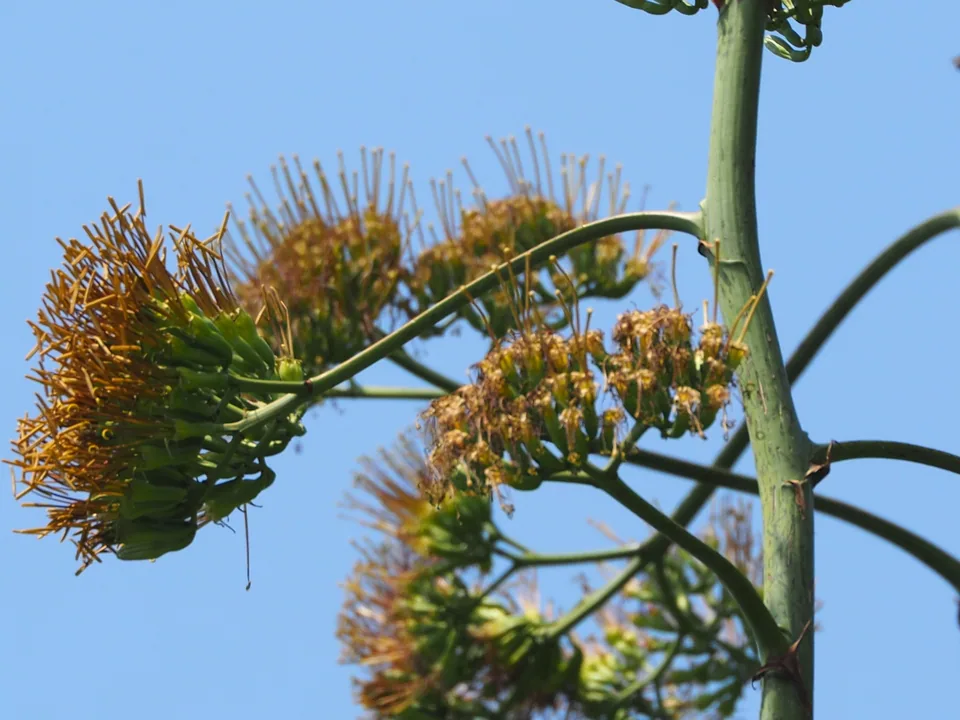
Sisal is a rosette-forming succulent grown both as an ornamental and for its leaf fibres. [7] Its flowers do not set seed but form bulbils, which are used for propagation. [4] The raw sap is corrosive and highly irritating to the eyes and skin. [6]
This record is incomplete: the sources we read do not cover every field yet.
Not yet covered by our sources: Pruning
Sisal care
How to water Sisal
Watering
Water, then allow to dry before watering again
What the sources say (1)
Plants should be watered and allowed to dry before watering again.Watering notes
In winter water only enough to keep the leaves from shriveling; ground-grown plants are more drought tolerant and need little if any irrigation once established
How much light Sisal needs
How much cold Sisal can take
Hardiness, coldest zone
9b [winter low −3.9 to −1.1 °C (25 to 30 °F)]
What the sources say (1)
Hardiness: USDA hardiness zones 9b to 11b: from 25°F (-3.9°C) to 50°F (10°C).Hardiness, warmest zone
11b [winter low 7.2 to 10 °C (45 to 50 °F)]
What the sources say (1)
Hardiness: USDA hardiness zones 9b to 11b: from 25°F (-3.9°C) to 50°F (10°C).Where to grow Sisal
Yes
What the sources say (1)
When grown as a houseplant, the temperature should never drop below 10How to propagate Sisal
How to grow Sisal
The plant
Family
Agavaceae
What the sources say (1)
Family:
AGAVACEAE
Genus:
Agave
Province distribution:
Balearic Islands.Sisal pests and problems
Sharp leaf tips
Symptom: Puncture wounds from the sharp terminal spine can become infected and inflamed
What to do: The sharp spine at the leaf tip is sometimes removed to protect people and animals
What the sources say (1)
Infection and inflammation of puncture wounds caused by the sharp leaf tips near bone have resulted in a granuloma reaction resembling a neoplasm. The sharp spine at the tip of its toothed leaves is sometime removed to protect people and animals.
— Agave sisalana [6]
Remedies
Each remedy shows what official sources say about it; traditional remedies without an official source are marked as such. Harmful ones are listed so you know to avoid them.
First aid
First aid: not a substitute for a doctor
irritant sap on the skin (contact dermatitis)
washing the skin with plenty of water Official source, not independently tested
The sap of many agave species can be irritating to skin, so wear gloves when handling and planting your agave.
— gardeningsolutions.ifas.ufl.edu [10] Contact your provider if: - You have symptoms of contact dermatitis.
— medlineplus.gov [9] How: Wash the area with a lot of water to get rid of any traces of the irritant that are still on the skin, and avoid further exposure.
Often, treatment includes washing the area with a lot of water to get rid of any traces of the irritant that are still on the skin. You should avoid further exposure to the substance.
— medlineplus.gov [9]
Is Sisal toxic to pets?
Reported by the source, quoted verbatim. This is not medical or veterinary advice: if a person or an animal may have eaten this plant, contact a poison control centre or a veterinarian.
Animals
They have irritating sap and sometimes very sharp thorns that can injure small children and even pets.
[4]- Poisonous parts
They have irritating sap and sometimes very sharp thorns that can injure small children and even pets.
[4]
People
Toxic properties: The raw sap of the plant is corrosive and highly irritating to the eyes and skin.
[6]- Poisonous parts
The raw sap of the plant is corrosive and highly irritating to the eyes and skin.
[6]- Toxic principle
Calcium oxalate needles in the sap are thought to be the cause of irritation and swelling of the tissues of the mouth and throat when ingested.
[6]- Symptoms
Skin contact with the sap from the cut leaves produces immediate burning, redness, itching and swelling
[6]
Calendar
Harvest
2-4 years after planting, for fibre
What the sources say (1)
Harvest can begin 2-4 years after planting, depending on temperature, and can continue up to about the 7-12th or even 20th year.Pruning
Not stated in the sources we read.
Months as given by the sources, which are mostly from the United States (northern hemisphere). In the southern hemisphere they shift by about six months.
Similar plants
- Agave ovatifolia Agave ovatifolia
- American Agave Agave virginica
- Century Plant Agave salmiana
- Coastal agave Agave shawii
- Henequen Agave fourcroydes
- Parry's Agave Agave parryi
- Tuberose Agave amica
- Century Plant Agave americana
Sources
Every value above is quoted from these documents. Links lead to the original publisher.
- Ethnobotanical Plant Agave sisalana | Dr. Duke's Phytochemical and Ethnobotanical Databases · phytochem.nal.usda.gov, consulted
- Agave sisalana Perrine - Herbari Virtual del Mediterrani Occidental · herbarivirtual.uib.cat, consulted
- Agave sisalana / [Species detail] / Plant Atlas · florida.plantatlas.usf.edu, consulted
- Agave sisalana (Sisal) - World of Succulents · worldofsucculents.com, consulted
- Sisal (Agave sisalana) · desert-tropicals.com, consulted
- Agave sisalana · llifle.com, consulted
- Agave sisalana, sisal · americansouthwest.net, consulted
- View crop · ecocrop.apps.fao.org, consulted
- medlineplus.gov · medlineplus.gov
- gardeningsolutions.ifas.ufl.edu · gardeningsolutions.ifas.ufl.edu
Written by Emilio Marruso · last checked