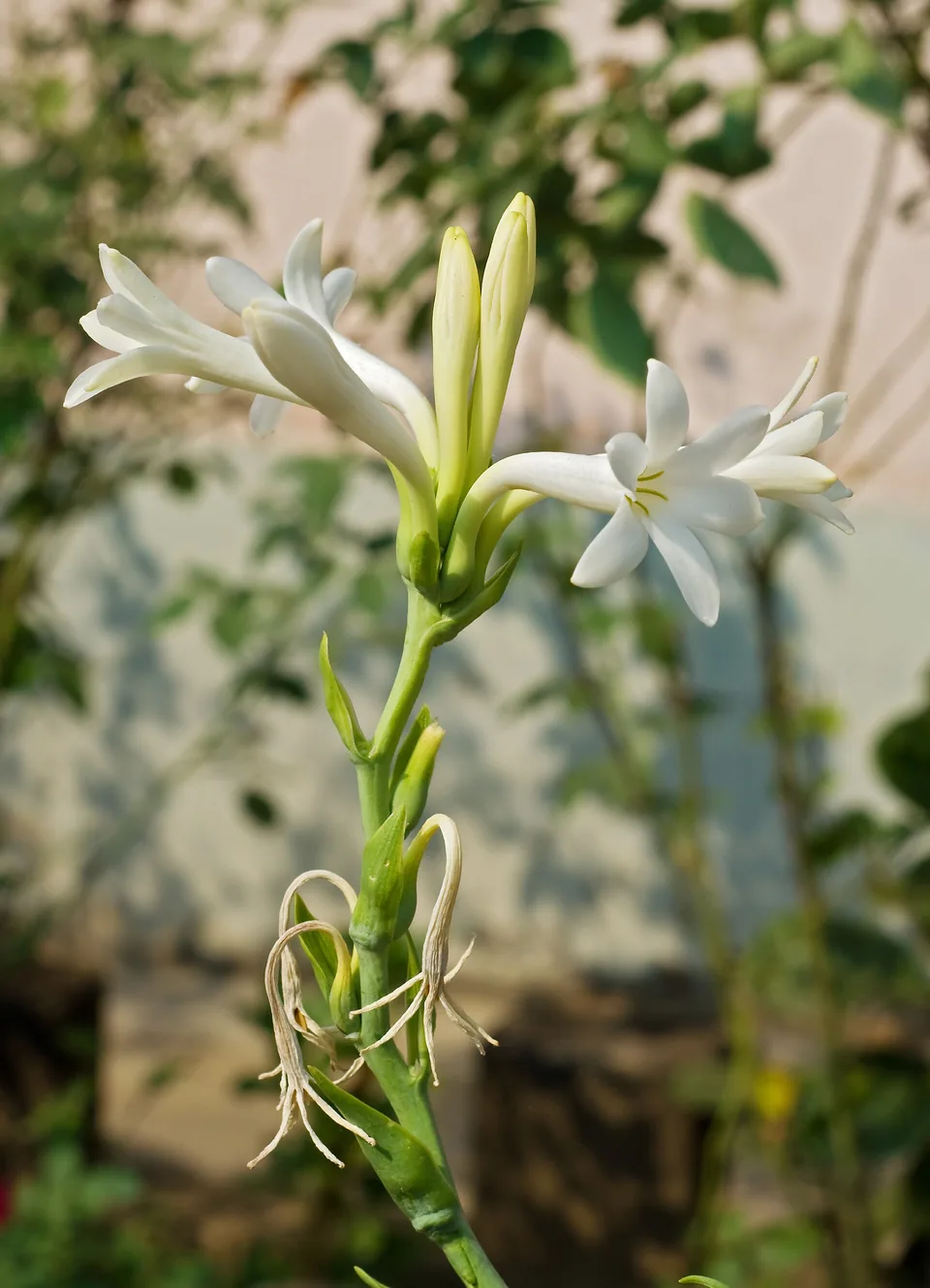

How to Grow and Care for Tuberose
Agave amica
Written by Emilio Marruso · last checked
At a glance
Tuberose is a perennial you grow from tubers: plant them 2 inches deep in full sun or partial shade, and let the soil dry out partly between waterings. It reaches 2–3 feet tall and grows happily in containers too. Where winters are cold, simply lift the tubers once the plant dies back and store them indoors in something dry.
- Sun
Full sun to partial shade
What the sources say (1)
Light: Full sun to partial shade
Light: Full sun (6 or more hours of direct sunlight a day) Partial Shade (Direct sunlight only part of the day, 2-6 hours)
— Agave amica (Amole, Polyanthus Lily, St. Joesph's Staff, Tuberose) | North Carolina Extension Gardener Plant Toolbox [1] - Water
Let the soil dry partly between waterings; water less when the leaves turn yellow
What the sources say (3)
Watering: Allow the soil to partially dry between watering
The plant will grow 2-3 feet tall from a tuber resembling a bulb. Plant the tubers 2 inches deep in well-drained loamy or sandy soil and allow the soil to partially dry between watering.
— Agave amica (Amole, Polyanthus Lily, St. Joesph's Staff, Tuberose) | North Carolina Extension Gardener Plant Toolbox [1] Watering notes: Reduce moisture once the leaves begin to yellow as the plant goes dormant; too wet soils can cause root rot
Reduce moisture once the leaves begin to yellow as the plant will go dormant.
— Agave amica (Amole, Polyanthus Lily, St. Joesph's Staff, Tuberose) | North Carolina Extension Gardener Plant Toolbox [1] Insects, Diseases, and Other Plant Problems: Too wet soils can cause root rot.
— Agave amica (Amole, Polyanthus Lily, St. Joesph's Staff, Tuberose) | North Carolina Extension Gardener Plant Toolbox [1] - Cold
Survives winters down to 10 °F (−12.2 °C)
Hardy in cold winters · USDA 8a · RHS H5 · Z8
What the sources say (2)
Hardiness, coldest zone: 8a [winter low −12.2 to −9.4 °C (10 to 15 °F)]
USDA Plant Hardiness Zone: 8a, 8b, 9a, 9b, 10a, 10b
— Agave amica (Amole, Polyanthus Lily, St. Joesph's Staff, Tuberose) | North Carolina Extension Gardener Plant Toolbox [1] Hardiness, warmest zone: 10b [winter low 1.7 to 4.4 °C (35 to 40 °F)]
USDA Plant Hardiness Zone: 8a, 8b, 9a, 9b, 10a, 10b
— Agave amica (Amole, Polyanthus Lily, St. Joesph's Staff, Tuberose) | North Carolina Extension Gardener Plant Toolbox [1] - Soil
Slightly acidic to alkaline soil, pH 6.0–8.0
What the sources say (2)
Soil pH, minimum: 6.0
Soil pH: Neutral (6.0-8.0) Soil Drainage: Good Drainage
— Agave amica (Amole, Polyanthus Lily, St. Joesph's Staff, Tuberose) | North Carolina Extension Gardener Plant Toolbox [1] Soil pH, maximum: 8.0
Soil pH: Neutral (6.0-8.0) Soil Drainage: Good Drainage
— Agave amica (Amole, Polyanthus Lily, St. Joesph's Staff, Tuberose) | North Carolina Extension Gardener Plant Toolbox [1] - Planting
Plant the tubers 2 inches deep
What the sources say (1)
Sowing depth: 5 cm (2 in), for tubers
Plant the tubers 2 inches deep in well-drained loamy or sandy soil and allow the soil to partially dry between watering.
— Agave amica (Amole, Polyanthus Lily, St. Joesph's Staff, Tuberose) | North Carolina Extension Gardener Plant Toolbox [1] - Pests
Spider mites, aphids, scale and thrips; soggy soil causes root rot
What the sources say (2)
Pests: spider mites, aphids, scale insects, thrips
Insects, Diseases, and Other Plant Problems: Too wet soils can cause root rot. Watch for spider mites, aphids, scale insects, thrips, and anthracnose
— Agave amica (Amole, Polyanthus Lily, St. Joesph's Staff, Tuberose) | North Carolina Extension Gardener Plant Toolbox [1] Diseases: root rot, anthracnose
Insects, Diseases, and Other Plant Problems: Too wet soils can cause root rot. Watch for spider mites, aphids, scale insects, thrips, and anthracnose
— Agave amica (Amole, Polyanthus Lily, St. Joesph's Staff, Tuberose) | North Carolina Extension Gardener Plant Toolbox [1] - Watch out
In cold-winter areas, lift the tubers when the plant dies back and store them dry indoors
What the sources say (2)
Storage: Lift the tubers and store them indoors in a dry medium once the plant dies back (in zones lower than 8)
Lift tubers and store them inside in zones lower than 8 or grow them in pots and bring them inside for the winter.
— Agave amica (Amole, Polyanthus Lily, St. Joesph's Staff, Tuberose) | North Carolina Extension Gardener Plant Toolbox [1] Once the plant dies back in the fall, store in a dry medium at 70-75 degrees F (10 degrees C).
— Agave amica (Amole, Polyanthus Lily, St. Joesph's Staff, Tuberose) | North Carolina Extension Gardener Plant Toolbox [1] - Size
2–3 ft tall and 1–3.5 ft wide
What the sources say (3)
Mature height: 61-91 cm (2-3 ft)
The plant will grow 2-3 feet tall from a tuber resembling a bulb.
— Agave amica (Amole, Polyanthus Lily, St. Joesph's Staff, Tuberose) | North Carolina Extension Gardener Plant Toolbox [1] Dimensions: Height: 2 ft. 0 in. - 3 ft. 0 in.
— Agave amica (Amole, Polyanthus Lily, St. Joesph's Staff, Tuberose) | North Carolina Extension Gardener Plant Toolbox [1] Mature width: 30-107 cm (1 ft - 3 ft 6 in)
Width: 1 ft. 0 in. - 3 ft. 6 in.
— Agave amica (Amole, Polyanthus Lily, St. Joesph's Staff, Tuberose) | North Carolina Extension Gardener Plant Toolbox [1] - Propagation
Divide the clumps or take stem cuttings
What the sources say (2)
Propagation: Division; stem cutting
Recommended Propagation Strategy: Division Stem Cutting Country Or Region Of Origin:
— Agave amica (Amole, Polyanthus Lily, St. Joesph's Staff, Tuberose) | North Carolina Extension Gardener Plant Toolbox [1] The tubers produce offsets and will need to be divided every 2-3 years.
— Agave amica (Amole, Polyanthus Lily, St. Joesph's Staff, Tuberose) | North Carolina Extension Gardener Plant Toolbox [1] - Containers
Grows in containers too
What the sources say (1)
In containers: Yes
Use tuberose in the border in masse planting, in containers, near the patio or in a cutting garden.
— Agave amica (Amole, Polyanthus Lily, St. Joesph's Staff, Tuberose) | North Carolina Extension Gardener Plant Toolbox [1]
Overview
Tuberose, listed as Agave amica, is a herbaceous perennial in the asparagus family native to Mexico. [1] It grows 2-3 feet [61–91 cm] tall from a tuber resembling a bulb, planted in well-drained loamy or sandy soil with the soil allowed to partially dry between waterings. [1] Too wet soils can cause root rot. [1]
This record is incomplete: the sources we read do not cover every field yet.
Not yet covered by our sources: Pruning
Tuberose care
Measurements in square brackets are our conversion into the other unit system; the quoted text is unchanged.
How to water Tuberose
Watering
Allow the soil to partially dry between watering
What the sources say (1)
The plant will grow 2-3 feet tall from a tuber resembling a bulb. Plant the tubers 2 inches deep in well-drained loamy or sandy soil and allow the soil to partially dry between watering.Watering notes
Reduce moisture once the leaves begin to yellow as the plant goes dormant; too wet soils can cause root rot
What the sources say (2)
Reduce moisture once the leaves begin to yellow as the plant will go dormant.Insects, Diseases, and Other Plant Problems: Too wet soils can cause root rot.How much light Tuberose needs
Full sun to partial shade
What the sources say (1)
Light:
Full sun (6 or more hours of direct sunlight a day)
Partial Shade (Direct sunlight only part of the day, 2-6 hours)How much cold Tuberose can take
Hardiness, coldest zone
8a [winter low −12.2 to −9.4 °C (10 to 15 °F)]
What the sources say (1)
USDA Plant Hardiness Zone:
8a, 8b, 9a, 9b, 10a, 10bHardiness, warmest zone
10b [winter low 1.7 to 4.4 °C (35 to 40 °F)]
What the sources say (1)
USDA Plant Hardiness Zone:
8a, 8b, 9a, 9b, 10a, 10bBest soil for Tuberose
Soil pH, minimum
6.0
What the sources say (1)
Soil pH:
Neutral (6.0-8.0)
Soil Drainage:
Good DrainageSoil pH, maximum
8.0
What the sources say (1)
Soil pH:
Neutral (6.0-8.0)
Soil Drainage:
Good DrainageWhere to grow Tuberose
Yes
What the sources say (1)
Use tuberose in the border in masse planting, in containers, near the patio or in a cutting garden.How to propagate Tuberose
Division; stem cutting
What the sources say (2)
Recommended Propagation Strategy:
Division
Stem Cutting
Country Or Region Of Origin:The tubers produce offsets and will need to be divided every 2-3 years.How to grow Tuberose
The plant
Life cycle
perennial
What the sources say (1)
Tuberose is a herbaceous perennial in the asparagus family (Asparagaceae) native to Mexico.Family
Asparagaceae
What the sources say (1)
Tuberose is a herbaceous perennial in the asparagus family (Asparagaceae) native to Mexico.Mature height
61-91 cm (2-3 ft)
What the sources say (2)
The plant will grow 2-3 feet tall from a tuber resembling a bulb.Dimensions: Height: 2 ft. 0 in. - 3 ft. 0 in.Mature width
30-107 cm (1 ft - 3 ft 6 in)
What the sources say (1)
Width: 1 ft. 0 in. - 3 ft. 6 in.Sowing and growth
Sowing depth
5 cm (2 in), for tubers
What the sources say (1)
Plant the tubers 2 inches deep in well-drained loamy or sandy soil and allow the soil to partially dry between watering.Harvest and storage
Storage
Lift the tubers and store them indoors in a dry medium once the plant dies back (in zones lower than 8)
What the sources say (2)
Lift tubers and store them inside in zones lower than 8 or grow them in pots and bring them inside for the winter.Once the plant dies back in the fall, store in a dry medium at 70-75 degrees F (10 degrees C).Pests and diseases
Pests
spider mites, aphids, scale insects, thrips
What the sources say (1)
Insects, Diseases, and Other Plant Problems: Too wet soils can cause root rot. Watch for spider mites, aphids, scale insects, thrips, and anthracnoseDiseases
root rot, anthracnose
What the sources say (1)
Insects, Diseases, and Other Plant Problems: Too wet soils can cause root rot. Watch for spider mites, aphids, scale insects, thrips, and anthracnoseFertilizing
When
The sources give different values depending on region, zone or growing conditions.
What each source says
commercial cut-flower production (Punjab, India): Manure one month before planting; phosphorus and potash at planting
commercial cut-flower production (Punjab, India): Nitrogen during the early growth phase
What the sources say (2)
commercial cut-flower production (Punjab, India): planting of tuberose and add well rotten farm yard manure @ 20 tones /acre one month before planting. Add 60 kg of phosphorous and 80 kg potash (MOP) /acre as a basal dose at the time of planting (SSP).commercial cut-flower production (Punjab, India): During early growth phase, 60 kg Nitrogen/acre may be applied in two split doses at monthly interval for better vegetative growth. The fertilizer dose can be reduced depending upon the fertility of the soil.How often
The sources give different values depending on region, zone or growing conditions.
What each source says
commercial cut-flower production (Punjab, India): Nitrogen in two split doses a month apart
What the sources say (1)
commercial cut-flower production (Punjab, India): During early growth phase, 60 kg Nitrogen/acre may be applied in two split doses at monthly interval for better vegetative growth. The fertilizer dose can be reduced depending upon the fertility of the soil.Natural fertilizers
The sources give different values depending on region, zone or growing conditions.
What each source says
commercial cut-flower production (Punjab, India): Well-rotted farmyard manure, 49.4 t/ha one month before planting
What the sources say (1)
commercial cut-flower production (Punjab, India): Soil should be ploughed two to three times and leveled properly before planting of tuberose and add well rotten farm yard manure @ 20 tones /acre one month before planting.Mineral fertilizers
The sources give different values depending on region, zone or growing conditions.
What each source says
commercial cut-flower production (Punjab, India): Basal dose at planting: 148 kg [326.3 lb]/ha of phosphorus (single superphosphate) and 198 kg [436.5 lb]/ha of potash (muriate of potash)
commercial cut-flower production (Punjab, India): Nitrogen 148 kg [326.3 lb]/ha during the early growth phase, in two split doses; reduce the dose on fertile soil
What the sources say (2)
commercial cut-flower production (Punjab, India): planting of tuberose and add well rotten farm yard manure @ 20 tones /acre one month before planting. Add 60 kg of phosphorous and 80 kg potash (MOP) /acre as a basal dose at the time of planting (SSP).commercial cut-flower production (Punjab, India): During early growth phase, 60 kg Nitrogen/acre may be applied in two split doses at monthly interval for better vegetative growth. The fertilizer dose can be reduced depending upon the fertility of the soil.Tuberose pests and problems
Root rot
What to do: Allow the soil to partially dry between watering
What the sources say (2)
Insects, Diseases, and Other Plant Problems: Too wet soils can cause root rot.
— Agave amica (Amole, Polyanthus Lily, St. Joesph's Staff, Tuberose) | North Carolina Extension Gardener Plant Toolbox [1] The plant will grow 2-3 feet tall from a tuber resembling a bulb. Plant the tubers 2 inches deep in well-drained loamy or sandy soil and allow the soil to partially dry between watering.
— Agave amica (Amole, Polyanthus Lily, St. Joesph's Staff, Tuberose) | North Carolina Extension Gardener Plant Toolbox [1] Pests and anthracnose
What to do: Not stated in the sources
What the sources say (1)
Watch for spider mites, aphids, scale insects, thrips, and anthracnose
— Agave amica (Amole, Polyanthus Lily, St. Joesph's Staff, Tuberose) | North Carolina Extension Gardener Plant Toolbox [1]
Remedies
Each remedy shows what official sources say about it; traditional remedies without an official source are marked as such. Harmful ones are listed so you know to avoid them.
Treating the plant
mealybugs
manual removal of mealybugs and washing the leaves Not verified
Traditional remedy, not verified by an official source.
How: If the pests remain, remove them with the edge of a sharp blade and then wash the leaves with warm water.
neem oil Partly works
Another key point is that organic doesn’t mean that only the target pest will be killed. Other non-target beneficial organisms can be impacted as well.
— extension.unh.edu [9] How: In some cases, an insecticide (neem oil) may treat an infestation.
In some cases, an insecticide (Neem oil) may treat an infestation.
— plantcaretoday.com [8] What the evidence says However, neem oil is not effective against every insect and disease, and often must be frequently reapplied to reach the desired outcome.
— extension.unh.edu [9]
snails and slugs
hand removal of snails and slugs Not verified
Traditional remedy, not verified by an official source.
How: Remove snails and slugs by hand or with physical barriers, especially after rain.
fungus
clipping away affected leaves Partly works
How: If the green leaves develop dry patches and fungus may develop, move the plant to a drier spot and cut away the affected leaves.
If the green leaves develop dry patches, it may start to develop fungus. To stop this threat, move the plant to a drier spot and cut away the affected leaves.
— plantcaretoday.com [8] What the evidence says Many insect and disease issues can be solved in the home garden by hand-picking insects or clipping and disposing of diseased plant parts.
— extension.unh.edu [9]
Calendar
Pruning
Not stated in the sources we read.
Months as given by the sources, which are mostly from the United States (northern hemisphere). In the southern hemisphere they shift by about six months.
Indicative values
Values from a secondary source, not checked word for word like the rest of this page. Use them as a starting point.
- Hours of sun
- 6-7 hoursIndicative value, adapt it to your climate · Secondary source
- Soil
- Rocky, gravelly, dry, Well-drainedIndicative value, adapt it to your climate · Secondary source
- Growth rate
- LowIndicative value, adapt it to your climate · Secondary source
- Pruning
- December, JanuaryIndicative value, adapt it to your climate · Secondary source
Similar plants
- American Agave Agave virginica
- Century Plant Agave salmiana
- Coastal agave Agave shawii
- Henequen Agave fourcroydes
- Parry's Agave Agave parryi
- Century Plant Agave americana
- Agave ovatifolia Agave ovatifolia
- Sisal Agave sisalana
Sources
Every value above is quoted from these documents. Links lead to the original publisher.
- Agave amica (Amole, Polyanthus Lily, St. Joesph's Staff, Tuberose) | North Carolina Extension Gardener Plant Toolbox · plants.ces.ncsu.edu, consulted
- Amole - Agave amica | North Carolina Extension Gardener Plant Toolbox · plants.ces.ncsu.edu, consulted
- Tuberose - Agave amica | North Carolina Extension Gardener Plant Toolbox · plants.ces.ncsu.edu, consulted
- Agave (Agave, Century Plant) | North Carolina Extension Gardener Plant Toolbox · plants.ces.ncsu.edu, consulted
- Agave - Agave | North Carolina Extension Gardener Plant Toolbox · plants.ces.ncsu.edu, consulted
- Century Plant - Agave | North Carolina Extension Gardener Plant Toolbox · plants.ces.ncsu.edu, consulted
- pau.edu · pau.edu
- plantcaretoday.com · plantcaretoday.com
- extension.unh.edu · extension.unh.edu
Written by Emilio Marruso · last checked