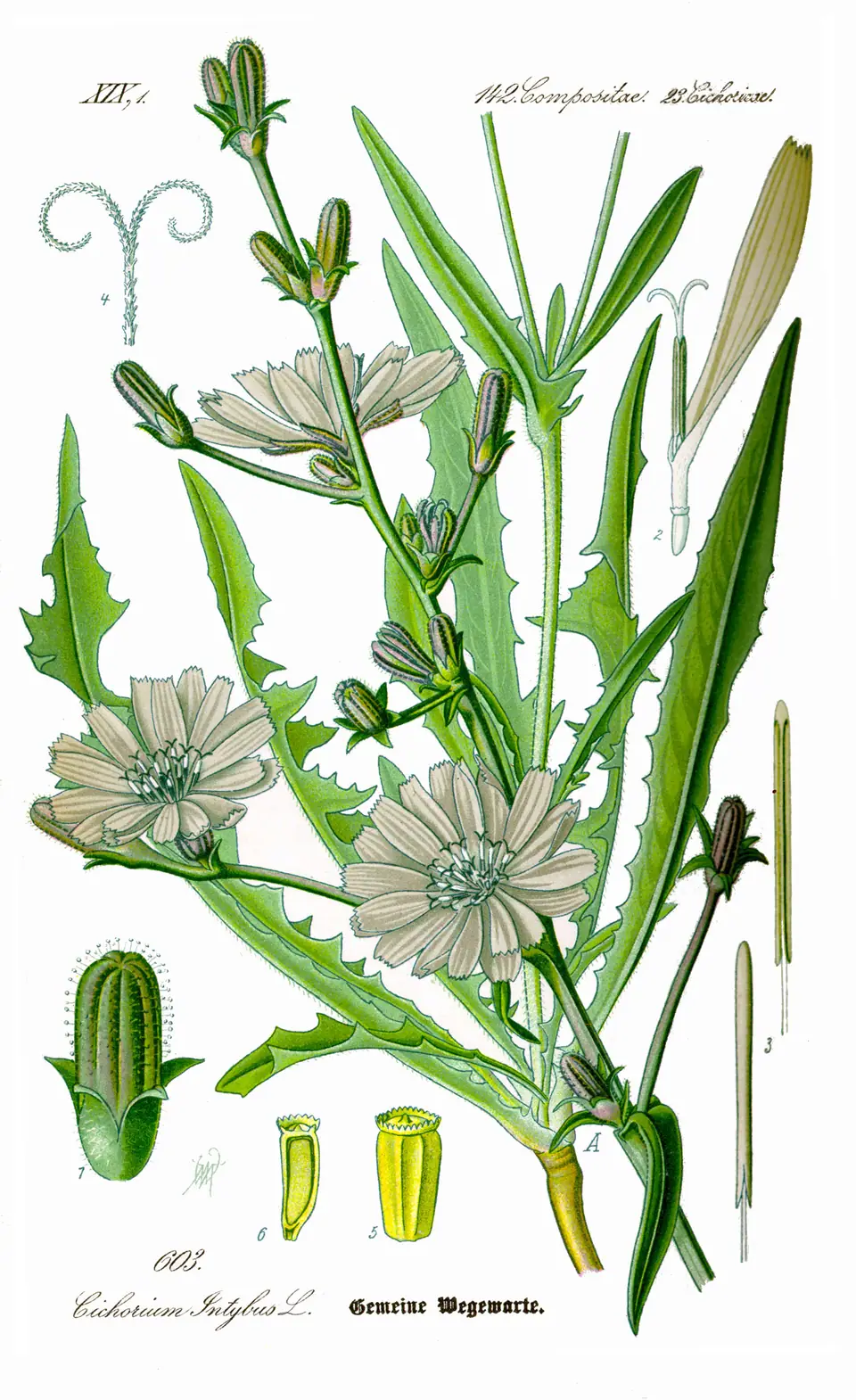


Cómo cultivar y cuidar Escarola
Cichorium intybus
Escrito por Emilio Marruso · última revisión
De un vistazo
La achicoria es una planta de clima fresco que te da más de una cosecha: hojas tiernas para ensaladas, botones florales que se comen crudos y raíces que puedes hervir o usar como sustituto del café. Dale sol pleno y una tierra siempre húmeda, y te premiará con hojas crujientes. Sus bonitas flores incluso sirven para adornar el plato.
- Sol
Sol pleno: 6 horas al día o más
Qué dicen las fuentes (1)
Luz: Pleno sol (6 o más horas de luz solar directa al día)
Full sun (6 or more hours of direct sunlight a day)
— Cichorium intybus (Blue Sailors, Chicory, Coffeeweed, Common Chicory, Cornflower, Italian Dandelion, Succory) | North Carolina Extension Gardener Plant Toolbox [1] - Riego
2,5–5 cm de agua a la semana; la sequía amarga las hojas, así que acolchar ayuda
Qué dicen las fuentes (7)
Riego: Mantén el suelo uniformemente húmedo con 1-2 pulgadas (25.4-50.8 mm) por semana para las plantas cultivadas en jardín; las plantas silvestres establecidas pueden tolerar bastante la sequía
tipos de jardín (fuente: Extensión de la Universidad Estatal de Utah): Water chicory regularly to maintain a uniformly moist soil, applying 1-2 inches per week.
— How to Grow Chicory in Your Garden | USU [7] plantas establecidas (fuente: Extensión de NC State): It does best cool weather and one established can be quite drought tolerant though it does not do well in heat and humidity so it can suffer in southern summers.
— Cichorium intybus (Blue Sailors, Chicory, Coffeeweed, Common Chicory, Cornflower, Italian Dandelion, Succory) | North Carolina Extension Gardener Plant Toolbox [1] forraje (fuente: Extensión de la Universidad Estatal de Mississippi): Drought tolerant species, it is suited to be grown on well-drained or moderately drained soils.
— Chicory (Cichorium intybus) | Mississippi State University Extension Service [3] Water chicory regularly to maintain a uniformly moist soil, applying 1-2 inches per week.
— How to Grow Chicory in Your Garden | USU [7] It does best cool weather and one established can be quite drought tolerant though it does not do well in heat and humidity so it can suffer in southern summers.
— Cichorium intybus (Blue Sailors, Chicory, Coffeeweed, Common Chicory, Cornflower, Italian Dandelion, Succory) | North Carolina Extension Gardener Plant Toolbox [1] Notas sobre el riego: El estrés por sequía durante el crecimiento retrasa el desarrollo de las hojas y causa sabores amargos; el mantillo orgánico conserva la humedad del suelo
Drought stress during growth will cause slow leaf development and bitter flavors to develop.
— How to Grow Chicory in Your Garden | USU [7] Using organic mulch around the plant also helps conserve soil moisture and reduce weed growth.
— How to Grow Chicory in Your Garden | USU [7] - Frío
Aguanta inviernos de hasta −40 °C (−40 °F)
Muy rústica · USDA 3a · RHS H7 · Z3
Qué dicen las fuentes (5)
Rusticidad, zona más fría: 3a [mínima invernal de −40 a −37,2 °C (de −40 a −35 °F)]
3a, 3b, 4a, 4b, 5a, 5b, 6a, 6b, 7a, 7b, 8a, 8b
— Cichorium intybus (Blue Sailors, Chicory, Coffeeweed, Common Chicory, Cornflower, Italian Dandelion, Succory) | North Carolina Extension Gardener Plant Toolbox [1] Rusticidad, zona más cálida:
Según NC State Extension: 3a, 3b, 4a, 4b, 5a, 5b, 6a, 6b, 7a, 7b, 8a, 8b
— Cichorium intybus (Blue Sailors, Chicory, Coffeeweed, Common Chicory, Cornflower, Italian Dandelion, Succory) | North Carolina Extension Gardener Plant Toolbox [1] Según University of Wisconsin Extension: surviving in zones 3-9
— Chicory, Cichorium intybus – Wisconsin Horticulture [2] Según University of Vermont Extension: can now be found growing in United States Department of Agriculture Hardiness Zones 3 to 9
— Getting to Know Chicory | University of Vermont Extension [6] 3a, 3b, 4a, 4b, 5a, 5b, 6a, 6b, 7a, 7b, 8a, 8b
— Cichorium intybus (Blue Sailors, Chicory, Coffeeweed, Common Chicory, Cornflower, Italian Dandelion, Succory) | North Carolina Extension Gardener Plant Toolbox [1] - Suelo
Suelo con pH de 5,5 o más
Qué dicen las fuentes (1)
pH del suelo, mínimo: 5.5
Very tolerant to acid soils (pH 5.5 or higher).
— Chicory (Cichorium intybus) | Mississippi State University Extension Service [3] - Distancia
Endibia: 23 cm entre plantas y 51 cm entre hileras; radicchio: 20 cm y 30 cm
Qué dicen las fuentes (4)
Distancia de plantación: Witloof: 9 pulgadas (22.9 cm) entre plantas, filas a 20 pulgadas (50.8 cm) de distancia; radicchio: 8 pulgadas (20.3 cm) entre plantas, filas a 12 pulgadas (30.5 cm) de distancia
witloof (fuente: Extensión de la Universidad Estatal de Utah): Seeded or transplanted witloof should be spaced 9 inches between plants in the row with rows 20 inches apart.
— How to Grow Chicory in Your Garden | USU [7] radicchio (fuente: Extensión de la Universidad Estatal de Utah): Seeded or transplanted radicchio should be spaced 8 inches between plants in the row with rows 12 inches apart.
— How to Grow Chicory in Your Garden | USU [7] Seeded or transplanted witloof should be spaced 9 inches between plants in the row with rows 20 inches apart.
— How to Grow Chicory in Your Garden | USU [7] Seeded or transplanted radicchio should be spaced 8 inches between plants in the row with rows 12 inches apart.
— How to Grow Chicory in Your Garden | USU [7] - Plantación
Trasplanta cuando hayan pasado las últimas heladas
Qué dicen las fuentes (2)
Plantación: Trasplantes de witloof poco después de la última fecha sin heladas; trasplantes de radicchio cerca de la última fecha sin heladas
Transplants should be planted shortly after the last frost-free date for the growing area.
— How to Grow Chicory in Your Garden | USU [7] Transplants should be planted near the last frost-free date for the growing area.
— How to Grow Chicory in Your Garden | USU [7] - Abonado
Abona 4 semanas después del trasplante; nada de nitrógeno cuando empiecen a formarse los cogollos
Qué dicen las fuentes (5)
Cuándo: 4 semanas después del trasplante o del aclareo; no se añade nitrógeno extra una vez que las cabezas comienzan a formarse
praderas establecidas: Chicory has a high N requirement and at least 100 to 150 lb N/ac/yr should be applied to an established stand at rates of 50 lb N/ac in early spring, early summer and early fall.
— Chicory (Cichorium intybus) | Mississippi State University Extension Service [3] Apply 1/4 cup of a nitrogen-based fertilizer (21-0-0) per 10 feet of row 4 weeks after transplanting or thinning.
— How to Grow Chicory in Your Garden | USU [7] Place the fertilizer to the side of the plants and irrigate it into the soil. Avoid adding additional nitrogen after heads begin to form.
— How to Grow Chicory in Your Garden | USU [7] Evitar: Exceso de nitrógeno, que impide cabezas compactas y raíces sanas; no añadas más nitrógeno una vez que las cabezas comiencen a formarse
Avoid excessive nitrogen fertilization to retain tight heads and healthy root formation. Irrigation should be uniform and frequent to ensure healthy growth.
— How to Grow Chicory in Your Garden | USU [7] Place the fertilizer to the side of the plants and irrigate it into the soil. Avoid adding additional nitrogen after heads begin to form.
— How to Grow Chicory in Your Garden | USU [7] - Cosecha
Recoge las hojas tiernas para ensalada; corta el radicchio al alcanzar su tamaño, si esperas amarga
Qué dicen las fuentes (3)
Cómo cosechar: Radicchio: cosecha cuando las hojas o cabezas alcancen su tamaño completo y corta el tallo justo debajo de las hojas para mantener la cabeza unida; si retrasas la cosecha, se vuelve amarga y dura. Witloof: cosecha las hojas jóvenes y tiernas; desentierra las raíces para forzarlas justo antes de la primera helada.
Radicchio should be harvested when the leaves or heads reach full size. Delaying harvest causes radicchio to develop bitter flavors and toughness. Cut the stem just below the leaves to keep the head together.
— How to Grow Chicory in Your Garden | USU [7] Witloof used for greens should be harvested when leaves are young and tender.
— How to Grow Chicory in Your Garden | USU [7] Witloof roots, used for forcing chicons, should be harvested just before the first frost date.
— How to Grow Chicory in Your Garden | USU [7] - Plagas
Babosas, caracoles, pulgones, gusanos grises y orugas de la col; las raíces pueden pudrirse
Qué dicen las fuentes (5)
Plagas: babosas, caracoles, gusanos cortadores, pulgones, gusanos y orugas medidoras (gusanos de la col)
Insects, Diseases, and Other Plant Problems: No serious problems. Slugs, snails, and cutworms are occasional pests.
— Cichorium intybus (Blue Sailors, Chicory, Coffeeweed, Common Chicory, Cornflower, Italian Dandelion, Succory) | North Carolina Extension Gardener Plant Toolbox [1] Aphids | Green or black soft-bodied insects that feed on underside of leaves.
— How to Grow Chicory in Your Garden | USU [7] Worms and Loopers | Light to dark green insects that chew holes and hide in leaves.
— How to Grow Chicory in Your Garden | USU [7] Enfermedades: pudriciones fúngicas de raíz, virus
Fungal Root Rots | Wilting and reduced plant vigor which occurs during forcing.
— How to Grow Chicory in Your Garden | USU [7] Viruses | Stunting of growth. Interveinal yellowing and brittleness in older and lower leaves.
— How to Grow Chicory in Your Garden | USU [7] - Atención
Las malas hierbas la ahogan, quítalas pronto; el calor y la humedad amargan las hojas
Qué dicen las fuentes (2)
Calor: Se desarrolla mejor en clima fresco y no le va bien con el calor y la humedad; las altas temperaturas de verano reducen el crecimiento y la calidad y pueden hacer que las hojas sean amargas.
It does best cool weather and one established can be quite drought tolerant though it does not do well in heat and humidity so it can suffer in southern summers.
— Cichorium intybus (Blue Sailors, Chicory, Coffeeweed, Common Chicory, Cornflower, Italian Dandelion, Succory) | North Carolina Extension Gardener Plant Toolbox [1] High summer temperatures reduce growth, decrease quality, and may cause bitter or off-flavors to develop.
— How to Grow Chicory in Your Garden | USU [7] - Tamaño
De 0,9 a 1,2 m de alto
Qué dicen las fuentes (2)
Altura adulta: 91-122 cm (3-4 pies)
Height: 3 ft. 0 in. - 4 ft. 0 in.
— Cichorium intybus (Blue Sailors, Chicory, Coffeeweed, Common Chicory, Cornflower, Italian Dandelion, Succory) | North Carolina Extension Gardener Plant Toolbox [1] Biennial or perennial herb, stems erect and branching, to 40 inches tall, stems rough with stiff hairs,
— Cichorium intybus - chicory | Yavapai County Native and Naturalized Plants [5] - Multiplicación
Se multiplica por semilla, trozos de raíz o plantel
- Siembra
Siembra a 6–13 mm de profundidad; germina mejor a 18–21 °C y peor por encima de 27 °C
Qué dicen las fuentes (5)
Profundidad de siembra: 0,6-1,3 cm (1/4-1/2 pulgada)
Chicory seeds should be planted 0.25- to 0.5-inch deep.
— Chicory (Cichorium intybus) | Mississippi State University Extension Service [3] Plant chicory seeds ¼ inch deep in early spring.
— How to Grow Chicory in Your Garden | USU [7] Germinación: Las semillas germinan mejor a 18.3-21.1 °C [65–70 °F]; temperaturas superiores a 26.7 °C [80 °F] reducen la germinación. Siembra a 0.64-1.27 cm [0,3–0,5 in] de profundidad, varias semillas por planta.
Seeds germinate best at 65-70ºF, while temperatures above 80ºF reduce germination.
— How to Grow Chicory in Your Garden | USU [7] Chicory seeds should be planted 0.25- to 0.5-inch deep.
— Chicory (Cichorium intybus) | Mississippi State University Extension Service [3] Sow several seeds for each plant desired, as not every seed will germinate.
— How to Grow Chicory in Your Garden | USU [7]
Resumen
La achicoria común es una planta bienal o perenne con raíz pivotante, miembro de la familia Asteraceae, con flores azules, cultivada por sus hojas, brotes y raíces comestibles. [1][2] Prefiere pleno sol y suelo bien drenado. [1] Los tipos de achicoria de jardín son cultivos de estación fría, y las raíces se utilizan como sustituto del café. [7][6]
Citado en inglés, como en la fuente.
Cuidados
Las medidas entre corchetes son nuestra conversión al otro sistema de unidades; el texto citado no cambia.
Riego
Riego
Mantén el suelo uniformemente húmedo con 1-2 pulgadas (25.4-50.8 mm) por semana para las plantas cultivadas en jardín; las plantas silvestres establecidas pueden tolerar bastante la sequía
Lo que dice cada fuente
tipos de jardín (fuente: Extensión de la Universidad Estatal de Utah): Mantén el suelo uniformemente húmedo, 1-2 pulgadas [2,5–5,1 cm] por semana
plantas establecidas (fuente: Extensión de NC State): Bastante tolerante a la sequía una vez establecido
forraje (fuente: Extensión de la Universidad Estatal de Mississippi): Especies tolerantes a la sequía
Qué dicen las fuentes (5)
tipos de jardín (fuente: Extensión de la Universidad Estatal de Utah): Water chicory regularly to maintain a uniformly moist soil, applying 1-2 inches per week.plantas establecidas (fuente: Extensión de NC State): It does best cool weather and one established can be quite drought tolerant though it does not do well in heat and humidity so it can suffer in southern summers.forraje (fuente: Extensión de la Universidad Estatal de Mississippi): Drought tolerant species, it is suited to be grown on well-drained or moderately drained soils.Water chicory regularly to maintain a uniformly moist soil, applying 1-2 inches per week.It does best cool weather and one established can be quite drought tolerant though it does not do well in heat and humidity so it can suffer in southern summers.Notas sobre el riego
El estrés por sequía durante el crecimiento retrasa el desarrollo de las hojas y causa sabores amargos; el mantillo orgánico conserva la humedad del suelo
Qué dicen las fuentes (2)
Drought stress during growth will cause slow leaf development and bitter flavors to develop.Using organic mulch around the plant also helps conserve soil moisture and reduce weed growth.Luz
Pleno sol (6 o más horas de luz solar directa al día)
Qué dicen las fuentes (1)
Full sun (6 or more hours of direct sunlight a day)Clima y frío
Rusticidad, zona más fría
3a [mínima invernal de −40 a −37,2 °C (de −40 a −35 °F)]
Qué dicen las fuentes (1)
3a, 3b, 4a, 4b, 5a, 5b, 6a, 6b, 7a, 7b, 8a, 8bRusticidad, zona más cálida
Las fuentes dan valores distintos según la región, la zona o las condiciones de cultivo.
Lo que dice cada fuente
Según NC State Extension: 8b [mínima invernal de −9,4 a −6,7 °C (de 15 a 20 °F)]
Según University of Wisconsin Extension: 9 [mínima invernal de −6,7 a −1,1 °C (de 20 a 30 °F)]
Según University of Vermont Extension: 9 [mínima invernal de −6,7 a −1,1 °C (de 20 a 30 °F)]
Qué dicen las fuentes (4)
Según NC State Extension: 3a, 3b, 4a, 4b, 5a, 5b, 6a, 6b, 7a, 7b, 8a, 8bSegún University of Wisconsin Extension: surviving in zones 3-9Según University of Vermont Extension: can now be found growing in United States Department of Agriculture Hardiness Zones 3 to 93a, 3b, 4a, 4b, 5a, 5b, 6a, 6b, 7a, 7b, 8a, 8bSuelo
5.5
Qué dicen las fuentes (1)
Very tolerant to acid soils (pH 5.5 or higher).Dónde cultivarla
Witloof: 9 pulgadas (22.9 cm) entre plantas, filas a 20 pulgadas (50.8 cm) de distancia; radicchio: 8 pulgadas (20.3 cm) entre plantas, filas a 12 pulgadas (30.5 cm) de distancia
Lo que dice cada fuente
witloof (fuente: Extensión de la Universidad Estatal de Utah): 22.9 cm (9 pulgadas) entre plantas, filas a 50.8 cm (20 pulgadas) de distancia
radicchio (fuente: Extensión de la Universidad Estatal de Utah): 20.3 cm (8 pulgadas) entre plantas, filas a 30.5 cm (12 pulgadas) de distancia
Qué dicen las fuentes (4)
witloof (fuente: Extensión de la Universidad Estatal de Utah): Seeded or transplanted witloof should be spaced 9 inches between plants in the row with rows 20 inches apart.radicchio (fuente: Extensión de la Universidad Estatal de Utah): Seeded or transplanted radicchio should be spaced 8 inches between plants in the row with rows 12 inches apart.Seeded or transplanted witloof should be spaced 9 inches between plants in the row with rows 20 inches apart.Seeded or transplanted radicchio should be spaced 8 inches between plants in the row with rows 12 inches apart.Propagación
Cultivo
La planta
Ciclo de vida
bienal o perenne
Qué dicen las fuentes (2)
Lifecycle Biennial or perennial Height 40 inchesLife Cycle: Biennial Perennial Recommended Propagation Strategy: SeedFamilia
Asteraceae
Qué dicen las fuentes (2)
Chicory, a biennial member of the Asteraceae (daisy) family, was introduced from Europe and has become naturalized over much of the nation.Chicory belongs to the aster family (Asteraceae) and has been cultivated for centuries for its edible leaves, buds and roots and it has also been used medicinally.Altura adulta
91-122 cm (3-4 pies)
Qué dicen las fuentes (2)
Height: 3 ft. 0 in. - 4 ft. 0 in.Biennial or perennial herb, stems erect and branching, to 40 inches tall, stems rough with stiff hairs,Siembra y crecimiento
Profundidad de siembra
0,6-1,3 cm (1/4-1/2 pulgada)
Distancia entre hileras
Las fuentes dan valores distintos según la región, la zona o las condiciones de cultivo.
Lo que dice cada fuente
tipo cultivado 'witloof' (hileras a 51 cm / 20 in de separación):
tipo cultivado 'radicchio' (hileras a 30 cm / 12 in de separación):
Qué dicen las fuentes (2)
tipo cultivado 'witloof' (hileras a 51 cm / 20 in de separación): Seeded or transplanted witloof should be spaced 9 inches between plants in the row with rows 20 inches apart.tipo cultivado 'radicchio' (hileras a 30 cm / 12 in de separación): Seeded or transplanted radicchio should be spaced 8 inches between plants in the row with rows 12 inches apart.Días hasta la madurez
Las fuentes no coinciden:
Seeds are planted in the early fall for a winter crop of greens or in the early spring with leaves of harvest size in about 60 days.
[8]For fall planted radicchio, select early maturing cultivars and plant 75-85 days before the anticipated maturity date.
[7]Spring-seeded chicory can be grazed after 80 to 100 days, depending on climatic conditions.
[3]
Cosecha y conservación
Cómo cosechar
Radicchio: cosecha cuando las hojas o cabezas alcancen su tamaño completo y corta el tallo justo debajo de las hojas para mantener la cabeza unida; si retrasas la cosecha, se vuelve amarga y dura. Witloof: cosecha las hojas jóvenes y tiernas; desentierra las raíces para forzarlas justo antes de la primera helada.
Qué dicen las fuentes (3)
Radicchio should be harvested when the leaves or heads reach full size. Delaying harvest causes radicchio to develop bitter flavors and toughness. Cut the stem just below the leaves to keep the head together.Witloof used for greens should be harvested when leaves are young and tender.Witloof roots, used for forcing chicons, should be harvested just before the first frost date.Conservación
El radicchio se conserva de 2 a 3 semanas y los chicons de witloof forzados de 2 a 4 semanas a 0 C (32 F) y 95% de humedad relativa; las raíces de witloof recortadas se almacenan de 3 a 7 semanas a 0-1 C (32-34 F) antes de forzarlas. No guardes el radicchio con manzanas o peras.
Qué dicen las fuentes (4)
Radicchio can be stored for 2-3 weeks at 32ºF and 95% relative humidity.Chicons can be stored for 2-4 weeks at 32ºF and 95% relative humidity.Trimmed roots should be stored for 3 to 7 weeks at temperatures of 32-34ºF before forcing.Avoid storing radicchio with fruits such as apples and pears as bitter flavors will develop.Plagas y enfermedades
Plagas
babosas, caracoles, gusanos cortadores, pulgones, gusanos y orugas medidoras (gusanos de la col)
Qué dicen las fuentes (3)
Insects, Diseases, and Other Plant Problems: No serious problems. Slugs, snails, and cutworms are occasional pests.Aphids | Green or black soft-bodied insects that feed on underside of leaves.Worms and Loopers | Light to dark green insects that chew holes and hide in leaves.Enfermedades
pudriciones fúngicas de raíz, virus
Abonado
Cuándo
4 semanas después del trasplante o del aclareo; no se añade nitrógeno extra una vez que las cabezas comienzan a formarse
Lo que dice cada fuente
praderas establecidas: principios de primavera, principios de verano y principios de otoño
Qué dicen las fuentes (3)
praderas establecidas: Chicory has a high N requirement and at least 100 to 150 lb N/ac/yr should be applied to an established stand at rates of 50 lb N/ac in early spring, early summer and early fall.Apply 1/4 cup of a nitrogen-based fertilizer (21-0-0) per 10 feet of row 4 weeks after transplanting or thinning.Place the fertilizer to the side of the plants and irrigate it into the soil. Avoid adding additional nitrogen after heads begin to form.Frecuencia
Las fuentes dan valores distintos según la región, la zona o las condiciones de cultivo.
Lo que dice cada fuente
praderas establecidas: tres aplicaciones al año
Qué dicen las fuentes (1)
praderas establecidas: Chicory has a high N requirement and at least 100 to 150 lb N/ac/yr should be applied to an established stand at rates of 50 lb N/ac in early spring, early summer and early fall.Abonos naturales
Materia orgánica bien compostada antes de plantar: no más de 2.54 cm [1 in] por cada 9.29 m² de jardín
Qué dicen las fuentes (1)
If you fertilize with compost, apply no more than 1 inch of well-composted organic matter per 100 square feet of garden area.Abonos minerales
Fertilizante nitrogenado 21-0-0: 59 mL por cada 3.05 m [10 ft] de hilera, colocado junto a las plantas y regado
Qué dicen las fuentes (1)
Apply 1/4 cup of a nitrogen-based fertilizer (21-0-0) per 10 feet of row 4 weeks after transplanting or thinning. Place the fertilizer to the side of the plants and irrigate it into the soil.Evitar
Exceso de nitrógeno, que impide cabezas compactas y raíces sanas; no añadas más nitrógeno una vez que las cabezas comiencen a formarse
Qué dicen las fuentes (2)
Avoid excessive nitrogen fertilization to retain tight heads and healthy root formation. Irrigation should be uniform and frequent to ensure healthy growth.Place the fertilizer to the side of the plants and irrigate it into the soil. Avoid adding additional nitrogen after heads begin to form.Distancias
Entre plantas
Las fuentes dan valores distintos según la región, la zona o las condiciones de cultivo.
Lo que dice cada fuente
witloof: 23 cm [9,1 in] en la hilera
radicchio: 20 cm [7,9 in] en la hilera
Qué dicen las fuentes (2)
witloof: Thin seedlings or transplant witloof 9 inches apart in the row with rows 20 inches apart.radicchio: Plant radicchio 8 inches apart in the row with rows spaced 12 inches apart.Entre hileras
Las fuentes dan valores distintos según la región, la zona o las condiciones de cultivo.
Lo que dice cada fuente
witloof: 51 cm [20 in]
radicchio: 30 cm [12 in]
Qué dicen las fuentes (2)
witloof: Thin seedlings or transplant witloof 9 inches apart in the row with rows 20 inches apart.radicchio: Plant radicchio 8 inches apart in the row with rows spaced 12 inches apart.Raíces
Sistema radicular
Raíz pivotante profunda, carnosa y ramificada con savia lechosa; la planta vuelve a crecer desde la raíz pivotante cuando se corta.
Qué dicen las fuentes (3)
The deep, fleshy taproot exudes a milky sap when cut.Like a dandelion, it has a relatively large, brown, fleshy, branched taproot with a milky sap.For chicory infesting lawns, mowing will cut off some of the leaves and the flowering stems, leaving hard stumps, but the plant will regrow from the tap root.Propagación
Germinación
Las semillas germinan mejor a 18.3-21.1 °C [65–70 °F]; temperaturas superiores a 26.7 °C [80 °F] reducen la germinación. Siembra a 0.64-1.27 cm [0,3–0,5 in] de profundidad, varias semillas por planta.
Qué dicen las fuentes (3)
Seeds germinate best at 65-70ºF, while temperatures above 80ºF reduce germination.Chicory seeds should be planted 0.25- to 0.5-inch deep.Sow several seeds for each plant desired, as not every seed will germinate.Tras la cosecha
Conservación
A 0 °C [32 °F] y 95% de humedad relativa: los chicons de witloof se conservan de 2 a 4 semanas; el radicchio, de 2 a 3 semanas; las raíces recortadas de witloof se conservan de 3 a 7 semanas a 0-1.1 °C [32–34 °F] antes del forzado. No guardes el radicchio con manzanas o peras.
Qué dicen las fuentes (4)
Chicons can be stored for 2-4 weeks at 32ºF and 95% relative humidity.Radicchio can be stored for 2-3 weeks at 32ºF and 95% relative humidity.Trimmed roots should be stored for 3 to 7 weeks at temperatures of 32-34ºF before forcing.Avoid storing radicchio with fruits such as apples and pears as bitter flavors will develop.Calor y sequía
Calor
Se desarrolla mejor en clima fresco y no le va bien con el calor y la humedad; las altas temperaturas de verano reducen el crecimiento y la calidad y pueden hacer que las hojas sean amargas.
Qué dicen las fuentes (2)
It does best cool weather and one established can be quite drought tolerant though it does not do well in heat and humidity so it can suffer in southern summers.High summer temperatures reduce growth, decrease quality, and may cause bitter or off-flavors to develop.Sequía
Una vez establecida, puede tolerar bastante la sequía; en cultivo, el estrés por sequía durante el crecimiento retrasa el desarrollo de las hojas y hace que sean amargas.
Qué dicen las fuentes (2)
It does best cool weather and one established can be quite drought tolerant though it does not do well in heat and humidity so it can suffer in southern summers.Drought stress during growth will cause slow leaf development and bitter flavors to develop.Problemas
Pulgones
Síntoma: Insectos de cuerpo blando, verdes o negros, en el envés de las hojas; las hojas se arrugan y se enrollan
Qué hacer: Jabones insecticidas, insecticidas apropiados o una corriente fuerte de agua para desalojar los insectos
Qué dicen las fuentes (1)
Green or black soft-bodied insects that feed on underside of leaves. Leaves become crinkled and curled.
— How to Grow Chicory in Your Garden | USU [7] Gusanos y orugas
Síntoma: Insectos de color verde claro a oscuro que mastican agujeros y se esconden en las hojas
Qué hacer: Insecticidas apropiados o medidas biológicas
Qué dicen las fuentes (1)
Control worms and loopers with appropriate insecticides or biological measures.
— How to Grow Chicory in Your Garden | USU [7] Pudriciones fúngicas de la raíz
Síntoma: Marchitamiento y reducción del vigor de la planta durante el forzado
Qué hacer: Prácticas culturales que facilitan el movimiento del aire
Qué dicen las fuentes (1)
Cultural practices that facilitate air movement will reduce disease severity.
— How to Grow Chicory in Your Garden | USU [7] Malezas
Síntoma: La achicoria no compite bien con las malas hierbas
Qué hacer: Control de malas hierbas durante el establecimiento, plantas con espaciamiento cercano, cultivo superficial
Qué dicen las fuentes (1)
Chicory does not compete well with weeds, so weed control is particularly important during establishment.
— How to Grow Chicory in Your Garden | USU [7]
Remedios
Cada remedio indica qué dicen las fuentes oficiales; los remedios tradicionales sin fuente oficial aparecen marcados. Los perjudiciales están para que sepas evitarlos.
Cuidar la planta
babosas
Recoge babosas y caracoles a mano. Funciona
Cómo: Retira las plagas a mano por la tarde o temprano en la mañana.
If you aren’t squeamish, you can pick the pests off by hand in the evening or early morning.
— gardeningknowhow.com [9] Qué dicen las pruebas Many insect and disease issues can be solved in the home garden by hand-picking insects or clipping and disposing of diseased plant parts.
— extension.unh.edu [10] barrera de tierra de diatomeas No verificado
Remedio tradicional, no verificado por una fuente oficial.
Cómo: Rodea la planta con tierra de diatomeas, que abrasa la piel de la plaga.
pulgones
spray de jabón insecticida Funciona
When “oils and soaps” are mentioned in UC IPM publications, we are referring to commercially available oils and soaps that are formulated specifically for use as pesticides- not household oils and soaps meant for cooking, cleaning, or other purposes.
— ucanr.edu [12] Cómo: El spray de jabón insecticida es efectivo, pero pueden ser necesarias varias aplicaciones para controlar una infestación severa.
Insecticidal soap spray is effective, but several applications may be needed to control a severe infestation.
— gardeningknowhow.com [9] Qué dicen las pruebas For example, insecticidal soap is a safe, effective organic insecticide with minimal environmental impact.
— extension.psu.edu [11] chorro de agua fuerte Fuente oficial, sin prueba independiente
Cómo: Usa una corriente de agua fuerte para desalojar los insectos.
Use insecticidal soaps, appropriate insecticides, or strong water stream to dislodge insects.
— How to Grow Chicory in Your Garden | USU [7]
trips
spray de jabón insecticida Funciona
When “oils and soaps” are mentioned in UC IPM publications, we are referring to commercially available oils and soaps that are formulated specifically for use as pesticides- not household oils and soaps meant for cooking, cleaning, or other purposes.
— ucanr.edu [12] Cómo: Los trips se tratan fácilmente con spray de jabón insecticida.
Like aphids, thrips are easily treated with insecticidal soap spray.
— gardeningknowhow.com [9] Qué dicen las pruebas For example, insecticidal soap is a safe, effective organic insecticide with minimal environmental impact.
— extension.psu.edu [11]
orugas del repollo
Recoge las orugas del repollo a mano. Funciona
Cómo: Retira las plagas a mano.
The pests can cause significant damage when they chew holes in the leaves. You can remove the pests by hand
— gardeningknowhow.com [9] Qué dicen las pruebas Many insect and disease issues can be solved in the home garden by hand-picking insects or clipping and disposing of diseased plant parts.
— extension.unh.edu [10]
Cómo eliminarla
la achicoria como maleza
eliminación manual de toda la raíz Funciona
Cómo: En jardines pequeños, retira la planta a mano, asegurándote de quitar toda la raíz.
In small gardens, hand removal – making sure to remove all of the root – is probably the best control option.
— Chicory, Cichorium intybus – Wisconsin Horticulture [2] Qué dicen las pruebas In small gardens, hand removal – making sure to remove all of the root – is probably the best control option.
— Chicory, Cichorium intybus – Wisconsin Horticulture [2] excavación de la raíz principal con un tenedor de desherbar No verificado
Remedio tradicional, no verificado por una fuente oficial.
Cómo: Usa un extractor de dientes de león, una horquilla de deshierbe, una pala estrecha o un extractor de raíces especializado; inspecciona el agujero para ver si quedan fragmentos de raíz y retíralos.
siega repetida Funciona en parte
Cómo: La siega elimina algunas de las hojas y los tallos florales, pero la planta vuelve a crecer desde la raíz principal.
For chicory infesting lawns, mowing will cut off some of the leaves and the flowering stems, leaving hard stumps, but the plant will regrow from the tap root.
— Chicory, Cichorium intybus – Wisconsin Horticulture [2] Qué dicen las pruebas For chicory infesting lawns, mowing will cut off some of the leaves and the flowering stems, leaving hard stumps, but the plant will regrow from the tap root.
— Chicory, Cichorium intybus – Wisconsin Horticulture [2] escarda de plantas jóvenes Funciona
Cómo: Usa una azada afilada para cortar la planta joven justo por debajo de la superficie del suelo.
Technique: Use a sharp hoe to sever the young plant just below the soil surface.
— gardenbotany.com [13] Qué dicen las pruebas Regularly pulling, hoeing or mowing weeds and encouraging grass to grow and out-compete the weeds is an excellent solution.
— extension.usu.edu [14] Sofoca las malas hierbas con cartón y periódico. Funciona
Cómo: Cubre el área con varias capas de cartón o periódico grueso, cúbrelo con 6-12 pulgadas de mantillo orgánico y déjalo en su lugar durante al menos 6 meses a un año.
Cover the area with several layers of cardboard or thick newspaper.
— gardenbotany.com [13] Qué dicen las pruebas A variety of household items, such as newspapers, can be used as weed barriers.
— extension.usu.edu [14] solarización del suelo No verificado
Remedio tradicional, no verificado por una fuente oficial.
Cómo: Cubre el área firmemente con láminas de plástico transparente (de 4-6 mil de grosor), enterrando los bordes para atrapar el calor, y déjalo en su lugar durante 4-8 semanas en la parte más calurosa del verano.
Calendario
Siembra
Las fuentes dan valores distintos según la región, la zona o las condiciones de cultivo.
Lo que dice cada fuente
principios de primavera (fuente: Extensión de la Universidad de Vermont): Varias semanas antes de la última fecha promedio de heladas
witloof (fuente: Extensión de la Universidad Estatal de Utah): 3-4 semanas antes de la última fecha sin heladas
Arkansas (fuente: División de Agricultura de la Universidad de Arkansas): Principios de otoño para una cosecha de verdura de invierno, o principios de primavera
forraje (fuente: Extensión de la Universidad Estatal de Mississippi): Septiembre a octubre, sembrado en surcos
Qué dicen las fuentes (8)
principios de primavera (fuente: Extensión de la Universidad de Vermont): Sow seeds according to package directions several weeks before the last average frost date for your area.witloof (fuente: Extensión de la Universidad Estatal de Utah): Seeded witloof may be planted 3-4 weeks before the last frost-free date for the growing area.Arkansas (fuente: División de Agricultura de la Universidad de Arkansas): Seeds are planted in the early fall for a winter crop of greens or in the early springforraje (fuente: Extensión de la Universidad Estatal de Mississippi): It could be drill planted from September to October in a prepared seed bed or grass sod at a rate of 3 to 4 lbs/ac.Sow seeds according to package directions several weeks before the last average frost date for your area.Chicory can also be directly sown in late summer or early fall.Seeded witloof may be planted 3-4 weeks before the last frost-free date for the growing area.Seeds are planted in the early fall for a winter crop of greens or in the early springPlantación
Trasplantes de witloof poco después de la última fecha sin heladas; trasplantes de radicchio cerca de la última fecha sin heladas
Cosecha
Las fuentes dan valores distintos según la región, la zona o las condiciones de cultivo.
Lo que dice cada fuente
Arkansas (fuente: División de Agricultura de la Universidad de Arkansas): Hojas de tamaño de cosecha en unos 60 días
forraje (fuente: Extensión de la Universidad Estatal de Mississippi): La achicoria sembrada en primavera puede pastarse después de 80-100 días
raíces de witloof (fuente: Extensión de la Universidad Estatal de Utah): Justo antes de la fecha de la primera helada
Qué dicen las fuentes (6)
Arkansas (fuente: División de Agricultura de la Universidad de Arkansas): with leaves of harvest size in about 60 days.forraje (fuente: Extensión de la Universidad Estatal de Mississippi): Spring-seeded chicory can be grazed after 80 to 100 days, depending on climatic conditions.raíces de witloof (fuente: Extensión de la Universidad Estatal de Utah): Witloof roots, used for forcing chicons, should be harvested just before the first frost date.with leaves of harvest size in about 60 days.Witloof roots, used for forcing chicons, should be harvested just before the first frost date.Radicchio should be harvested when the leaves or heads reach full size.Meses tal como los dan las fuentes, en su mayoría de Estados Unidos (hemisferio norte). En el hemisferio sur se desplazan unos seis meses.
Respecto a las heladas
Estimación menos precisa: no hay ninguna estación meteorológica a menos de 300 km.
Busca las fechas de heladas por código postal o ciudad
Siembra al aire libre: de 3 a 4 semanas antes de la última helada
Seeded witloof may be planted 3-4 weeks before the last frost-free date for the growing area.
— How to Grow Chicory in Your Garden | USU [7] Trasplante: hacia la última helada
Transplants should be planted near the last frost-free date for the growing area.
— How to Grow Chicory in Your Garden | USU [7] Cosecha: de 3 a 4 semanas después de la primera helada
The maturity date should be about 3-4 weeks after the first fall frost.
— How to Grow Chicory in Your Garden | USU [7]
Cuenta desde las fechas medias de las heladas de tu zona.
Comestibilidad
Según la fuente, citada textualmente. No comas una planta basándote solo en esta página: los errores de identificación pueden ser peligrosos.
Young leaves can be added to salads. As the season progresses, leaves will grow more bitter.
[6]Chicory root can be boiled and eaten as a vegetable, but perhaps the best-known use is as a coffee substitute.
[6]Flower buds can be eaten raw. Freshly picked flowers make a lovely edible garnish, though they may be bitter.
[6]
Valores orientativos
Valores de una fuente secundaria, no comprobados palabra por palabra como el resto de esta página. Úselos como punto de partida.
- Resiste la sequía
- SíValor orientativo, adáptalo a tu clima · Fuente secundaria
- Nivel de cuidado
- MedioValor orientativo, adáptalo a tu clima · Fuente secundaria
- Crecimiento
- BajoValor orientativo, adáptalo a tu clima · Fuente secundaria
- Poda
- Diciembre, enero, marzo, abrilValor orientativo, adáptalo a tu clima · Fuente secundaria
Plantas similares
- Endibia Cichorium endivia
- Cichorium pumilum Cichorium pumilum
- Cichorium spinosum Cichorium spinosum
- African Daisy Dimorphotheca pluvialis
- Cempasúchil Tagetes erecta
- Ageratum Ageratum houstonianum
- Alpine aster Aster alpinus
- American Burnweed Erechtites hieraciifolius
Fuentes
Cada valor anterior se cita de estos documentos. Los enlaces llevan al editor original.
- Cichorium intybus (Blue Sailors, Chicory, Coffeeweed, Common Chicory, Cornflower, Italian Dandelion, Succory) | North Carolina Extension Gardener Plant Toolbox · plants.ces.ncsu.edu, consultado
- Chicory, Cichorium intybus – Wisconsin Horticulture · hort.extension.wisc.edu, consultado
- Chicory (Cichorium intybus) | Mississippi State University Extension Service · extension.msstate.edu, consultado
- Chicory - Cichorium intybus | North Carolina Extension Gardener Plant Toolbox · plants.ces.ncsu.edu, consultado
- Cichorium intybus - chicory | Yavapai County Native and Naturalized Plants · yavapaiplants.extension.arizona.edu, consultado
- Getting to Know Chicory | University of Vermont Extension · uvm.edu, consultado
- How to Grow Chicory in Your Garden | USU · extension.usu.edu, consultado
- Chicory · uaex.uada.edu, consultado
- gardeningknowhow.com · gardeningknowhow.com
- extension.unh.edu · extension.unh.edu
- extension.psu.edu · extension.psu.edu
- ucanr.edu · ucanr.edu
- gardenbotany.com · gardenbotany.com
- extension.usu.edu · extension.usu.edu
Escrito por Emilio Marruso · última revisión