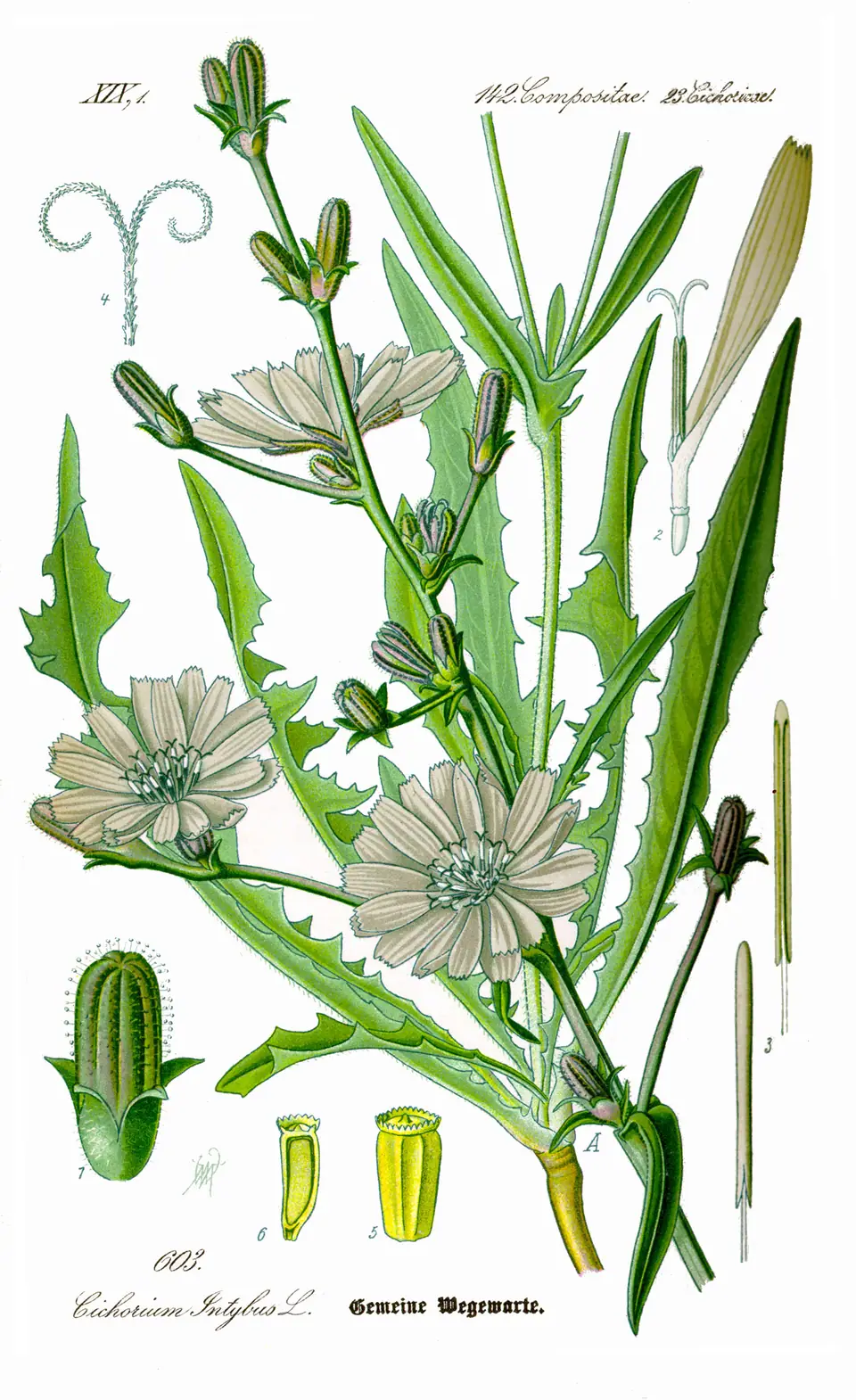


How to Grow and Care for Chicory
Cichorium intybus
Written by Emilio Marruso · last checked
At a glance
Chicory is a cool-weather favorite that gives you more than one harvest: young leaves for salads, flower buds you can eat raw, and roots you can boil or use as a coffee substitute. Give it full sun and evenly moist soil, and it rewards you with crisp leaves. Its pretty flowers even make a lovely edible garnish for your plate.
- Sun
Full sun: 6 or more hours a day
What the sources say (1)
Light: Full sun (6 or more hours of direct sunlight a day)
Full sun (6 or more hours of direct sunlight a day)
— Cichorium intybus (Blue Sailors, Chicory, Coffeeweed, Common Chicory, Cornflower, Italian Dandelion, Succory) | North Carolina Extension Gardener Plant Toolbox [1] - Water
1–2 inches of water a week; dry soil makes the leaves bitter, so mulch helps
What the sources say (7)
Watering: Keep soil uniformly moist with 1-2 inches (25.4-50.8 mm) per week for garden-grown types; established wild plants can be quite drought tolerant
garden types (fonte: Utah State University Extension): Water chicory regularly to maintain a uniformly moist soil, applying 1-2 inches per week.
— How to Grow Chicory in Your Garden | USU [7] established plants (fonte: NC State Extension): It does best cool weather and one established can be quite drought tolerant though it does not do well in heat and humidity so it can suffer in southern summers.
— Cichorium intybus (Blue Sailors, Chicory, Coffeeweed, Common Chicory, Cornflower, Italian Dandelion, Succory) | North Carolina Extension Gardener Plant Toolbox [1] forage (fonte: Mississippi State University Extension): Drought tolerant species, it is suited to be grown on well-drained or moderately drained soils.
— Chicory (Cichorium intybus) | Mississippi State University Extension Service [3] Water chicory regularly to maintain a uniformly moist soil, applying 1-2 inches per week.
— How to Grow Chicory in Your Garden | USU [7] It does best cool weather and one established can be quite drought tolerant though it does not do well in heat and humidity so it can suffer in southern summers.
— Cichorium intybus (Blue Sailors, Chicory, Coffeeweed, Common Chicory, Cornflower, Italian Dandelion, Succory) | North Carolina Extension Gardener Plant Toolbox [1] Watering notes: Drought stress during growth slows leaf development and causes bitter flavors; organic mulch conserves soil moisture
Drought stress during growth will cause slow leaf development and bitter flavors to develop.
— How to Grow Chicory in Your Garden | USU [7] Using organic mulch around the plant also helps conserve soil moisture and reduce weed growth.
— How to Grow Chicory in Your Garden | USU [7] - Cold
Survives winters down to −40 °F (−40 °C)
Very hardy · USDA 3a · RHS H7 · Z3
What the sources say (5)
Hardiness, coldest zone: 3a [winter low −40 to −37.2 °C (−40 to −35 °F)]
3a, 3b, 4a, 4b, 5a, 5b, 6a, 6b, 7a, 7b, 8a, 8b
— Cichorium intybus (Blue Sailors, Chicory, Coffeeweed, Common Chicory, Cornflower, Italian Dandelion, Succory) | North Carolina Extension Gardener Plant Toolbox [1] Hardiness, warmest zone:
According to NC State Extension: 3a, 3b, 4a, 4b, 5a, 5b, 6a, 6b, 7a, 7b, 8a, 8b
— Cichorium intybus (Blue Sailors, Chicory, Coffeeweed, Common Chicory, Cornflower, Italian Dandelion, Succory) | North Carolina Extension Gardener Plant Toolbox [1] According to University of Wisconsin Extension: surviving in zones 3-9
— Chicory, Cichorium intybus – Wisconsin Horticulture [2] According to University of Vermont Extension: can now be found growing in United States Department of Agriculture Hardiness Zones 3 to 9
— Getting to Know Chicory | University of Vermont Extension [6] 3a, 3b, 4a, 4b, 5a, 5b, 6a, 6b, 7a, 7b, 8a, 8b
— Cichorium intybus (Blue Sailors, Chicory, Coffeeweed, Common Chicory, Cornflower, Italian Dandelion, Succory) | North Carolina Extension Gardener Plant Toolbox [1] - Soil
Soil with a pH of 5.5 or higher
What the sources say (1)
Soil pH, minimum: 5.5
Very tolerant to acid soils (pH 5.5 or higher).
— Chicory (Cichorium intybus) | Mississippi State University Extension Service [3] - Spacing
Belgian endive: 9 in apart, rows 20 in; radicchio: 8 in apart, rows 12 in
What the sources say (4)
Spacing: Witloof: 22.9 cm (9 in) between plants, rows 50.8 cm (20 in) apart; radicchio: 20.3 cm (8 in) between plants, rows 30.5 cm (12 in) apart
witloof (fonte: Utah State University Extension): Seeded or transplanted witloof should be spaced 9 inches between plants in the row with rows 20 inches apart.
— How to Grow Chicory in Your Garden | USU [7] radicchio (fonte: Utah State University Extension): Seeded or transplanted radicchio should be spaced 8 inches between plants in the row with rows 12 inches apart.
— How to Grow Chicory in Your Garden | USU [7] Seeded or transplanted witloof should be spaced 9 inches between plants in the row with rows 20 inches apart.
— How to Grow Chicory in Your Garden | USU [7] Seeded or transplanted radicchio should be spaced 8 inches between plants in the row with rows 12 inches apart.
— How to Grow Chicory in Your Garden | USU [7] - Planting
Set out transplants once the last frost has passed
What the sources say (2)
Planting: Witloof transplants shortly after the last frost-free date; radicchio transplants near the last frost-free date
Transplants should be planted shortly after the last frost-free date for the growing area.
— How to Grow Chicory in Your Garden | USU [7] Transplants should be planted near the last frost-free date for the growing area.
— How to Grow Chicory in Your Garden | USU [7] - Feeding
Feed 4 weeks after transplanting; no more nitrogen once heads start to form
What the sources say (5)
When: 4 weeks after transplanting or thinning; no extra nitrogen once heads begin to form
established forage stands: Chicory has a high N requirement and at least 100 to 150 lb N/ac/yr should be applied to an established stand at rates of 50 lb N/ac in early spring, early summer and early fall.
— Chicory (Cichorium intybus) | Mississippi State University Extension Service [3] Apply 1/4 cup of a nitrogen-based fertilizer (21-0-0) per 10 feet of row 4 weeks after transplanting or thinning.
— How to Grow Chicory in Your Garden | USU [7] Place the fertilizer to the side of the plants and irrigate it into the soil. Avoid adding additional nitrogen after heads begin to form.
— How to Grow Chicory in Your Garden | USU [7] Avoid: Excess nitrogen, which prevents tight heads and healthy roots; no additional nitrogen after heads begin to form
Avoid excessive nitrogen fertilization to retain tight heads and healthy root formation. Irrigation should be uniform and frequent to ensure healthy growth.
— How to Grow Chicory in Your Garden | USU [7] Place the fertilizer to the side of the plants and irrigate it into the soil. Avoid adding additional nitrogen after heads begin to form.
— How to Grow Chicory in Your Garden | USU [7] - Harvest
Pick leaves young for salads; cut radicchio heads at full size, as waiting makes them bitter
What the sources say (3)
How to harvest: Radicchio: harvest when the leaves or heads reach full size and cut the stem just below the leaves to keep the head together; delaying harvest makes it bitter and tough. Witloof: harvest leaves young and tender; dig the roots for forcing just before the first frost.
Radicchio should be harvested when the leaves or heads reach full size. Delaying harvest causes radicchio to develop bitter flavors and toughness. Cut the stem just below the leaves to keep the head together.
— How to Grow Chicory in Your Garden | USU [7] Witloof used for greens should be harvested when leaves are young and tender.
— How to Grow Chicory in Your Garden | USU [7] Witloof roots, used for forcing chicons, should be harvested just before the first frost date.
— How to Grow Chicory in Your Garden | USU [7] - Pests
Slugs, snails, aphids, cutworms and cabbage worms; roots can rot
What the sources say (5)
Pests: slugs, snails, cutworms, aphids, worms and loopers (cabbage worms)
Insects, Diseases, and Other Plant Problems: No serious problems. Slugs, snails, and cutworms are occasional pests.
— Cichorium intybus (Blue Sailors, Chicory, Coffeeweed, Common Chicory, Cornflower, Italian Dandelion, Succory) | North Carolina Extension Gardener Plant Toolbox [1] Aphids | Green or black soft-bodied insects that feed on underside of leaves.
— How to Grow Chicory in Your Garden | USU [7] Worms and Loopers | Light to dark green insects that chew holes and hide in leaves.
— How to Grow Chicory in Your Garden | USU [7] Diseases: fungal root rots, viruses
Fungal Root Rots | Wilting and reduced plant vigor which occurs during forcing.
— How to Grow Chicory in Your Garden | USU [7] Viruses | Stunting of growth. Interveinal yellowing and brittleness in older and lower leaves.
— How to Grow Chicory in Your Garden | USU [7] - Watch out
Weeds crowd it out, so pull them early; heat and humidity make leaves bitter
What the sources say (2)
Heat: Does best in cool weather and does not do well in heat and humidity; high summer temperatures reduce growth and quality and can make leaves bitter.
It does best cool weather and one established can be quite drought tolerant though it does not do well in heat and humidity so it can suffer in southern summers.
— Cichorium intybus (Blue Sailors, Chicory, Coffeeweed, Common Chicory, Cornflower, Italian Dandelion, Succory) | North Carolina Extension Gardener Plant Toolbox [1] High summer temperatures reduce growth, decrease quality, and may cause bitter or off-flavors to develop.
— How to Grow Chicory in Your Garden | USU [7] - Size
3 to 4 ft tall
What the sources say (2)
Mature height: 91-122 cm (3-4 ft)
Height: 3 ft. 0 in. - 4 ft. 0 in.
— Cichorium intybus (Blue Sailors, Chicory, Coffeeweed, Common Chicory, Cornflower, Italian Dandelion, Succory) | North Carolina Extension Gardener Plant Toolbox [1] Biennial or perennial herb, stems erect and branching, to 40 inches tall, stems rough with stiff hairs,
— Cichorium intybus - chicory | Yavapai County Native and Naturalized Plants [5] - Propagation
Grow it from seed, root pieces or transplants
- Sowing
Sow 1/4–1/2 in deep; seeds sprout best at 65–70 °F (18–21 °C), poorly above 80 °F
What the sources say (5)
Sowing depth: 0.6-1.3 cm (1/4-1/2 in)
Chicory seeds should be planted 0.25- to 0.5-inch deep.
— Chicory (Cichorium intybus) | Mississippi State University Extension Service [3] Plant chicory seeds ¼ inch deep in early spring.
— How to Grow Chicory in Your Garden | USU [7] Germination: Seeds germinate best at 18.3-21.1 °C [65–70 °F]; temperatures above 26.7 °C [80 °F] reduce germination. Sow 0.64-1.27 cm [0.3–0.5 in] deep, several seeds per plant wanted.
Seeds germinate best at 65-70ºF, while temperatures above 80ºF reduce germination.
— How to Grow Chicory in Your Garden | USU [7] Chicory seeds should be planted 0.25- to 0.5-inch deep.
— Chicory (Cichorium intybus) | Mississippi State University Extension Service [3] Sow several seeds for each plant desired, as not every seed will germinate.
— How to Grow Chicory in Your Garden | USU [7]
Overview
Common chicory is a biennial or perennial taprooted member of the Asteraceae with blue flowers, grown for edible leaves, buds and roots. [1][2] It prefers full sun and well-drained soil. [1] Garden chicory types are cool-season crops, and the roots are used as a coffee substitute. [7][6]
Chicory care
Measurements in square brackets are our conversion into the other unit system; the quoted text is unchanged.
How to water Chicory
Watering
Keep soil uniformly moist with 1-2 inches (25.4-50.8 mm) per week for garden-grown types; established wild plants can be quite drought tolerant
What each source says
garden types (fonte: Utah State University Extension): Keep soil uniformly moist, 1-2 inches [2.5–5.1 cm] per week
established plants (fonte: NC State Extension): Quite drought tolerant once established
forage (fonte: Mississippi State University Extension): Drought tolerant species
What the sources say (5)
garden types (fonte: Utah State University Extension): Water chicory regularly to maintain a uniformly moist soil, applying 1-2 inches per week.established plants (fonte: NC State Extension): It does best cool weather and one established can be quite drought tolerant though it does not do well in heat and humidity so it can suffer in southern summers.forage (fonte: Mississippi State University Extension): Drought tolerant species, it is suited to be grown on well-drained or moderately drained soils.Water chicory regularly to maintain a uniformly moist soil, applying 1-2 inches per week.It does best cool weather and one established can be quite drought tolerant though it does not do well in heat and humidity so it can suffer in southern summers.Watering notes
Drought stress during growth slows leaf development and causes bitter flavors; organic mulch conserves soil moisture
What the sources say (2)
Drought stress during growth will cause slow leaf development and bitter flavors to develop.Using organic mulch around the plant also helps conserve soil moisture and reduce weed growth.How much light Chicory needs
Full sun (6 or more hours of direct sunlight a day)
What the sources say (1)
Full sun (6 or more hours of direct sunlight a day)How much cold Chicory can take
Hardiness, coldest zone
3a [winter low −40 to −37.2 °C (−40 to −35 °F)]
What the sources say (1)
3a, 3b, 4a, 4b, 5a, 5b, 6a, 6b, 7a, 7b, 8a, 8bHardiness, warmest zone
The sources give different values depending on region, zone or growing conditions.
What each source says
According to NC State Extension: 8b [winter low −9.4 to −6.7 °C (15 to 20 °F)]
According to University of Wisconsin Extension: 9 [winter low −6.7 to −1.1 °C (20 to 30 °F)]
According to University of Vermont Extension: 9 [winter low −6.7 to −1.1 °C (20 to 30 °F)]
What the sources say (4)
According to NC State Extension: 3a, 3b, 4a, 4b, 5a, 5b, 6a, 6b, 7a, 7b, 8a, 8bAccording to University of Wisconsin Extension: surviving in zones 3-9According to University of Vermont Extension: can now be found growing in United States Department of Agriculture Hardiness Zones 3 to 93a, 3b, 4a, 4b, 5a, 5b, 6a, 6b, 7a, 7b, 8a, 8bBest soil for Chicory
5.5
What the sources say (1)
Very tolerant to acid soils (pH 5.5 or higher).Where to grow Chicory
Witloof: 22.9 cm (9 in) between plants, rows 50.8 cm (20 in) apart; radicchio: 20.3 cm (8 in) between plants, rows 30.5 cm (12 in) apart
What each source says
witloof (fonte: Utah State University Extension): 22.9 cm (9 in) between plants, rows 50.8 cm (20 in) apart
radicchio (fonte: Utah State University Extension): 20.3 cm (8 in) between plants, rows 30.5 cm (12 in) apart
What the sources say (4)
witloof (fonte: Utah State University Extension): Seeded or transplanted witloof should be spaced 9 inches between plants in the row with rows 20 inches apart.radicchio (fonte: Utah State University Extension): Seeded or transplanted radicchio should be spaced 8 inches between plants in the row with rows 12 inches apart.Seeded or transplanted witloof should be spaced 9 inches between plants in the row with rows 20 inches apart.Seeded or transplanted radicchio should be spaced 8 inches between plants in the row with rows 12 inches apart.How to propagate Chicory
How to grow Chicory
The plant
Life cycle
biennial or perennial
What the sources say (2)
Lifecycle Biennial or perennial Height 40 inchesLife Cycle: Biennial Perennial Recommended Propagation Strategy: SeedFamily
Asteraceae
What the sources say (2)
Chicory, a biennial member of the Asteraceae (daisy) family, was introduced from Europe and has become naturalized over much of the nation.Chicory belongs to the aster family (Asteraceae) and has been cultivated for centuries for its edible leaves, buds and roots and it has also been used medicinally.Mature height
91-122 cm (3-4 ft)
What the sources say (2)
Height: 3 ft. 0 in. - 4 ft. 0 in.Biennial or perennial herb, stems erect and branching, to 40 inches tall, stems rough with stiff hairs,Sowing and growth
Sowing depth
0.6-1.3 cm (1/4-1/2 in)
Row spacing
The sources give different values depending on region, zone or growing conditions.
What each source says
cultivated type 'witloof' (rows 51 cm / 20 in apart):
cultivated type 'radicchio' (rows 30 cm / 12 in apart):
What the sources say (2)
cultivated type 'witloof' (rows 51 cm / 20 in apart): Seeded or transplanted witloof should be spaced 9 inches between plants in the row with rows 20 inches apart.cultivated type 'radicchio' (rows 30 cm / 12 in apart): Seeded or transplanted radicchio should be spaced 8 inches between plants in the row with rows 12 inches apart.Days to maturity
The sources disagree:
Seeds are planted in the early fall for a winter crop of greens or in the early spring with leaves of harvest size in about 60 days.
[8]For fall planted radicchio, select early maturing cultivars and plant 75-85 days before the anticipated maturity date.
[7]Spring-seeded chicory can be grazed after 80 to 100 days, depending on climatic conditions.
[3]
Harvest and storage
How to harvest
Radicchio: harvest when the leaves or heads reach full size and cut the stem just below the leaves to keep the head together; delaying harvest makes it bitter and tough. Witloof: harvest leaves young and tender; dig the roots for forcing just before the first frost.
What the sources say (3)
Radicchio should be harvested when the leaves or heads reach full size. Delaying harvest causes radicchio to develop bitter flavors and toughness. Cut the stem just below the leaves to keep the head together.Witloof used for greens should be harvested when leaves are young and tender.Witloof roots, used for forcing chicons, should be harvested just before the first frost date.Storage
Radicchio keeps 2-3 weeks and forced witloof chicons 2-4 weeks at 0 C (32 F) and 95% relative humidity; trimmed witloof roots are stored 3-7 weeks at 0-1 C (32-34 F) before forcing. Do not store radicchio with apples or pears.
What the sources say (4)
Radicchio can be stored for 2-3 weeks at 32ºF and 95% relative humidity.Chicons can be stored for 2-4 weeks at 32ºF and 95% relative humidity.Trimmed roots should be stored for 3 to 7 weeks at temperatures of 32-34ºF before forcing.Avoid storing radicchio with fruits such as apples and pears as bitter flavors will develop.Pests and diseases
Pests
slugs, snails, cutworms, aphids, worms and loopers (cabbage worms)
What the sources say (3)
Insects, Diseases, and Other Plant Problems: No serious problems. Slugs, snails, and cutworms are occasional pests.Aphids | Green or black soft-bodied insects that feed on underside of leaves.Worms and Loopers | Light to dark green insects that chew holes and hide in leaves.Diseases
fungal root rots, viruses
Fertilizing
When
4 weeks after transplanting or thinning; no extra nitrogen once heads begin to form
What each source says
established forage stands: early spring, early summer and early fall
What the sources say (3)
established forage stands: Chicory has a high N requirement and at least 100 to 150 lb N/ac/yr should be applied to an established stand at rates of 50 lb N/ac in early spring, early summer and early fall.Apply 1/4 cup of a nitrogen-based fertilizer (21-0-0) per 10 feet of row 4 weeks after transplanting or thinning.Place the fertilizer to the side of the plants and irrigate it into the soil. Avoid adding additional nitrogen after heads begin to form.How often
The sources give different values depending on region, zone or growing conditions.
What each source says
established forage stands: three applications a year
What the sources say (1)
established forage stands: Chicory has a high N requirement and at least 100 to 150 lb N/ac/yr should be applied to an established stand at rates of 50 lb N/ac in early spring, early summer and early fall.Natural fertilizers
Well-composted organic matter before planting: no more than 2.54 cm [1 in] per 9.29 m² of garden
What the sources say (1)
If you fertilize with compost, apply no more than 1 inch of well-composted organic matter per 100 square feet of garden area.Mineral fertilizers
Nitrogen fertilizer 21-0-0: 59 mL per 3.05 m [10 ft] of row, placed beside the plants and watered in
What the sources say (1)
Apply 1/4 cup of a nitrogen-based fertilizer (21-0-0) per 10 feet of row 4 weeks after transplanting or thinning. Place the fertilizer to the side of the plants and irrigate it into the soil.Avoid
Excess nitrogen, which prevents tight heads and healthy roots; no additional nitrogen after heads begin to form
What the sources say (2)
Avoid excessive nitrogen fertilization to retain tight heads and healthy root formation. Irrigation should be uniform and frequent to ensure healthy growth.Place the fertilizer to the side of the plants and irrigate it into the soil. Avoid adding additional nitrogen after heads begin to form.Spacing
Between plants
The sources give different values depending on region, zone or growing conditions.
What each source says
witloof: 23 cm [9.1 in] in the row
radicchio: 20 cm [7.9 in] in the row
What the sources say (2)
witloof: Thin seedlings or transplant witloof 9 inches apart in the row with rows 20 inches apart.radicchio: Plant radicchio 8 inches apart in the row with rows spaced 12 inches apart.Between rows
The sources give different values depending on region, zone or growing conditions.
What each source says
witloof: 51 cm [20 in]
radicchio: 30 cm [12 in]
What the sources say (2)
witloof: Thin seedlings or transplant witloof 9 inches apart in the row with rows 20 inches apart.radicchio: Plant radicchio 8 inches apart in the row with rows spaced 12 inches apart.Roots
Root system
Deep, fleshy, branched taproot with milky sap; the plant regrows from the taproot when cut back.
What the sources say (3)
The deep, fleshy taproot exudes a milky sap when cut.Like a dandelion, it has a relatively large, brown, fleshy, branched taproot with a milky sap.For chicory infesting lawns, mowing will cut off some of the leaves and the flowering stems, leaving hard stumps, but the plant will regrow from the tap root.Propagation
Germination
Seeds germinate best at 18.3-21.1 °C [65–70 °F]; temperatures above 26.7 °C [80 °F] reduce germination. Sow 0.64-1.27 cm [0.3–0.5 in] deep, several seeds per plant wanted.
What the sources say (3)
Seeds germinate best at 65-70ºF, while temperatures above 80ºF reduce germination.Chicory seeds should be planted 0.25- to 0.5-inch deep.Sow several seeds for each plant desired, as not every seed will germinate.After harvest
Storage
At 0 °C [32 °F] and 95% relative humidity: witloof chicons keep 2-4 weeks, radicchio 2-3 weeks; trimmed witloof roots keep 3-7 weeks at 0-1.1 °C [32–34 °F] before forcing. Do not store radicchio with apples or pears.
What the sources say (4)
Chicons can be stored for 2-4 weeks at 32ºF and 95% relative humidity.Radicchio can be stored for 2-3 weeks at 32ºF and 95% relative humidity.Trimmed roots should be stored for 3 to 7 weeks at temperatures of 32-34ºF before forcing.Avoid storing radicchio with fruits such as apples and pears as bitter flavors will develop.Heat and drought
Heat
Does best in cool weather and does not do well in heat and humidity; high summer temperatures reduce growth and quality and can make leaves bitter.
What the sources say (2)
It does best cool weather and one established can be quite drought tolerant though it does not do well in heat and humidity so it can suffer in southern summers.High summer temperatures reduce growth, decrease quality, and may cause bitter or off-flavors to develop.Drought
Once established it can be quite drought tolerant; in cultivation, drought stress during growth slows leaf development and makes leaves bitter.
What the sources say (2)
It does best cool weather and one established can be quite drought tolerant though it does not do well in heat and humidity so it can suffer in southern summers.Drought stress during growth will cause slow leaf development and bitter flavors to develop.Chicory pests and problems
Aphids
Symptom: Green or black soft-bodied insects on the underside of leaves; leaves become crinkled and curled
What to do: Insecticidal soaps, appropriate insecticides, or a strong water stream to dislodge insects
What the sources say (1)
Green or black soft-bodied insects that feed on underside of leaves. Leaves become crinkled and curled.
— How to Grow Chicory in Your Garden | USU [7] Worms and loopers
Symptom: Light to dark green insects that chew holes and hide in leaves
What to do: Appropriate insecticides or biological measures
What the sources say (1)
Control worms and loopers with appropriate insecticides or biological measures.
— How to Grow Chicory in Your Garden | USU [7] Fungal root rots
Symptom: Wilting and reduced plant vigor during forcing
What to do: Cultural practices that facilitate air movement
What the sources say (1)
Cultural practices that facilitate air movement will reduce disease severity.
— How to Grow Chicory in Your Garden | USU [7] Weeds
Symptom: Chicory does not compete well with weeds
What to do: Weed control during establishment, closely spaced plants, shallow cultivation
What the sources say (1)
Chicory does not compete well with weeds, so weed control is particularly important during establishment.
— How to Grow Chicory in Your Garden | USU [7]
Remedies
Each remedy shows what official sources say about it; traditional remedies without an official source are marked as such. Harmful ones are listed so you know to avoid them.
Treating the plant
slugs
hand-picking slugs and snails Works
How: Pick the pests off by hand in the evening or early morning.
If you aren’t squeamish, you can pick the pests off by hand in the evening or early morning.
— gardeningknowhow.com [9] What the evidence says Many insect and disease issues can be solved in the home garden by hand-picking insects or clipping and disposing of diseased plant parts.
— extension.unh.edu [10] diatomaceous earth barrier Not verified
Traditional remedy, not verified by an official source.
How: Surround the plant with diatomaceous earth, which abrades the pest's skin.
aphids
insecticidal soap spray Works
When “oils and soaps” are mentioned in UC IPM publications, we are referring to commercially available oils and soaps that are formulated specifically for use as pesticides- not household oils and soaps meant for cooking, cleaning, or other purposes.
— ucanr.edu [12] How: Insecticidal soap spray is effective, but several applications may be needed to control a severe infestation.
Insecticidal soap spray is effective, but several applications may be needed to control a severe infestation.
— gardeningknowhow.com [9] What the evidence says For example, insecticidal soap is a safe, effective organic insecticide with minimal environmental impact.
— extension.psu.edu [11] strong water stream Official source, not independently tested
How: Use a strong water stream to dislodge the insects.
Use insecticidal soaps, appropriate insecticides, or strong water stream to dislodge insects.
— How to Grow Chicory in Your Garden | USU [7]
thrips
insecticidal soap spray Works
When “oils and soaps” are mentioned in UC IPM publications, we are referring to commercially available oils and soaps that are formulated specifically for use as pesticides- not household oils and soaps meant for cooking, cleaning, or other purposes.
— ucanr.edu [12] How: Thrips are easily treated with insecticidal soap spray.
Like aphids, thrips are easily treated with insecticidal soap spray.
— gardeningknowhow.com [9] What the evidence says For example, insecticidal soap is a safe, effective organic insecticide with minimal environmental impact.
— extension.psu.edu [11]
cabbage loopers
hand-picking cabbage loopers Works
How: Remove the pests by hand.
The pests can cause significant damage when they chew holes in the leaves. You can remove the pests by hand
— gardeningknowhow.com [9] What the evidence says Many insect and disease issues can be solved in the home garden by hand-picking insects or clipping and disposing of diseased plant parts.
— extension.unh.edu [10]
Getting rid of it
chicory as a weed
hand removal of the whole root Works
How: In small gardens, remove the plant by hand, making sure to remove all of the root.
In small gardens, hand removal – making sure to remove all of the root – is probably the best control option.
— Chicory, Cichorium intybus – Wisconsin Horticulture [2] What the evidence says In small gardens, hand removal – making sure to remove all of the root – is probably the best control option.
— Chicory, Cichorium intybus – Wisconsin Horticulture [2] digging out the taproot with a weeding fork Not verified
Traditional remedy, not verified by an official source.
How: Use a dandelion digger, a weeding fork, a narrow trowel or a specialized root weeder; inspect the hole for remaining root fragments and remove them.
repeated mowing Partly works
How: Mowing cuts off some of the leaves and the flowering stems, but the plant regrows from the taproot.
For chicory infesting lawns, mowing will cut off some of the leaves and the flowering stems, leaving hard stumps, but the plant will regrow from the tap root.
— Chicory, Cichorium intybus – Wisconsin Horticulture [2] What the evidence says For chicory infesting lawns, mowing will cut off some of the leaves and the flowering stems, leaving hard stumps, but the plant will regrow from the tap root.
— Chicory, Cichorium intybus – Wisconsin Horticulture [2] hoeing young plants Works
How: Use a sharp hoe to sever the young plant just below the soil surface.
Technique: Use a sharp hoe to sever the young plant just below the soil surface.
— gardenbotany.com [13] What the evidence says Regularly pulling, hoeing or mowing weeds and encouraging grass to grow and out-compete the weeds is an excellent solution.
— extension.usu.edu [14] smothering with cardboard and newspaper Works
How: Cover the area with several layers of cardboard or thick newspaper, cover it with 6-12 inches of organic mulch and leave it in place for at least 6 months to a year.
Cover the area with several layers of cardboard or thick newspaper.
— gardenbotany.com [13] What the evidence says A variety of household items, such as newspapers, can be used as weed barriers.
— extension.usu.edu [14] soil solarization Not verified
Traditional remedy, not verified by an official source.
How: Cover the area tightly with clear plastic sheeting (4-6 mil thick), burying the edges to trap heat, and leave it in place for 4-8 weeks during the hottest part of summer.
Calendar
Sowing
The sources give different values depending on region, zone or growing conditions.
What each source says
early spring (fonte: University of Vermont Extension): Several weeks before the last average frost date
witloof (fonte: Utah State University Extension): 3-4 weeks before the last frost-free date
Arkansas (fonte: University of Arkansas Division of Agriculture): Early fall for a winter crop of greens, or early spring
forage (fonte: Mississippi State University Extension): September to October, drill planted
What the sources say (8)
early spring (fonte: University of Vermont Extension): Sow seeds according to package directions several weeks before the last average frost date for your area.witloof (fonte: Utah State University Extension): Seeded witloof may be planted 3-4 weeks before the last frost-free date for the growing area.Arkansas (fonte: University of Arkansas Division of Agriculture): Seeds are planted in the early fall for a winter crop of greens or in the early springforage (fonte: Mississippi State University Extension): It could be drill planted from September to October in a prepared seed bed or grass sod at a rate of 3 to 4 lbs/ac.Sow seeds according to package directions several weeks before the last average frost date for your area.Chicory can also be directly sown in late summer or early fall.Seeded witloof may be planted 3-4 weeks before the last frost-free date for the growing area.Seeds are planted in the early fall for a winter crop of greens or in the early springPlanting
Witloof transplants shortly after the last frost-free date; radicchio transplants near the last frost-free date
Harvest
The sources give different values depending on region, zone or growing conditions.
What each source says
Arkansas (fonte: University of Arkansas Division of Agriculture): Leaves of harvest size in about 60 days
forage (fonte: Mississippi State University Extension): Spring-seeded chicory can be grazed after 80-100 days
witloof roots (fonte: Utah State University Extension): Just before the first frost date
What the sources say (6)
Arkansas (fonte: University of Arkansas Division of Agriculture): with leaves of harvest size in about 60 days.forage (fonte: Mississippi State University Extension): Spring-seeded chicory can be grazed after 80 to 100 days, depending on climatic conditions.witloof roots (fonte: Utah State University Extension): Witloof roots, used for forcing chicons, should be harvested just before the first frost date.with leaves of harvest size in about 60 days.Witloof roots, used for forcing chicons, should be harvested just before the first frost date.Radicchio should be harvested when the leaves or heads reach full size.Months as given by the sources, which are mostly from the United States (northern hemisphere). In the southern hemisphere they shift by about six months.
Relative to frost
Less precise estimate: there is no weather station within 300 km.
Find frost dates by ZIP code or city
Sow outdoors: 3 to 4 weeks before the last frost
Seeded witloof may be planted 3-4 weeks before the last frost-free date for the growing area.
— How to Grow Chicory in Your Garden | USU [7] Transplant: around the last frost
Transplants should be planted near the last frost-free date for the growing area.
— How to Grow Chicory in Your Garden | USU [7] Harvest: 3 to 4 weeks after the first frost
The maturity date should be about 3-4 weeks after the first fall frost.
— How to Grow Chicory in Your Garden | USU [7]
Count from the average frost dates where you live.
Edibility
Reported by the source, quoted verbatim. Do not eat a plant on the basis of this page alone: identification mistakes can be dangerous.
Young leaves can be added to salads. As the season progresses, leaves will grow more bitter.
[6]Chicory root can be boiled and eaten as a vegetable, but perhaps the best-known use is as a coffee substitute.
[6]Flower buds can be eaten raw. Freshly picked flowers make a lovely edible garnish, though they may be bitter.
[6]
Indicative values
Values from a secondary source, not checked word for word like the rest of this page. Use them as a starting point.
- Drought tolerant
- yesIndicative value, adapt it to your climate · Secondary source
- Care level
- MediumIndicative value, adapt it to your climate · Secondary source
- Growth rate
- LowIndicative value, adapt it to your climate · Secondary source
- Pruning
- December, January, March, AprilIndicative value, adapt it to your climate · Secondary source
Similar plants
- Cultivated endive Cichorium endivia
- Cichorium pumilum Cichorium pumilum
- Cichorium spinosum Cichorium spinosum
- African Daisy Dimorphotheca pluvialis
- African Marigold Tagetes erecta
- Ageratum Ageratum houstonianum
- Alpine aster Aster alpinus
- American Burnweed Erechtites hieraciifolius
Sources
Every value above is quoted from these documents. Links lead to the original publisher.
- Cichorium intybus (Blue Sailors, Chicory, Coffeeweed, Common Chicory, Cornflower, Italian Dandelion, Succory) | North Carolina Extension Gardener Plant Toolbox · plants.ces.ncsu.edu, consulted
- Chicory, Cichorium intybus – Wisconsin Horticulture · hort.extension.wisc.edu, consulted
- Chicory (Cichorium intybus) | Mississippi State University Extension Service · extension.msstate.edu, consulted
- Chicory - Cichorium intybus | North Carolina Extension Gardener Plant Toolbox · plants.ces.ncsu.edu, consulted
- Cichorium intybus - chicory | Yavapai County Native and Naturalized Plants · yavapaiplants.extension.arizona.edu, consulted
- Getting to Know Chicory | University of Vermont Extension · uvm.edu, consulted
- How to Grow Chicory in Your Garden | USU · extension.usu.edu, consulted
- Chicory · uaex.uada.edu, consulted
- gardeningknowhow.com · gardeningknowhow.com
- extension.unh.edu · extension.unh.edu
- extension.psu.edu · extension.psu.edu
- ucanr.edu · ucanr.edu
- gardenbotany.com · gardenbotany.com
- extension.usu.edu · extension.usu.edu
Written by Emilio Marruso · last checked