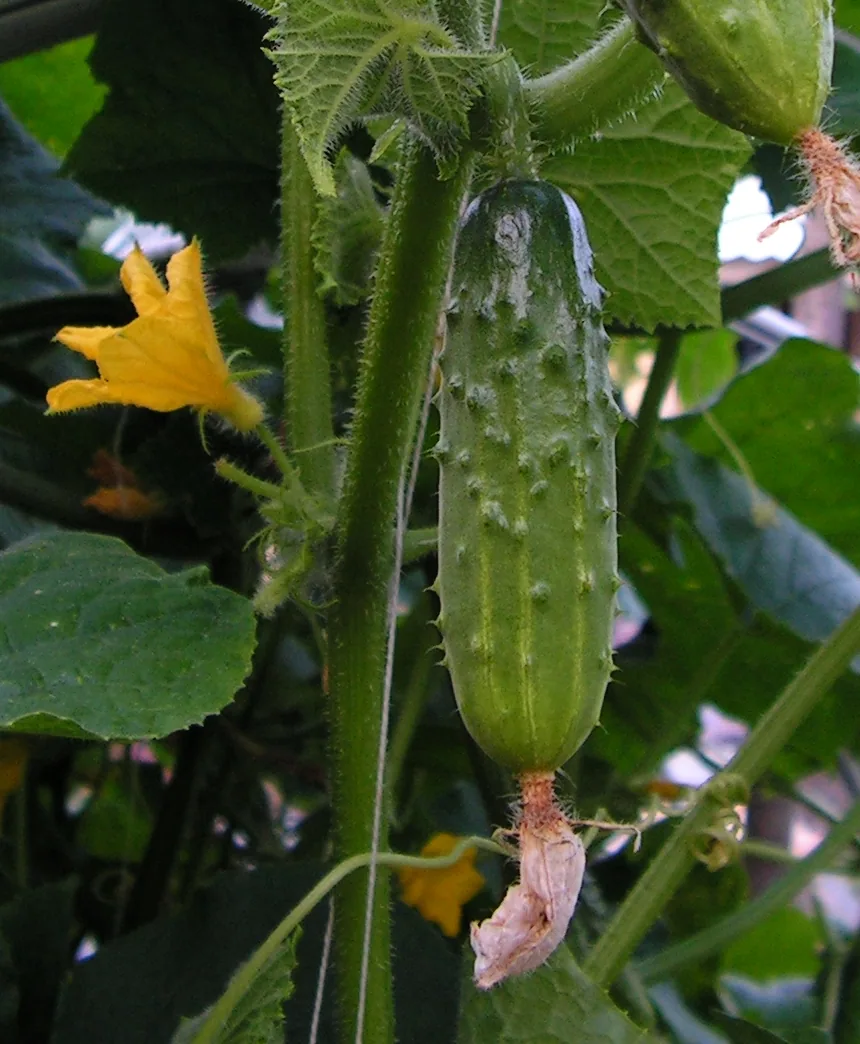


Cómo cultivar y cuidar Pepino
Cucumis sativus
Escrito por Emilio Marruso · última revisión
No tóxica para gatos y perros, según las fuentes · Fuentes
De un vistazo
El pepino te recompensa rápido: la mayoría está listo en 50 a 70 días, y cada fruto se puede coger 5–7 días después de la flor. Dale sol pleno, riégalo al pie por la mañana y recoge cada 2 o 3 días para que la planta siga produciendo. Crece bien también en maceta y no es tóxico para gatos, perros ni caballos.
- Sol
Sol pleno: 6 horas o más al día
Qué dicen las fuentes (2)
Luz: Pleno sol (6 o más horas de luz solar directa al día)
Full sun (6 or more hours of direct sunlight a day)
— Cucumis sativus (Cucumber, Cucumbers, Garden Cucumber, Garden Cucumbers, Gherkin, Gherkins, Immature Cucumbers) | North Carolina Extension Gardener Plant Toolbox [1] Cucumbers perform best in fertile, well-drained soils in full sun.
— Growing Cucumbers in the Home Garden | Yard and Garden [6] - Riego
Riega al pie por la mañana sin mojar las hojas; la falta de agua amarga los frutos
Qué dicen las fuentes (6)
Notas sobre el riego: Mantén las hojas secas al regar para prevenir enfermedades fúngicas; riega en la base de la planta por la mañana; el acolchado conserva el agua; las plantas cultivadas verticalmente pierden humedad más fácilmente; el estrés por falta de agua causa frutos amargos y deformes
Keep the leaves dry while watering to prevent fungal diseases. Note that vertically grown cucumber plants lose moisture more easily.
— Cucumis sativus (Cucumber, Cucumbers, Garden Cucumber, Garden Cucumbers, Gherkin, Gherkins, Immature Cucumbers) | North Carolina Extension Gardener Plant Toolbox [1] To aid in preventing disease, water at the base of the plant in the morning and avoid wetting the foliage.
— Cucumber | Home & Garden Information Center [4] Avoid water stressing the plants as this causes the fruits to be bitter, have pointed ends, and be misshapen.
— How to Grow Cucumber in Your Garden | USU [7] Sequía: Con sus raíces superficiales, sufre sin riego durante las sequías; el estrés por sequía causa amargor temporal y hace que las plantas sean susceptibles a los ácaros araña.
Cucumbers have a shallow root system and can suffer when no irrigation is provided during droughts.
— Cucumber | Home & Garden Information Center [4] Bitterness in cucumbers is a temporary issue caused by plant stress, such as temperatures below 60°F or above 90°F, drought conditions, or poor nutrition.
— Grow your own cucumbers | OSU Extension Service [8] Drought-stressed plants are susceptible to spider mites. ## Weed control Cultivation should be shallow
— Grow your own cucumbers | OSU Extension Service [8] - Frío
Aguanta inviernos de hasta −45,6 °C (−50 °F)
Muy rústica · USDA 2a · RHS H7 · Z2
Qué dicen las fuentes (2)
Rusticidad, zona más fría: 2a [mínima invernal de −45,6 a −42,8 °C (de −50 a −45 °F)]
2a, 2b, 3a, 3b, 4a, 4b, 5a, 5b, 6a, 6b, 7a, 7b, 8a, 8b, 9a, 9b, 10a, 10b, 11a, 11b
— Cucumis sativus (Cucumber, Cucumbers, Garden Cucumber, Garden Cucumbers, Gherkin, Gherkins, Immature Cucumbers) | North Carolina Extension Gardener Plant Toolbox [1] Rusticidad, zona más cálida: 11b [mínima invernal de 7,2 a 10 °C (de 45 a 50 °F)]
2a, 2b, 3a, 3b, 4a, 4b, 5a, 5b, 6a, 6b, 7a, 7b, 8a, 8b, 9a, 9b, 10a, 10b, 11a, 11b
— Cucumis sativus (Cucumber, Cucumbers, Garden Cucumber, Garden Cucumbers, Gherkin, Gherkins, Immature Cucumbers) | North Carolina Extension Gardener Plant Toolbox [1] - Suelo
Suelo ligeramente ácido, pH 6,0–6,8
Qué dicen las fuentes (3)
pH del suelo, mínimo: 6.0
The soil pH should be between 6.0 and 6.5.
— Cucumber | Home & Garden Information Center [4] Soil pH: The ideal pH for cucumber growth is between 6.0 and 6.8.
— Grow your own cucumbers | OSU Extension Service [8] pH del suelo, máximo: 6.8
Soil pH: The ideal pH for cucumber growth is between 6.0 and 6.8.
— Grow your own cucumbers | OSU Extension Service [8] - Abonado
Abona antes de plantar y añade nitrógeno cuando crezcan las guías; si te pasas, da hojas y pocos frutos
Qué dicen las fuentes (4)
Cuándo: Antes de plantar, luego un abono nitrogenado de cobertura durante el crecimiento de la vid
Incorporate organic matter and a complete fertilizer into the area before planting.
— How to Grow Cucumber in Your Garden | USU [7] Before the vines start to develop , sidedress with 34-0-0 at 1 pound per 100 feet of row or calcium nitrate (15.5-0-0) at 2 pounds per 100 feet of row.
— Cucumber | Home & Garden Information Center [4] After the vines develop runners, side dress each plant with 3-4 tablespoons of a nitrogen fertilizer (21-0-0), sprinkled around the plant, then water in the fertilizer. Sidedress before the plant starts to flower.
— How to Grow Cucumber in Your Garden | USU [7] Evitar: Abonar en exceso con nitrógeno, lo que favorece el crecimiento excesivo de la vid y reduce la producción de frutos
Do not overfertilize with nitrogen as this encourages excess vine growth and reduces fruit production.
— Cucumber | Home & Garden Information Center [4] - Cosecha
Listo en 50–70 días; corta con cuchillo cada 2–3 días, antes de que el fruto amarillee
Qué dicen las fuentes (9)
Cosecha: Listo en 50 a 70 días según el cultivar; los frutos están listos 5-7 días después de la floración; recolecta cada 2 a 3 días
Según Clemson HGIC: Depending on the cultivar, cucumbers should be ready for harvest in about 50 to 70 days.
— Cucumber | Home & Garden Information Center [4] Según Oregon State University Extension: Cucumber varieties vary in their days to maturity, with early-maturing varieties requiring as little as 50 days at relatively high temperatures (75 to 85°F) to reach harvest, while late-maturing varieties may take up to 70 days.
— Grow your own cucumbers | OSU Extension Service [8] Según Utah State University Extension: Cucumbers are ready to harvest 5-7 days after flowering.
— How to Grow Cucumber in Your Garden | USU [7] Depending on the cultivar, cucumbers should be ready for harvest in about 50 to 70 days.
— Cucumber | Home & Garden Information Center [4] Cucumbers are ready to harvest 5-7 days after flowering.
— How to Grow Cucumber in Your Garden | USU [7] Harvest cucumbers frequently (every 2 to 3 days) as the fruit develops quickly and can easily grow beyond the desired size.
— Growing Cucumbers in the Home Garden | Yard and Garden [6] Cómo cosechar: Corta el tallo con un cuchillo afilado o podadoras (previene daños a la vid); cosecha con frecuencia, cada 2 a 3 días, antes de que el fruto se vuelva amarillo, las semillas se endurezcan o la pulpa se vuelva amarga. La cosecha frecuente mantiene las vides produciendo.
Harvest the fruits by cutting stems with a sharp knife or pruners. This prevents vine damage and results in a clean break.
— Cucumber | Home & Garden Information Center [4] Harvest cucumbers frequently (every 2 to 3 days) as the fruit develops quickly and can easily grow beyond the desired size.
— Growing Cucumbers in the Home Garden | Yard and Garden [6] Harvest cucumbers any time after they reach the desired size but before they turn yellow, and the seeds harden.
— Grow your own cucumbers | OSU Extension Service [8] - Plagas
Escarabajos del pepino, pulgón y ácaros; oídio y marchitez bacteriana
Qué dicen las fuentes (4)
Plagas: escarabajos del pepino, gusanos del pepino, pulgones, ácaros, moscas blancas, barrenadores de la vid de calabaza, orugas del repollo, trips, babosas, arañitas rojas, sinfilanos del jardín, gusanos de alambre
The major pests that feed on cucumber are cucumber beetles, pickleworms, aphids, mites, whiteflies , and squash vine borers.
— Cucumber | Home & Garden Information Center [4] Pests include aphids, cucumber beetles, cabbage loopers, thrips, slugs, spider mites, garden symphylans and wireworms.
— Grow your own cucumbers | OSU Extension Service [8] Enfermedades: mildiú polvoroso, mildiú velloso, antracnosis, añublo gomoso del tallo, marchitez bacteriana, virus del mosaico, mancha objetivo, pudrición del vientre, damping-off, rizo de la punta
Diseases that occur in the home garden include powdery and downy mildews, anthracnose, gummy stem blight, bacterial wilt, mosaic viruses, target spot , and belly rot.
— Cucumber | Home & Garden Information Center [4] Cucumber diseases include damping-off (caused by Pythium ultimum ), curly top, powdery mildew and cucumber mosaic virus.
— Grow your own cucumbers | OSU Extension Service [8] - Atención
Raíces superficiales: no dañes la raíz principal al trasplantar
Qué dicen las fuentes (2)
Sistema radicular: Sistema radicular superficial; la raíz principal no debe dañarse al trasplantar.
Cucumbers have a shallow root system and can suffer when no irrigation is provided during droughts.
— Cucumber | Home & Garden Information Center [4] Be careful to avoid damaging the plant's taproot when transplanting.
— Cucumis sativus (Cucumber, Cucumbers, Garden Cucumber, Garden Cucumbers, Gherkin, Gherkins, Immature Cucumbers) | North Carolina Extension Gardener Plant Toolbox [1] - Tamaño
20–46 cm de alto y 0,9–2,4 m de ancho
Qué dicen las fuentes (2)
Altura adulta: 20-46 cm (8 a 18 pulgadas)
Cucumber plants can grow 8 to 18 inches high and 3 to 8 feet wide. If given proper soil and water, cucumber plants can be an incredibly prolific addition to your vegetable garden.
— Cucumis sativus (Cucumber, Cucumbers, Garden Cucumber, Garden Cucumbers, Gherkin, Gherkins, Immature Cucumbers) | North Carolina Extension Gardener Plant Toolbox [1] Anchura adulta: 91-244 cm (3 a 8 pies)
Cucumber plants can grow 8 to 18 inches high and 3 to 8 feet wide. If given proper soil and water, cucumber plants can be an incredibly prolific addition to your vegetable garden.
— Cucumis sativus (Cucumber, Cucumbers, Garden Cucumber, Garden Cucumbers, Gherkin, Gherkins, Immature Cucumbers) | North Carolina Extension Gardener Plant Toolbox [1] - Multiplicación
Por semilla o con plantel
Qué dicen las fuentes (2)
Propagación: Semilla; trasplantes
Note that vertically grown cucumber plants lose moisture more easily. Propagate cucumber by seed.
— Cucumis sativus (Cucumber, Cucumbers, Garden Cucumber, Garden Cucumbers, Gherkin, Gherkins, Immature Cucumbers) | North Carolina Extension Gardener Plant Toolbox [1] Cucumber can be grown from seed or transplants.
— How to Grow Cucumber in Your Garden | USU [7] - Siembra
Siembra a 2,5 cm; nace en 5–10 días a 18–29 °C, y no por debajo de 10 °C
Qué dicen las fuentes (6)
Profundidad de siembra: 2.5 cm (1 pulgada)
Plant 4 to 5 seeds per hill at a depth of 1 inch. Later, remove all but 2 or 3 plants per hill when seedlings have 1 or 2 true leaves.
— Growing Cucumbers in the Home Garden | Yard and Garden [6] Cucumber can be grown from seed or transplants. Seed should be planted 1 inch deep.
— How to Grow Cucumber in Your Garden | USU [7] Plant 4–6 seeds per hill at a depth of 1 inch.
— Grow your own cucumbers | OSU Extension Service [8] Días de germinación: 5-10 días (a 65-85°F [18–29 °C])
Seeds germinate in 5-10 days at temperatures between 65- 85°F. Transplants mature about 2 weeks before seeded cucumbers.
— How to Grow Cucumber in Your Garden | USU [7] Germinación: Germina en 5-10 días a 18.3-29.4 °C [65–85 °F]; no germina a temperaturas del suelo por debajo de 10 °C [50 °F].
Seeds germinate in 5-10 days at temperatures between 65- 85°F.
— How to Grow Cucumber in Your Garden | USU [7] Seeds will not germinate at soil temperatures below 50 °F.
— Cucumber | Home & Garden Information Center [4] - Maceta
Crece también en maceta
Qué dicen las fuentes (1)
En maceta: Sí
It can also be grown in a container of a minimum size of 1 gallon and 8 inches depth.
— Cucumis sativus (Cucumber, Cucumbers, Garden Cucumber, Garden Cucumbers, Gherkin, Gherkins, Immature Cucumbers) | North Carolina Extension Gardener Plant Toolbox [1] - Seguridad
No es tóxico para gatos, perros ni caballos
Resumen
El pepino es una planta trepadora o rastrera anual que se cultiva como hortaliza por su fruto verde y crujiente. [1] Crece mejor a pleno sol y en suelo húmedo, rico y bien drenado, con humedad constante. [1] Es un cultivo de clima cálido que se siembra o trasplanta después de que haya pasado el peligro de las heladas. [4][6]
Citado en inglés, como en la fuente.
Cuidados
Las medidas entre corchetes son nuestra conversión al otro sistema de unidades; el texto citado no cambia.
Riego
Riego
Las fuentes dan valores distintos según la región, la zona o las condiciones de cultivo.
Lo que dice cada fuente
Según Utah State University Extension: Profunda y poco frecuente, 1-2 pulgadas [2,5–5,1 cm] por semana
Según Iowa State University Extension: Una vez a la semana durante clima seco
Según Oregon State University Extension: Riego frecuente
Qué dicen las fuentes (6)
Según Utah State University Extension: Water deeply and infrequently, applying 1-2 inches per week depending on plant size.Según Iowa State University Extension: Water plants once a week during dry weather.Según Oregon State University Extension: Cucumbers typically have a rooting depth of 36–48 inches and require frequent watering.Water deeply and infrequently, applying 1-2 inches per week depending on plant size.It is important to provide a uniform moisture supply to the crop as this is critical during fruit set and development.Water plants once a week during dry weather.Notas sobre el riego
Mantén las hojas secas al regar para prevenir enfermedades fúngicas; riega en la base de la planta por la mañana; el acolchado conserva el agua; las plantas cultivadas verticalmente pierden humedad más fácilmente; el estrés por falta de agua causa frutos amargos y deformes
Qué dicen las fuentes (3)
Keep the leaves dry while watering to prevent fungal diseases. Note that vertically grown cucumber plants lose moisture more easily.To aid in preventing disease, water at the base of the plant in the morning and avoid wetting the foliage.Avoid water stressing the plants as this causes the fruits to be bitter, have pointed ends, and be misshapen.Luz
Pleno sol (6 o más horas de luz solar directa al día)
Qué dicen las fuentes (2)
Full sun (6 or more hours of direct sunlight a day)Cucumbers perform best in fertile, well-drained soils in full sun.Clima y frío
Rusticidad, zona más fría
2a [mínima invernal de −45,6 a −42,8 °C (de −50 a −45 °F)]
Qué dicen las fuentes (1)
2a, 2b, 3a, 3b, 4a, 4b, 5a, 5b, 6a, 6b, 7a, 7b, 8a, 8b, 9a, 9b, 10a, 10b, 11a, 11bRusticidad, zona más cálida
11b [mínima invernal de 7,2 a 10 °C (de 45 a 50 °F)]
Qué dicen las fuentes (1)
2a, 2b, 3a, 3b, 4a, 4b, 5a, 5b, 6a, 6b, 7a, 7b, 8a, 8b, 9a, 9b, 10a, 10b, 11a, 11bSuelo
pH del suelo, mínimo
6.0
pH del suelo, máximo
6.8
Qué dicen las fuentes (1)
Soil pH: The ideal pH for cucumber growth is between 6.0 and 6.8.Dónde cultivarla
En maceta
Sí
Qué dicen las fuentes (1)
It can also be grown in a container of a minimum size of 1 gallon and 8 inches depth.Distancia de plantación
Las fuentes dan valores distintos según la región, la zona o las condiciones de cultivo.
Lo que dice cada fuente
sin enrejado (fuente: Clemson HGIC): 20.3-25.4 cm (8-10 pulgadas) de separación en hileras de 152.4 cm (5 pies) de separación
con enrejado (fuente: Clemson HGIC): Aclara a 22.9-30.5 cm (9-12 pulgadas) de separación en hileras de 91.4 cm (3 pies) de separación
montículos (fuente: Iowa State University Extension): 91.4-152.4 cm (3-5 pies) de separación dentro de la hilera, hileras a 121.9-152.4 cm (4-5 pies) de separación
hileras (fuente: Iowa State University Extension): Sembradas a 15.2 cm (6 pulgadas) de separación, aclaradas a 38.1-45.7 cm (15-18 pulgadas) de separación
semillas (fuente: Utah State University Extension): 30.5-45.7 cm (12-18 pulgadas) de separación en hileras a 121.9 cm (4 pies) de separación
trasplantes (fuente: Extensión de la Universidad Estatal de Utah): 61.0 cm (2 pies) de separación en la hilera, hileras a 121.9 cm (4 pies) de separación
trasplantes (fuente: Extensión de la Universidad Estatal de Oregón): 30.5-61.0 cm (12-24 pulgadas) de separación dentro de hileras a 121.9-182.9 cm (48-72 pulgadas) de separación
montículos (fuente: Extensión de la Universidad Estatal de Oregón): 121.9-152.4 cm (4-5 pies) de separación con 121.9 cm (4 pies) entre hileras
Qué dicen las fuentes (12)
sin enrejado (fuente: Clemson HGIC): For non-trellised cucumbers, space plants 8 to 10 inches apart in rows that are 5 feet apartcon enrejado (fuente: Clemson HGIC): When plants are 4 to 5 inches high, thin so they are 9 to 12 inches apart.montículos (fuente: Iowa State University Extension): Hills of cucumbers should be spaced 3 to 5 feet apart within the row. Rows should be 4 to 5 feet apart.hileras (fuente: Iowa State University Extension): Sow seeds 6 inches apart. After germination, thin the seedlings so the remaining plants are spaced 15 to 18 inches apart.semillas (fuente: Utah State University Extension): Plant 4-6 seeds every 12-18 inches in rows 4 feet apart.trasplantes (fuente: Extensión de la Universidad Estatal de Utah): Transplants should be planted 2 feet apart in row, with rows 4 feet apart.trasplantes (fuente: Extensión de la Universidad Estatal de Oregón): Spacing: Space transplants 12–24 inches apart within rows that are spaced 48–72 inches apart.montículos (fuente: Extensión de la Universidad Estatal de Oregón): Spacing: Space hills 4–5 feet apart with 4 feet between rows.For non-trellised cucumbers, space plants 8 to 10 inches apart in rows that are 5 feet apart .If cucumbers are trellised, plant four to five seeds per foot in rows spaced 3 feet apart. When plants are 4 to 5 inches high, thin so they are 9 to 12 inches apart.Hills of cucumbers should be spaced 3 to 5 feet apart within the row.Transplants should be planted 2 feet apart in row, with rows 4 feet apart.Propagación
Semilla; trasplantes
Qué dicen las fuentes (2)
Note that vertically grown cucumber plants lose moisture more easily. Propagate cucumber by seed.Cucumber can be grown from seed or transplants.Cultivo
La planta
Ciclo de vida
anual
Qué dicen las fuentes (2)
Cucumber is an annual climbing or spreading vine and common vegetable grown for its crisp, green fruit.Like other cultivated plants in the family Cucurbitaceae, cucumbers ( Cucumis sativus ) are annual vines that flower throughout the summer.Familia
Cucurbitaceae
Qué dicen las fuentes (2)
It is a member of the Cucurbitaceae (gourd) family, and its native growing region is Himalaya to northern Thailand.They belong to the Cucurbitaceae family, along with squash, pumpkins, muskmelons and gourds.Altura adulta
20-46 cm (8 a 18 pulgadas)
Qué dicen las fuentes (1)
Cucumber plants can grow 8 to 18 inches high and 3 to 8 feet wide. If given proper soil and water, cucumber plants can be an incredibly prolific addition to your vegetable garden.Anchura adulta
91-244 cm (3 a 8 pies)
Qué dicen las fuentes (1)
Cucumber plants can grow 8 to 18 inches high and 3 to 8 feet wide. If given proper soil and water, cucumber plants can be an incredibly prolific addition to your vegetable garden.Siembra y crecimiento
Días de germinación
5-10 días (a 65-85°F [18–29 °C])
Qué dicen las fuentes (1)
Seeds germinate in 5-10 days at temperatures between 65- 85°F. Transplants mature about 2 weeks before seeded cucumbers.Profundidad de siembra
2.5 cm (1 pulgada)
Qué dicen las fuentes (3)
Plant 4 to 5 seeds per hill at a depth of 1 inch. Later, remove all but 2 or 3 plants per hill when seedlings have 1 or 2 true leaves.Cucumber can be grown from seed or transplants. Seed should be planted 1 inch deep.Plant 4–6 seeds per hill at a depth of 1 inch.Distancia entre hileras
Días hasta la madurez
50-70 días, según el cultivar
Qué dicen las fuentes (2)
Depending on the cultivar, cucumbers should be ready for harvest in about 50 to 70 days.Cucumber varieties vary in their days to maturity, with early-maturing varieties requiring as little as 50 days at relatively high temperatures (75 to 85°F) to reach harvest, while late-maturing varieties may take up to 70 days.Cosecha y conservación
Cómo cosechar
Corta el tallo con un cuchillo afilado o podadoras (previene daños a la vid); cosecha con frecuencia, cada 2 a 3 días, antes de que el fruto se vuelva amarillo, las semillas se endurezcan o la pulpa se vuelva amarga. La cosecha frecuente mantiene las vides produciendo.
Qué dicen las fuentes (3)
Harvest the fruits by cutting stems with a sharp knife or pruners. This prevents vine damage and results in a clean break.Harvest cucumbers frequently (every 2 to 3 days) as the fruit develops quickly and can easily grow beyond the desired size.Harvest cucumbers any time after they reach the desired size but before they turn yellow, and the seeds harden.Conservación
Las fuentes no coinciden:
Store cucumbers in the refrigerator for about a week. The optimal conditions for storage are temperatures of 45 to 50 °F and 95% relative humidity.
[4]Cucumbers can be stored for 10 to 14 days at 50 to 55°F and 90 to 95% relative humidity.
[6]Cucumbers can be stored for 10-14 days at 55°F. If held in the refrigerator, fruits will breakdown rapidly and will yellow if stored near apples.
[7]
Plagas y enfermedades
Plagas
escarabajos del pepino, gusanos del pepino, pulgones, ácaros, moscas blancas, barrenadores de la vid de calabaza, orugas del repollo, trips, babosas, arañitas rojas, sinfilanos del jardín, gusanos de alambre
Qué dicen las fuentes (2)
The major pests that feed on cucumber are cucumber beetles, pickleworms, aphids, mites, whiteflies , and squash vine borers.Pests include aphids, cucumber beetles, cabbage loopers, thrips, slugs, spider mites, garden symphylans and wireworms.Enfermedades
mildiú polvoroso, mildiú velloso, antracnosis, añublo gomoso del tallo, marchitez bacteriana, virus del mosaico, mancha objetivo, pudrición del vientre, damping-off, rizo de la punta
Qué dicen las fuentes (2)
Diseases that occur in the home garden include powdery and downy mildews, anthracnose, gummy stem blight, bacterial wilt, mosaic viruses, target spot , and belly rot.Cucumber diseases include damping-off (caused by Pythium ultimum ), curly top, powdery mildew and cucumber mosaic virus.Abonado
Cuándo
Antes de plantar, luego un abono nitrogenado de cobertura durante el crecimiento de la vid
Qué dicen las fuentes (3)
Incorporate organic matter and a complete fertilizer into the area before planting.Before the vines start to develop , sidedress with 34-0-0 at 1 pound per 100 feet of row or calcium nitrate (15.5-0-0) at 2 pounds per 100 feet of row.After the vines develop runners, side dress each plant with 3-4 tablespoons of a nitrogen fertilizer (21-0-0), sprinkled around the plant, then water in the fertilizer. Sidedress before the plant starts to flower.Frecuencia
Una aplicación antes de plantar y una de cobertura; abono de cobertura más frecuente en suelo arenoso o después de lluvias que lixivien nutrientes
Qué dicen las fuentes (3)
More frequent sidedressing may be required if the garden is sandy or if leaching rains occur.Incorporate organic matter and a complete fertilizer into the area before planting.Side-dress: One week after flowering begins, side-dress with 1.5 oz of ammonium sulfate per 10 feet of row.Abonos naturales
Materia orgánica bien compostada, sin exceder una capa de 2.54 cm [1 in] sobre la zona del jardín
Qué dicen las fuentes (2)
If you fertilize with compost, apply no more than 1 inch of well-composted organic matter per 100 square feet of garden area.Cucumbers adapt to most soils but grow best in fertile soil with plenty of compost.Abonos minerales
Abono completo (como 10-10-10 o 5-10-10) incorporado al suelo antes de plantar, luego un abono nitrogenado como cobertura
Lo que dice cada fuente
abono de cobertura: Aplicado a lo largo de un lado de la hilera, a 10.2-15.2 cm [4–6 in] de las plantas según su tamaño.
Qué dicen las fuentes (4)
abono de cobertura: Apply fertilizer along one side of the row and about 4 to 6 inches from the plants depending on their size.If a soil test has not yet been conducted, apply and incorporate 1 to 2 pounds of all-purpose garden fertilizer, such as 10-10-10, per 100 square feet prior to planting.If a recent soil test has not been taken, make a preplant application of 5-10-10 at the rate of 3 pounds per 100 square feet.After the vines develop runners, side dress each plant with 3-4 tablespoons of a nitrogen fertilizer (21-0-0), sprinkled around the plant, then water in the fertilizer. Sidedress before the plant starts to flower.Evitar
Abonar en exceso con nitrógeno, lo que favorece el crecimiento excesivo de la vid y reduce la producción de frutos
Qué dicen las fuentes (1)
Do not overfertilize with nitrogen as this encourages excess vine growth and reduces fruit production.Signos de carencia
Plantas atrofiadas con hojas pálidas; frutos deformes por baja fertilidad o mala polinización
Qué dicen las fuentes (2)
Signs of nutrient deficiency and toxicity: Watch for stunted plants with pale leaves, indicating low fertility, or vigorous plants that fail to bloom or set fruit, indicating excessive fertility.Misshapen fruit is often due to low fertility or poor pollination.Signos de exceso
Plantas vigorosas y crecimiento excesivo de la vid que no florecen ni cuajan frutos, con producción reducida
Qué dicen las fuentes (2)
Signs of nutrient deficiency and toxicity: Watch for stunted plants with pale leaves, indicating low fertility, or vigorous plants that fail to bloom or set fruit, indicating excessive fertility.Do not overfertilize with nitrogen as this encourages excess vine growth and reduces fruit production.Distancias
Entre plantas
Las fuentes dan valores distintos según la región, la zona o las condiciones de cultivo.
Lo que dice cada fuente
sin espaldera (Carolina del Sur, EE. UU.): 20.3-25.4 cm [8–10 in] en la hilera
colinas (Iowa, EE. UU.): montículos a 91.4-152 cm [36–60 in] entre sí en la hilera
siembra directa, después de aclarar (Iowa, EE. UU.): 38.1-45.7 cm [15–18 in]
siembra directa (Utah, EE. UU.): 30.5-45.7 cm [12–18 in]
trasplantes (Utah, EE. UU.): 61 cm [24 in] en la hilera
Qué dicen las fuentes (5)
sin espaldera (Carolina del Sur, EE. UU.): If non-trellised, space cucumber plants 8 to 10 inches apart in rows that are 5 feet apart.colinas (Iowa, EE. UU.): Hills of cucumbers should be spaced 3 to 5 feet apart within the row. Rows should be 4 to 5 feet apart.siembra directa, después de aclarar (Iowa, EE. UU.): After germination, thin the seedlings so the remaining plants are spaced 15 to 18 inches apart.siembra directa (Utah, EE. UU.): Seeds should be planted 1 inch deep, 12-18 inches apart, in rows 4 feet apart.trasplantes (Utah, EE. UU.): Transplants should be planted 2 feet apart in row, with rows 4 feet apart.Entre hileras
Las fuentes dan valores distintos según la región, la zona o las condiciones de cultivo.
Lo que dice cada fuente
sin espaldera (Carolina del Sur, EE. UU.): 152 cm [60 in] entre hileras
con enrejado (Carolina del Sur, EE. UU.): 91.4 cm [36 in] entre hileras
colinas (Iowa, EE. UU.): 122-152 cm [48–60 in] entre hileras
Utah (EE. UU.): 122 cm [48 in] entre hileras
Qué dicen las fuentes (4)
sin espaldera (Carolina del Sur, EE. UU.): If non-trellised, space cucumber plants 8 to 10 inches apart in rows that are 5 feet apart.con enrejado (Carolina del Sur, EE. UU.): If cucumbers are trellised, plant four to five seeds per foot in rows spaced 3 feet apart.colinas (Iowa, EE. UU.): Hills of cucumbers should be spaced 3 to 5 feet apart within the row. Rows should be 4 to 5 feet apart.Utah (EE. UU.): Transplants should be planted 2 feet apart in row, with rows 4 feet apart.Raíces
Sistema radicular
Sistema radicular superficial; la raíz principal no debe dañarse al trasplantar.
Qué dicen las fuentes (2)
Cucumbers have a shallow root system and can suffer when no irrigation is provided during droughts.Be careful to avoid damaging the plant's taproot when transplanting.Propagación
Germinación
Germina en 5-10 días a 18.3-29.4 °C [65–85 °F]; no germina a temperaturas del suelo por debajo de 10 °C [50 °F].
Tras la cosecha
Conservación
10-14 días a 10-12.8 °C [50–55 °F] y 90-95% de humedad relativa.
Calor y sequía
Calor
Las temperaturas altas reducen el cuaje y la calidad del fruto; las temperaturas superiores a 32.2 °C [90 °F] o inferiores a 15.6 °C [60 °F] causan amargor temporal.
Qué dicen las fuentes (2)
Hot temperatures will reduce fruit set and affect fruit quality.Bitterness in cucumbers is a temporary issue caused by plant stress, such as temperatures below 60°F or above 90°F, drought conditions, or poor nutrition.Sequía
Con sus raíces superficiales, sufre sin riego durante las sequías; el estrés por sequía causa amargor temporal y hace que las plantas sean susceptibles a los ácaros araña.
Qué dicen las fuentes (3)
Cucumbers have a shallow root system and can suffer when no irrigation is provided during droughts.Bitterness in cucumbers is a temporary issue caused by plant stress, such as temperatures below 60°F or above 90°F, drought conditions, or poor nutrition.Drought-stressed plants are susceptible to spider mites. ## Weed control Cultivation should be shallowProblemas
Escarabajos del pepino
Síntoma: Los adultos se alimentan de las hojas y las enredaderas; las larvas perforan las raíces y los tallos causando marchitez; transmiten la marchitez bacteriana
Qué hacer: Cubiertas flotantes sobre las plantas jóvenes (retiradas en la floración) o insecticidas
Qué dicen las fuentes (1)
Prevent cucumber beetles from damaging young plants by covering them with floating row covers or other protective materials or by using insecticides.
— Growing Cucumbers in the Home Garden | Yard and Garden [6] Pulgones
Síntoma: Insectos de cuerpo blando verdes o negros en el envés de las hojas; hojas arrugadas y rizadas; pueden transmitir enfermedades virales
Qué hacer: Jabones insecticidas o un chorro fuerte de agua
Qué dicen las fuentes (1)
Use insecticidal soaps or strong water stream to dislodge insect.
— How to Grow Cucumber in Your Garden | USU [7] Mildiu polvoriento
Síntoma: Parches fúngicos blancos en las hojas más viejas que se extienden a todas las partes de la planta; el follaje muere
Qué hacer: Planta variedades resistentes
Qué dicen las fuentes (1)
White fungal patches start on older leaves. The disease eventually spreads to all plant parts.
— How to Grow Cucumber in Your Garden | USU [7] Marchitez bacteriana de las cucurbitáceas
Síntoma: Las hojas se vuelven de un verde apagado y las hojas laterales se marchitan progresivamente, hasta que la planta entera muere
Qué hacer: Controla los escarabajos del pepino, que transmiten la enfermedad
Qué dicen las fuentes (1)
Typically, the leaves turn a dull green and the lateral leaves progressively wilt.
— Growing Cucumbers in the Home Garden | Yard and Garden [6] Fruto amargo
Síntoma: Amargor causado por cucurbitacinas cuando las plantas están bajo estrés
Qué hacer: Riega durante el clima caluroso y seco; corta el extremo del tallo y pela la fruta
Qué dicen las fuentes (1)
Bitter cucumbers can sometimes be salvaged by cutting off the stem end and peeling the remainder of the fruit.
— Growing Cucumbers in the Home Garden | Yard and Garden [6] Fruto deforme
Síntoma: Fruto de forma deficiente, generalmente por una mala polinización
Qué hacer: Protege a las abejas; poliniza a mano por la mañana o planta cultivares partenocárpicos
Qué dicen las fuentes (1)
Hand pollination can improve cucumber fruit production in the absence of pollinators.
— Cucumber | Home & Garden Information Center [4]
Remedios
Cada remedio indica qué dicen las fuentes oficiales; los remedios tradicionales sin fuente oficial aparecen marcados. Los perjudiciales están para que sepas evitarlos.
Cuidar la planta
pulgones
spray de jabón insecticida Funciona
Squash leaves are easily burned by insecticidal soaps, so use the most dilute concentration recommended and use sparingly. Do not spray plants in direct sun or if plants are drought-stressed.
— hgic.clemson.edu [9] spraying home remedies that contain dish detergent on plants on a sunny day can injure the plant, essentially burning it.
— extension.psu.edu [10] Cómo: Rocía las hojas con agua jabonosa y luego enjuágalas con agua limpia.
In addition to natural enemies, you can spray leaves with soapy water, then rinse with clear water.
— hgic.clemson.edu [9] Qué dicen las pruebas For aphid or spider mite control, use insecticidal soap sprays first.
— hgic.clemson.edu [9] chorro de agua fuerte Fuente oficial, sin prueba independiente
Cómo: Usa una corriente de agua fuerte para desalojar los insectos.
Use insecticidal soaps or strong water stream to dislodge insect.
— How to Grow Cucumber in Your Garden | USU [7]
ácaros araña
chorro fuerte de agua Funciona
Cómo: Los ácaros se pueden eliminar con un fuerte chorro de agua.
Mites can be removed with a strong spray of water.
— hgic.clemson.edu [9] Qué dicen las pruebas Mites can be removed with a strong spray of water.
— hgic.clemson.edu [9] extracto de aceite de neem Funciona
Natural pesticides for cucumber plants can still affect beneficial insects.
— groworganic.com [11] Cómo: Las arañitas rojas también se pueden controlar con extracto de aceite de neem.
Spider mites can also be controlled with neem oil extract.
— hgic.clemson.edu [9] Qué dicen las pruebas Spider mites can also be controlled with neem oil extract.
— hgic.clemson.edu [9] spray de jabón insecticida Funciona
Squash leaves are easily burned by insecticidal soaps, so use the most dilute concentration recommended and use sparingly. Do not spray plants in direct sun or if plants are drought-stressed.
— hgic.clemson.edu [9] Cómo: Aplica jabón insecticida antes de que los números sean demasiado altos; haz dos aplicaciones con cinco días de diferencia.
Insecticidal soaps generally offer adequate control when applied before the numbers are too high. Make two applications five days apart.
— hgic.clemson.edu [9] Qué dicen las pruebas Insecticidal soaps generally offer adequate control when applied before the numbers are too high. Make two applications five days apart.
— hgic.clemson.edu [9]
Escarabajos del pepino
arcilla de caolín Funciona en parte
Cómo: Rocía las plantas con arcilla de caolín para repeler a los escarabajos de alimentarse del cultivo; no los mata.
Kaolin clay is uniquely effective against cucumber beetle because it builds up in their antennae and creates a gummy coating, making it difficult for them to navigate.
— blog-fruit-vegetable-ipm.extension.umn.edu [12] Qué dicen las pruebas Kaolin clay will not kill cucumber beetles, so it should not be used as a rescue treatment. Rather, it's meant to repel them from directly feeding on your crop.
— blog-fruit-vegetable-ipm.extension.umn.edu [12] mantillo de paja Funciona en parte
Cómo: Usa mantillo de paja o mantillo plástico (el plástico reflectante funciona especialmente bien); no detendrá a los escarabajos por completo pero les hará la vida un poco más difícil.
Use straw mulch or plastic mulch. Reflective plastic works particularly well. This won't stop them totally, but makes their lives a little harder.
— blog-fruit-vegetable-ipm.extension.umn.edu [12] Qué dicen las pruebas Straw makes it harder for them to move around and provided habitat for predators, reflective mulches can repel them.
— blog-fruit-vegetable-ipm.extension.umn.edu [12] spray de aceite de neem Funciona en parte
Natural pesticides for cucumber plants can still affect beneficial insects.
— groworganic.com [11] Cómo: Rocía aceite de neem en las plantas al primer signo de daño.
Spray neem oil on the plants at the first sign of damage. This natural control prevents insects from feeding, which will eventually kill them.
— gardeningknowhow.com [13] Qué dicen las pruebas However, neem oil is not effective against every insect and disease, and often must be frequently reapplied to reach the desired outcome.
— extension.unh.edu [14]
Toxicidad
Según la fuente, citada textualmente. No es un consejo médico ni veterinario: si una persona o un animal pudo haber ingerido esta planta, contacta con un centro de toxicología o con un veterinario.
#ebh #non-toxic for cats #non-toxic for horses #non-toxic for dogs #vine #container plant
[1]La fuente señala el riesgo para este animal pero no explica por qué.
Calendario
Siembra
Las fuentes dan valores distintos según la región, la zona o las condiciones de cultivo.
Lo que dice cada fuente
siembra directa (fuente: Extensión de la Universidad Estatal de Iowa): Después de que pase el peligro de las heladas y el suelo esté a 60-70 F (16-21 C); centro de Iowa a mediados de mayo
siembra directa (fuente: Extensión de la Universidad Estatal de Utah): Cuando los suelos estén a 65 F (18 C) o después de que haya pasado todo peligro de heladas
siembra directa (fuente: Extensión de la Universidad Estatal de Oregón): Después de que pase el peligro de las heladas, el suelo al menos a 65 F (18 C)
inicio en interiores (fuente: Extensión de la Universidad Estatal de Carolina del Norte): De tres a seis semanas antes del trasplante
inicio en interiores (fuente: Extensión de la Universidad Estatal de Iowa): 2 a 3 semanas antes de la fecha prevista de plantación al aire libre
inicio en interiores (fuente: Extensión de la Universidad Estatal de Oregón): Aproximadamente 2-3 semanas antes del trasplante
trasplantes (fuente: Extensión de la Universidad Estatal de Utah): Deja de 4 a 6 semanas para desarrollar los trasplantes
Qué dicen las fuentes (11)
siembra directa (fuente: Extensión de la Universidad Estatal de Iowa): Plant cucumbers after the danger of frost is past and soil temperatures have warmed to 60 to 70°F.siembra directa (fuente: Extensión de la Universidad Estatal de Utah): Cucumber should be planted when soils are 65°F or after all frost danger has past.siembra directa (fuente: Extensión de la Universidad Estatal de Oregón): Ensure the soil temperature is at least 65°F for optimal germination.inicio en interiores (fuente: Extensión de la Universidad Estatal de Carolina del Norte): started indoors three to six weeks before transplantinginicio en interiores (fuente: Extensión de la Universidad Estatal de Iowa): Start seeds indoors 2 to 3 weeks before the anticipated outdoor planting date.inicio en interiores (fuente: Extensión de la Universidad Estatal de Oregón): Earlier crop: Start seeds indoors about 2-3 weeks before transplanting.trasplantes (fuente: Extensión de la Universidad Estatal de Utah): Allow 4-6 weeks to grow transplants.Seeds can be directly sown after the last frost or started indoors three to six weeks before transplanting, or less than four weeks before the last frost date.Plant cucumbers after the danger of frost is past and soil temperatures have warmed to 60 to 70°F.The last practical date to sow cucumbers is July 10.Start seeds indoors 2 to 3 weeks before the anticipated outdoor planting date.Plantación
Las fuentes dan valores distintos según la región, la zona o las condiciones de cultivo.
Lo que dice cada fuente
Según Clemson HGIC: Después de que haya pasado el peligro de las heladas, suelo a 70 F (21 C)
Según Utah State University Extension: Suelo a 65 F (18 C) o después de que haya pasado todo el peligro de las heladas
Qué dicen las fuentes (4)
Según Clemson HGIC: Plant seed or transplants after the fear of frost has passed , and the soil temperature has reached 70 °F.Según Utah State University Extension: Cucumber should be planted when soils are 65°F or after all frost danger has past.Plant seed or transplants after the fear of frost has passed , and the soil temperature has reached 70 °F.Seeds may be started indoors two to three weeks prior to planting outdoors.Cosecha
Listo en 50 a 70 días según el cultivar; los frutos están listos 5-7 días después de la floración; recolecta cada 2 a 3 días
Lo que dice cada fuente
Según Clemson HGIC: Alrededor de 50 a 70 días según el cultivar
Según Oregon State University Extension: Tan solo 50 días a 75-85 F para las variedades tempranas, hasta 70 días para las variedades tardías
Según Utah State University Extension: 5-7 días después de la floración
Qué dicen las fuentes (6)
Según Clemson HGIC: Depending on the cultivar, cucumbers should be ready for harvest in about 50 to 70 days.Según Oregon State University Extension: Cucumber varieties vary in their days to maturity, with early-maturing varieties requiring as little as 50 days at relatively high temperatures (75 to 85°F) to reach harvest, while late-maturing varieties may take up to 70 days.Según Utah State University Extension: Cucumbers are ready to harvest 5-7 days after flowering.Depending on the cultivar, cucumbers should be ready for harvest in about 50 to 70 days.Cucumbers are ready to harvest 5-7 days after flowering.Harvest cucumbers frequently (every 2 to 3 days) as the fruit develops quickly and can easily grow beyond the desired size.Meses tal como los dan las fuentes, en su mayoría de Estados Unidos (hemisferio norte). En el hemisferio sur se desplazan unos seis meses.
Respecto a las heladas
Estimación menos precisa: no hay ninguna estación meteorológica a menos de 300 km.
Busca las fechas de heladas por código postal o ciudad
Siembra al aire libre: hacia la última helada
Plant cucumbers after the danger of frost is past and soil temperatures have warmed to 60 to 70°F.
— Growing Cucumbers in the Home Garden | Yard and Garden [6] Trasplante: hacia la última helada
Plant seed or transplants after the fear of frost has passed , and the soil temperature has reached 70 °F.
— Cucumber | Home & Garden Information Center [4] Plantación: de 2 a 3 semanas antes de la última helada
When using plastic mulch and row covers, seeds or plants can be set out 2-3weeks before the last frost date.
— How to Grow Cucumber in Your Garden | USU [7]
Cuenta desde las fechas medias de las heladas de tu zona.
Comestibilidad
Según la fuente, citada textualmente. No comas una planta basándote solo en esta página: los errores de identificación pueden ser peligrosos.
Valores orientativos
Valores de una fuente secundaria, no comprobados palabra por palabra como el resto de esta página. Úselos como punto de partida.
- Horas de sol
- 6-10 horasValor orientativo, adáptalo a tu clima · Fuente secundaria
- Suelo
- Bien drenadoValor orientativo, adáptalo a tu clima · Fuente secundaria
- Nivel de cuidado
- MedioValor orientativo, adáptalo a tu clima · Fuente secundaria
- Crecimiento
- BajoValor orientativo, adáptalo a tu clima · Fuente secundaria
- Poda
- Marzo, abril, mayo, junio, julio, agosto, septiembreValor orientativo, adáptalo a tu clima · Fuente secundaria
Plantas similares
- Arabian Cucumber Cucumis dipsaceus
- Melón Cucumis melo
- Generalmente conocido como pepinillo Cucumis anguria
- Melón amargo Momordica charantia
- Bottle gourd Lagenaria siceraria
- Calabacín Cucurbita pepo
- Chilacayote Cucurbita ficifolia
- Esponjas vegetales Luffa aegyptiaca
Fuentes
Cada valor anterior se cita de estos documentos. Los enlaces llevan al editor original.
- Cucumis sativus (Cucumber, Cucumbers, Garden Cucumber, Garden Cucumbers, Gherkin, Gherkins, Immature Cucumbers) | North Carolina Extension Gardener Plant Toolbox · plants.ces.ncsu.edu, consultado
- Garden Cucumber - Cucumis sativus | North Carolina Extension Gardener Plant Toolbox · plants.ces.ncsu.edu, consultado
- Garden Cucumbers - Cucumis sativus | North Carolina Extension Gardener Plant Toolbox · plants.ces.ncsu.edu, consultado
- Cucumber | Home & Garden Information Center · hgic.clemson.edu, consultado
- Cucumber Pollination · extension.psu.edu, consultado
- Growing Cucumbers in the Home Garden | Yard and Garden · yardandgarden.extension.iastate.edu, consultado
- How to Grow Cucumber in Your Garden | USU · extension.usu.edu, consultado
- Grow your own cucumbers | OSU Extension Service · extension.oregonstate.edu, consultado
- hgic.clemson.edu · hgic.clemson.edu
- extension.psu.edu · extension.psu.edu
- groworganic.com · groworganic.com
- blog-fruit-vegetable-ipm.extension.umn.edu · blog-fruit-vegetable-ipm.extension.umn.edu
- gardeningknowhow.com · gardeningknowhow.com
- extension.unh.edu · extension.unh.edu
Escrito por Emilio Marruso · última revisión