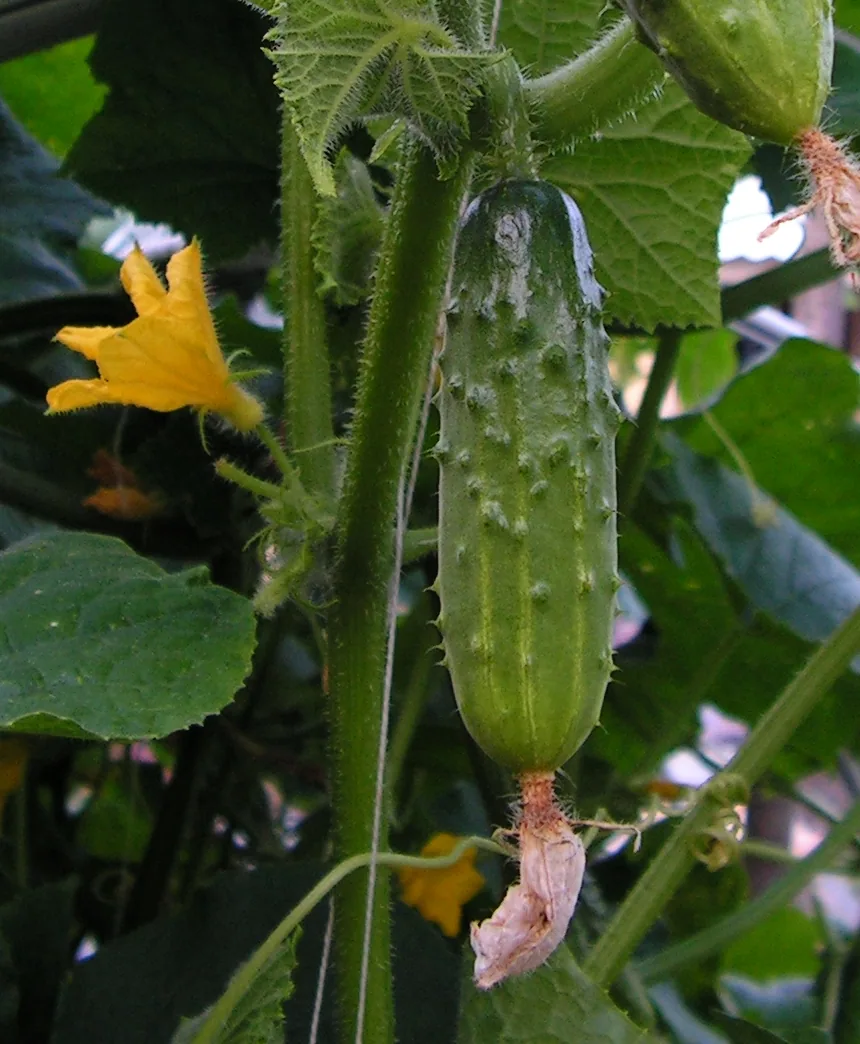


How to Grow and Care for Garden cucumber
Cucumis sativus
Written by Emilio Marruso · last checked
Not toxic to cats and dogs, according to the sources · Sources
At a glance
Cucumbers reward you quickly: most are ready in 50 to 70 days, and each fruit is ready to pick 5–7 days after flowering. Give them full sun, water at the base in the morning, and pick every 2 to 3 days to keep the vines producing. They grow happily in containers too and are safe for cats, dogs and horses.
- Sun
Full sun: 6 or more hours a day
What the sources say (2)
Light: Full sun (6 or more hours of direct sunlight a day)
Full sun (6 or more hours of direct sunlight a day)
— Cucumis sativus (Cucumber, Cucumbers, Garden Cucumber, Garden Cucumbers, Gherkin, Gherkins, Immature Cucumbers) | North Carolina Extension Gardener Plant Toolbox [1] Cucumbers perform best in fertile, well-drained soils in full sun.
— Growing Cucumbers in the Home Garden | Yard and Garden [6] - Water
Water at the base in the morning, keeping leaves dry; dry spells make the fruit bitter
What the sources say (6)
Watering notes: Keep leaves dry while watering to prevent fungal diseases; water at the base of the plant in the morning; mulch conserves water; vertically grown plants lose moisture more easily; water stress causes bitter, misshapen fruit
Keep the leaves dry while watering to prevent fungal diseases. Note that vertically grown cucumber plants lose moisture more easily.
— Cucumis sativus (Cucumber, Cucumbers, Garden Cucumber, Garden Cucumbers, Gherkin, Gherkins, Immature Cucumbers) | North Carolina Extension Gardener Plant Toolbox [1] To aid in preventing disease, water at the base of the plant in the morning and avoid wetting the foliage.
— Cucumber | Home & Garden Information Center [4] Avoid water stressing the plants as this causes the fruits to be bitter, have pointed ends, and be misshapen.
— How to Grow Cucumber in Your Garden | USU [7] Drought: With its shallow roots it suffers without irrigation during droughts; drought stress causes temporary bitterness and makes plants susceptible to spider mites.
Cucumbers have a shallow root system and can suffer when no irrigation is provided during droughts.
— Cucumber | Home & Garden Information Center [4] Bitterness in cucumbers is a temporary issue caused by plant stress, such as temperatures below 60°F or above 90°F, drought conditions, or poor nutrition.
— Grow your own cucumbers | OSU Extension Service [8] Drought-stressed plants are susceptible to spider mites. ## Weed control Cultivation should be shallow
— Grow your own cucumbers | OSU Extension Service [8] - Cold
Survives winters down to −50 °F (−45.6 °C)
Very hardy · USDA 2a · RHS H7 · Z2
What the sources say (2)
Hardiness, coldest zone: 2a [winter low −45.6 to −42.8 °C (−50 to −45 °F)]
2a, 2b, 3a, 3b, 4a, 4b, 5a, 5b, 6a, 6b, 7a, 7b, 8a, 8b, 9a, 9b, 10a, 10b, 11a, 11b
— Cucumis sativus (Cucumber, Cucumbers, Garden Cucumber, Garden Cucumbers, Gherkin, Gherkins, Immature Cucumbers) | North Carolina Extension Gardener Plant Toolbox [1] Hardiness, warmest zone: 11b [winter low 7.2 to 10 °C (45 to 50 °F)]
2a, 2b, 3a, 3b, 4a, 4b, 5a, 5b, 6a, 6b, 7a, 7b, 8a, 8b, 9a, 9b, 10a, 10b, 11a, 11b
— Cucumis sativus (Cucumber, Cucumbers, Garden Cucumber, Garden Cucumbers, Gherkin, Gherkins, Immature Cucumbers) | North Carolina Extension Gardener Plant Toolbox [1] - Soil
Slightly acidic soil, pH 6.0–6.8
What the sources say (3)
Soil pH, minimum: 6.0
The soil pH should be between 6.0 and 6.5.
— Cucumber | Home & Garden Information Center [4] Soil pH: The ideal pH for cucumber growth is between 6.0 and 6.8.
— Grow your own cucumbers | OSU Extension Service [8] Soil pH, maximum: 6.8
Soil pH: The ideal pH for cucumber growth is between 6.0 and 6.8.
— Grow your own cucumbers | OSU Extension Service [8] - Feeding
Feed before planting, then add nitrogen as vines grow; too much gives vines and few fruits
What the sources say (4)
When: Before planting, then a nitrogen side-dressing during vine growth
Incorporate organic matter and a complete fertilizer into the area before planting.
— How to Grow Cucumber in Your Garden | USU [7] Before the vines start to develop , sidedress with 34-0-0 at 1 pound per 100 feet of row or calcium nitrate (15.5-0-0) at 2 pounds per 100 feet of row.
— Cucumber | Home & Garden Information Center [4] After the vines develop runners, side dress each plant with 3-4 tablespoons of a nitrogen fertilizer (21-0-0), sprinkled around the plant, then water in the fertilizer. Sidedress before the plant starts to flower.
— How to Grow Cucumber in Your Garden | USU [7] Avoid: Over-fertilizing with nitrogen, which encourages excess vine growth and reduces fruit production
Do not overfertilize with nitrogen as this encourages excess vine growth and reduces fruit production.
— Cucumber | Home & Garden Information Center [4] - Harvest
Ready in 50–70 days; cut with a knife every 2–3 days, before the fruit turns yellow
What the sources say (9)
Harvest: Ready in 50 to 70 days depending on the cultivar; fruits ready 5-7 days after flowering; pick every 2 to 3 days
According to Clemson HGIC: Depending on the cultivar, cucumbers should be ready for harvest in about 50 to 70 days.
— Cucumber | Home & Garden Information Center [4] According to Oregon State University Extension: Cucumber varieties vary in their days to maturity, with early-maturing varieties requiring as little as 50 days at relatively high temperatures (75 to 85°F) to reach harvest, while late-maturing varieties may take up to 70 days.
— Grow your own cucumbers | OSU Extension Service [8] According to Utah State University Extension: Cucumbers are ready to harvest 5-7 days after flowering.
— How to Grow Cucumber in Your Garden | USU [7] Depending on the cultivar, cucumbers should be ready for harvest in about 50 to 70 days.
— Cucumber | Home & Garden Information Center [4] Cucumbers are ready to harvest 5-7 days after flowering.
— How to Grow Cucumber in Your Garden | USU [7] Harvest cucumbers frequently (every 2 to 3 days) as the fruit develops quickly and can easily grow beyond the desired size.
— Growing Cucumbers in the Home Garden | Yard and Garden [6] How to harvest: Cut the stem with a sharp knife or pruners (prevents vine damage); pick frequently, every 2 to 3 days, before the fruit turns yellow, the seeds harden or the flesh becomes bitter. Frequent picking keeps the vines producing.
Harvest the fruits by cutting stems with a sharp knife or pruners. This prevents vine damage and results in a clean break.
— Cucumber | Home & Garden Information Center [4] Harvest cucumbers frequently (every 2 to 3 days) as the fruit develops quickly and can easily grow beyond the desired size.
— Growing Cucumbers in the Home Garden | Yard and Garden [6] Harvest cucumbers any time after they reach the desired size but before they turn yellow, and the seeds harden.
— Grow your own cucumbers | OSU Extension Service [8] - Pests
Cucumber beetles, aphids and mites; powdery mildew and bacterial wilt
What the sources say (4)
Pests: cucumber beetles, pickleworms, aphids, mites, whiteflies, squash vine borers, cabbage loopers, thrips, slugs, spider mites, garden symphylans, wireworms
The major pests that feed on cucumber are cucumber beetles, pickleworms, aphids, mites, whiteflies , and squash vine borers.
— Cucumber | Home & Garden Information Center [4] Pests include aphids, cucumber beetles, cabbage loopers, thrips, slugs, spider mites, garden symphylans and wireworms.
— Grow your own cucumbers | OSU Extension Service [8] Diseases: powdery mildew, downy mildew, anthracnose, gummy stem blight, bacterial wilt, mosaic viruses, target spot, belly rot, damping-off, curly top
Diseases that occur in the home garden include powdery and downy mildews, anthracnose, gummy stem blight, bacterial wilt, mosaic viruses, target spot , and belly rot.
— Cucumber | Home & Garden Information Center [4] Cucumber diseases include damping-off (caused by Pythium ultimum ), curly top, powdery mildew and cucumber mosaic virus.
— Grow your own cucumbers | OSU Extension Service [8] - Watch out
Shallow roots: don't damage the main root when transplanting
What the sources say (2)
Root system: Shallow root system; the taproot should not be damaged when transplanting.
Cucumbers have a shallow root system and can suffer when no irrigation is provided during droughts.
— Cucumber | Home & Garden Information Center [4] Be careful to avoid damaging the plant's taproot when transplanting.
— Cucumis sativus (Cucumber, Cucumbers, Garden Cucumber, Garden Cucumbers, Gherkin, Gherkins, Immature Cucumbers) | North Carolina Extension Gardener Plant Toolbox [1] - Size
8–18 in tall, spreading 3–8 ft wide
What the sources say (2)
Mature height: 20-46 cm (8 to 18 inches)
Cucumber plants can grow 8 to 18 inches high and 3 to 8 feet wide. If given proper soil and water, cucumber plants can be an incredibly prolific addition to your vegetable garden.
— Cucumis sativus (Cucumber, Cucumbers, Garden Cucumber, Garden Cucumbers, Gherkin, Gherkins, Immature Cucumbers) | North Carolina Extension Gardener Plant Toolbox [1] Mature width: 91-244 cm (3 to 8 feet)
Cucumber plants can grow 8 to 18 inches high and 3 to 8 feet wide. If given proper soil and water, cucumber plants can be an incredibly prolific addition to your vegetable garden.
— Cucumis sativus (Cucumber, Cucumbers, Garden Cucumber, Garden Cucumbers, Gherkin, Gherkins, Immature Cucumbers) | North Carolina Extension Gardener Plant Toolbox [1] - Propagation
From seed or young transplants
What the sources say (2)
Propagation: Seed; transplants
Note that vertically grown cucumber plants lose moisture more easily. Propagate cucumber by seed.
— Cucumis sativus (Cucumber, Cucumbers, Garden Cucumber, Garden Cucumbers, Gherkin, Gherkins, Immature Cucumbers) | North Carolina Extension Gardener Plant Toolbox [1] Cucumber can be grown from seed or transplants.
— How to Grow Cucumber in Your Garden | USU [7] - Sowing
Sow 1 inch deep; sprouts in 5–10 days at 65–85 °F (18–29 °C), not below 50 °F (10 °C)
What the sources say (6)
Sowing depth: 2.5 cm (1 inch)
Plant 4 to 5 seeds per hill at a depth of 1 inch. Later, remove all but 2 or 3 plants per hill when seedlings have 1 or 2 true leaves.
— Growing Cucumbers in the Home Garden | Yard and Garden [6] Cucumber can be grown from seed or transplants. Seed should be planted 1 inch deep.
— How to Grow Cucumber in Your Garden | USU [7] Plant 4–6 seeds per hill at a depth of 1 inch.
— Grow your own cucumbers | OSU Extension Service [8] Days to germination: 5-10 days (at 65-85°F [18–29 °C])
Seeds germinate in 5-10 days at temperatures between 65- 85°F. Transplants mature about 2 weeks before seeded cucumbers.
— How to Grow Cucumber in Your Garden | USU [7] Germination: Germinates in 5-10 days at 18.3-29.4 °C [65–85 °F]; no germination at soil temperatures below 10 °C [50 °F].
Seeds germinate in 5-10 days at temperatures between 65- 85°F.
— How to Grow Cucumber in Your Garden | USU [7] Seeds will not germinate at soil temperatures below 50 °F.
— Cucumber | Home & Garden Information Center [4] - Containers
Grows in containers too
What the sources say (1)
In containers: Yes
It can also be grown in a container of a minimum size of 1 gallon and 8 inches depth.
— Cucumis sativus (Cucumber, Cucumbers, Garden Cucumber, Garden Cucumbers, Gherkin, Gherkins, Immature Cucumbers) | North Carolina Extension Gardener Plant Toolbox [1] - Safety
Not toxic to cats, dogs or horses
Overview
Cucumber is an annual climbing or spreading vine grown as a vegetable for its crisp, green fruit. [1] It grows best in full sun and moist, rich, well-drained soil with consistent moisture. [1] It is a warm-season crop sown or transplanted after the danger of frost has passed. [4][6]
Garden cucumber care
Measurements in square brackets are our conversion into the other unit system; the quoted text is unchanged.
How to water Garden cucumber
Watering
The sources give different values depending on region, zone or growing conditions.
What each source says
According to Utah State University Extension: Deeply and infrequently, 1-2 inches [2.5–5.1 cm] per week
According to Iowa State University Extension: Once a week during dry weather
According to Oregon State University Extension: Frequent watering
What the sources say (6)
According to Utah State University Extension: Water deeply and infrequently, applying 1-2 inches per week depending on plant size.According to Iowa State University Extension: Water plants once a week during dry weather.According to Oregon State University Extension: Cucumbers typically have a rooting depth of 36–48 inches and require frequent watering.Water deeply and infrequently, applying 1-2 inches per week depending on plant size.It is important to provide a uniform moisture supply to the crop as this is critical during fruit set and development.Water plants once a week during dry weather.Watering notes
Keep leaves dry while watering to prevent fungal diseases; water at the base of the plant in the morning; mulch conserves water; vertically grown plants lose moisture more easily; water stress causes bitter, misshapen fruit
What the sources say (3)
Keep the leaves dry while watering to prevent fungal diseases. Note that vertically grown cucumber plants lose moisture more easily.To aid in preventing disease, water at the base of the plant in the morning and avoid wetting the foliage.Avoid water stressing the plants as this causes the fruits to be bitter, have pointed ends, and be misshapen.How much light Garden cucumber needs
Full sun (6 or more hours of direct sunlight a day)
What the sources say (2)
Full sun (6 or more hours of direct sunlight a day)Cucumbers perform best in fertile, well-drained soils in full sun.How much cold Garden cucumber can take
Hardiness, coldest zone
2a [winter low −45.6 to −42.8 °C (−50 to −45 °F)]
What the sources say (1)
2a, 2b, 3a, 3b, 4a, 4b, 5a, 5b, 6a, 6b, 7a, 7b, 8a, 8b, 9a, 9b, 10a, 10b, 11a, 11bHardiness, warmest zone
11b [winter low 7.2 to 10 °C (45 to 50 °F)]
What the sources say (1)
2a, 2b, 3a, 3b, 4a, 4b, 5a, 5b, 6a, 6b, 7a, 7b, 8a, 8b, 9a, 9b, 10a, 10b, 11a, 11bBest soil for Garden cucumber
Soil pH, minimum
6.0
Soil pH, maximum
6.8
What the sources say (1)
Soil pH: The ideal pH for cucumber growth is between 6.0 and 6.8.Where to grow Garden cucumber
In containers
Yes
What the sources say (1)
It can also be grown in a container of a minimum size of 1 gallon and 8 inches depth.Spacing
The sources give different values depending on region, zone or growing conditions.
What each source says
non-trellised (fonte: Clemson HGIC): 20.3-25.4 cm (8-10 in) apart in rows 152.4 cm (5 ft) apart
trellised (fonte: Clemson HGIC): Thinned to 22.9-30.5 cm (9-12 in) apart in rows 91.4 cm (3 ft) apart
hills (fonte: Iowa State University Extension): 91.4-152.4 cm (3-5 ft) apart within the row, rows 121.9-152.4 cm (4-5 ft) apart
rows (fonte: Iowa State University Extension): Sown 15.2 cm (6 in) apart, thinned to 38.1-45.7 cm (15-18 in) apart
seeds (fonte: Utah State University Extension): 30.5-45.7 cm (12-18 in) apart in rows 121.9 cm (4 ft) apart
transplants (fonte: Utah State University Extension): 61.0 cm (2 ft) apart in row, rows 121.9 cm (4 ft) apart
transplants (fonte: Oregon State University Extension): 30.5-61.0 cm (12-24 in) apart within rows 121.9-182.9 cm (48-72 in) apart
hills (fonte: Oregon State University Extension): 121.9-152.4 cm (4-5 ft) apart with 121.9 cm (4 ft) between rows
What the sources say (12)
non-trellised (fonte: Clemson HGIC): For non-trellised cucumbers, space plants 8 to 10 inches apart in rows that are 5 feet aparttrellised (fonte: Clemson HGIC): When plants are 4 to 5 inches high, thin so they are 9 to 12 inches apart.hills (fonte: Iowa State University Extension): Hills of cucumbers should be spaced 3 to 5 feet apart within the row. Rows should be 4 to 5 feet apart.rows (fonte: Iowa State University Extension): Sow seeds 6 inches apart. After germination, thin the seedlings so the remaining plants are spaced 15 to 18 inches apart.seeds (fonte: Utah State University Extension): Plant 4-6 seeds every 12-18 inches in rows 4 feet apart.transplants (fonte: Utah State University Extension): Transplants should be planted 2 feet apart in row, with rows 4 feet apart.transplants (fonte: Oregon State University Extension): Spacing: Space transplants 12–24 inches apart within rows that are spaced 48–72 inches apart.hills (fonte: Oregon State University Extension): Spacing: Space hills 4–5 feet apart with 4 feet between rows.For non-trellised cucumbers, space plants 8 to 10 inches apart in rows that are 5 feet apart .If cucumbers are trellised, plant four to five seeds per foot in rows spaced 3 feet apart. When plants are 4 to 5 inches high, thin so they are 9 to 12 inches apart.Hills of cucumbers should be spaced 3 to 5 feet apart within the row.Transplants should be planted 2 feet apart in row, with rows 4 feet apart.How to propagate Garden cucumber
Seed; transplants
What the sources say (2)
Note that vertically grown cucumber plants lose moisture more easily. Propagate cucumber by seed.Cucumber can be grown from seed or transplants.How to grow Garden cucumber
The plant
Life cycle
annual
What the sources say (2)
Cucumber is an annual climbing or spreading vine and common vegetable grown for its crisp, green fruit.Like other cultivated plants in the family Cucurbitaceae, cucumbers ( Cucumis sativus ) are annual vines that flower throughout the summer.Family
Cucurbitaceae
What the sources say (2)
It is a member of the Cucurbitaceae (gourd) family, and its native growing region is Himalaya to northern Thailand.They belong to the Cucurbitaceae family, along with squash, pumpkins, muskmelons and gourds.Mature height
20-46 cm (8 to 18 inches)
What the sources say (1)
Cucumber plants can grow 8 to 18 inches high and 3 to 8 feet wide. If given proper soil and water, cucumber plants can be an incredibly prolific addition to your vegetable garden.Mature width
91-244 cm (3 to 8 feet)
What the sources say (1)
Cucumber plants can grow 8 to 18 inches high and 3 to 8 feet wide. If given proper soil and water, cucumber plants can be an incredibly prolific addition to your vegetable garden.Sowing and growth
Days to germination
5-10 days (at 65-85°F [18–29 °C])
What the sources say (1)
Seeds germinate in 5-10 days at temperatures between 65- 85°F. Transplants mature about 2 weeks before seeded cucumbers.Sowing depth
2.5 cm (1 inch)
What the sources say (3)
Plant 4 to 5 seeds per hill at a depth of 1 inch. Later, remove all but 2 or 3 plants per hill when seedlings have 1 or 2 true leaves.Cucumber can be grown from seed or transplants. Seed should be planted 1 inch deep.Plant 4–6 seeds per hill at a depth of 1 inch.Row spacing
Days to maturity
50-70 days, depending on the cultivar
What the sources say (2)
Depending on the cultivar, cucumbers should be ready for harvest in about 50 to 70 days.Cucumber varieties vary in their days to maturity, with early-maturing varieties requiring as little as 50 days at relatively high temperatures (75 to 85°F) to reach harvest, while late-maturing varieties may take up to 70 days.Harvest and storage
How to harvest
Cut the stem with a sharp knife or pruners (prevents vine damage); pick frequently, every 2 to 3 days, before the fruit turns yellow, the seeds harden or the flesh becomes bitter. Frequent picking keeps the vines producing.
What the sources say (3)
Harvest the fruits by cutting stems with a sharp knife or pruners. This prevents vine damage and results in a clean break.Harvest cucumbers frequently (every 2 to 3 days) as the fruit develops quickly and can easily grow beyond the desired size.Harvest cucumbers any time after they reach the desired size but before they turn yellow, and the seeds harden.Storage
The sources disagree:
Store cucumbers in the refrigerator for about a week. The optimal conditions for storage are temperatures of 45 to 50 °F and 95% relative humidity.
[4]Cucumbers can be stored for 10 to 14 days at 50 to 55°F and 90 to 95% relative humidity.
[6]Cucumbers can be stored for 10-14 days at 55°F. If held in the refrigerator, fruits will breakdown rapidly and will yellow if stored near apples.
[7]
Pests and diseases
Pests
cucumber beetles, pickleworms, aphids, mites, whiteflies, squash vine borers, cabbage loopers, thrips, slugs, spider mites, garden symphylans, wireworms
What the sources say (2)
The major pests that feed on cucumber are cucumber beetles, pickleworms, aphids, mites, whiteflies , and squash vine borers.Pests include aphids, cucumber beetles, cabbage loopers, thrips, slugs, spider mites, garden symphylans and wireworms.Diseases
powdery mildew, downy mildew, anthracnose, gummy stem blight, bacterial wilt, mosaic viruses, target spot, belly rot, damping-off, curly top
What the sources say (2)
Diseases that occur in the home garden include powdery and downy mildews, anthracnose, gummy stem blight, bacterial wilt, mosaic viruses, target spot , and belly rot.Cucumber diseases include damping-off (caused by Pythium ultimum ), curly top, powdery mildew and cucumber mosaic virus.Fertilizing
When
Before planting, then a nitrogen side-dressing during vine growth
What the sources say (3)
Incorporate organic matter and a complete fertilizer into the area before planting.Before the vines start to develop , sidedress with 34-0-0 at 1 pound per 100 feet of row or calcium nitrate (15.5-0-0) at 2 pounds per 100 feet of row.After the vines develop runners, side dress each plant with 3-4 tablespoons of a nitrogen fertilizer (21-0-0), sprinkled around the plant, then water in the fertilizer. Sidedress before the plant starts to flower.How often
One pre-plant application and one side-dressing; more frequent side-dressing on sandy soil or after leaching rains
What the sources say (3)
More frequent sidedressing may be required if the garden is sandy or if leaching rains occur.Incorporate organic matter and a complete fertilizer into the area before planting.Side-dress: One week after flowering begins, side-dress with 1.5 oz of ammonium sulfate per 10 feet of row.Natural fertilizers
Well-composted organic matter, no more than a 2.54 cm [1 in] layer over the garden area
What the sources say (2)
If you fertilize with compost, apply no more than 1 inch of well-composted organic matter per 100 square feet of garden area.Cucumbers adapt to most soils but grow best in fertile soil with plenty of compost.Mineral fertilizers
Complete fertilizer (such as 10-10-10 or 5-10-10) worked into the soil before planting, then a nitrogen fertilizer as side-dressing
What each source says
side-dressing: Applied along one side of the row, 10.2-15.2 cm [4–6 in] from the plants depending on their size.
What the sources say (4)
side-dressing: Apply fertilizer along one side of the row and about 4 to 6 inches from the plants depending on their size.If a soil test has not yet been conducted, apply and incorporate 1 to 2 pounds of all-purpose garden fertilizer, such as 10-10-10, per 100 square feet prior to planting.If a recent soil test has not been taken, make a preplant application of 5-10-10 at the rate of 3 pounds per 100 square feet.After the vines develop runners, side dress each plant with 3-4 tablespoons of a nitrogen fertilizer (21-0-0), sprinkled around the plant, then water in the fertilizer. Sidedress before the plant starts to flower.Avoid
Over-fertilizing with nitrogen, which encourages excess vine growth and reduces fruit production
What the sources say (1)
Do not overfertilize with nitrogen as this encourages excess vine growth and reduces fruit production.Signs of deficiency
Stunted plants with pale leaves; misshapen fruit from low fertility or poor pollination
What the sources say (2)
Signs of nutrient deficiency and toxicity: Watch for stunted plants with pale leaves, indicating low fertility, or vigorous plants that fail to bloom or set fruit, indicating excessive fertility.Misshapen fruit is often due to low fertility or poor pollination.Signs of excess
Vigorous plants and excess vine growth that fail to bloom or set fruit, with reduced fruit production
What the sources say (2)
Signs of nutrient deficiency and toxicity: Watch for stunted plants with pale leaves, indicating low fertility, or vigorous plants that fail to bloom or set fruit, indicating excessive fertility.Do not overfertilize with nitrogen as this encourages excess vine growth and reduces fruit production.Spacing
Between plants
The sources give different values depending on region, zone or growing conditions.
What each source says
non-trellised (South Carolina, USA): 20.3-25.4 cm [8–10 in] in the row
hills (Iowa, USA): hills 91.4-152 cm [36–60 in] apart in the row
direct-sown, after thinning (Iowa, USA): 38.1-45.7 cm [15–18 in]
direct-sown (Utah, USA): 30.5-45.7 cm [12–18 in]
transplants (Utah, USA): 61 cm [24 in] in the row
What the sources say (5)
non-trellised (South Carolina, USA): If non-trellised, space cucumber plants 8 to 10 inches apart in rows that are 5 feet apart.hills (Iowa, USA): Hills of cucumbers should be spaced 3 to 5 feet apart within the row. Rows should be 4 to 5 feet apart.direct-sown, after thinning (Iowa, USA): After germination, thin the seedlings so the remaining plants are spaced 15 to 18 inches apart.direct-sown (Utah, USA): Seeds should be planted 1 inch deep, 12-18 inches apart, in rows 4 feet apart.transplants (Utah, USA): Transplants should be planted 2 feet apart in row, with rows 4 feet apart.Between rows
The sources give different values depending on region, zone or growing conditions.
What each source says
non-trellised (South Carolina, USA): 152 cm [60 in] between rows
trellised (South Carolina, USA): 91.4 cm [36 in] between rows
hills (Iowa, USA): 122-152 cm [48–60 in] between rows
Utah (USA): 122 cm [48 in] between rows
What the sources say (4)
non-trellised (South Carolina, USA): If non-trellised, space cucumber plants 8 to 10 inches apart in rows that are 5 feet apart.trellised (South Carolina, USA): If cucumbers are trellised, plant four to five seeds per foot in rows spaced 3 feet apart.hills (Iowa, USA): Hills of cucumbers should be spaced 3 to 5 feet apart within the row. Rows should be 4 to 5 feet apart.Utah (USA): Transplants should be planted 2 feet apart in row, with rows 4 feet apart.Roots
Root system
Shallow root system; the taproot should not be damaged when transplanting.
What the sources say (2)
Cucumbers have a shallow root system and can suffer when no irrigation is provided during droughts.Be careful to avoid damaging the plant's taproot when transplanting.Propagation
Germination
Germinates in 5-10 days at 18.3-29.4 °C [65–85 °F]; no germination at soil temperatures below 10 °C [50 °F].
After harvest
Storage
10-14 days at 10-12.8 °C [50–55 °F] and 90-95% relative humidity.
Heat and drought
Heat
Hot temperatures reduce fruit set and fruit quality; temperatures above 32.2 °C [90 °F] or below 15.6 °C [60 °F] cause temporary bitterness.
What the sources say (2)
Hot temperatures will reduce fruit set and affect fruit quality.Bitterness in cucumbers is a temporary issue caused by plant stress, such as temperatures below 60°F or above 90°F, drought conditions, or poor nutrition.Drought
With its shallow roots it suffers without irrigation during droughts; drought stress causes temporary bitterness and makes plants susceptible to spider mites.
What the sources say (3)
Cucumbers have a shallow root system and can suffer when no irrigation is provided during droughts.Bitterness in cucumbers is a temporary issue caused by plant stress, such as temperatures below 60°F or above 90°F, drought conditions, or poor nutrition.Drought-stressed plants are susceptible to spider mites. ## Weed control Cultivation should be shallowGarden cucumber pests and problems
Cucumber beetles
Symptom: Adults feed on leaves and vines; larvae bore into roots and stems causing wilt; transmit bacterial wilt
What to do: Floating row covers on young plants (removed at flowering) or insecticides
What the sources say (1)
Prevent cucumber beetles from damaging young plants by covering them with floating row covers or other protective materials or by using insecticides.
— Growing Cucumbers in the Home Garden | Yard and Garden [6] Aphids
Symptom: Green or black soft-bodied insects on the underside of leaves; leaves crinkled and curled; may transmit virus diseases
What to do: Insecticidal soaps or a strong water stream
What the sources say (1)
Use insecticidal soaps or strong water stream to dislodge insect.
— How to Grow Cucumber in Your Garden | USU [7] Powdery mildew
Symptom: White fungal patches on older leaves that spread to all plant parts; foliage dies
What to do: Plant resistant varieties
What the sources say (1)
White fungal patches start on older leaves. The disease eventually spreads to all plant parts.
— How to Grow Cucumber in Your Garden | USU [7] Cucurbit bacterial wilt
Symptom: Leaves turn dull green and lateral leaves progressively wilt, eventually killing the whole plant
What to do: Control cucumber beetles, which transmit the disease
What the sources say (1)
Typically, the leaves turn a dull green and the lateral leaves progressively wilt.
— Growing Cucumbers in the Home Garden | Yard and Garden [6] Bitter fruit
Symptom: Bitterness caused by cucurbitacins when plants are under stress
What to do: Water during hot dry weather; cut off the stem end and peel the fruit
What the sources say (1)
Bitter cucumbers can sometimes be salvaged by cutting off the stem end and peeling the remainder of the fruit.
— Growing Cucumbers in the Home Garden | Yard and Garden [6] Misshapen fruit
Symptom: Poorly-shaped fruit usually from poor pollination
What to do: Protect bees; hand pollinate in the morning or plant parthenocarpic cultivars
What the sources say (1)
Hand pollination can improve cucumber fruit production in the absence of pollinators.
— Cucumber | Home & Garden Information Center [4]
Remedies
Each remedy shows what official sources say about it; traditional remedies without an official source are marked as such. Harmful ones are listed so you know to avoid them.
Treating the plant
aphids
insecticidal soap spray Works
Squash leaves are easily burned by insecticidal soaps, so use the most dilute concentration recommended and use sparingly. Do not spray plants in direct sun or if plants are drought-stressed.
— hgic.clemson.edu [9] spraying home remedies that contain dish detergent on plants on a sunny day can injure the plant, essentially burning it.
— extension.psu.edu [10] How: Spray leaves with soapy water, then rinse with clear water.
In addition to natural enemies, you can spray leaves with soapy water, then rinse with clear water.
— hgic.clemson.edu [9] What the evidence says For aphid or spider mite control, use insecticidal soap sprays first.
— hgic.clemson.edu [9] strong water stream Official source, not independently tested
How: Use a strong water stream to dislodge the insects.
Use insecticidal soaps or strong water stream to dislodge insect.
— How to Grow Cucumber in Your Garden | USU [7]
spider mites
strong spray of water Works
How: Mites can be removed with a strong spray of water.
Mites can be removed with a strong spray of water.
— hgic.clemson.edu [9] What the evidence says Mites can be removed with a strong spray of water.
— hgic.clemson.edu [9] neem oil extract Works
Natural pesticides for cucumber plants can still affect beneficial insects.
— groworganic.com [11] How: Spider mites can also be controlled with neem oil extract.
Spider mites can also be controlled with neem oil extract.
— hgic.clemson.edu [9] What the evidence says Spider mites can also be controlled with neem oil extract.
— hgic.clemson.edu [9] insecticidal soap spray Works
Squash leaves are easily burned by insecticidal soaps, so use the most dilute concentration recommended and use sparingly. Do not spray plants in direct sun or if plants are drought-stressed.
— hgic.clemson.edu [9] How: Apply insecticidal soap before the numbers are too high; make two applications five days apart.
Insecticidal soaps generally offer adequate control when applied before the numbers are too high. Make two applications five days apart.
— hgic.clemson.edu [9] What the evidence says Insecticidal soaps generally offer adequate control when applied before the numbers are too high. Make two applications five days apart.
— hgic.clemson.edu [9]
cucumber beetles
kaolin clay Partly works
How: Spray the plants with kaolin clay to repel the beetles from feeding on the crop; it does not kill them.
Kaolin clay is uniquely effective against cucumber beetle because it builds up in their antennae and creates a gummy coating, making it difficult for them to navigate.
— blog-fruit-vegetable-ipm.extension.umn.edu [12] What the evidence says Kaolin clay will not kill cucumber beetles, so it should not be used as a rescue treatment. Rather, it's meant to repel them from directly feeding on your crop.
— blog-fruit-vegetable-ipm.extension.umn.edu [12] straw mulch Partly works
How: Use straw mulch or plastic mulch (reflective plastic works particularly well); it won't stop the beetles totally but makes their lives a little harder.
Use straw mulch or plastic mulch. Reflective plastic works particularly well. This won't stop them totally, but makes their lives a little harder.
— blog-fruit-vegetable-ipm.extension.umn.edu [12] What the evidence says Straw makes it harder for them to move around and provided habitat for predators, reflective mulches can repel them.
— blog-fruit-vegetable-ipm.extension.umn.edu [12] neem oil spray Partly works
Natural pesticides for cucumber plants can still affect beneficial insects.
— groworganic.com [11] How: Spray neem oil on the plants at the first sign of damage.
Spray neem oil on the plants at the first sign of damage. This natural control prevents insects from feeding, which will eventually kill them.
— gardeningknowhow.com [13] What the evidence says However, neem oil is not effective against every insect and disease, and often must be frequently reapplied to reach the desired outcome.
— extension.unh.edu [14]
Is Garden cucumber poisonous?
Reported by the source, quoted verbatim. This is not medical or veterinary advice: if a person or an animal may have eaten this plant, contact a poison control centre or a veterinarian.
#ebh #non-toxic for cats #non-toxic for horses #non-toxic for dogs #vine #container plant
[1]The source flags the risk for this animal but does not explain why.
Calendar
Sowing
The sources give different values depending on region, zone or growing conditions.
What each source says
direct sowing (fonte: Iowa State University Extension): After frost danger is past and soil at 60-70 F (16-21 C); central Iowa mid-May
direct sowing (fonte: Utah State University Extension): When soils are 65 F (18 C) or after all frost danger has passed
direct sowing (fonte: Oregon State University Extension): After frost danger has passed, soil at least 65 F (18 C)
indoor start (fonte: NC State Extension): Three to six weeks before transplanting
indoor start (fonte: Iowa State University Extension): 2 to 3 weeks before the anticipated outdoor planting date
indoor start (fonte: Oregon State University Extension): About 2-3 weeks before transplanting
transplants (fonte: Utah State University Extension): Allow 4-6 weeks to grow transplants
What the sources say (11)
direct sowing (fonte: Iowa State University Extension): Plant cucumbers after the danger of frost is past and soil temperatures have warmed to 60 to 70°F.direct sowing (fonte: Utah State University Extension): Cucumber should be planted when soils are 65°F or after all frost danger has past.direct sowing (fonte: Oregon State University Extension): Ensure the soil temperature is at least 65°F for optimal germination.indoor start (fonte: NC State Extension): started indoors three to six weeks before transplantingindoor start (fonte: Iowa State University Extension): Start seeds indoors 2 to 3 weeks before the anticipated outdoor planting date.indoor start (fonte: Oregon State University Extension): Earlier crop: Start seeds indoors about 2-3 weeks before transplanting.transplants (fonte: Utah State University Extension): Allow 4-6 weeks to grow transplants.Seeds can be directly sown after the last frost or started indoors three to six weeks before transplanting, or less than four weeks before the last frost date.Plant cucumbers after the danger of frost is past and soil temperatures have warmed to 60 to 70°F.The last practical date to sow cucumbers is July 10.Start seeds indoors 2 to 3 weeks before the anticipated outdoor planting date.Planting
The sources give different values depending on region, zone or growing conditions.
What each source says
According to Clemson HGIC: After frost danger has passed, soil at 70 F (21 C)
According to Utah State University Extension: Soil at 65 F (18 C) or after all frost danger has passed
What the sources say (4)
According to Clemson HGIC: Plant seed or transplants after the fear of frost has passed , and the soil temperature has reached 70 °F.According to Utah State University Extension: Cucumber should be planted when soils are 65°F or after all frost danger has past.Plant seed or transplants after the fear of frost has passed , and the soil temperature has reached 70 °F.Seeds may be started indoors two to three weeks prior to planting outdoors.Harvest
Ready in 50 to 70 days depending on the cultivar; fruits ready 5-7 days after flowering; pick every 2 to 3 days
What each source says
According to Clemson HGIC: About 50 to 70 days depending on the cultivar
According to Oregon State University Extension: As little as 50 days at 75-85 F for early varieties, up to 70 days for late varieties
According to Utah State University Extension: 5-7 days after flowering
What the sources say (6)
According to Clemson HGIC: Depending on the cultivar, cucumbers should be ready for harvest in about 50 to 70 days.According to Oregon State University Extension: Cucumber varieties vary in their days to maturity, with early-maturing varieties requiring as little as 50 days at relatively high temperatures (75 to 85°F) to reach harvest, while late-maturing varieties may take up to 70 days.According to Utah State University Extension: Cucumbers are ready to harvest 5-7 days after flowering.Depending on the cultivar, cucumbers should be ready for harvest in about 50 to 70 days.Cucumbers are ready to harvest 5-7 days after flowering.Harvest cucumbers frequently (every 2 to 3 days) as the fruit develops quickly and can easily grow beyond the desired size.Months as given by the sources, which are mostly from the United States (northern hemisphere). In the southern hemisphere they shift by about six months.
Relative to frost
Less precise estimate: there is no weather station within 300 km.
Find frost dates by ZIP code or city
Sow outdoors: around the last frost
Plant cucumbers after the danger of frost is past and soil temperatures have warmed to 60 to 70°F.
— Growing Cucumbers in the Home Garden | Yard and Garden [6] Transplant: around the last frost
Plant seed or transplants after the fear of frost has passed , and the soil temperature has reached 70 °F.
— Cucumber | Home & Garden Information Center [4] Plant: 2 to 3 weeks before the last frost
When using plastic mulch and row covers, seeds or plants can be set out 2-3weeks before the last frost date.
— How to Grow Cucumber in Your Garden | USU [7]
Count from the average frost dates where you live.
Edibility
Reported by the source, quoted verbatim. Do not eat a plant on the basis of this page alone: identification mistakes can be dangerous.
Indicative values
Values from a secondary source, not checked word for word like the rest of this page. Use them as a starting point.
- Hours of sun
- 6-10 hoursIndicative value, adapt it to your climate · Secondary source
- Soil
- Well-drainedIndicative value, adapt it to your climate · Secondary source
- Care level
- MediumIndicative value, adapt it to your climate · Secondary source
- Growth rate
- LowIndicative value, adapt it to your climate · Secondary source
- Pruning
- March, April, May, June, July, August, SeptemberIndicative value, adapt it to your climate · Secondary source
Similar plants
- Arabian Cucumber Cucumis dipsaceus
- Cantaloupe Cucumis melo
- Maroon Cucumber Cucumis anguria
- Bitter Melon Momordica charantia
- Bottle gourd Lagenaria siceraria
- Field pumpkin Cucurbita pepo
- Figleaf Gourd Cucurbita ficifolia
- Loofah Luffa aegyptiaca
Sources
Every value above is quoted from these documents. Links lead to the original publisher.
- Cucumis sativus (Cucumber, Cucumbers, Garden Cucumber, Garden Cucumbers, Gherkin, Gherkins, Immature Cucumbers) | North Carolina Extension Gardener Plant Toolbox · plants.ces.ncsu.edu, consulted
- Garden Cucumber - Cucumis sativus | North Carolina Extension Gardener Plant Toolbox · plants.ces.ncsu.edu, consulted
- Garden Cucumbers - Cucumis sativus | North Carolina Extension Gardener Plant Toolbox · plants.ces.ncsu.edu, consulted
- Cucumber | Home & Garden Information Center · hgic.clemson.edu, consulted
- Cucumber Pollination · extension.psu.edu, consulted
- Growing Cucumbers in the Home Garden | Yard and Garden · yardandgarden.extension.iastate.edu, consulted
- How to Grow Cucumber in Your Garden | USU · extension.usu.edu, consulted
- Grow your own cucumbers | OSU Extension Service · extension.oregonstate.edu, consulted
- hgic.clemson.edu · hgic.clemson.edu
- extension.psu.edu · extension.psu.edu
- groworganic.com · groworganic.com
- blog-fruit-vegetable-ipm.extension.umn.edu · blog-fruit-vegetable-ipm.extension.umn.edu
- gardeningknowhow.com · gardeningknowhow.com
- extension.unh.edu · extension.unh.edu
Written by Emilio Marruso · last checked