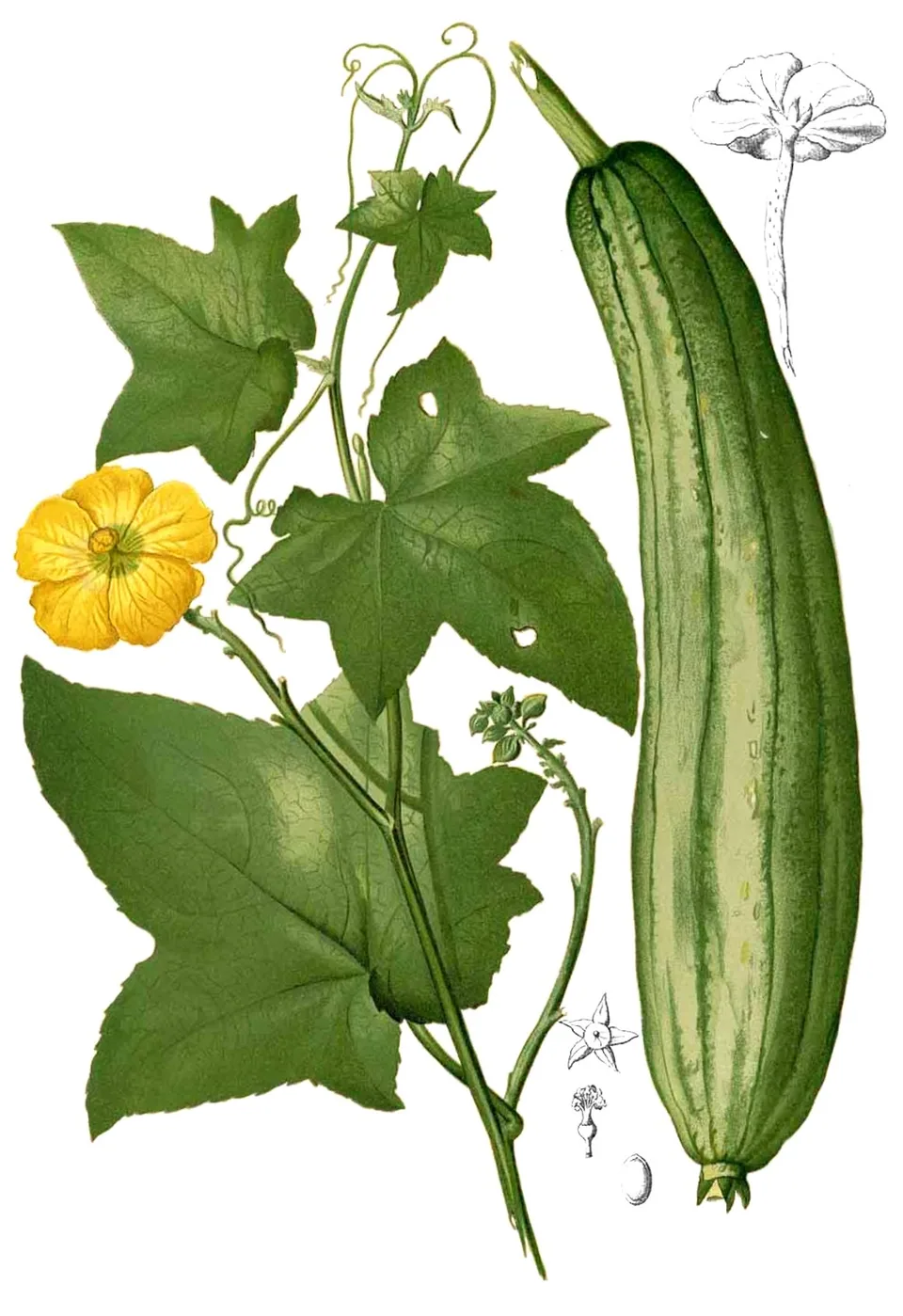


How to Grow and Care for Loofah
Luffa aegyptiaca
Written by Emilio Marruso · last checked
At a glance
Luffa is a vine that gives you two harvests in one: pick the young fruits under 7 inches to eat like squash, or let them ripen for up to 200 days into your very own sponges. Give it full sun and evenly moist, well-drained soil, and watch it reach 30 to 50 feet.
- Sun
Full sun: 6 or more hours a day
What the sources say (1)
Light: Full sun (6 or more hours of direct sunlight a day)
Light: Full sun (6 or more hours of direct sunlight a day)
— Luffa aegyptiaca (Loofah, Luffa Sponge, Smooth Luffa, Sponge Gourd) | North Carolina Extension Gardener Plant Toolbox [1] - Water
Keep the soil evenly moist but well drained
What the sources say (1)
Watering: Evenly moist, well-drained soil
To thrive in the garden, sponge gourds need at least 6 hours of full sun, well-drained, evenly moist, rich loam, good air circulation, and a sturdy trellis to climb.
— Luffa aegyptiaca (Loofah, Luffa Sponge, Smooth Luffa, Sponge Gourd) | North Carolina Extension Gardener Plant Toolbox [1] - Cold
Survives winters down to 10 °F (−12.2 °C)
Hardy in cold winters · USDA 8a · RHS H5 · Z8
What the sources say (2)
Hardiness, coldest zone: 8a [winter low −12.2 to −9.4 °C (10 to 15 °F)]
USDA Plant Hardiness Zone: 8a, 8b, 9a, 9b, 10a, 10b, 11a, 11b
— Luffa aegyptiaca (Loofah, Luffa Sponge, Smooth Luffa, Sponge Gourd) | North Carolina Extension Gardener Plant Toolbox [1] Hardiness, warmest zone: 11b [winter low 7.2 to 10 °C (45 to 50 °F)]
USDA Plant Hardiness Zone: 8a, 8b, 9a, 9b, 10a, 10b, 11a, 11b
— Luffa aegyptiaca (Loofah, Luffa Sponge, Smooth Luffa, Sponge Gourd) | North Carolina Extension Gardener Plant Toolbox [1] - Soil
Soil with a pH no higher than 6.0
What the sources say (1)
Soil pH, maximum: 6.0
High Organic Matter Loam (Silt) Soil pH: Acid (<6.0)
— Luffa aegyptiaca (Loofah, Luffa Sponge, Smooth Luffa, Sponge Gourd) | North Carolina Extension Gardener Plant Toolbox [1] - Feeding
Feed before planting and during the season; too much nitrogen means more vine and fewer fruits
What the sources say (4)
When: Before planting (worked into the soil) and as side-dressings during the growing season; dry granular fertilizer goes in at planting
It is recommended to split applications of N, P, and K, incorporating them into the soil pre-plant and as a side dressing during the growing season.
— [6] If using dry granular fertilizer, it should be applied at planting to ensure nutrient availability during early root development.
— [6] Avoid: Excess nitrogen (too much vine growth, fewer and poorer fruits) and excess phosphorus (locks up zinc and other micronutrients)
Nitrogen within this range promotes healthy foliage and vigorous growth; however, levels exceeding 6.0% can lead to excessive vegetative growth, nutrient imbalances, and reduced fruit yields and quality
— [6] Excess P, though rare, can cause imbalances with other nutrients, particularly micronutrients like zinc, iron, and copper, which may become less available or even deficient
— [6] - Harvest
Eat fruits young at 6–8 in; for sponges, pick when tan, light and dry and the seeds rattle
What the sources say (3)
How to harvest: For sponges: harvest when the skin feels loose and brittle around the hardened fibers, or when the gourds are tan, light and dry and the seeds rattle; harvest immediately after the first frost. For eating: pick young fruits at 15-20 cm (6-8 in), under 18 cm (7 in) and green.
Luffa sponges are ready to harvest when the skin feels loose and brittle around the hardened fibers inside.
— Growing Luffa | Home & Garden Information Center [4] harvest immediately after the first frost in the fall when the gourds are tan, light and dry, and the seeds shake inside when rattled
— Luffa aegyptiaca (Loofah, Luffa Sponge, Smooth Luffa, Sponge Gourd) | North Carolina Extension Gardener Plant Toolbox [1] They are pretty like a zucchini if picked at around 6-8 inches in length.
— Growing Loofa Gourds | The Garden Scoop | Illinois Extension | Illinois [3] - Pests
Cucumber beetles, squash bugs, aphids and spider mites; powdery and downy mildew
What the sources say (2)
Pests: cucumber beetles, squash bugs, thrips, aphids, spider mites
Cucumber beetles, squash bugs, thrips, aphids, and spider mites can be problematic.
— Luffa aegyptiaca (Loofah, Luffa Sponge, Smooth Luffa, Sponge Gourd) | North Carolina Extension Gardener Plant Toolbox [1] Diseases: powdery mildew, downy mildew, leaf spot diseases
Powdery mildew, downy mildew, and various leaf spot diseases are possible.
— Luffa aegyptiaca (Loofah, Luffa Sponge, Smooth Luffa, Sponge Gourd) | North Carolina Extension Gardener Plant Toolbox [1] - Size
30–50 ft tall and 1–3 ft wide
What the sources say (2)
Mature height: 914-1524 cm (30-50 ft)
Dimensions: Height: 30 ft. 0 in. - 50 ft. 0 in. Width: 1 ft. 0 in. - 3 ft. 0 in.
— Luffa aegyptiaca (Loofah, Luffa Sponge, Smooth Luffa, Sponge Gourd) | North Carolina Extension Gardener Plant Toolbox [1] Mature width: 30-91 cm (1-3 ft)
Dimensions: Height: 30 ft. 0 in. - 50 ft. 0 in. Width: 1 ft. 0 in. - 3 ft. 0 in.
— Luffa aegyptiaca (Loofah, Luffa Sponge, Smooth Luffa, Sponge Gourd) | North Carolina Extension Gardener Plant Toolbox [1] - Propagation
By seed: shake the seeds from a dried gourd and save some for next year
What the sources say (2)
Propagation: Seed
Start luffas from seeds in warm soil in late spring.
— Growing Luffa | Home & Garden Information Center [4] Saving seeds: Shake the seeds loose from the dried gourd and save some for next year.
To process the sponges, peel the skin off, shake the seeds loose (save some for next year)
— Growing Luffa | Home & Garden Information Center [4] - Sowing
Sow outdoors after frost; in cooler climates start indoors 6–8 weeks before the last frost
What the sources say (5)
Sowing: Sow seeds directly in the garden after the threat of frost; in cooler zones start seeds indoors 6 to 8 weeks before the last frost date
zones with a frost-free growing season of at least four months: In zones that meet those requirements, sow seeds directly in the garden after the threat of frost.
— Luffa aegyptiaca (Loofah, Luffa Sponge, Smooth Luffa, Sponge Gourd) | North Carolina Extension Gardener Plant Toolbox [1] cooler zones: In cooler zones, start seeds indoors 6 to 8 weeks before the last frost date after soaking the seeds in water for 24 hours.
— Luffa aegyptiaca (Loofah, Luffa Sponge, Smooth Luffa, Sponge Gourd) | North Carolina Extension Gardener Plant Toolbox [1] According to Clemson Extension: Start luffas from seeds in warm soil in late spring.
— Growing Luffa | Home & Garden Information Center [4] According to Illinois Extension: we did get an early start, growing seedlings under grow lights before the frost-free date. My wife started the seeds along with a few other veggies back in March.
— Growing Loofa Gourds | The Garden Scoop | Illinois Extension | Illinois [3] In zones that meet those requirements, sow seeds directly in the garden after the threat of frost. In cooler zones, start seeds indoors 6 to 8 weeks before the last frost date
— Luffa aegyptiaca (Loofah, Luffa Sponge, Smooth Luffa, Sponge Gourd) | North Carolina Extension Gardener Plant Toolbox [1]
Overview
Luffa aegyptiaca is an annual climbing vine in the cucumber family grown as a vegetable and for loofah sponges. [1] It needs full sun, well-drained evenly moist rich soil and a sturdy trellis. [1] Young fruits are eaten like squash, while fully mature fibrous fruits are dried for sponges. [1]
This record is incomplete: the sources we read do not cover every field yet.
Not yet covered by our sources: Spacing
Loofah care
Measurements in square brackets are our conversion into the other unit system; the quoted text is unchanged.
How to water Loofah
Evenly moist, well-drained soil
What the sources say (1)
To thrive in the garden, sponge gourds need at least 6 hours of full sun, well-drained, evenly moist, rich loam, good air circulation, and a sturdy trellis to climb.How much light Loofah needs
Full sun (6 or more hours of direct sunlight a day)
What the sources say (1)
Light:
Full sun (6 or more hours of direct sunlight a day)How much cold Loofah can take
Hardiness, coldest zone
8a [winter low −12.2 to −9.4 °C (10 to 15 °F)]
What the sources say (1)
USDA Plant Hardiness Zone:
8a, 8b, 9a, 9b, 10a, 10b, 11a, 11bHardiness, warmest zone
11b [winter low 7.2 to 10 °C (45 to 50 °F)]
What the sources say (1)
USDA Plant Hardiness Zone:
8a, 8b, 9a, 9b, 10a, 10b, 11a, 11bBest soil for Loofah
6.0
What the sources say (1)
High Organic Matter
Loam (Silt)
Soil pH:
Acid (<6.0)Where to grow Loofah
Not stated in the sources we read.
How to propagate Loofah
Seed
What the sources say (1)
Start luffas from seeds in warm soil in late spring.How to grow Loofah
The plant
Life cycle
annual
What the sources say (1)
Sponge gourd is an annual climbing vine in the cucumber family.Family
Cucurbitaceae
What the sources say (1)
Genus:
Luffa
Species:
aegyptiaca
Family:
Cucurbitaceae
Uses (Ethnobotany):
The loofah has been usedMature height
914-1524 cm (30-50 ft)
What the sources say (1)
Dimensions:
Height: 30 ft. 0 in. - 50 ft. 0 in.
Width: 1 ft. 0 in. - 3 ft. 0 in.Mature width
30-91 cm (1-3 ft)
What the sources say (1)
Dimensions:
Height: 30 ft. 0 in. - 50 ft. 0 in.
Width: 1 ft. 0 in. - 3 ft. 0 in.Sowing and growth
Days to maturity
up to 200 days to fully ripen as a sponge gourd
What the sources say (1)
The early start is needed to allow enough time for the gourds to fully ripen, since they can take up to 200 days to reach maturityHarvest and storage
How to harvest
For sponges: harvest when the skin feels loose and brittle around the hardened fibers, or when the gourds are tan, light and dry and the seeds rattle; harvest immediately after the first frost. For eating: pick young fruits at 15-20 cm (6-8 in), under 18 cm (7 in) and green.
What the sources say (3)
Luffa sponges are ready to harvest when the skin feels loose and brittle around the hardened fibers inside.harvest immediately after the first frost in the fall when the gourds are tan, light and dry, and the seeds shake inside when rattledThey are pretty like a zucchini if picked at around 6-8 inches in length.Saving seeds
Shake the seeds loose from the dried gourd and save some for next year.
What the sources say (1)
To process the sponges, peel the skin off, shake the seeds loose (save some for next year)Pests and diseases
Pests
cucumber beetles, squash bugs, thrips, aphids, spider mites
What the sources say (1)
Cucumber beetles, squash bugs, thrips, aphids, and spider mites can be problematic.Diseases
powdery mildew, downy mildew, leaf spot diseases
What the sources say (1)
Powdery mildew, downy mildew, and various leaf spot diseases are possible.Fertilizing
When
Before planting (worked into the soil) and as side-dressings during the growing season; dry granular fertilizer goes in at planting
What the sources say (2)
It is recommended to split applications of N, P, and K, incorporating them into the soil pre-plant and as a side dressing during the growing season.If using dry granular fertilizer, it should be applied at planting to ensure nutrient availability during early root development.How often
Split applications: one before planting, then side-dressings through the season; with fertigation, many small doses over the season
What the sources say (2)
It is recommended to split applications of N, P, and K, incorporating them into the soil pre-plant and as a side dressing during the growing season.For luffa plants in fertigation, N, P, and K can be applied in multiple micro- doses through the irrigation system over the course of the season.Mineral fertilizers
N, P and K fertilizer in balanced proportions, split between pre-plant incorporation and side-dressings
What each source says
field production (cucumber guidelines adapted): Nitrogen 168 kg [370.4 lb]/ha
field production with drip fertigation on phosphorus-rich soils: Liquid fertilizer 8-0-8 or 10-0-10 through drip irrigation
What the sources say (4)
field production (cucumber guidelines adapted): Before rates are established, growers can follow UF/IFAS recommendations for cucumber production (Liu et al. 2022): target soil pH of 6.0 to 6.5; nitrogen supplementation of 150 lbs/acre;field production with drip fertigation on phosphorus-rich soils: In northeast Florida, soil is rich in phosphorus. Growers should use liquid fertilizers of either 8-0-8 or 10-0-10 for fertigation through drip irrigation.Potassium is essential for plant health, water relations, and fruit yield and quality. It is typically applied in balanced proportions with N and P in an NPK fertilizer program.It is recommended to split applications of N, P, and K, incorporating them into the soil pre-plant and as a side dressing during the growing season.Micronutrients
Zinc, iron and copper: too much phosphorus makes them less available, zinc above all
What the sources say (2)
Excess P, though rare, can cause imbalances with other nutrients, particularly micronutrients like zinc, iron, and copper, which may become less available or even deficientAdditionally, excessive P can suppress the root uptake mechanisms responsible for absorbing certain micronutrients, particularly zinc. This imbalance can lead to deficiency symptoms such as interveinal chlorosis, stunted growth, or poor fruit development,Avoid
Excess nitrogen (too much vine growth, fewer and poorer fruits) and excess phosphorus (locks up zinc and other micronutrients)
What the sources say (2)
Nitrogen within this range promotes healthy foliage and vigorous growth; however, levels exceeding 6.0% can lead to excessive vegetative growth, nutrient imbalances, and reduced fruit yields and qualityExcess P, though rare, can cause imbalances with other nutrients, particularly micronutrients like zinc, iron, and copper, which may become less available or even deficientSigns of deficiency
Nitrogen: pale yellow-green leaves from the margins inward, then early leaf drop starting with older leaves. Phosphorus: yellowing between the veins, purplish or bronze spots. Potassium: yellowing at the edges of older, lower leaves
What the sources say (4)
Early symptoms show pale yellowish-green chlorosis starting from leaf margins and progressing inward.Severe deficiency results in premature leaf senescence and abscission, particularly affecting older leaves first due to nitrogen mobility.Visible purplish or bronze spots, along with necrotic areas, indicate tissue death due to severe phosphorus deficiency.The leaves, particularly the older and lower ones, exhibit yellowing (chlorosis) around the edges, a common symptom of potassium deficiency.Signs of excess
Excess nitrogen: excessive vine and leaf growth with lower fruit yield and quality. Excess phosphorus: induced zinc deficiency with interveinal chlorosis and stunted growth
What the sources say (2)
Nitrogen within this range promotes healthy foliage and vigorous growth; however, levels exceeding 6.0% can lead to excessive vegetative growth, nutrient imbalances, and reduced fruit yields and qualityAdditionally, excessive P can suppress the root uptake mechanisms responsible for absorbing certain micronutrients, particularly zinc. This imbalance can lead to deficiency symptoms such as interveinal chlorosis, stunted growth, or poor fruit development,Loofah pests and problems
Fungal diseases
Symptom: Powdery mildew, downy mildew and leaf spots
What to do: No management given in the source.
What the sources say (1)
Powdery mildew, downy mildew, and various leaf spot diseases are possible.
— Luffa aegyptiaca (Loofah, Luffa Sponge, Smooth Luffa, Sponge Gourd) | North Carolina Extension Gardener Plant Toolbox [1] Insect pests
Symptom: Cucumber beetles, squash bugs, thrips, aphids and spider mites
What to do: No management given in the source.
What the sources say (1)
Cucumber beetles, squash bugs, thrips, aphids, and spider mites can be problematic.
— Luffa aegyptiaca (Loofah, Luffa Sponge, Smooth Luffa, Sponge Gourd) | North Carolina Extension Gardener Plant Toolbox [1]
Remedies
Each remedy shows what official sources say about it; traditional remedies without an official source are marked as such. Harmful ones are listed so you know to avoid them.
Treating the plant
red pumpkin beetle
hand-picking beetles into soapy water Works
Be aware that the products suggested to be combined in these home remedies may include additives that could harm the environment.
— extension.psu.edu [10] How: Hand-pick beetles in the early morning and drop them into soapy water; use floating row covers to protect young plants and remove nearby cucurbit weeds that host adults.
Hand-pick beetles in the early morning and drop them into soapy water, use floating row covers to protect young plants, and remove nearby cucurbit weeds that host adults.
— botanapp.com [8] What the evidence says Many insect and disease issues can be solved in the home garden by hand-picking insects or clipping and disposing of diseased plant parts.
— extension.unh.edu [9]
aphids
insecticidal soap on heavy infestations Works
How: Control the aphids that spread the virus with reflective mulches and insecticidal soap on heavy infestations.
control aphids that spread the virus by using reflective mulches and insecticidal soap on heavy infestations
— botanapp.com [8] What the evidence says insecticidal soap is a safe, effective organic insecticide with minimal environmental impact
— extension.psu.edu [11]
powdery mildew
skim milk spray Not verified
Traditional remedy, not verified by an official source.
How: Mix 1 cup skim milk (only skim) with 5 cups of water and spray the plants every week for 3 weeks until leaves develop.
Calendar
Sowing
Sow seeds directly in the garden after the threat of frost; in cooler zones start seeds indoors 6 to 8 weeks before the last frost date
What each source says
zones with a frost-free growing season of at least four months: Sow seeds directly in the garden after the threat of frost
cooler zones: Start seeds indoors 6 to 8 weeks before the last frost date
According to Clemson Extension: Late spring, in warm soil
According to Illinois Extension: Seedlings started in March under grow lights, before the frost-free date
What the sources say (5)
zones with a frost-free growing season of at least four months: In zones that meet those requirements, sow seeds directly in the garden after the threat of frost.cooler zones: In cooler zones, start seeds indoors 6 to 8 weeks before the last frost date after soaking the seeds in water for 24 hours.According to Clemson Extension: Start luffas from seeds in warm soil in late spring.According to Illinois Extension: we did get an early start, growing seedlings under grow lights before the frost-free date. My wife started the seeds along with a few other veggies back in March.In zones that meet those requirements, sow seeds directly in the garden after the threat of frost. In cooler zones, start seeds indoors 6 to 8 weeks before the last frost dateHarvest
The sources give different values depending on region, zone or growing conditions.
What each source says
sponge use: fonte NC State Extension: Immediately after the first frost in the fall
sponge use: fonte Illinois Extension: Before a frost
young fruit: fonte NC State Extension: Less than 7 inches [18 cm] long
young fruit: fonte Illinois Extension: 6-8 inches [15–20 cm] in length
What the sources say (4)
sponge use: fonte NC State Extension: harvest immediately after the first frost in the fall when the gourds are tan, light and drysponge use: fonte Illinois Extension: They do need to be harvested before a frost, because the cold will really zap this warm-season vegetable and can ruin unharvested loofas.young fruit: fonte NC State Extension: fruits that are edible when young (typically less than 7 inches long and green) and can be eaten as squash or fresh cucumber substituteyoung fruit: fonte Illinois Extension: Like other squash, Luffa is edible if harvested early enough. They are pretty like a zucchini if picked at around 6-8 inches in length.Months as given by the sources, which are mostly from the United States (northern hemisphere). In the southern hemisphere they shift by about six months.
Relative to frost
Less precise estimate: there is no weather station within 300 km.
Find frost dates by ZIP code or city
Sow indoors: 6 to 8 weeks before the last frost
In cooler zones, start seeds indoors 6 to 8 weeks before the last frost date
— Luffa aegyptiaca (Loofah, Luffa Sponge, Smooth Luffa, Sponge Gourd) | North Carolina Extension Gardener Plant Toolbox [1] Sow outdoors: around the last frost
sow seeds directly in the garden after the threat of frost
— Luffa aegyptiaca (Loofah, Luffa Sponge, Smooth Luffa, Sponge Gourd) | North Carolina Extension Gardener Plant Toolbox [1] Harvest: around the first frost
harvest immediately after the first frost in the fall when the gourds are tan, light and dry, and the seeds shake inside when rattled
— Luffa aegyptiaca (Loofah, Luffa Sponge, Smooth Luffa, Sponge Gourd) | North Carolina Extension Gardener Plant Toolbox [1]
Count from the average frost dates where you live.
Edibility
Reported by the source, quoted verbatim. Do not eat a plant on the basis of this page alone: identification mistakes can be dangerous.
Indicative values
Values from a secondary source, not checked word for word like the rest of this page. Use them as a starting point.
- Hours of sun
- 6-8 hoursIndicative value, adapt it to your climate · Secondary source
- Care level
- MediumIndicative value, adapt it to your climate · Secondary source
- Growth rate
- HighIndicative value, adapt it to your climate · Secondary source
- Pruning
- March, April, May, June, July, August, September, May, September, October, NovemberIndicative value, adapt it to your climate · Secondary source
Similar plants
- Arabian Cucumber Cucumis dipsaceus
- Bitter Melon Momordica charantia
- Bottle gourd Lagenaria siceraria
- Cantaloupe Cucumis melo
- Field pumpkin Cucurbita pepo
- Figleaf Gourd Cucurbita ficifolia
- Garden cucumber Cucumis sativus
- Maroon Cucumber Cucumis anguria
Sources
Every value above is quoted from these documents. Links lead to the original publisher.
- Luffa aegyptiaca (Loofah, Luffa Sponge, Smooth Luffa, Sponge Gourd) | North Carolina Extension Gardener Plant Toolbox · plants.ces.ncsu.edu, consulted
- Luffa Sponge - Luffa aegyptiaca | North Carolina Extension Gardener Plant Toolbox · plants.ces.ncsu.edu, consulted
- Growing Loofa Gourds | The Garden Scoop | Illinois Extension | Illinois · extension.illinois.edu, consulted
- Growing Luffa | Home & Garden Information Center · hgic.clemson.edu, consulted
- Ask IFAS: Topic - Luffa · ask.ifas.ufl.edu, consulted
- edis.ifas.ufl.edu · edis.ifas.ufl.edu
- edis.ifas.ufl.edu · edis.ifas.ufl.edu
- botanapp.com · botanapp.com
- extension.unh.edu · extension.unh.edu
- extension.psu.edu · extension.psu.edu
- extension.psu.edu · extension.psu.edu
Written by Emilio Marruso · last checked