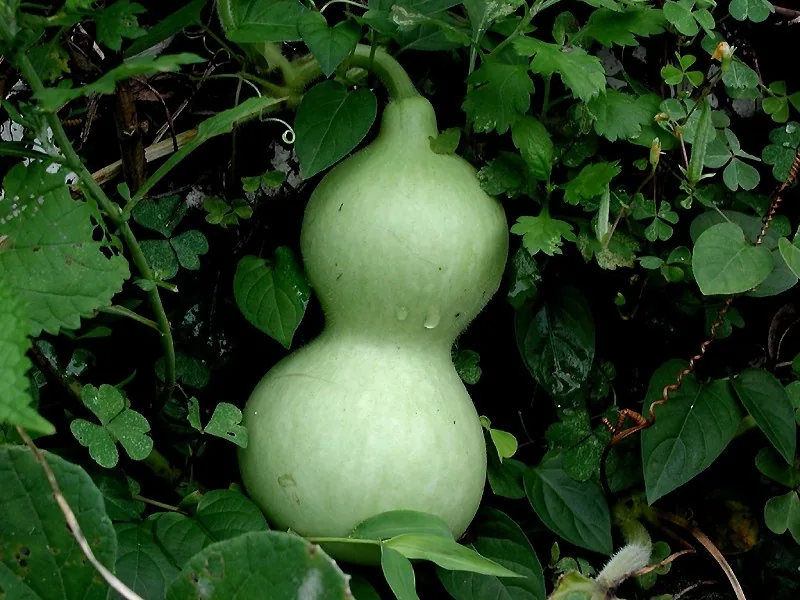


How to Grow and Care for Bottle gourd
Lagenaria siceraria
Written by Emilio Marruso · last checked
Toxic to: People · Why
At a glance
Calabash is a fast, generous annual vine that loves full sun and spreads 10 to 16 feet wide. Sow the seeds outdoors once the soil warms to 70 °F (21 °C), and they sprout in 5 to 13 days. You can boil the young fruits as a vegetable, or let them harden on the vine and dry them into lasting gourds.
- Sun
Full sun
What the sources say (2)
Light: Full sun
Bottle gourd does best in sandy or loamy, well-drained, soil in full sun
— Lagenaria siceraria (Bottle Gourd, Calabash Gourd, Gourds) | North Carolina Extension Gardener Plant Toolbox [1] Plant in full sun and fertile, well-drained soil that is slightly acidic.
— How to grow birdhouse gourds (Lagenaria siceraria) | Extension [2] - Water
Keep the soil moist; water young plants 2–3 times a week; for dried gourds, stop watering as fall nears
What the sources say (3)
Watering: Consistent moisture; young plants watered two or three times a week
Provide consistent moisture. The plants grow from seed quickly
— Lagenaria siceraria (Bottle Gourd, Calabash Gourd, Gourds) | North Carolina Extension Gardener Plant Toolbox [1] Young plants will thrive with watering two or three times a week.
— Bottle Gourds – Gardening Solutions [3] Watering notes: For dried gourds, stop watering as fall approaches and let the vines wither and die
As fall approaches, discontinue watering and allow the vines to wither and die.
— Bottle Gourds – Gardening Solutions [3] - Cold
Survives winters down to −50 °F (−45.6 °C)
Very hardy · USDA 2a · RHS H7 · Z2
What the sources say (2)
Hardiness, coldest zone: 2a [winter low −45.6 to −42.8 °C (−50 to −45 °F)]
2a, 2b, 3a, 3b, 4a, 4b, 5a, 5b
— Lagenaria siceraria (Bottle Gourd, Calabash Gourd, Gourds) | North Carolina Extension Gardener Plant Toolbox [1] Hardiness, warmest zone: 11b [winter low 7.2 to 10 °C (45 to 50 °F)]
7a, 7b, 8a, 8b, 9a, 9b, 10a, 10b, 11a, 11b
— Lagenaria siceraria (Bottle Gourd, Calabash Gourd, Gourds) | North Carolina Extension Gardener Plant Toolbox [1] - Spacing
3–4 ft between rows
What the sources say (1)
Row spacing: 91-122 cm (3-4 ft)
Planting Depth : ½-1 inch Soil Temperature : 70℉ Germination : 5-13 days Plant Spacing: 3-4 feet Row Spacing : 3-4 feet Maturity : 90-95 days
— How to grow birdhouse gourds (Lagenaria siceraria) | Extension [2] - Feeding
Mix compost into the soil before planting, then feed again when the vines start to run
What the sources say (3)
When: Before planting, based on a soil test, and again when the vines begin to run
It is best to base fertilizer applications on soil test results.
— [4] When the vines begin to "run," additional fertilizer will help to maintain optimum growth.
— [4] Natural fertilizers: Compost, composted manure or peat moss worked into the soil before planting
The soil should be enriched with organic matter, such as compost, composted manure or peat moss, and prepared thoroughly.
— [4] - Pruning
Prune when vines reach 8–10 ft long to get more branches and flowers
What the sources say (1)
Pruning: When vines are 8-10 feet [2.4–3 m] long, to encourage branching and flower production
Gourd enthusiasts recommend that the vines be pruned when they are between 8-10 feet long to encourage branching and flower production.
— Bottle Gourds – Gardening Solutions [3] - Harvest
Pick when the skin hardens, 90–95 days; young fruits can be boiled as a vegetable
What the sources say (3)
Harvest: When the skin has hardened (rind turns white or starts to brown); maturity 90-95 days
Harvest the fruit when the skin has hardened.
— Lagenaria siceraria (Bottle Gourd, Calabash Gourd, Gourds) | North Carolina Extension Gardener Plant Toolbox [1] Harvest when smooth, greenish rind turns white or starts to brown.
— How to grow birdhouse gourds (Lagenaria siceraria) | Extension [2] Row Spacing : 3-4 feet Maturity : 90-95 days
— How to grow birdhouse gourds (Lagenaria siceraria) | Extension [2] - Pests
Aphids, cucumber beetles, squash bugs and vine borers; powdery mildew and downy mildew
What the sources say (3)
Pests: aphids, cucumber beetles, squash bugs, stink bugs, cutworms, pickleworm, squash vine borers
Potential insect problems include aphids, cucumber beetles, squash bugs, stink bugs, cutworms, pickleworm and squash vine borers.
— Lagenaria siceraria (Bottle Gourd, Calabash Gourd, Gourds) | North Carolina Extension Gardener Plant Toolbox [1] Diseases: anthracnose, fusarium wilt, bacterial wilt, downy mildew, powdery mildew, blights, mosaic virus, fruit rot
Potential disease problems include anthracnose, fusarium wilt, bacterial wilt, downy mildew, powdery mildew and blights.
— Lagenaria siceraria (Bottle Gourd, Calabash Gourd, Gourds) | North Carolina Extension Gardener Plant Toolbox [1] Lagenaria is likely to be attacked by powdery mildew, mosaic virus, fusarium wilt, and fruit rot.
— Bottle Gourds – Gardening Solutions [3] - Watch out
Fruit lying on the ground can rot: give it a support or mulch the soil
- Size
Spreads 10–16 ft wide
What the sources say (1)
Mature width: 305-488 cm (10-16 ft)
Dimensions: Height: 0 ft. 9 in. - 1 ft. 6 in. Width: 10 ft. 0 in. - 16 ft. 0 in.
— Lagenaria siceraria (Bottle Gourd, Calabash Gourd, Gourds) | North Carolina Extension Gardener Plant Toolbox [1] - Propagation
Grows from seed
What the sources say (1)
Propagation: Seed
Recommended Propagation Strategy: Seed Country Or Region Of Origin: Western Tropical Africa to Ethiopia and Tanzania
— Lagenaria siceraria (Bottle Gourd, Calabash Gourd, Gourds) | North Carolina Extension Gardener Plant Toolbox [1] - Sowing
Sow outdoors after the last frost, 1/2–1 in deep, once soil hits 70 °F (21 °C); sprouts in 5–13 days
What the sources say (4)
Sowing: Outdoors after the last frost, when ground temperature reaches 70 F (21 C); late spring
Direct seed outdoors after the danger of frost has passed and the ground temperature reaches 70 degrees F.
— Lagenaria siceraria (Bottle Gourd, Calabash Gourd, Gourds) | North Carolina Extension Gardener Plant Toolbox [1] Sow in late spring when the soil temperature is at least 70℉ and frost danger has passed.
— How to grow birdhouse gourds (Lagenaria siceraria) | Extension [2] Sowing depth: 1.3-2.5 cm (1/2-1 in)
Planting Depth : ½-1 inch Soil Temperature : 70℉ Germination : 5-13 days Plant Spacing: 3-4 feet Row Spacing : 3-4 feet Maturity : 90-95 days
— How to grow birdhouse gourds (Lagenaria siceraria) | Extension [2] Days to germination: 5-13
Planting Depth : ½-1 inch Soil Temperature : 70℉ Germination : 5-13 days Plant Spacing: 3-4 feet Row Spacing : 3-4 feet Maturity : 90-95 days
— How to grow birdhouse gourds (Lagenaria siceraria) | Extension [2] - Safety
Usually safe to eat, but bitter fruits could cause stomach ulcers
Overview
Bottle gourd is an annual climbing vine in the cucumber family grown for its shaped fruits. [1] It is sown outdoors after frost danger has passed and needs full sun. [1][2] Mature fruit shells are hard and waterproof and are dried for containers. [1]
Bottle gourd care
Measurements in square brackets are our conversion into the other unit system; the quoted text is unchanged.
How to water Bottle gourd
Watering
Consistent moisture; young plants watered two or three times a week
What the sources say (2)
Provide consistent moisture. The plants grow from seed quicklyYoung plants will thrive with watering two or three times a week.Watering notes
For dried gourds, stop watering as fall approaches and let the vines wither and die
What the sources say (1)
As fall approaches, discontinue watering and allow the vines to wither and die.How much light Bottle gourd needs
Full sun
What the sources say (2)
Bottle gourd does best in sandy or loamy, well-drained, soil in full sunPlant in full sun and fertile, well-drained soil that is slightly acidic.How much cold Bottle gourd can take
Hardiness, coldest zone
2a [winter low −45.6 to −42.8 °C (−50 to −45 °F)]
What the sources say (1)
2a, 2b, 3a, 3b, 4a, 4b, 5a, 5bHardiness, warmest zone
11b [winter low 7.2 to 10 °C (45 to 50 °F)]
What the sources say (1)
7a, 7b, 8a, 8b, 9a, 9b, 10a, 10b, 11a, 11bWhere to grow Bottle gourd
The sources give different values depending on region, zone or growing conditions.
What each source says
if growing on supports (fonte: NC State Extension): 91.4 cm (3 feet) apart
if the vine will trail on the ground (fonte: NC State Extension): 121.9-182.9 cm (4 to 6 feet) apart
According to UNH Extension: 91.4-121.9 cm (3-4 feet) plant spacing and row spacing
According to UF/IFAS Gardening Solutions: 274.3 cm (9 feet) between plants after thinning
What the sources say (6)
if growing on supports (fonte: NC State Extension): Plant several seeds in mounds 3 feet apart if growing on supportsif the vine will trail on the ground (fonte: NC State Extension): or 4 to 6 feet apart is the vine will trail on the ground.According to UNH Extension: Plant Spacing: 3-4 feet
Row Spacing : 3-4 feetAccording to UF/IFAS Gardening Solutions: Thin the seedlings to one plant every nine feet.Plant several seeds in mounds 3 feet apart if growing on supports or 4 to 6 feet apart is the vine will trail on the ground.Plant Spacing: 3-4 feet
Row Spacing : 3-4 feetHow to propagate Bottle gourd
Seed
What the sources say (1)
Recommended Propagation Strategy:
Seed
Country Or Region Of Origin:
Western Tropical Africa to Ethiopia and TanzaniaHow to grow Bottle gourd
The plant
Life cycle
annual
What the sources say (2)
Genus: Lagenaria Species: siceraria Family: Cucurbitaceae Uses (Ethnobotany): The fruit is edible and the outer shell is ornamental or can be used as a container. Life Cycle: AnnualThe Lagenaria species are annual vines that can be grownFamily
Cucurbitaceae
What the sources say (1)
Family: Cucurbitaceae Uses (Ethnobotany): The fruit is edible and the outer shell is ornamental or can be used as a container.Mature height
Mature width
305-488 cm (10-16 ft)
What the sources say (1)
Dimensions: Height: 0 ft. 9 in. - 1 ft. 6 in. Width: 10 ft. 0 in. - 16 ft. 0 in.Sowing and growth
Days to germination
5-13
What the sources say (1)
Planting Depth : ½-1 inch Soil Temperature : 70℉ Germination : 5-13 days Plant Spacing: 3-4 feet Row Spacing : 3-4 feet Maturity : 90-95 daysSowing depth
1.3-2.5 cm (1/2-1 in)
What the sources say (1)
Planting Depth : ½-1 inch Soil Temperature : 70℉ Germination : 5-13 days Plant Spacing: 3-4 feet Row Spacing : 3-4 feet Maturity : 90-95 daysRow spacing
91-122 cm (3-4 ft)
What the sources say (1)
Planting Depth : ½-1 inch Soil Temperature : 70℉ Germination : 5-13 days Plant Spacing: 3-4 feet Row Spacing : 3-4 feet Maturity : 90-95 daysHarvest and storage
How to harvest
Harvest the fruit when the skin has hardened (rind turning white or starting to brown); for dried gourds leave them to mature on the vine and cut the stems off when they turn brown, with an inch [2.5 cm] or more of stem.
What the sources say (3)
Harvest the fruit when the skin has hardened. IfHarvest when smooth, greenish rind turns white or starts to brown.When the gourd stems turn brown, cut them off the vine with an inch or more ofStorage
Dry the gourds somewhere warm and well ventilated; drying can take up to six months.
What the sources say (1)
Store your gourds somewhere warm and well ventilated where they can dry. The drying process can take up to six months,Pests and diseases
Pests
aphids, cucumber beetles, squash bugs, stink bugs, cutworms, pickleworm, squash vine borers
What the sources say (1)
Potential insect problems include aphids, cucumber beetles, squash bugs, stink bugs, cutworms, pickleworm and squash vine borers.Diseases
anthracnose, fusarium wilt, bacterial wilt, downy mildew, powdery mildew, blights, mosaic virus, fruit rot
What the sources say (2)
Potential disease problems include anthracnose, fusarium wilt, bacterial wilt, downy mildew, powdery mildew and blights.Lagenaria is likely to be attacked by powdery mildew, mosaic virus, fusarium wilt, and fruit rot.Fertilizing
When
Before planting, based on a soil test, and again when the vines begin to run
Natural fertilizers
Compost, composted manure or peat moss worked into the soil before planting
What the sources say (1)
The soil should be enriched with organic matter, such as compost, composted manure or peat moss, and prepared thoroughly.Mineral fertilizers
5-10-10 (1:2:2 ratio) at 97.6–146 g/m² before planting; 10-10-10 at 146 g/m² when the vines begin to run
What each source says
field production: N 168 kg [370.4 lb]/ha; P₂O₅ and K₂O 135, 112 and 89.7 kg [246.9–197.8 lb]/ha for very low, low and medium soil levels
What the sources say (3)
field production: Growers can temporarily use the fertilizer recommendations for cucum- ber: N, 150 lb/A; both of P2O5 and K2O, 120, 100, and 80 lb/A for very low, low, and medium levels of the nutrients, respectively.However, a general recommendation is to apply two to three pounds of fertilizer with a 1:2:2 ratio (e.g. 5-10-10), per 100 square feet of garden area.Apply about three pounds of a fertilizer fairly high in nitrogen (e.g. 10-10-10) per 100 square feet of garden area.Bottle gourd pests and problems
Insect pests
Symptom: Potential insect problems include aphids, cucumber beetles, squash bugs, stink bugs, cutworms, pickleworm and squash vine borers.
What to do: Not stated in the documents.
What the sources say (1)
Potential insect problems include aphids, cucumber beetles, squash bugs, stink bugs, cutworms, pickleworm and squash vine borers.
— Lagenaria siceraria (Bottle Gourd, Calabash Gourd, Gourds) | North Carolina Extension Gardener Plant Toolbox [1] Diseases
Symptom: Potential disease problems include anthracnose, fusarium wilt, bacterial wilt, downy mildew, powdery mildew and blights.
What to do: Not stated in the documents.
What the sources say (1)
Potential disease problems include anthracnose, fusarium wilt, bacterial wilt, downy mildew, powdery mildew and blights.
— Lagenaria siceraria (Bottle Gourd, Calabash Gourd, Gourds) | North Carolina Extension Gardener Plant Toolbox [1] Fruit rot on the ground
Symptom: Fruit can rot if it lies on the ground.
What to do: Provide support structures or mulch the ground.
What the sources say (1)
A trellis is advised, but vines may be allowed to run on the ground; be sure to add mulch to avoid fruit rotting.
— Bottle Gourds – Gardening Solutions [3]
Remedies
Each remedy shows what official sources say about it; traditional remedies without an official source are marked as such. Harmful ones are listed so you know to avoid them.
Treating the plant
fruit rot
mulch under fruit grown on the ground Works
How: A trellis is advised, but vines may be allowed to run on the ground; be sure to add mulch to avoid fruit rotting.
A trellis is advised, but vines may be allowed to run on the ground; be sure to add mulch to avoid fruit rotting.
— Bottle Gourds – Gardening Solutions [3] What the evidence says A trellis is advised, but vines may be allowed to run on the ground; be sure to add mulch to avoid fruit rotting.
— Bottle Gourds – Gardening Solutions [3]
insect pests
neem seed kernel extract Partly works
How: Neem seed kernel extract (NSKE) at 5% serves as a botanical repellent.
pheromone traps target fruit flies, and neem seed kernel extract (NSKE) at 5% serves as a botanical repellent;
— grokipedia.com [6] What the evidence says Neem oil is found in the seeds of the neem tree. The active component found in this biological pesticide reduces insect feeding, interferes with hormones -- making it hard to grow or lay eggs -- and acts as a repellent.
— extension.illinois.edu [7]
mold on drying gourds
water and bleach wash Official source, not independently tested
Warning: Risky ingredient
Some homemade pesticide ingredients like bleach, salt, and vinegar can be very toxic when applied to the environment.
— pubs.ext.vt.edu [8] How: Gently wash the gourds in a 10:1 solution of water and bleach. As your gourds dry it is normal to see mold starting to grow; just wash them again with the same water and bleach solution.
As your gourds dry it is normal to see mold starting to grow; just wash them again with the same water and bleach solution.
— Bottle Gourds – Gardening Solutions [3]
Is Bottle gourd poisonous?
Reported by the source, quoted verbatim. This is not medical or veterinary advice: if a person or an animal may have eaten this plant, contact a poison control centre or a veterinarian.
Calendar
Sowing
Outdoors after the last frost, when ground temperature reaches 70 F (21 C); late spring
What the sources say (2)
Direct seed outdoors after the danger of frost has passed and the ground temperature reaches 70 degrees F.Sow in late spring when the soil temperature is at least 70℉ and frost danger has passed.Harvest
When the skin has hardened (rind turns white or starts to brown); maturity 90-95 days
What the sources say (3)
Harvest the fruit when the skin has hardened.Harvest when smooth, greenish rind turns white or starts to brown.Row Spacing : 3-4 feet
Maturity : 90-95 daysPruning
When vines are 8-10 feet [2.4–3 m] long, to encourage branching and flower production
What the sources say (1)
Gourd enthusiasts recommend that the vines be pruned when they are between 8-10 feet long to encourage branching and flower production.Months as given by the sources, which are mostly from the United States (northern hemisphere). In the southern hemisphere they shift by about six months.
Relative to frost
Less precise estimate: there is no weather station within 300 km.
Find frost dates by ZIP code or city
Sow outdoors: around the last frost
Direct seed outdoors after the danger of frost has passed
— Lagenaria siceraria (Bottle Gourd, Calabash Gourd, Gourds) | North Carolina Extension Gardener Plant Toolbox [1]
Count from the average frost dates where you live.
Edibility
Reported by the source, quoted verbatim. Do not eat a plant on the basis of this page alone: identification mistakes can be dangerous.
Indicative values
Values from a secondary source, not checked word for word like the rest of this page. Use them as a starting point.
- Drought tolerant
- yesIndicative value, adapt it to your climate · Secondary source
- Soil pH
- 6-7Indicative value, adapt it to your climate · Secondary source
- Care level
- MediumIndicative value, adapt it to your climate · Secondary source
- Growth rate
- LowIndicative value, adapt it to your climate · Secondary source
Similar plants
- Arabian Cucumber Cucumis dipsaceus
- Bitter Melon Momordica charantia
- Cantaloupe Cucumis melo
- Field pumpkin Cucurbita pepo
- Figleaf Gourd Cucurbita ficifolia
- Garden cucumber Cucumis sativus
- Loofah Luffa aegyptiaca
- Maroon Cucumber Cucumis anguria
Sources
Every value above is quoted from these documents. Links lead to the original publisher.
- Lagenaria siceraria (Bottle Gourd, Calabash Gourd, Gourds) | North Carolina Extension Gardener Plant Toolbox · plants.ces.ncsu.edu, consulted
- How to grow birdhouse gourds (Lagenaria siceraria) | Extension · extension.unh.edu, consulted
- Bottle Gourds – Gardening Solutions · gardeningsolutions.ifas.ufl.edu, consulted
- ipm.missouri.edu · ipm.missouri.edu
- edis.ifas.ufl.edu · edis.ifas.ufl.edu
- grokipedia.com · grokipedia.com
- extension.illinois.edu · extension.illinois.edu
- pubs.ext.vt.edu · pubs.ext.vt.edu
Written by Emilio Marruso · last checked