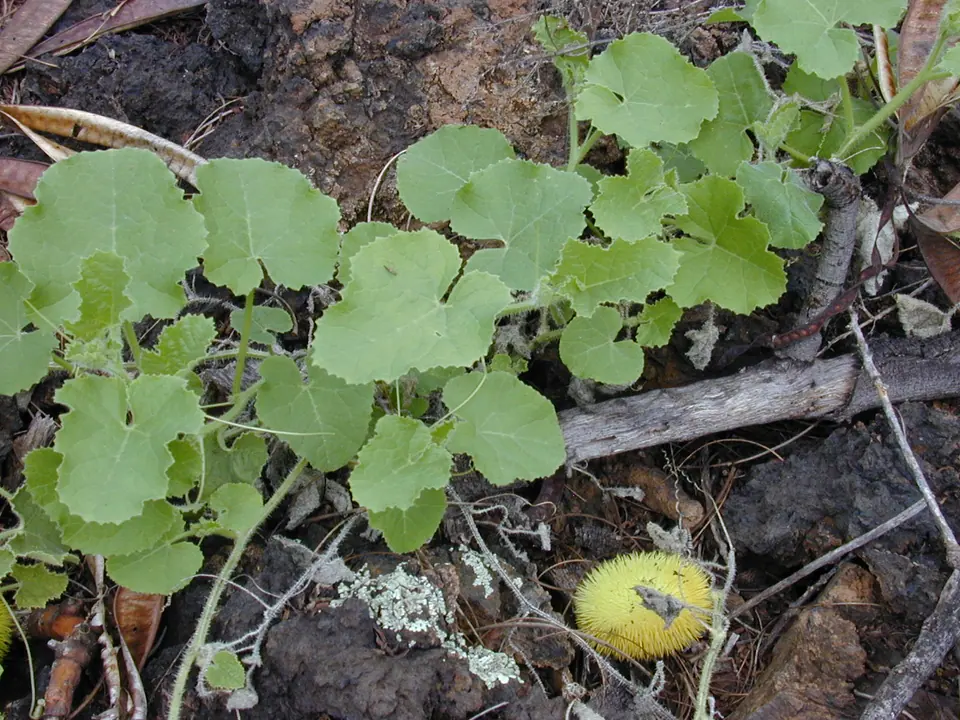


How to Grow and Care for Arabian Cucumber
Cucumis dipsaceus
Written by Emilio Marruso · last checked
Not toxic to cats and dogs, according to the sources · Sources
At a glance
This easygoing annual from the cucumber and gourd family loves full sun and a dry, well-drained spot. It grows from seed and reaches 6 to 10 feet tall, yet stays slim. Best of all, the fruits, seeds, young leaves and shoots are all edible, and it is safe around cats, dogs and horses.
- Sun
Full sun
What the sources say (2)
Light: Full sun
The plant grows best in full sun, in well-drained soil, and prefers a dry site.
— Cucumis dipsaceus (Arabian Cucumber, Hedgehog Gourd, Teasel Gourd) | North Carolina Extension Gardener Plant Toolbox [1] Light: Full sun (6 or more hours of direct sunlight a day)
— Cucumis dipsaceus (Arabian Cucumber, Hedgehog Gourd, Teasel Gourd) | North Carolina Extension Gardener Plant Toolbox [1] - Water
Likes a dry spot; never let water sit around the roots
What the sources say (1)
Watering notes: Prefers a dry site; well-drained soil
The plant grows best in full sun, in well-drained soil, and prefers a dry site.
— Cucumis dipsaceus (Arabian Cucumber, Hedgehog Gourd, Teasel Gourd) | North Carolina Extension Gardener Plant Toolbox [1] - Soil
Well-drained soil, pH 6.0–8.0
What the sources say (3)
Soil pH, minimum: 6.0
Soil pH: Neutral (6.0-8.0)
— Cucumis dipsaceus (Arabian Cucumber, Hedgehog Gourd, Teasel Gourd) | North Carolina Extension Gardener Plant Toolbox [1] Soil pH, maximum: 8.0
Soil pH: Neutral (6.0-8.0)
— Cucumis dipsaceus (Arabian Cucumber, Hedgehog Gourd, Teasel Gourd) | North Carolina Extension Gardener Plant Toolbox [1] Watering notes: Prefers a dry site; well-drained soil
The plant grows best in full sun, in well-drained soil, and prefers a dry site.
— Cucumis dipsaceus (Arabian Cucumber, Hedgehog Gourd, Teasel Gourd) | North Carolina Extension Gardener Plant Toolbox [1] - Harvest
Fruits, seeds, young leaves and shoots are all edible; cook the young leaves and shoots
- Watch out
In tropical climates it can spread and become a weed
- Size
6 to 10 ft tall but only 2 to 6 in wide
What the sources say (2)
Mature height: 182.88-304.8 cm (6-10 ft)
Dimensions: Height: 6 ft. 0 in. - 10 ft. 0 in. Width: 0 ft. 2 in. - 0 ft. 6 in.
— Cucumis dipsaceus (Arabian Cucumber, Hedgehog Gourd, Teasel Gourd) | North Carolina Extension Gardener Plant Toolbox [1] Mature width: 5.08-15.24 cm (0 ft 2 in - 0 ft 6 in)
Dimensions: Height: 6 ft. 0 in. - 10 ft. 0 in. Width: 0 ft. 2 in. - 0 ft. 6 in.
— Cucumis dipsaceus (Arabian Cucumber, Hedgehog Gourd, Teasel Gourd) | North Carolina Extension Gardener Plant Toolbox [1] - Propagation
Grows from seed
What the sources say (1)
Propagation: Seed
Recommended Propagation Strategy: Seed
— Cucumis dipsaceus (Arabian Cucumber, Hedgehog Gourd, Teasel Gourd) | North Carolina Extension Gardener Plant Toolbox [1] - Safety
Not toxic to cats, dogs or horses
Overview
Cucumis dipsaceus is an annual warm-season vegetable and climbing vine native to tropical Africa. [1] It grows best in full sun in well-drained soil and prefers a dry site. [1] It can be weedy and has become problematic in some tropical areas of the world. [1]
This record is incomplete: the sources we read do not cover every field yet.
Not yet covered by our sources: Watering, Sowing / Planting, Harvest, Spacing
Arabian Cucumber care
How to water Arabian Cucumber
Watering
Not stated in the sources we read.
Watering notes
Prefers a dry site; well-drained soil
What the sources say (1)
The plant grows best in full sun, in well-drained soil, and prefers a dry site.How much light Arabian Cucumber needs
Full sun
What the sources say (2)
The plant grows best in full sun, in well-drained soil, and prefers a dry site.Light:
Full sun (6 or more hours of direct sunlight a day)Best soil for Arabian Cucumber
Soil pH, minimum
6.0
What the sources say (1)
Soil pH:
Neutral (6.0-8.0)Soil pH, maximum
8.0
What the sources say (1)
Soil pH:
Neutral (6.0-8.0)Where to grow Arabian Cucumber
Not stated in the sources we read.
How to propagate Arabian Cucumber
Seed
What the sources say (1)
Recommended Propagation Strategy:
SeedHow to grow Arabian Cucumber
The plant
Life cycle
annual
What the sources say (1)
Arabian Cucumber is an annual warm-season vegetable, climbing vine, with yellow flowers and yellow fruit native to tropical Africa.Family
Cucurbitaceae
What the sources say (1)
Genus:
Cucumis
Species:
dipsaceus
Family:
Cucurbitaceae
Uses (Ethnobotany):
Fruits are used for fodder, medicinally as an analgesic, and human consumption.Mature height
182.88-304.8 cm (6-10 ft)
What the sources say (1)
Dimensions:
Height: 6 ft. 0 in. - 10 ft. 0 in.
Width: 0 ft. 2 in. - 0 ft. 6 in.Mature width
5.08-15.24 cm (0 ft 2 in - 0 ft 6 in)
What the sources say (1)
Dimensions:
Height: 6 ft. 0 in. - 10 ft. 0 in.
Width: 0 ft. 2 in. - 0 ft. 6 in.Arabian Cucumber pests and problems
Weediness
Symptom: Can be weedy and has become problematic in some tropical areas of the world including Mexico and South America.
What to do: No management given.
What the sources say (1)
Can be weedy and has become problematic in some tropical areas of the world including Mexico and South America.
— Cucumis dipsaceus (Arabian Cucumber, Hedgehog Gourd, Teasel Gourd) | North Carolina Extension Gardener Plant Toolbox [1]
Remedies
The sources we checked give no remedies for this plant.
Is Arabian Cucumber poisonous?
Reported by the source, quoted verbatim. This is not medical or veterinary advice: if a person or an animal may have eaten this plant, contact a poison control centre or a veterinarian.
#non-toxic for cats #non-toxic for horses #non-toxic for dogs
[1]The source flags the risk for this animal but does not explain why.
#non-toxic for horses #non-toxic for dogs
[1]The source flags the risk for this animal but does not explain why.
#non-toxic for dogs #annual vegetable
[1]The source flags the risk for this animal but does not explain why.
Calendar
Sowing
Not stated in the sources we read.
Planting
Not stated in the sources we read.
Harvest
Not stated in the sources we read.
Months as given by the sources, which are mostly from the United States (northern hemisphere). In the southern hemisphere they shift by about six months.
Edibility
Reported by the source, quoted verbatim. Do not eat a plant on the basis of this page alone: identification mistakes can be dangerous.
Similar plants
- Cantaloupe Cucumis melo
- Garden cucumber Cucumis sativus
- Maroon Cucumber Cucumis anguria
- Bitter Melon Momordica charantia
- Bottle gourd Lagenaria siceraria
- Creeping Cucumber Melothria pendula
- Field pumpkin Cucurbita pepo
- Figleaf Gourd Cucurbita ficifolia
Sources
Every value above is quoted from these documents. Links lead to the original publisher.
- Cucumis dipsaceus (Arabian Cucumber, Hedgehog Gourd, Teasel Gourd) | North Carolina Extension Gardener Plant Toolbox · plants.ces.ncsu.edu, consulted
Written by Emilio Marruso · last checked