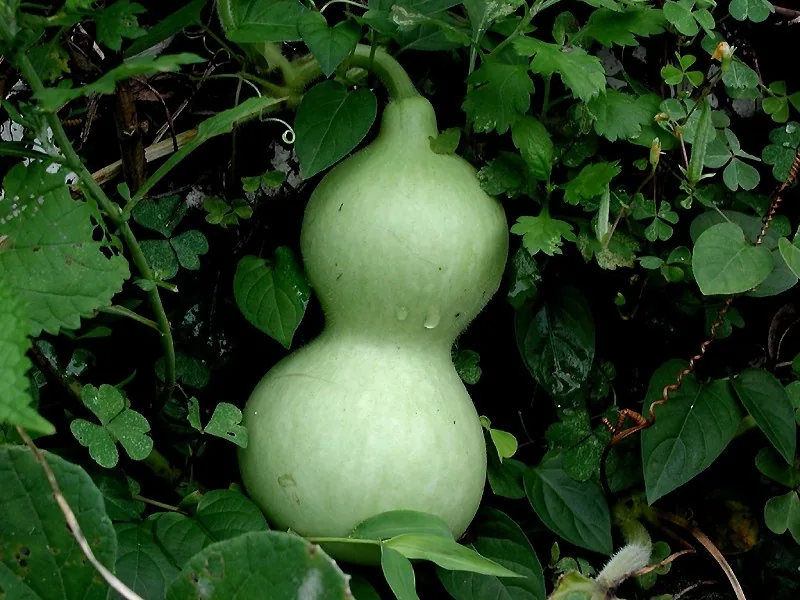


Cómo cultivar y cuidar Bottle gourd
Lagenaria siceraria
Escrito por Emilio Marruso · última revisión
Tóxica para: Personas · Por qué
De un vistazo
El calabacino es una enredadera anual rápida y generosa que adora el sol pleno y se extiende de 3 a 4,9 m de ancho. Siembra las semillas al aire libre cuando la tierra llegue a 21 °C y brotarán en 5 a 13 días. Puedes hervir los frutos jóvenes como verdura o dejar que se endurezcan en la planta y secarlos para guardarlos.
- Sol
Sol pleno
Qué dicen las fuentes (2)
Luz: Pleno sol
Bottle gourd does best in sandy or loamy, well-drained, soil in full sun
— Lagenaria siceraria (Bottle Gourd, Calabash Gourd, Gourds) | North Carolina Extension Gardener Plant Toolbox [1] Plant in full sun and fertile, well-drained soil that is slightly acidic.
— How to grow birdhouse gourds (Lagenaria siceraria) | Extension [2] - Riego
Mantén la tierra húmeda; riega las plantas jóvenes 2–3 veces por semana; para secarlas, deja de regar al llegar el otoño
Qué dicen las fuentes (3)
Riego: Humedad constante; plantas jóvenes regadas dos o tres veces por semana
Provide consistent moisture. The plants grow from seed quickly
— Lagenaria siceraria (Bottle Gourd, Calabash Gourd, Gourds) | North Carolina Extension Gardener Plant Toolbox [1] Young plants will thrive with watering two or three times a week.
— Bottle Gourds – Gardening Solutions [3] Notas sobre el riego: Para calabazas secas, deja de regar cuando se acerque el otoño y deja que las enredaderas se marchiten y mueran
As fall approaches, discontinue watering and allow the vines to wither and die.
— Bottle Gourds – Gardening Solutions [3] - Frío
Aguanta inviernos de hasta −45,6 °C (−50 °F)
Muy rústica · USDA 2a · RHS H7 · Z2
Qué dicen las fuentes (2)
Rusticidad, zona más fría: 2a [mínima invernal de −45,6 a −42,8 °C (de −50 a −45 °F)]
2a, 2b, 3a, 3b, 4a, 4b, 5a, 5b
— Lagenaria siceraria (Bottle Gourd, Calabash Gourd, Gourds) | North Carolina Extension Gardener Plant Toolbox [1] Rusticidad, zona más cálida: 11b [mínima invernal de 7,2 a 10 °C (de 45 a 50 °F)]
7a, 7b, 8a, 8b, 9a, 9b, 10a, 10b, 11a, 11b
— Lagenaria siceraria (Bottle Gourd, Calabash Gourd, Gourds) | North Carolina Extension Gardener Plant Toolbox [1] - Distancia
0,9–1,2 m entre hileras
Qué dicen las fuentes (1)
Distancia entre hileras: 91-122 cm (3-4 pies)
Planting Depth : ½-1 inch Soil Temperature : 70℉ Germination : 5-13 days Plant Spacing: 3-4 feet Row Spacing : 3-4 feet Maturity : 90-95 days
— How to grow birdhouse gourds (Lagenaria siceraria) | Extension [2] - Abonado
Mezcla compost en la tierra antes de plantar y abona otra vez cuando los tallos empiecen a extenderse
Qué dicen las fuentes (3)
Cuándo: Antes de plantar, según un análisis de suelo, y nuevamente cuando las vides comiencen a extenderse
It is best to base fertilizer applications on soil test results.
— [4] When the vines begin to "run," additional fertilizer will help to maintain optimum growth.
— [4] Abonos naturales: Compost, estiércol compostado o turba incorporados al suelo antes de plantar
The soil should be enriched with organic matter, such as compost, composted manure or peat moss, and prepared thoroughly.
— [4] - Poda
Poda cuando los tallos midan 2,4–3 m para que salgan más ramas y flores
Qué dicen las fuentes (1)
Poda: Cuando las enredaderas midan 8-10 pies [2,4–3 m] de largo, para fomentar la ramificación y la producción de flores
Gourd enthusiasts recommend that the vines be pruned when they are between 8-10 feet long to encourage branching and flower production.
— Bottle Gourds – Gardening Solutions [3] - Cosecha
Cosecha cuando la piel se endurezca, a los 90–95 días; los frutos jóvenes se comen hervidos
Qué dicen las fuentes (3)
Cosecha: Cuando la piel se ha endurecido (la cáscara se vuelve blanca o empieza a dorarse); madurez en 90-95 días
Harvest the fruit when the skin has hardened.
— Lagenaria siceraria (Bottle Gourd, Calabash Gourd, Gourds) | North Carolina Extension Gardener Plant Toolbox [1] Harvest when smooth, greenish rind turns white or starts to brown.
— How to grow birdhouse gourds (Lagenaria siceraria) | Extension [2] Row Spacing : 3-4 feet Maturity : 90-95 days
— How to grow birdhouse gourds (Lagenaria siceraria) | Extension [2] - Plagas
Pulgones, escarabajos del pepino, chinches de la calabaza y barrenadores; oídio y mildiu
Qué dicen las fuentes (3)
Plagas: pulgones, escarabajos del pepino, chinches de la calabaza, chinches apestosas, gusanos cortadores, gusano del pepinillo, barrenadores de la vid de calabaza
Potential insect problems include aphids, cucumber beetles, squash bugs, stink bugs, cutworms, pickleworm and squash vine borers.
— Lagenaria siceraria (Bottle Gourd, Calabash Gourd, Gourds) | North Carolina Extension Gardener Plant Toolbox [1] Enfermedades: antracnosis, fusariosis, marchitez bacteriana, mildiu velloso, mildiu polvoriento, tizones, virus del mosaico, pudrición del fruto
Potential disease problems include anthracnose, fusarium wilt, bacterial wilt, downy mildew, powdery mildew and blights.
— Lagenaria siceraria (Bottle Gourd, Calabash Gourd, Gourds) | North Carolina Extension Gardener Plant Toolbox [1] Lagenaria is likely to be attacked by powdery mildew, mosaic virus, fusarium wilt, and fruit rot.
— Bottle Gourds – Gardening Solutions [3] - Atención
Los frutos que tocan el suelo se pudren: ponles un soporte o acolcha la tierra
- Tamaño
Se extiende de 3 a 4,9 m de ancho
Qué dicen las fuentes (1)
Anchura adulta: 305-488 cm (10-16 pies)
Dimensions: Height: 0 ft. 9 in. - 1 ft. 6 in. Width: 10 ft. 0 in. - 16 ft. 0 in.
— Lagenaria siceraria (Bottle Gourd, Calabash Gourd, Gourds) | North Carolina Extension Gardener Plant Toolbox [1] - Multiplicación
Se multiplica por semilla
Qué dicen las fuentes (1)
Propagación: Semilla
Recommended Propagation Strategy: Seed Country Or Region Of Origin: Western Tropical Africa to Ethiopia and Tanzania
— Lagenaria siceraria (Bottle Gourd, Calabash Gourd, Gourds) | North Carolina Extension Gardener Plant Toolbox [1] - Siembra
Siembra fuera tras la última helada, a 1–3 cm, con la tierra a 21 °C; brota en 5–13 días
Qué dicen las fuentes (4)
Siembra: Al aire libre después de la última helada, cuando la temperatura del suelo alcance 70 F (21 C); finales de primavera
Direct seed outdoors after the danger of frost has passed and the ground temperature reaches 70 degrees F.
— Lagenaria siceraria (Bottle Gourd, Calabash Gourd, Gourds) | North Carolina Extension Gardener Plant Toolbox [1] Sow in late spring when the soil temperature is at least 70℉ and frost danger has passed.
— How to grow birdhouse gourds (Lagenaria siceraria) | Extension [2] Profundidad de siembra: 1.3-2.5 cm (1/2-1 pulgada)
Planting Depth : ½-1 inch Soil Temperature : 70℉ Germination : 5-13 days Plant Spacing: 3-4 feet Row Spacing : 3-4 feet Maturity : 90-95 days
— How to grow birdhouse gourds (Lagenaria siceraria) | Extension [2] Días de germinación: 5-13
Planting Depth : ½-1 inch Soil Temperature : 70℉ Germination : 5-13 days Plant Spacing: 3-4 feet Row Spacing : 3-4 feet Maturity : 90-95 days
— How to grow birdhouse gourds (Lagenaria siceraria) | Extension [2] - Seguridad
Suele ser seguro comerlo, pero los frutos amargos podrían causar úlceras de estómago
Resumen
La calabaza de botella es una enredadera anual trepadora de la familia de los pepinos, cultivada por sus frutos con forma peculiar. [1] Se siembra al aire libre después de que pase el peligro de las heladas y necesita pleno sol. [1][2] Las cáscaras de los frutos maduros son duras e impermeables y se secan para usarse como recipientes. [1]
Citado en inglés, como en la fuente.
Cuidados
Las medidas entre corchetes son nuestra conversión al otro sistema de unidades; el texto citado no cambia.
Riego
Riego
Humedad constante; plantas jóvenes regadas dos o tres veces por semana
Qué dicen las fuentes (2)
Provide consistent moisture. The plants grow from seed quicklyYoung plants will thrive with watering two or three times a week.Notas sobre el riego
Para calabazas secas, deja de regar cuando se acerque el otoño y deja que las enredaderas se marchiten y mueran
Qué dicen las fuentes (1)
As fall approaches, discontinue watering and allow the vines to wither and die.Luz
Pleno sol
Qué dicen las fuentes (2)
Bottle gourd does best in sandy or loamy, well-drained, soil in full sunPlant in full sun and fertile, well-drained soil that is slightly acidic.Clima y frío
Rusticidad, zona más fría
2a [mínima invernal de −45,6 a −42,8 °C (de −50 a −45 °F)]
Qué dicen las fuentes (1)
2a, 2b, 3a, 3b, 4a, 4b, 5a, 5bRusticidad, zona más cálida
11b [mínima invernal de 7,2 a 10 °C (de 45 a 50 °F)]
Qué dicen las fuentes (1)
7a, 7b, 8a, 8b, 9a, 9b, 10a, 10b, 11a, 11bDónde cultivarla
Las fuentes dan valores distintos según la región, la zona o las condiciones de cultivo.
Lo que dice cada fuente
si se cultiva con soportes (fuente: NC State Extension): 91,4 cm (3 pies) de distancia
si la planta trepadora se arrastra por el suelo (fuente: NC State Extension): 121.9-182.9 cm (4 a 6 pies) de separación
Según UNH Extension: 91.4-121.9 cm (3-4 pies) de separación entre plantas y entre hileras
Según UF/IFAS Gardening Solutions: 274.3 cm (9 pies) entre plantas después del raleo
Qué dicen las fuentes (6)
si se cultiva con soportes (fuente: NC State Extension): Plant several seeds in mounds 3 feet apart if growing on supportssi la planta trepadora se arrastra por el suelo (fuente: NC State Extension): or 4 to 6 feet apart is the vine will trail on the ground.Según UNH Extension: Plant Spacing: 3-4 feet
Row Spacing : 3-4 feetSegún UF/IFAS Gardening Solutions: Thin the seedlings to one plant every nine feet.Plant several seeds in mounds 3 feet apart if growing on supports or 4 to 6 feet apart is the vine will trail on the ground.Plant Spacing: 3-4 feet
Row Spacing : 3-4 feetPropagación
Semilla
Qué dicen las fuentes (1)
Recommended Propagation Strategy:
Seed
Country Or Region Of Origin:
Western Tropical Africa to Ethiopia and TanzaniaCultivo
La planta
Ciclo de vida
anual
Qué dicen las fuentes (2)
Genus: Lagenaria Species: siceraria Family: Cucurbitaceae Uses (Ethnobotany): The fruit is edible and the outer shell is ornamental or can be used as a container. Life Cycle: AnnualThe Lagenaria species are annual vines that can be grownFamilia
Cucurbitaceae
Qué dicen las fuentes (1)
Family: Cucurbitaceae Uses (Ethnobotany): The fruit is edible and the outer shell is ornamental or can be used as a container.Altura adulta
Anchura adulta
305-488 cm (10-16 pies)
Qué dicen las fuentes (1)
Dimensions: Height: 0 ft. 9 in. - 1 ft. 6 in. Width: 10 ft. 0 in. - 16 ft. 0 in.Siembra y crecimiento
Días de germinación
5-13
Qué dicen las fuentes (1)
Planting Depth : ½-1 inch Soil Temperature : 70℉ Germination : 5-13 days Plant Spacing: 3-4 feet Row Spacing : 3-4 feet Maturity : 90-95 daysProfundidad de siembra
1.3-2.5 cm (1/2-1 pulgada)
Qué dicen las fuentes (1)
Planting Depth : ½-1 inch Soil Temperature : 70℉ Germination : 5-13 days Plant Spacing: 3-4 feet Row Spacing : 3-4 feet Maturity : 90-95 daysDistancia entre hileras
91-122 cm (3-4 pies)
Qué dicen las fuentes (1)
Planting Depth : ½-1 inch Soil Temperature : 70℉ Germination : 5-13 days Plant Spacing: 3-4 feet Row Spacing : 3-4 feet Maturity : 90-95 daysCosecha y conservación
Cómo cosechar
Cosecha el fruto cuando la piel se haya endurecido (la corteza se vuelve blanca o empieza a dorarse); para las calabazas secas, déjalas madurar en la vid y corta los tallos cuando se vuelvan marrones, dejando una pulgada [2,5 cm] o más de tallo.
Qué dicen las fuentes (3)
Harvest the fruit when the skin has hardened. IfHarvest when smooth, greenish rind turns white or starts to brown.When the gourd stems turn brown, cut them off the vine with an inch or more ofConservación
Seca las calabazas en un lugar cálido y bien ventilado; el secado puede tardar hasta seis meses.
Qué dicen las fuentes (1)
Store your gourds somewhere warm and well ventilated where they can dry. The drying process can take up to six months,Plagas y enfermedades
Plagas
pulgones, escarabajos del pepino, chinches de la calabaza, chinches apestosas, gusanos cortadores, gusano del pepinillo, barrenadores de la vid de calabaza
Qué dicen las fuentes (1)
Potential insect problems include aphids, cucumber beetles, squash bugs, stink bugs, cutworms, pickleworm and squash vine borers.Enfermedades
antracnosis, fusariosis, marchitez bacteriana, mildiu velloso, mildiu polvoriento, tizones, virus del mosaico, pudrición del fruto
Qué dicen las fuentes (2)
Potential disease problems include anthracnose, fusarium wilt, bacterial wilt, downy mildew, powdery mildew and blights.Lagenaria is likely to be attacked by powdery mildew, mosaic virus, fusarium wilt, and fruit rot.Abonado
Cuándo
Antes de plantar, según un análisis de suelo, y nuevamente cuando las vides comiencen a extenderse
Abonos naturales
Compost, estiércol compostado o turba incorporados al suelo antes de plantar
Qué dicen las fuentes (1)
The soil should be enriched with organic matter, such as compost, composted manure or peat moss, and prepared thoroughly.Abonos minerales
5-10-10 (relación 1:2:2) a 97.6–146 g/m² antes de plantar; 10-10-10 a 146 g/m² cuando las vides comiencen a extenderse
Lo que dice cada fuente
producción en campo: N 168 kg [370,4 lb]/ha; P₂O₅ y K₂O 135, 112 y 89.7 kg [246,9–197,8 lb]/ha para niveles de suelo muy bajo, bajo y medio
Qué dicen las fuentes (3)
producción en campo: Growers can temporarily use the fertilizer recommendations for cucum- ber: N, 150 lb/A; both of P2O5 and K2O, 120, 100, and 80 lb/A for very low, low, and medium levels of the nutrients, respectively.However, a general recommendation is to apply two to three pounds of fertilizer with a 1:2:2 ratio (e.g. 5-10-10), per 100 square feet of garden area.Apply about three pounds of a fertilizer fairly high in nitrogen (e.g. 10-10-10) per 100 square feet of garden area.Problemas
Insectos plaga
Síntoma: Los posibles problemas de insectos incluyen pulgones, escarabajos del pepino, chinches de la calabaza, chinches hediondas, gusanos cortadores, gusano del pepinillo y barrenadores del tallo de la calabaza.
Qué hacer: No se indica en los documentos.
Qué dicen las fuentes (1)
Potential insect problems include aphids, cucumber beetles, squash bugs, stink bugs, cutworms, pickleworm and squash vine borers.
— Lagenaria siceraria (Bottle Gourd, Calabash Gourd, Gourds) | North Carolina Extension Gardener Plant Toolbox [1] Enfermedades
Síntoma: Los posibles problemas de enfermedades incluyen antracnosis, marchitez por fusarium, marchitez bacteriana, mildiú velloso, mildiú polvoriento y tizones.
Qué hacer: No se indica en los documentos.
Qué dicen las fuentes (1)
Potential disease problems include anthracnose, fusarium wilt, bacterial wilt, downy mildew, powdery mildew and blights.
— Lagenaria siceraria (Bottle Gourd, Calabash Gourd, Gourds) | North Carolina Extension Gardener Plant Toolbox [1] Pudrición de la fruta en el suelo
Síntoma: La fruta puede pudrirse si queda en el suelo.
Qué hacer: Proporciona estructuras de soporte o cubre el suelo con mantillo.
Qué dicen las fuentes (1)
A trellis is advised, but vines may be allowed to run on the ground; be sure to add mulch to avoid fruit rotting.
— Bottle Gourds – Gardening Solutions [3]
Remedios
Cada remedio indica qué dicen las fuentes oficiales; los remedios tradicionales sin fuente oficial aparecen marcados. Los perjudiciales están para que sepas evitarlos.
Cuidar la planta
pudrición de la fruta
Cubre con mantillo la fruta que crece en el suelo Funciona
Cómo: Se recomienda un enrejado, pero las vides pueden dejarse correr por el suelo; asegúrate de añadir mantillo para evitar que la fruta se pudra.
A trellis is advised, but vines may be allowed to run on the ground; be sure to add mulch to avoid fruit rotting.
— Bottle Gourds – Gardening Solutions [3] Qué dicen las pruebas A trellis is advised, but vines may be allowed to run on the ground; be sure to add mulch to avoid fruit rotting.
— Bottle Gourds – Gardening Solutions [3]
plagas de insectos
extracto de semilla de neem Funciona en parte
Cómo: El extracto de semilla de neem (NSKE) al 5% sirve como repelente botánico.
pheromone traps target fruit flies, and neem seed kernel extract (NSKE) at 5% serves as a botanical repellent;
— grokipedia.com [6] Qué dicen las pruebas Neem oil is found in the seeds of the neem tree. The active component found in this biological pesticide reduces insect feeding, interferes with hormones -- making it hard to grow or lay eggs -- and acts as a repellent.
— extension.illinois.edu [7]
moho en calabazas secándose
lavado con agua y cloro Fuente oficial, sin prueba independiente
Atención: Ingrediente de riesgo
Some homemade pesticide ingredients like bleach, salt, and vinegar can be very toxic when applied to the environment.
— pubs.ext.vt.edu [8] Cómo: Lava suavemente las calabazas en una solución de 10:1 de agua y cloro. Mientras las calabazas se secan, es normal ver que empieza a aparecer moho; simplemente vuelve a lavarlas con la misma solución de agua y cloro.
As your gourds dry it is normal to see mold starting to grow; just wash them again with the same water and bleach solution.
— Bottle Gourds – Gardening Solutions [3]
Toxicidad
Según la fuente, citada textualmente. No es un consejo médico ni veterinario: si una persona o un animal pudo haber ingerido esta planta, contacta con un centro de toxicología o con un veterinario.
Calendario
Siembra
Al aire libre después de la última helada, cuando la temperatura del suelo alcance 70 F (21 C); finales de primavera
Qué dicen las fuentes (2)
Direct seed outdoors after the danger of frost has passed and the ground temperature reaches 70 degrees F.Sow in late spring when the soil temperature is at least 70℉ and frost danger has passed.Cosecha
Cuando la piel se ha endurecido (la cáscara se vuelve blanca o empieza a dorarse); madurez en 90-95 días
Qué dicen las fuentes (3)
Harvest the fruit when the skin has hardened.Harvest when smooth, greenish rind turns white or starts to brown.Row Spacing : 3-4 feet
Maturity : 90-95 daysPoda
Cuando las enredaderas midan 8-10 pies [2,4–3 m] de largo, para fomentar la ramificación y la producción de flores
Qué dicen las fuentes (1)
Gourd enthusiasts recommend that the vines be pruned when they are between 8-10 feet long to encourage branching and flower production.Meses tal como los dan las fuentes, en su mayoría de Estados Unidos (hemisferio norte). En el hemisferio sur se desplazan unos seis meses.
Respecto a las heladas
Estimación menos precisa: no hay ninguna estación meteorológica a menos de 300 km.
Busca las fechas de heladas por código postal o ciudad
Siembra al aire libre: hacia la última helada
Direct seed outdoors after the danger of frost has passed
— Lagenaria siceraria (Bottle Gourd, Calabash Gourd, Gourds) | North Carolina Extension Gardener Plant Toolbox [1]
Cuenta desde las fechas medias de las heladas de tu zona.
Comestibilidad
Según la fuente, citada textualmente. No comas una planta basándote solo en esta página: los errores de identificación pueden ser peligrosos.
Valores orientativos
Valores de una fuente secundaria, no comprobados palabra por palabra como el resto de esta página. Úselos como punto de partida.
- Resiste la sequía
- SíValor orientativo, adáptalo a tu clima · Fuente secundaria
- pH del suelo
- 6-7Valor orientativo, adáptalo a tu clima · Fuente secundaria
- Nivel de cuidado
- MedioValor orientativo, adáptalo a tu clima · Fuente secundaria
- Crecimiento
- BajoValor orientativo, adáptalo a tu clima · Fuente secundaria
Plantas similares
- Arabian Cucumber Cucumis dipsaceus
- Melón amargo Momordica charantia
- Melón Cucumis melo
- Calabacín Cucurbita pepo
- Chilacayote Cucurbita ficifolia
- Pepino Cucumis sativus
- Esponjas vegetales Luffa aegyptiaca
- Generalmente conocido como pepinillo Cucumis anguria
Fuentes
Cada valor anterior se cita de estos documentos. Los enlaces llevan al editor original.
- Lagenaria siceraria (Bottle Gourd, Calabash Gourd, Gourds) | North Carolina Extension Gardener Plant Toolbox · plants.ces.ncsu.edu, consultado
- How to grow birdhouse gourds (Lagenaria siceraria) | Extension · extension.unh.edu, consultado
- Bottle Gourds – Gardening Solutions · gardeningsolutions.ifas.ufl.edu, consultado
- ipm.missouri.edu · ipm.missouri.edu
- edis.ifas.ufl.edu · edis.ifas.ufl.edu
- grokipedia.com · grokipedia.com
- extension.illinois.edu · extension.illinois.edu
- pubs.ext.vt.edu · pubs.ext.vt.edu
Escrito por Emilio Marruso · última revisión