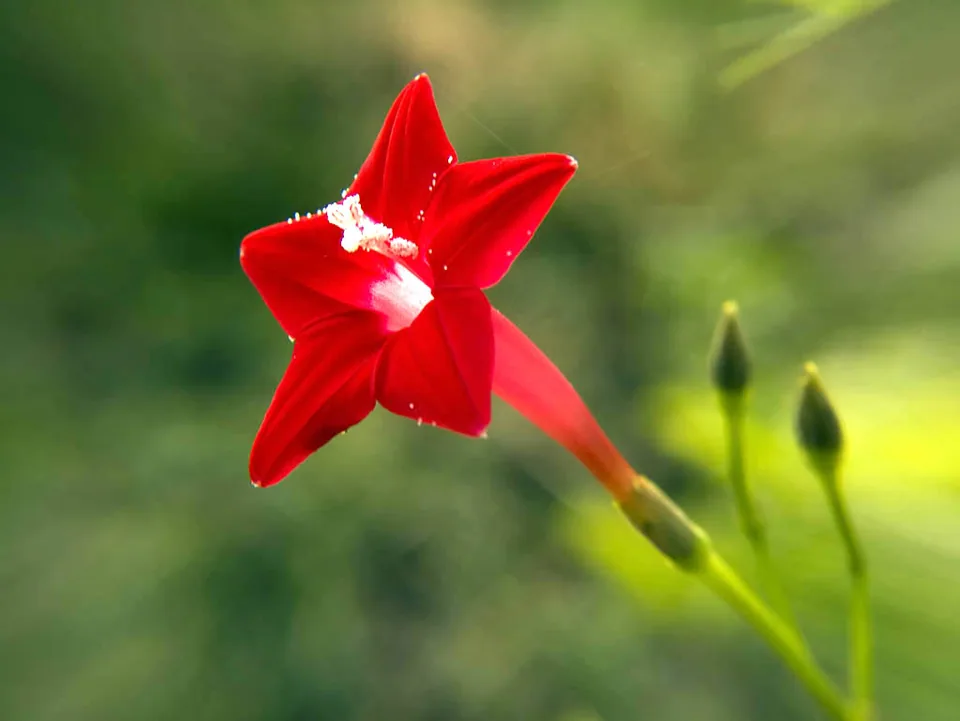


Cómo cultivar y cuidar Cundeamor
Ipomoea quamoclit
Escrito por Emilio Marruso · última revisión
Tóxica para: Gatos, Perros, Caballos, Personas · Por qué
De un vistazo
Esta anual agradecida es muy fácil de empezar: siembra en primavera, cuando la tierra se caliente, y dale sol pleno, aunque también tolera la semisombra. Aguanta algo de sequía, solo pide un abono líquido ligero cada pocas semanas y se extiende de 0,9 a 1,8 m de ancho. No te pases con el abono: demasiado nitrógeno da hojas en vez de flores.
- Sol
Sol pleno; también tolera la semisombra
Qué dicen las fuentes (2)
Luz: Pleno sol; tolera semisombra
This plant grows in full sun in average soil and requires good drainage but adequate moisture.
— Ipomoea quamoclit (Cypress Vine, Cypressvine Morningglory) | North Carolina Extension Gardener Plant Toolbox [1] Full sun to partial shade. Moist, well drained soils are best, but this vine will tolerate some dryness.
— Cypress Vine (Ipomoea quamoclit)-Hort Answers - University of Illinois Extension [4] - Riego
Riega con regularidad en épocas secas; tolera algo de sequía
Qué dicen las fuentes (3)
Riego: Humedad adecuada con buen drenaje; tolera algo de sequía y tanto suelo húmedo como seco; riega regularmente durante los períodos secos
This plant grows in full sun in average soil and requires good drainage but adequate moisture. It tolerates deer, some drought, and both wet and dry soil conditions.
— Ipomoea quamoclit (Cypress Vine, Cypressvine Morningglory) | North Carolina Extension Gardener Plant Toolbox [1] Water regularly during dry spells to keep the vine blooming strong, but it generally does not need heavy fertilizing.
— Cypress vine is fast-growing non-native garden highlight | Mississippi State University Extension Service [3] Notas sobre el riego: El suelo húmedo y bien drenado es lo mejor, pero tolera algo de sequedad
Moist, well drained soils are best, but this vine will tolerate some dryness. Cultivars
— Cypress Vine (Ipomoea quamoclit)-Hort Answers - University of Illinois Extension [4] - Frío
Aguanta inviernos de hasta 4,4 °C (40 °F)
Delicada: necesita invernadero sin heladas · USDA 11a · RHS H2 · Z11
Qué dicen las fuentes (2)
Rusticidad, zona más fría: 11a [mínima invernal de 4,4 a 7,2 °C (de 40 a 45 °F)]
USDA Plant Hardiness Zone: 11a, 11b, 12a, 12b
— Ipomoea quamoclit (Cypress Vine, Cypressvine Morningglory) | North Carolina Extension Gardener Plant Toolbox [1] Rusticidad, zona más cálida: 12b [mínima invernal de 12,8 a 15,6 °C (de 55 a 60 °F)]
USDA Plant Hardiness Zone: 11a, 11b, 12a, 12b
— Ipomoea quamoclit (Cypress Vine, Cypressvine Morningglory) | North Carolina Extension Gardener Plant Toolbox [1] - Suelo
Lo mejor es un suelo húmedo y con buen drenaje
Qué dicen las fuentes (3)
Notas sobre el riego: El suelo húmedo y bien drenado es lo mejor, pero tolera algo de sequedad
Moist, well drained soils are best, but this vine will tolerate some dryness. Cultivars
— Cypress Vine (Ipomoea quamoclit)-Hort Answers - University of Illinois Extension [4] Riego: Humedad adecuada con buen drenaje; tolera algo de sequía y tanto suelo húmedo como seco; riega regularmente durante los períodos secos
This plant grows in full sun in average soil and requires good drainage but adequate moisture. It tolerates deer, some drought, and both wet and dry soil conditions.
— Ipomoea quamoclit (Cypress Vine, Cypressvine Morningglory) | North Carolina Extension Gardener Plant Toolbox [1] Water regularly during dry spells to keep the vine blooming strong, but it generally does not need heavy fertilizing.
— Cypress vine is fast-growing non-native garden highlight | Mississippi State University Extension Service [3] - Abonado
Un abono líquido ligero cada pocas semanas; demasiado nitrógeno da hojas en vez de flores
Qué dicen las fuentes (5)
Frecuencia: Un fertilizante líquido ligero cada pocas semanas
A balanced, slow-release fertilizer or a light application of liquid feed every few weeks is usually all it needs.
— Cypress vine is fast-growing non-native garden highlight | Mississippi State University Extension Service [3] Abonos minerales: Un fertilizante de liberación lenta equilibrado, o un fertilizante líquido ligero; sin fertilización pesada
A balanced, slow-release fertilizer or a light application of liquid feed every few weeks is usually all it needs.
— Cypress vine is fast-growing non-native garden highlight | Mississippi State University Extension Service [3] Water regularly during dry spells to keep the vine blooming strong, but it generally does not need heavy fertilizing.
— Cypress vine is fast-growing non-native garden highlight | Mississippi State University Extension Service [3] Evitar: Fertilización pesada y demasiado nitrógeno
but it generally does not need heavy fertilizing. Too much nitrogen encourages leaf production at the expense of flowers.
— Cypress vine is fast-growing non-native garden highlight | Mississippi State University Extension Service [3] Signos de exceso: Crecimiento frondoso a expensas de las flores
Too much nitrogen encourages leaf production at the expense of flowers.
— Cypress vine is fast-growing non-native garden highlight | Mississippi State University Extension Service [3] - Plagas
Sin problemas graves de plagas ni enfermedades
- Atención
Se resiembra mucho y puede salir en cualquier sitio; arranca a mano las plántulas en primavera
- Tamaño
De 0,9 a 1,8 m de ancho
Qué dicen las fuentes (1)
Anchura adulta: 91-183 cm (3 pies 0 pulg - 6 pies 0 pulg)
Dimensions: Height: 15 ft. 0 in. - 20 ft. 0 in. Width: 3 ft. 0 in. - 6 ft. 0 in.
— Ipomoea quamoclit (Cypress Vine, Cypressvine Morningglory) | North Carolina Extension Gardener Plant Toolbox [1] - Multiplicación
Se multiplica por semilla
Qué dicen las fuentes (2)
Propagación: Semilla
Start it from seed once the soil warms in spring. The seeds have a tough coat
— Cypress vine is fast-growing non-native garden highlight | Mississippi State University Extension Service [3] Germination of seeds is aided by scarifying and soaking in water for 12-24 hours.
— Ipomoea quamoclit (Cypress Vine, Cypressvine Morningglory) | North Carolina Extension Gardener Plant Toolbox [1] - Siembra
Siembra en primavera, cuando la tierra se caliente
Qué dicen las fuentes (2)
Siembra: Primavera, una vez que el suelo se calienta
el sur (cultivado como anual): Cypress vine is grown as an annual in most of the South. Start it from seed once the soil warms in spring.
— Cypress vine is fast-growing non-native garden highlight | Mississippi State University Extension Service [3] Start it from seed once the soil warms in spring. The seeds have a tough coat
— Cypress vine is fast-growing non-native garden highlight | Mississippi State University Extension Service [3] - Seguridad
Tóxica para perros, gatos y caballos; en personas puede causar vómitos y muchas semillas, alucinaciones
Resumen
La vid de ciprés es una enredadera anual de crecimiento rápido con follaje parecido a helechos y pequeñas flores rojo escarlata. [1][3] Crece a pleno sol con buen drenaje y humedad adecuada, y se resiembra fácilmente. [1][3] Se reporta como tóxica para perros, gatos y caballos. [1]
Citado en inglés, como en la fuente.
Esta ficha está incompleta: las fuentes consultadas aún no cubren todos los campos.
Aún no cubierto por nuestras fuentes: Poda
Cuidados
Riego
Riego
Humedad adecuada con buen drenaje; tolera algo de sequía y tanto suelo húmedo como seco; riega regularmente durante los períodos secos
Qué dicen las fuentes (2)
This plant grows in full sun in average soil and requires good drainage but adequate moisture. It tolerates deer, some drought, and both wet and dry soil conditions.Water regularly during dry spells to keep the vine blooming strong, but it generally does not need heavy fertilizing.Notas sobre el riego
El suelo húmedo y bien drenado es lo mejor, pero tolera algo de sequedad
Qué dicen las fuentes (1)
Moist, well drained soils are best, but this vine will tolerate some dryness.
CultivarsLuz
Pleno sol; tolera semisombra
Qué dicen las fuentes (2)
This plant grows in full sun in average soil and requires good drainage but adequate moisture.Full sun to partial shade. Moist, well drained soils are best, but this vine will tolerate some dryness.Clima y frío
Rusticidad, zona más fría
11a [mínima invernal de 4,4 a 7,2 °C (de 40 a 45 °F)]
Qué dicen las fuentes (1)
USDA Plant Hardiness Zone:
11a, 11b, 12a, 12bRusticidad, zona más cálida
12b [mínima invernal de 12,8 a 15,6 °C (de 55 a 60 °F)]
Qué dicen las fuentes (1)
USDA Plant Hardiness Zone:
11a, 11b, 12a, 12bPropagación
Semilla
Qué dicen las fuentes (2)
Start it from seed once the soil warms in spring. The seeds have a tough coatGermination of seeds is aided by scarifying and soaking in water for 12-24 hours.Cultivo
La planta
Ciclo de vida
anual
Qué dicen las fuentes (1)
Alhough it is an annual, it spreads quickly by self-seeding.Familia
Convolvulaceae
Qué dicen las fuentes (1)
This weedy vine is native to the tropics of South Americain the morning glory family (Convolvulaceae).Altura adulta
Anchura adulta
91-183 cm (3 pies 0 pulg - 6 pies 0 pulg)
Qué dicen las fuentes (1)
Dimensions: Height: 15 ft. 0 in. - 20 ft. 0 in. Width: 3 ft. 0 in. - 6 ft. 0 in.Abonado
Frecuencia
Un fertilizante líquido ligero cada pocas semanas
Qué dicen las fuentes (1)
A balanced, slow-release fertilizer or a light application of liquid feed every few weeks is usually all it needs.Abonos minerales
Un fertilizante de liberación lenta equilibrado, o un fertilizante líquido ligero; sin fertilización pesada
Qué dicen las fuentes (2)
A balanced, slow-release fertilizer or a light application of liquid feed every few weeks is usually all it needs.Water regularly during dry spells to keep the vine blooming strong, but it generally does not need heavy fertilizing.Evitar
Fertilización pesada y demasiado nitrógeno
Qué dicen las fuentes (1)
but it generally does not need heavy fertilizing. Too much nitrogen encourages leaf production at the expense of flowers.Signos de exceso
Crecimiento frondoso a expensas de las flores
Qué dicen las fuentes (1)
Too much nitrogen encourages leaf production at the expense of flowers.Problemas
Maleza que se resiembra sola
Síntoma: Resiembra prolífica; puede volverse agresiva y aparecer en lugares inesperados
Qué hacer: UF IFAS recomienda arrancar a mano los nuevos brotes en primavera; el acolchado con láminas puede reducir la germinación
Qué dicen las fuentes (2)
Once it blooms and sets seed, new vines sprout the following spring, sometimes in unexpected places.
— Cypress vine is fast-growing non-native garden highlight | Mississippi State University Extension Service [3] Cultural/Physical Hand pull new sprouts in Spring. Sheet mulching can reduce germination.
— | Center for Aquatic and Invasive Plants | University of Florida, IFAS [2] Plagas y enfermedades
Síntoma: Sin problemas graves; puede volverse algo invasiva
Qué hacer: No especificado en la fuente
Qué dicen las fuentes (1)
Insects, Diseases, and Other Plant Problems: No serious problems. Can be somewhat weedy.
— Ipomoea quamoclit (Cypress Vine, Cypressvine Morningglory) | North Carolina Extension Gardener Plant Toolbox [1]
Remedios
Cada remedio indica qué dicen las fuentes oficiales; los remedios tradicionales sin fuente oficial aparecen marcados. Los perjudiciales están para que sepas evitarlos.
Cómo eliminarla
autosiembra invasiva
arrancando brotes nuevos con las manos Funciona
Cómo: Arranca los brotes nuevos con las manos en primavera.
Hand pull new sprouts in Spring. Sheet mulching can reduce germination.
— | Center for Aquatic and Invasive Plants | University of Florida, IFAS [2] Qué dicen las pruebas Regularly pulling, hoeing or mowing weeds and encouraging grass to grow and out-compete the weeds is an excellent solution.
— extension.usu.edu [6] acolchado en láminas (barrera contra malezas cubierta con mantillo) Funciona
Cómo: El acolchado en láminas puede reducir la germinación.
Hand pull new sprouts in Spring. Sheet mulching can reduce germination.
— | Center for Aquatic and Invasive Plants | University of Florida, IFAS [2] Qué dicen las pruebas Lay the material down to prevent sunlight from reaching the unwanted plants, and cover with mulch or other plant-resistant material.
— extension.usu.edu [6] Corta hasta el suelo cada dos semanas. No verificado
Remedio tradicional, no verificado por una fuente oficial.
Cómo: Corta una vid de ciprés hasta el suelo con tijeras de podar y sigue cortándola cada dos semanas. También puedes intentar arrancarla, lo cual es más fácil cuando el suelo está húmedo.
Desentierra plantas y arranca plántulas. Funciona
Cómo: Desentierra las plantas y luego arranca diligentemente las plántulas que brotaron.
They were controlled by digging them up and then diligently pulling the seedlings that sprouted.
— ajc.com [7] Qué dicen las pruebas Regularly pulling, hoeing or mowing weeds and encouraging grass to grow and out-compete the weeds is an excellent solution.
— extension.usu.edu [6]
Venenosa para los animales
Según la fuente, citada textualmente. No es un consejo médico ni veterinario: si una persona o un animal pudo haber ingerido esta planta, contacta con un centro de toxicología o con un veterinario.
Animales
It is toxic to dogs, cats and horses though.
[1]La fuente señala el riesgo para este animal pero no explica por qué.
Personas
Poison Severity: Low Poison Symptoms: Vomiting, large amounts of seeds may cause hallucinations
[1]
Calendario
Siembra
Primavera, una vez que el suelo se calienta
Lo que dice cada fuente
el sur (cultivado como anual): Primavera, una vez que el suelo se calienta
Qué dicen las fuentes (2)
el sur (cultivado como anual): Cypress vine is grown as an annual in most of the South. Start it from seed once the soil warms in spring.Start it from seed once the soil warms in spring. The seeds have a tough coatPoda
No figura en las fuentes consultadas.
Meses tal como los dan las fuentes, en su mayoría de Estados Unidos (hemisferio norte). En el hemisferio sur se desplazan unos seis meses.
Valores orientativos
Valores de una fuente secundaria, no comprobados palabra por palabra como el resto de esta página. Úselos como punto de partida.
- Horas de sol
- 6-8 horasValor orientativo, adáptalo a tu clima · Fuente secundaria
- Resiste la sequía
- SíValor orientativo, adáptalo a tu clima · Fuente secundaria
- pH del suelo
- 6-7.5Valor orientativo, adáptalo a tu clima · Fuente secundaria
- Nivel de cuidado
- MedioValor orientativo, adáptalo a tu clima · Fuente secundaria
- Crecimiento
- AltaValor orientativo, adáptalo a tu clima · Fuente secundaria
- Poda
- Marzo, abril, junio, julio, agostoValor orientativo, adáptalo a tu clima · Fuente secundaria
Plantas similares
- Beach Morning-glory Ipomoea imperati
- Gloria de la mañana Ipomoea purpurea
- Quiebra-cajete Ipomoea alba
- Morning Glory Ipomoea sagittata
- Morning Glory Ipomoea tricolor
- Campanita morada Ipomoea indica
- Scarlet Creeper Ipomoea coccinea
- Bandera de fuego Ipomoea lobata
Fuentes
Cada valor anterior se cita de estos documentos. Los enlaces llevan al editor original.
- Ipomoea quamoclit (Cypress Vine, Cypressvine Morningglory) | North Carolina Extension Gardener Plant Toolbox · plants.ces.ncsu.edu, consultado
- | Center for Aquatic and Invasive Plants | University of Florida, IFAS · plant-directory.ifas.ufl.edu, consultado
- Cypress vine is fast-growing non-native garden highlight | Mississippi State University Extension Service · extension.msstate.edu, consultado
- Cypress Vine (Ipomoea quamoclit)-Hort Answers - University of Illinois Extension · web.extension.illinois.edu, consultado
- Ipomoea (Cypress Vine, Morning Glory) | North Carolina Extension Gardener Plant Toolbox · plants.ces.ncsu.edu, consultado
- extension.usu.edu · extension.usu.edu
- ajc.com · ajc.com
Escrito por Emilio Marruso · última revisión