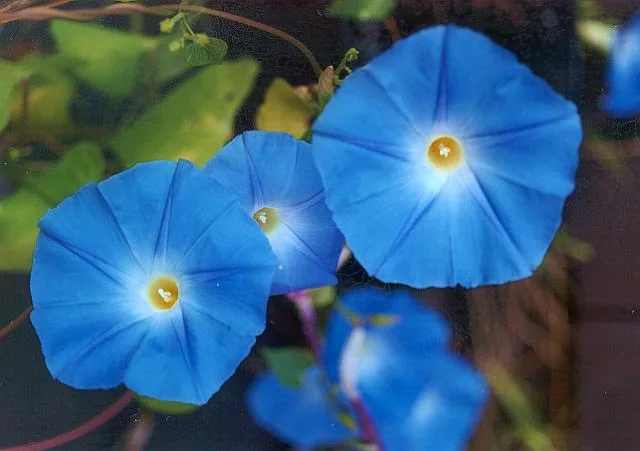


Cómo cultivar y cuidar Morning Glory
Ipomoea tricolor
Escrito por Emilio Marruso · última revisión
Tóxica para: Gatos, Perros, Caballos, Personas · Por qué
De un vistazo
El dondiego de día es una anual fácil de cultivar a partir de semilla: dale sol pleno y un suelo húmedo y bien drenado, y apenas necesitará abono, porque crece bien incluso en tierra pobre. Alcanza 2,4–3 m de alto y también se da bien en maceta. Eso sí, mantén sus semillas lejos de los niños y las mascotas.
- Sol
Sol pleno
Qué dicen las fuentes (1)
Luz: Pleno sol
The morning glory will thrive best in full sun and moist, well-drained soil.
— Ipomoea tricolor (Flying Saucers, Grannyvine, Heavenly Blue Morning Glory, Morning Glory, Pearly Gates Morning Glory) | North Carolina Extension Gardener Plant Toolbox [1] - Riego
Mantén la tierra húmeda pero nunca encharcada: no tolera el agua estancada
Qué dicen las fuentes (2)
Riego: Suelo húmedo y bien drenado
The morning glory will thrive best in full sun and moist, well-drained soil.
— Ipomoea tricolor (Flying Saucers, Grannyvine, Heavenly Blue Morning Glory, Morning Glory, Pearly Gates Morning Glory) | North Carolina Extension Gardener Plant Toolbox [1] Notas sobre el riego: No tolera el agua estancada.
It does not tolerate standing water, but it is tolerant to heat and urban conditions.
— Ipomoea tricolor (Flying Saucers, Grannyvine, Heavenly Blue Morning Glory, Morning Glory, Pearly Gates Morning Glory) | North Carolina Extension Gardener Plant Toolbox [1] - Frío
Aguanta inviernos de hasta −45,6 °C (−50 °F)
Muy rústica · USDA 2a · RHS H7 · Z2
Qué dicen las fuentes (2)
Rusticidad, zona más fría: 2a [mínima invernal de −45,6 a −42,8 °C (de −50 a −45 °F)]
2a, 2b, 3a, 3b, 4a, 4b, 5a, 5b, 6a, 6b, 7a, 7b, 8a, 8b, 9a, 9b, 10a, 10b, 11a, 11b, 12a, 12b
— Ipomoea tricolor (Flying Saucers, Grannyvine, Heavenly Blue Morning Glory, Morning Glory, Pearly Gates Morning Glory) | North Carolina Extension Gardener Plant Toolbox [1] Rusticidad, zona más cálida: 12b [mínima invernal de 12,8 a 15,6 °C (de 55 a 60 °F)]
2a, 2b, 3a, 3b, 4a, 4b, 5a, 5b, 6a, 6b, 7a, 7b, 8a, 8b, 9a, 9b, 10a, 10b, 11a, 11b, 12a, 12b
— Ipomoea tricolor (Flying Saucers, Grannyvine, Heavenly Blue Morning Glory, Morning Glory, Pearly Gates Morning Glory) | North Carolina Extension Gardener Plant Toolbox [1] - Suelo
Suelo bien drenado; crece bien incluso en tierra pobre
Qué dicen las fuentes (2)
Riego: Suelo húmedo y bien drenado
The morning glory will thrive best in full sun and moist, well-drained soil.
— Ipomoea tricolor (Flying Saucers, Grannyvine, Heavenly Blue Morning Glory, Morning Glory, Pearly Gates Morning Glory) | North Carolina Extension Gardener Plant Toolbox [1] Abonos minerales: Poco o nada: se desarrolla bien en suelos pobres
It will perform well in poor soil with little or no fertilizer
— Ipomoea tricolor (Flying Saucers, Grannyvine, Heavenly Blue Morning Glory, Morning Glory, Pearly Gates Morning Glory) | North Carolina Extension Gardener Plant Toolbox [1] - Abonado
Necesita poco abono o ninguno
Qué dicen las fuentes (1)
Abonos minerales: Poco o nada: se desarrolla bien en suelos pobres
It will perform well in poor soil with little or no fertilizer
— Ipomoea tricolor (Flying Saucers, Grannyvine, Heavenly Blue Morning Glory, Morning Glory, Pearly Gates Morning Glory) | North Carolina Extension Gardener Plant Toolbox [1] - Plagas
Vigila el pulgón, la araña roja, los minadores de hojas y las orugas
Qué dicen las fuentes (1)
Plagas: pulgones, arañitas rojas, minadores de hoja, orugas
Monitor for aphids, spider mites, leaf miners, and caterpillars.
— Ipomoea tricolor (Flying Saucers, Grannyvine, Heavenly Blue Morning Glory, Morning Glory, Pearly Gates Morning Glory) | North Carolina Extension Gardener Plant Toolbox [1] - Atención
Se resiembra sola y puede volverse invasora
- Tamaño
2,4–3 m de alto y 0,9–1,8 m de ancho
Qué dicen las fuentes (2)
Altura adulta: 244-305 cm (8 pies - 10 pies)
Height: 8 ft. 0 in. - 10 ft. 0 in.
— Ipomoea tricolor (Flying Saucers, Grannyvine, Heavenly Blue Morning Glory, Morning Glory, Pearly Gates Morning Glory) | North Carolina Extension Gardener Plant Toolbox [1] Anchura adulta: 91-183 cm (3 pies - 6 pies)
Width: 3 ft. 0 in. - 6 ft. 0 in.
— Ipomoea tricolor (Flying Saucers, Grannyvine, Heavenly Blue Morning Glory, Morning Glory, Pearly Gates Morning Glory) | North Carolina Extension Gardener Plant Toolbox [1] - Multiplicación
Es anual y se multiplica por semilla
Qué dicen las fuentes (2)
Propagación: Semilla
Uses (Ethnobotany): The morning glory reportedly has environmental and social uses. The plant can be used as a poison or medicine. Life Cycle: Annual Recommended Propagation Strategy: Seed
— Ipomoea tricolor (Flying Saucers, Grannyvine, Heavenly Blue Morning Glory, Morning Glory, Pearly Gates Morning Glory) | North Carolina Extension Gardener Plant Toolbox [1] Ciclo de vida: anual
Life Cycle: Annual
— Ipomoea tricolor (Flying Saucers, Grannyvine, Heavenly Blue Morning Glory, Morning Glory, Pearly Gates Morning Glory) | North Carolina Extension Gardener Plant Toolbox [1] - Maceta
Crece también en maceta
Qué dicen las fuentes (1)
En maceta: Sí
The plant may be used as groundcover, container plant, or grown on a trellis or arbor.
— Ipomoea tricolor (Flying Saucers, Grannyvine, Heavenly Blue Morning Glory, Morning Glory, Pearly Gates Morning Glory) | North Carolina Extension Gardener Plant Toolbox [1] - Seguridad
Tóxica para personas, perros, gatos y caballos: las semillas pueden causar alucinaciones
Resumen
La Ipomoea tricolor es una enredadera anual ornamental de rápido crecimiento que alcanza de 8 a 10 pies [2,4–3 m] de altura y de 3 a 6 pies [0,9–1,8 m] de ancho. [1] Prospera a pleno sol y en suelo húmedo y bien drenado, y necesita un soporte como un enrejado. [1] La página indica que es tóxica para perros, gatos y caballos, y que las semillas pueden causar alucinaciones. [1]
Citado en inglés, como en la fuente.
Esta ficha está incompleta: las fuentes consultadas aún no cubren todos los campos.
Aún no cubierto por nuestras fuentes: Poda
Cuidados
Las medidas entre corchetes son nuestra conversión al otro sistema de unidades; el texto citado no cambia.
Riego
Riego
Suelo húmedo y bien drenado
Qué dicen las fuentes (1)
The morning glory will thrive best in full sun and moist, well-drained soil.Notas sobre el riego
No tolera el agua estancada.
Qué dicen las fuentes (1)
It does not tolerate standing water, but it is tolerant to heat and urban conditions.Luz
Pleno sol
Qué dicen las fuentes (1)
The morning glory will thrive best in full sun and moist, well-drained soil.Clima y frío
Rusticidad, zona más fría
2a [mínima invernal de −45,6 a −42,8 °C (de −50 a −45 °F)]
Qué dicen las fuentes (1)
2a, 2b, 3a, 3b, 4a, 4b, 5a, 5b, 6a, 6b, 7a, 7b, 8a, 8b, 9a, 9b, 10a, 10b, 11a, 11b, 12a, 12bRusticidad, zona más cálida
12b [mínima invernal de 12,8 a 15,6 °C (de 55 a 60 °F)]
Qué dicen las fuentes (1)
2a, 2b, 3a, 3b, 4a, 4b, 5a, 5b, 6a, 6b, 7a, 7b, 8a, 8b, 9a, 9b, 10a, 10b, 11a, 11b, 12a, 12bDónde cultivarla
Sí
Qué dicen las fuentes (1)
The plant may be used as groundcover, container plant, or grown on a trellis or arbor.Propagación
Semilla
Qué dicen las fuentes (1)
Uses (Ethnobotany):
The morning glory reportedly has environmental and social uses. The plant can be used as a poison or medicine.
Life Cycle:
Annual
Recommended Propagation Strategy:
SeedCultivo
La planta
Ciclo de vida
anual
Qué dicen las fuentes (1)
Life Cycle: AnnualFamilia
Convolvulaceae
Qué dicen las fuentes (1)
Family: ConvolvulaceaeAltura adulta
244-305 cm (8 pies - 10 pies)
Qué dicen las fuentes (1)
Height: 8 ft. 0 in. - 10 ft. 0 in.Anchura adulta
91-183 cm (3 pies - 6 pies)
Qué dicen las fuentes (1)
Width: 3 ft. 0 in. - 6 ft. 0 in.Plagas y enfermedades
Plagas
pulgones, arañitas rojas, minadores de hoja, orugas
Qué dicen las fuentes (1)
Monitor for aphids, spider mites, leaf miners, and caterpillars.Abonado
Abonos minerales
Poco o nada: se desarrolla bien en suelos pobres
Qué dicen las fuentes (1)
It will perform well in poor soil with little or no fertilizerProblemas
Resiembra espontánea y carácter de maleza
Síntoma: Tiende a volverse maleza y puede ser problemática en la agricultura.
Qué hacer: Si es necesario, controla con herbicidas preemergentes.
Qué dicen las fuentes (1)
It is self-seeding and tends to become weedy and can be troublesome in agriculture. If necessary, the plant may be controlled by preemergent herbicides.
— Ipomoea tricolor (Flying Saucers, Grannyvine, Heavenly Blue Morning Glory, Morning Glory, Pearly Gates Morning Glory) | North Carolina Extension Gardener Plant Toolbox [1] Insectos
Síntoma: Vigila la presencia de pulgones, arañitas rojas, minadores de hojas y orugas.
Qué dicen las fuentes (1)
The morning glory has no serious insect or disease problems. Monitor for aphids, spider mites, leaf miners, and caterpillars.
— Ipomoea tricolor (Flying Saucers, Grannyvine, Heavenly Blue Morning Glory, Morning Glory, Pearly Gates Morning Glory) | North Carolina Extension Gardener Plant Toolbox [1]
Remedios
Cada remedio indica qué dicen las fuentes oficiales; los remedios tradicionales sin fuente oficial aparecen marcados. Los perjudiciales están para que sepas evitarlos.
Cuidar la planta
pulgones
jabón insecticida Funciona
Cómo: Usa jabón insecticida en colonias rebeldes por la tarde.
Blast with water, support ladybirds and lacewings, and use insecticidal soap or neem on stubborn colonies in the evening.
— growplants.org [3] Qué dicen las pruebas For example, insecticidal soap is a safe, effective organic insecticide with minimal environmental impact.
— extension.psu.edu [4]
escarabajos de la pulga
recogida manual Funciona
Cómo: Tolera daños leves y recoge los escarabajos a mano.
Tolerate light feeding, hand-pick beetles, keep plants vigorous, and use neem or spinosad only if damage becomes heavy on young plants.
— growplants.org [3] Qué dicen las pruebas Many insect and disease issues can be solved in the home garden by hand-picking insects or clipping and disposing of diseased plant parts.
— extension.unh.edu [5]
orugas
recogida manual Funciona
Cómo: Recoge a mano y desenrolla las hojas para eliminar las larvas.
Hand-pick and unroll leaves to remove larvae, encourage parasitic wasps and birds, and spray Bacillus thuringiensis (Bt) for significant infestations.
— growplants.org [3] Qué dicen las pruebas Many insect and disease issues can be solved in the home garden by hand-picking insects or clipping and disposing of diseased plant parts.
— extension.unh.edu [5]
plagas
Lava con agua fresca No verificado
Remedio tradicional, no verificado por una fuente oficial.
Cómo: Si la planta tiene plagas, lávalas con rociados de agua fresca.
Cómo eliminarla
autosiembra
Arranca las plantas voluntarias temprano. No verificado
Remedio tradicional, no verificado por una fuente oficial.
It is also recommended to wear protective gloves when handling the morning glory.
— Ipomoea tricolor (Flying Saucers, Grannyvine, Heavenly Blue Morning Glory, Morning Glory, Pearly Gates Morning Glory) | North Carolina Extension Gardener Plant Toolbox [1] Cómo: Quita las flores marchitas antes de que maduren las semillas para limitar la autosiembra y arranca temprano las plantas espontáneas.
Venenosa para los animales
Según la fuente, citada textualmente. No es un consejo médico ni veterinario: si una persona o un animal pudo haber ingerido esta planta, contacta con un centro de toxicología o con un veterinario.
Animales
This plant is toxic to dogs, cats, and horses. Ingestion of the seeds of this plant can cause hallucinations.
[1]
Personas
Calendario
Poda
No figura en las fuentes consultadas.
Meses tal como los dan las fuentes, en su mayoría de Estados Unidos (hemisferio norte). En el hemisferio sur se desplazan unos seis meses.
Plantas similares
- Beach Morning-glory Ipomoea imperati
- Gloria de la mañana Ipomoea purpurea
- Cundeamor Ipomoea quamoclit
- Quiebra-cajete Ipomoea alba
- Morning Glory Ipomoea sagittata
- Campanita morada Ipomoea indica
- Scarlet Creeper Ipomoea coccinea
- Bandera de fuego Ipomoea lobata
Fuentes
Cada valor anterior se cita de estos documentos. Los enlaces llevan al editor original.
- Ipomoea tricolor (Flying Saucers, Grannyvine, Heavenly Blue Morning Glory, Morning Glory, Pearly Gates Morning Glory) | North Carolina Extension Gardener Plant Toolbox · plants.ces.ncsu.edu, consultado
- Morning Glory - Ipomoea tricolor | North Carolina Extension Gardener Plant Toolbox · plants.ces.ncsu.edu, consultado
- growplants.org · growplants.org
- extension.psu.edu · extension.psu.edu
- extension.unh.edu · extension.unh.edu
Escrito por Emilio Marruso · última revisión