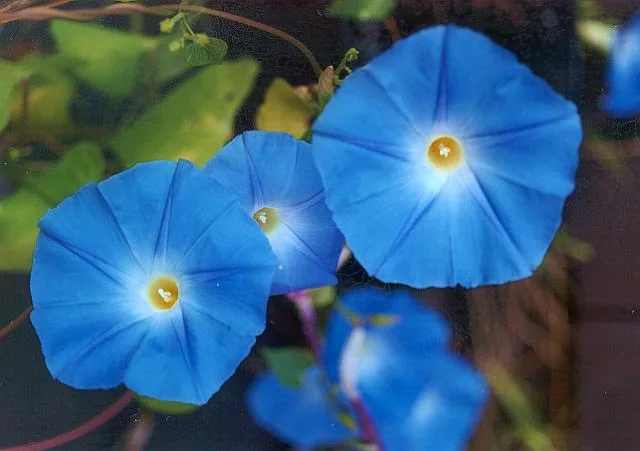


How to Grow and Care for Morning Glory
Ipomoea tricolor
Written by Emilio Marruso · last checked
Toxic to: Cats, Dogs, Horses, People · Why
At a glance
Morning glory is an easy annual to grow from seed: give it full sun and moist, well-drained soil, and it needs little or no fertilizer, because it does well even in poor soil. It reaches 8–10 ft tall and grows happily in containers too. Just keep its seeds away from children and pets.
- Sun
Full sun
What the sources say (1)
Light: Full sun
The morning glory will thrive best in full sun and moist, well-drained soil.
— Ipomoea tricolor (Flying Saucers, Grannyvine, Heavenly Blue Morning Glory, Morning Glory, Pearly Gates Morning Glory) | North Carolina Extension Gardener Plant Toolbox [1] - Water
Keep the soil moist but never soggy: it can't stand standing water
What the sources say (2)
Watering: Moist, well-drained soil
The morning glory will thrive best in full sun and moist, well-drained soil.
— Ipomoea tricolor (Flying Saucers, Grannyvine, Heavenly Blue Morning Glory, Morning Glory, Pearly Gates Morning Glory) | North Carolina Extension Gardener Plant Toolbox [1] Watering notes: Does not tolerate standing water
It does not tolerate standing water, but it is tolerant to heat and urban conditions.
— Ipomoea tricolor (Flying Saucers, Grannyvine, Heavenly Blue Morning Glory, Morning Glory, Pearly Gates Morning Glory) | North Carolina Extension Gardener Plant Toolbox [1] - Cold
Survives winters down to −50 °F (−45.6 °C)
Very hardy · USDA 2a · RHS H7 · Z2
What the sources say (2)
Hardiness, coldest zone: 2a [winter low −45.6 to −42.8 °C (−50 to −45 °F)]
2a, 2b, 3a, 3b, 4a, 4b, 5a, 5b, 6a, 6b, 7a, 7b, 8a, 8b, 9a, 9b, 10a, 10b, 11a, 11b, 12a, 12b
— Ipomoea tricolor (Flying Saucers, Grannyvine, Heavenly Blue Morning Glory, Morning Glory, Pearly Gates Morning Glory) | North Carolina Extension Gardener Plant Toolbox [1] Hardiness, warmest zone: 12b [winter low 12.8 to 15.6 °C (55 to 60 °F)]
2a, 2b, 3a, 3b, 4a, 4b, 5a, 5b, 6a, 6b, 7a, 7b, 8a, 8b, 9a, 9b, 10a, 10b, 11a, 11b, 12a, 12b
— Ipomoea tricolor (Flying Saucers, Grannyvine, Heavenly Blue Morning Glory, Morning Glory, Pearly Gates Morning Glory) | North Carolina Extension Gardener Plant Toolbox [1] - Soil
Well-drained soil; it does well even in poor soil
What the sources say (2)
Watering: Moist, well-drained soil
The morning glory will thrive best in full sun and moist, well-drained soil.
— Ipomoea tricolor (Flying Saucers, Grannyvine, Heavenly Blue Morning Glory, Morning Glory, Pearly Gates Morning Glory) | North Carolina Extension Gardener Plant Toolbox [1] Mineral fertilizers: Little or none: it performs well in poor soil
It will perform well in poor soil with little or no fertilizer
— Ipomoea tricolor (Flying Saucers, Grannyvine, Heavenly Blue Morning Glory, Morning Glory, Pearly Gates Morning Glory) | North Carolina Extension Gardener Plant Toolbox [1] - Feeding
Little or no fertilizer needed
What the sources say (1)
Mineral fertilizers: Little or none: it performs well in poor soil
It will perform well in poor soil with little or no fertilizer
— Ipomoea tricolor (Flying Saucers, Grannyvine, Heavenly Blue Morning Glory, Morning Glory, Pearly Gates Morning Glory) | North Carolina Extension Gardener Plant Toolbox [1] - Pests
Watch for aphids, spider mites, leaf miners and caterpillars
What the sources say (1)
Pests: aphids, spider mites, leaf miners, caterpillars
Monitor for aphids, spider mites, leaf miners, and caterpillars.
— Ipomoea tricolor (Flying Saucers, Grannyvine, Heavenly Blue Morning Glory, Morning Glory, Pearly Gates Morning Glory) | North Carolina Extension Gardener Plant Toolbox [1] - Watch out
It reseeds itself and can turn weedy
- Size
8–10 ft tall and 3–6 ft wide
What the sources say (2)
Mature height: 244-305 cm (8 ft - 10 ft)
Height: 8 ft. 0 in. - 10 ft. 0 in.
— Ipomoea tricolor (Flying Saucers, Grannyvine, Heavenly Blue Morning Glory, Morning Glory, Pearly Gates Morning Glory) | North Carolina Extension Gardener Plant Toolbox [1] Mature width: 91-183 cm (3 ft - 6 ft)
Width: 3 ft. 0 in. - 6 ft. 0 in.
— Ipomoea tricolor (Flying Saucers, Grannyvine, Heavenly Blue Morning Glory, Morning Glory, Pearly Gates Morning Glory) | North Carolina Extension Gardener Plant Toolbox [1] - Propagation
An annual grown from seed
What the sources say (2)
Propagation: Seed
Uses (Ethnobotany): The morning glory reportedly has environmental and social uses. The plant can be used as a poison or medicine. Life Cycle: Annual Recommended Propagation Strategy: Seed
— Ipomoea tricolor (Flying Saucers, Grannyvine, Heavenly Blue Morning Glory, Morning Glory, Pearly Gates Morning Glory) | North Carolina Extension Gardener Plant Toolbox [1] Life cycle: annual
Life Cycle: Annual
— Ipomoea tricolor (Flying Saucers, Grannyvine, Heavenly Blue Morning Glory, Morning Glory, Pearly Gates Morning Glory) | North Carolina Extension Gardener Plant Toolbox [1] - Containers
Grows in containers too
What the sources say (1)
In containers: Yes
The plant may be used as groundcover, container plant, or grown on a trellis or arbor.
— Ipomoea tricolor (Flying Saucers, Grannyvine, Heavenly Blue Morning Glory, Morning Glory, Pearly Gates Morning Glory) | North Carolina Extension Gardener Plant Toolbox [1] - Safety
Toxic to people, dogs, cats and horses: the seeds can cause hallucinations
Overview
Ipomoea tricolor is a fast-growing, twining ornamental annual vine that grows 8 to 10 feet [2.4–3 m] tall and 3 to 6 feet [0.9–1.8 m] wide. [1] It thrives in full sun and moist, well-drained soil and needs a support such as a trellis. [1] The page states it is toxic to dogs, cats and horses, and that the seeds can cause hallucinations. [1]
This record is incomplete: the sources we read do not cover every field yet.
Not yet covered by our sources: Pruning
Morning Glory care
Measurements in square brackets are our conversion into the other unit system; the quoted text is unchanged.
How to water Morning Glory
Watering
Moist, well-drained soil
What the sources say (1)
The morning glory will thrive best in full sun and moist, well-drained soil.Watering notes
Does not tolerate standing water
What the sources say (1)
It does not tolerate standing water, but it is tolerant to heat and urban conditions.How much light Morning Glory needs
Full sun
What the sources say (1)
The morning glory will thrive best in full sun and moist, well-drained soil.How much cold Morning Glory can take
Hardiness, coldest zone
2a [winter low −45.6 to −42.8 °C (−50 to −45 °F)]
What the sources say (1)
2a, 2b, 3a, 3b, 4a, 4b, 5a, 5b, 6a, 6b, 7a, 7b, 8a, 8b, 9a, 9b, 10a, 10b, 11a, 11b, 12a, 12bHardiness, warmest zone
12b [winter low 12.8 to 15.6 °C (55 to 60 °F)]
What the sources say (1)
2a, 2b, 3a, 3b, 4a, 4b, 5a, 5b, 6a, 6b, 7a, 7b, 8a, 8b, 9a, 9b, 10a, 10b, 11a, 11b, 12a, 12bWhere to grow Morning Glory
Yes
What the sources say (1)
The plant may be used as groundcover, container plant, or grown on a trellis or arbor.How to propagate Morning Glory
Seed
What the sources say (1)
Uses (Ethnobotany):
The morning glory reportedly has environmental and social uses. The plant can be used as a poison or medicine.
Life Cycle:
Annual
Recommended Propagation Strategy:
SeedHow to grow Morning Glory
The plant
Life cycle
annual
What the sources say (1)
Life Cycle: AnnualFamily
Convolvulaceae
What the sources say (1)
Family: ConvolvulaceaeMature height
244-305 cm (8 ft - 10 ft)
What the sources say (1)
Height: 8 ft. 0 in. - 10 ft. 0 in.Mature width
91-183 cm (3 ft - 6 ft)
What the sources say (1)
Width: 3 ft. 0 in. - 6 ft. 0 in.Pests and diseases
Pests
aphids, spider mites, leaf miners, caterpillars
What the sources say (1)
Monitor for aphids, spider mites, leaf miners, and caterpillars.Fertilizing
Mineral fertilizers
Little or none: it performs well in poor soil
What the sources say (1)
It will perform well in poor soil with little or no fertilizerMorning Glory pests and problems
Self-seeding and weediness
Symptom: Tends to become weedy and can be troublesome in agriculture.
What to do: If necessary, control with preemergent herbicides.
What the sources say (1)
It is self-seeding and tends to become weedy and can be troublesome in agriculture. If necessary, the plant may be controlled by preemergent herbicides.
— Ipomoea tricolor (Flying Saucers, Grannyvine, Heavenly Blue Morning Glory, Morning Glory, Pearly Gates Morning Glory) | North Carolina Extension Gardener Plant Toolbox [1] Insects
Symptom: Monitor for aphids, spider mites, leaf miners, and caterpillars.
What the sources say (1)
The morning glory has no serious insect or disease problems. Monitor for aphids, spider mites, leaf miners, and caterpillars.
— Ipomoea tricolor (Flying Saucers, Grannyvine, Heavenly Blue Morning Glory, Morning Glory, Pearly Gates Morning Glory) | North Carolina Extension Gardener Plant Toolbox [1]
Remedies
Each remedy shows what official sources say about it; traditional remedies without an official source are marked as such. Harmful ones are listed so you know to avoid them.
Treating the plant
aphids
insecticidal soap Works
How: Use insecticidal soap on stubborn colonies in the evening.
Blast with water, support ladybirds and lacewings, and use insecticidal soap or neem on stubborn colonies in the evening.
— growplants.org [3] What the evidence says For example, insecticidal soap is a safe, effective organic insecticide with minimal environmental impact.
— extension.psu.edu [4]
flea beetles
hand-picking Works
How: Tolerate light damage and hand-pick the beetles.
Tolerate light feeding, hand-pick beetles, keep plants vigorous, and use neem or spinosad only if damage becomes heavy on young plants.
— growplants.org [3] What the evidence says Many insect and disease issues can be solved in the home garden by hand-picking insects or clipping and disposing of diseased plant parts.
— extension.unh.edu [5]
caterpillars
hand-picking Works
How: Hand-pick and unroll leaves to remove larvae.
Hand-pick and unroll leaves to remove larvae, encourage parasitic wasps and birds, and spray Bacillus thuringiensis (Bt) for significant infestations.
— growplants.org [3] What the evidence says Many insect and disease issues can be solved in the home garden by hand-picking insects or clipping and disposing of diseased plant parts.
— extension.unh.edu [5]
pests
washing off with cool water Not verified
Traditional remedy, not verified by an official source.
How: If the plant has any pests, wash them off with sprays of cool water.
Getting rid of it
self-seeding
pulling volunteers early Not verified
Traditional remedy, not verified by an official source.
It is also recommended to wear protective gloves when handling the morning glory.
— Ipomoea tricolor (Flying Saucers, Grannyvine, Heavenly Blue Morning Glory, Morning Glory, Pearly Gates Morning Glory) | North Carolina Extension Gardener Plant Toolbox [1] How: Deadhead before seeds ripen to limit self-sowing and pull volunteers early.
Is Morning Glory toxic to pets?
Reported by the source, quoted verbatim. This is not medical or veterinary advice: if a person or an animal may have eaten this plant, contact a poison control centre or a veterinarian.
Animals
This plant is toxic to dogs, cats, and horses. Ingestion of the seeds of this plant can cause hallucinations.
[1]
People
Calendar
Pruning
Not stated in the sources we read.
Months as given by the sources, which are mostly from the United States (northern hemisphere). In the southern hemisphere they shift by about six months.
Similar plants
- Beach Morning-glory Ipomoea imperati
- Common Morning Glory Ipomoea purpurea
- Cypress Vine Ipomoea quamoclit
- Moonflower Ipomoea alba
- Morning Glory Ipomoea sagittata
- Oceanblue Morning Glory Ipomoea indica
- Scarlet Creeper Ipomoea coccinea
- Spanish Flag Ipomoea lobata
Sources
Every value above is quoted from these documents. Links lead to the original publisher.
- Ipomoea tricolor (Flying Saucers, Grannyvine, Heavenly Blue Morning Glory, Morning Glory, Pearly Gates Morning Glory) | North Carolina Extension Gardener Plant Toolbox · plants.ces.ncsu.edu, consulted
- Morning Glory - Ipomoea tricolor | North Carolina Extension Gardener Plant Toolbox · plants.ces.ncsu.edu, consulted
- growplants.org · growplants.org
- extension.psu.edu · extension.psu.edu
- extension.unh.edu · extension.unh.edu
Written by Emilio Marruso · last checked