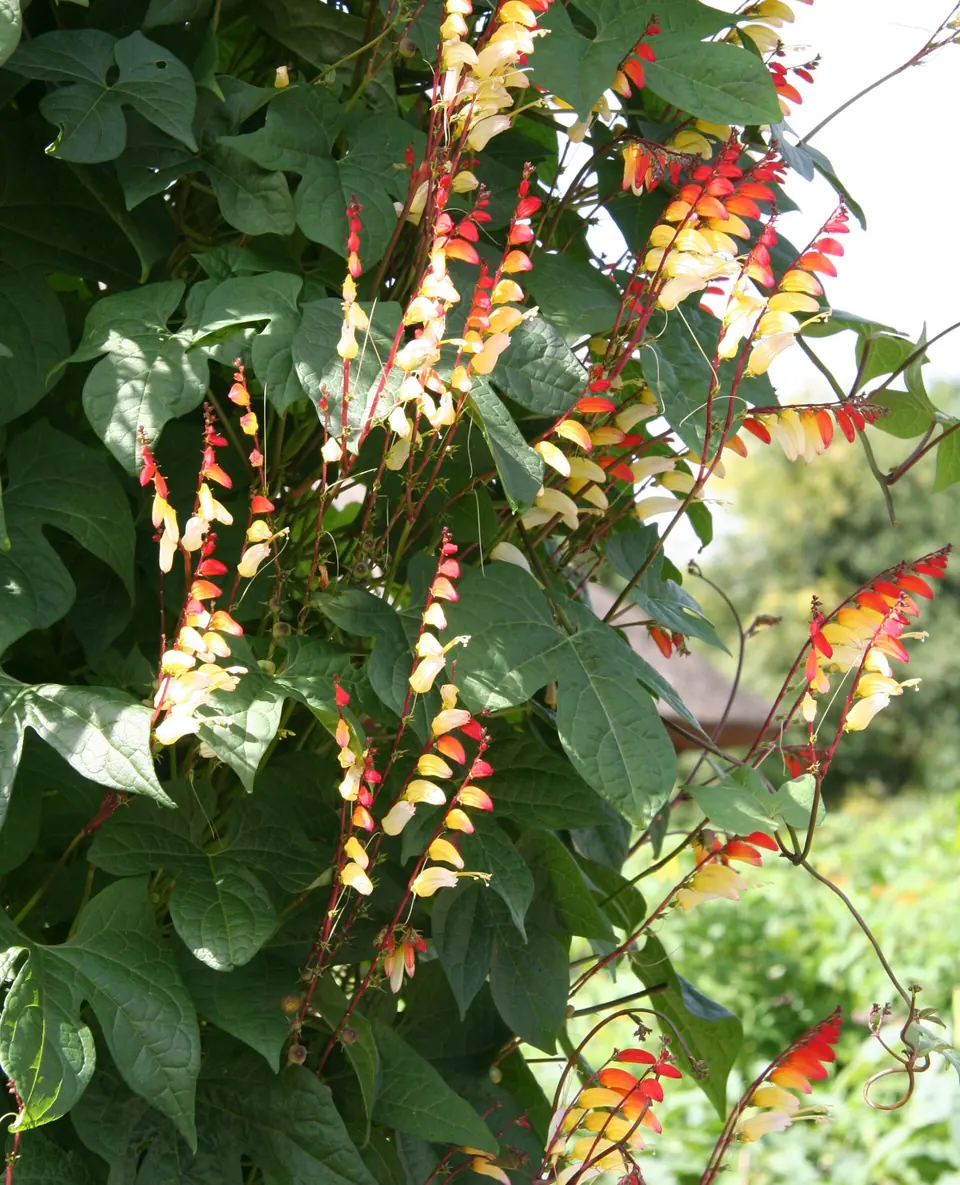


How to Grow and Care for Spanish Flag
Ipomoea lobata
Written by Emilio Marruso · last checked
Toxic to: Cats, Dogs, Horses, People · Why
At a glance
Grown as an annual, this plant can climb to 10–20 feet tall while staying just 1–2 feet wide. Start the seeds indoors six weeks before your last frost, then move it outside once the threat of frost has completely passed. Give it full sun and consistently moist soil, and it will flower at its best, even in a container.
- Sun
Full sun; it tolerates some shade, but it flowers less
What the sources say (1)
Light: Full sun; tolerates some shade, but flowering suffers
in a sheltered spot with full sun. It will tolerate some shade, but the colorful floral display will suffer.
— Ipomoea lobata (Firecracker Vine, Fire Vine, Spanish Flag) | North Carolina Extension Gardener Plant Toolbox [1] - Water
Keep the soil consistently moist
What the sources say (1)
Watering: Consistently moist soil
Spanish flag does best in consistently moist, organically rich, well-draining soil in a sheltered spot with full sun.
— Ipomoea lobata (Firecracker Vine, Fire Vine, Spanish Flag) | North Carolina Extension Gardener Plant Toolbox [1] - Cold
Survives winters down to 20 °F (−6.7 °C)
Hardy in average winters · USDA 9a · RHS H4 · Z9
What the sources say (2)
Hardiness, coldest zone: 9a [winter low −6.7 to −3.9 °C (20 to 25 °F)]
USDA Plant Hardiness Zone: 9a, 9b, 10a, 10b, 11a, 11b
— Ipomoea lobata (Firecracker Vine, Fire Vine, Spanish Flag) | North Carolina Extension Gardener Plant Toolbox [1] Hardiness, warmest zone: 11b [winter low 7.2 to 10 °C (45 to 50 °F)]
USDA Plant Hardiness Zone: 9a, 9b, 10a, 10b, 11a, 11b
— Ipomoea lobata (Firecracker Vine, Fire Vine, Spanish Flag) | North Carolina Extension Gardener Plant Toolbox [1] - Planting
Plant outdoors only once frost has completely passed; it can't take temperatures below 40 °F (4 °C)
What the sources say (1)
Planting: Outdoors once the threat of frost has completely passed
Keep the plant as a indoor plant or plant outdoors once the threat of frost has completely past.
— Ipomoea lobata (Firecracker Vine, Fire Vine, Spanish Flag) | North Carolina Extension Gardener Plant Toolbox [1] - Size
10–20 ft tall and 1–2 ft wide
What the sources say (2)
Mature height: 304.8-609.6 cm (10-20 ft)
Dimensions: Height: 10 ft. 0 in. - 20 ft. 0 in. Width: 1 ft. 0 in. - 2 ft. 0 in.
— Ipomoea lobata (Firecracker Vine, Fire Vine, Spanish Flag) | North Carolina Extension Gardener Plant Toolbox [1] Mature width: 30.48-60.96 cm (1-2 ft)
Dimensions: Height: 10 ft. 0 in. - 20 ft. 0 in. Width: 1 ft. 0 in. - 2 ft. 0 in.
— Ipomoea lobata (Firecracker Vine, Fire Vine, Spanish Flag) | North Carolina Extension Gardener Plant Toolbox [1] - Propagation
Grows from seed
What the sources say (1)
Propagation: Seed
Life Cycle: Annual Recommended Propagation Strategy: Seed
— Ipomoea lobata (Firecracker Vine, Fire Vine, Spanish Flag) | North Carolina Extension Gardener Plant Toolbox [1] - Sowing
Sow indoors six weeks before your last frost date
What the sources say (1)
Sowing: Start seeds indoors about six weeks before the average last frost date
You should start seeds indoors about six weeks before the average last frost date.
— Ipomoea lobata (Firecracker Vine, Fire Vine, Spanish Flag) | North Carolina Extension Gardener Plant Toolbox [1] - Containers
Grows in containers and indoors too
What the sources say (2)
In containers: Yes
Landscape Location: Container Patio Vertical Spaces
— Ipomoea lobata (Firecracker Vine, Fire Vine, Spanish Flag) | North Carolina Extension Gardener Plant Toolbox [1] Indoors: Yes
Keep the plant as a indoor plant or plant outdoors once the threat of frost has completely past.
— Ipomoea lobata (Firecracker Vine, Fire Vine, Spanish Flag) | North Carolina Extension Gardener Plant Toolbox [1] - Safety
Harmful to cats, dogs and horses; in people it causes vomiting, and many seeds can cause hallucinations
Overview
Spanish flag is an annual or frost-tender perennial twining vine native to Mexico that is typically grown as an ornamental annual. [1] It does best in consistently moist, organically rich, well-draining soil in full sun. [1] It is a climbing vine that will probably require a trellis or other structure. [1]
This record is incomplete: the sources we read do not cover every field yet.
Not yet covered by our sources: Pruning
Spanish Flag care
How to water Spanish Flag
Consistently moist soil
What the sources say (1)
Spanish flag does best in consistently moist, organically rich, well-draining soil in a sheltered spot with full sun.How much light Spanish Flag needs
Full sun; tolerates some shade, but flowering suffers
What the sources say (1)
in a sheltered spot with full sun. It will tolerate some shade, but the colorful floral display will suffer.How much cold Spanish Flag can take
Hardiness, coldest zone
9a [winter low −6.7 to −3.9 °C (20 to 25 °F)]
What the sources say (1)
USDA Plant Hardiness Zone:
9a, 9b, 10a, 10b, 11a, 11bHardiness, warmest zone
11b [winter low 7.2 to 10 °C (45 to 50 °F)]
What the sources say (1)
USDA Plant Hardiness Zone:
9a, 9b, 10a, 10b, 11a, 11bWhere to grow Spanish Flag
Indoors
Yes
What the sources say (1)
Keep the plant as a indoor plant or plant outdoors once the threat of frost has completely past.In containers
Yes
What the sources say (1)
Landscape Location:
Container
Patio
Vertical SpacesHow to propagate Spanish Flag
Seed
What the sources say (1)
Life Cycle:
Annual
Recommended Propagation Strategy:
SeedHow to grow Spanish Flag
The plant
Life cycle
annual (perennial in its warm native range; grown as an ornamental annual)
What the sources say (1)
It is a perennial in its warm, native, home, but because it is not frost tolerant, it is typically grown as an ornamental annual.Family
Convolvulaceae
What the sources say (1)
Genus:
Ipomoea
Species:
lobata
Family:
Convolvulaceae
Life Cycle:
AnnualMature height
304.8-609.6 cm (10-20 ft)
What the sources say (1)
Dimensions:
Height: 10 ft. 0 in. - 20 ft. 0 in.
Width: 1 ft. 0 in. - 2 ft. 0 in.Mature width
30.48-60.96 cm (1-2 ft)
What the sources say (1)
Dimensions:
Height: 10 ft. 0 in. - 20 ft. 0 in.
Width: 1 ft. 0 in. - 2 ft. 0 in.Spanish Flag pests and problems
Frost
Symptom: The plant is not frost tolerant and will not tolerate temperatures below 40 F
What to do: Plant outdoors only once the threat of frost has completely passed
What the sources say (2)
Other than frost issues, there are no known diseases, insect pests, or other plant problems.
— Ipomoea lobata (Firecracker Vine, Fire Vine, Spanish Flag) | North Carolina Extension Gardener Plant Toolbox [1] but will not tolerate temperatures below 40°F.
— Ipomoea lobata (Firecracker Vine, Fire Vine, Spanish Flag) | North Carolina Extension Gardener Plant Toolbox [1]
Remedies
Each remedy shows what official sources say about it; traditional remedies without an official source are marked as such. Harmful ones are listed so you know to avoid them.
First aid
First aid: not a substitute for a doctor
swallowed seeds
drink a small amount of water or milk Official source, not independently tested
Do not induce vomiting. Ipecac syrup is no longer recommended.
— poison.org [5] Call your poison center at 1-800-222-1222 for help.
— poison.org [5] How: Drink a small amount of water or milk immediately if the swallowed product is burning, irritating or caustic and the person is conscious and able to swallow.
Drink a small amount of water or milk immediately if: - The product swallowed is burning, irritating or caustic, AND - The person is conscious, not having convulsions, and able to swallow.
— poison.org [5]
Treating the plant
spider mites
forceful water spray Partly works
How: Washing foliage with a forceful water spray once per day.
Spider mite outbreaks can sometimes be deterred by washing foliage with a forceful water spray once per day.
— extension.msstate.edu [6] What the evidence says Spider mite outbreaks can sometimes be deterred by washing foliage with a forceful water spray once per day.
— extension.msstate.edu [6] neem oil spray Partly works
and there is a risk of spray-induced plant injury
— extension.msstate.edu [6] How: Thorough spray coverage, especially to undersides of leaves, and repeated sprays.
Treatments such as horticultural oils, neem oil, or insecticidal soaps will control spider mites, but it takes thorough spray coverage, especially to undersides of leaves, and repeated sprays
— extension.msstate.edu [6] What the evidence says Treatments such as horticultural oils, neem oil, or insecticidal soaps will control spider mites, but it takes thorough spray coverage, especially to undersides of leaves, and repeated sprays
— extension.msstate.edu [6] insecticidal soap spray Partly works
and there is a risk of spray-induced plant injury
— extension.msstate.edu [6] How: Thorough spray coverage, especially to undersides of leaves, and repeated sprays.
Treatments such as horticultural oils, neem oil, or insecticidal soaps will control spider mites, but it takes thorough spray coverage, especially to undersides of leaves, and repeated sprays
— extension.msstate.edu [6] What the evidence says Treatments such as horticultural oils, neem oil, or insecticidal soaps will control spider mites, but it takes thorough spray coverage, especially to undersides of leaves, and repeated sprays
— extension.msstate.edu [6]
Is Spanish Flag toxic to pets?
Reported by the source, quoted verbatim. This is not medical or veterinary advice: if a person or an animal may have eaten this plant, contact a poison control centre or a veterinarian.
Animals
Problems: Problem for Cats Problem for Dogs Problem for Horses
[1]- Poisonous parts
Causes Contact Dermatitis: No Poison Part: Seeds
[1]- Toxic principle
Poison Toxic Principle: Indole alkaloids (Lysergic acid, lysergamide, elymoclavine and chanoclavine) Causes
[1]- Symptoms
Vomiting, large amounts of seeds may cause hallucinations
[1]- Severity
Poison Severity: Low Poison Symptoms: Vomiting
[1]
People
Poison Severity: Low Poison Symptoms: Vomiting, large amounts of seeds may cause hallucinations
[1]- Poisonous parts
Causes Contact Dermatitis: No Poison Part: Seeds
[1]- Toxic principle
Poison Toxic Principle: Indole alkaloids (Lysergic acid, lysergamide, elymoclavine and chanoclavine) Causes
[1]- Symptoms
Vomiting, large amounts of seeds may cause hallucinations
[1]- Severity
Poison Severity: Low Poison Symptoms: Vomiting
[1]
Calendar
Sowing
Start seeds indoors about six weeks before the average last frost date
What the sources say (1)
You should start seeds indoors about six weeks before the average last frost date.Planting
Outdoors once the threat of frost has completely passed
What the sources say (1)
Keep the plant as a indoor plant or plant outdoors once the threat of frost has completely past.Pruning
Not stated in the sources we read.
Months as given by the sources, which are mostly from the United States (northern hemisphere). In the southern hemisphere they shift by about six months.
Relative to frost
Less precise estimate: there is no weather station within 300 km.
Find frost dates by ZIP code or city
Sow indoors: 6 weeks before the last frost
You should start seeds indoors about six weeks before the average last frost date.
— Ipomoea lobata (Firecracker Vine, Fire Vine, Spanish Flag) | North Carolina Extension Gardener Plant Toolbox [1] Plant: around the last frost
Keep the plant as a indoor plant or plant outdoors once the threat of frost has completely past.
— Ipomoea lobata (Firecracker Vine, Fire Vine, Spanish Flag) | North Carolina Extension Gardener Plant Toolbox [1]
Count from the average frost dates where you live.
Indicative values
Values from a secondary source, not checked word for word like the rest of this page. Use them as a starting point.
- Hours of sun
- 5-7 hoursIndicative value, adapt it to your climate · Secondary source
- Drought tolerant
- yesIndicative value, adapt it to your climate · Secondary source
- Soil pH
- 6-7.5Indicative value, adapt it to your climate · Secondary source
- Care level
- MediumIndicative value, adapt it to your climate · Secondary source
- Growth rate
- LowIndicative value, adapt it to your climate · Secondary source
- Pruning
- June, July, AugustIndicative value, adapt it to your climate · Secondary source
Similar plants
- Beach Morning-glory Ipomoea imperati
- Common Morning Glory Ipomoea purpurea
- Cypress Vine Ipomoea quamoclit
- Moonflower Ipomoea alba
- Morning Glory Ipomoea sagittata
- Morning Glory Ipomoea tricolor
- Oceanblue Morning Glory Ipomoea indica
- Scarlet Creeper Ipomoea coccinea
Sources
Every value above is quoted from these documents. Links lead to the original publisher.
- Ipomoea lobata (Firecracker Vine, Fire Vine, Spanish Flag) | North Carolina Extension Gardener Plant Toolbox · plants.ces.ncsu.edu, consulted
- Firecracker Vine - Ipomoea lobata | North Carolina Extension Gardener Plant Toolbox · plants.ces.ncsu.edu, consulted
- Spanish Flag - Ipomoea lobata | North Carolina Extension Gardener Plant Toolbox · plants.ces.ncsu.edu, consulted
- Spanish Flag · uaex.uada.edu, consulted
- poison.org · poison.org
- extension.msstate.edu · extension.msstate.edu
Written by Emilio Marruso · last checked