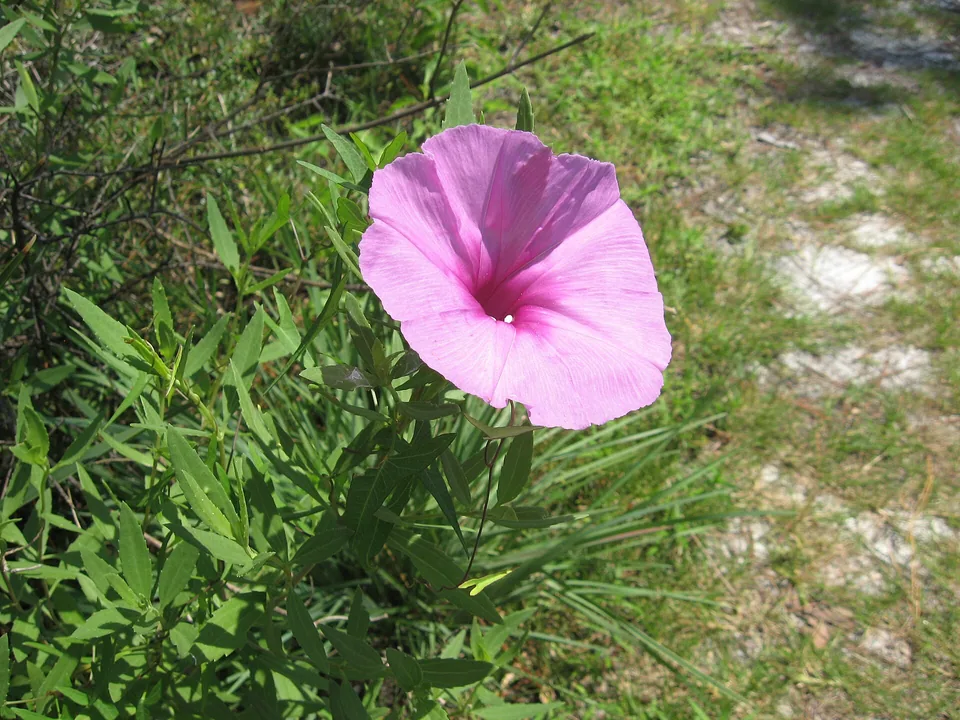


How to Grow and Care for Morning Glory
Ipomoea sagittata
Written by Emilio Marruso · last checked
Toxic to: Cats, Dogs, Horses, People · Why
At a glance
This perennial vine comes back year after year and can climb 3 to 10 feet tall, spreading 3 to 6 feet wide. It is happy in full sun or partial shade and loves moist, sandy soil. Best of all, it is easy to share: grow new plants from seed, from stem cuttings or by dividing an established plant.
- Sun
Full sun to partial shade
What the sources say (1)
Light: Full sun to partial shade
Light: Full sun (6 or more hours of direct sunlight a day) Partial Shade (Direct sunlight only part of the day, 2-6 hours)
— Ipomoea sagittata (Everglades morning glory, Morning Glory, Saltmarsh Morning Glory) | North Carolina Extension Gardener Plant Toolbox [1] - Water
Keep the soil moist
What the sources say (1)
Watering: Prefers moist sandy soil
It is salt-tolerant, prefers moist sandy soil and full sun to partial shade.
— Ipomoea sagittata (Everglades morning glory, Morning Glory, Saltmarsh Morning Glory) | North Carolina Extension Gardener Plant Toolbox [1] - Cold
Survives winters down to −20 °F (−28.9 °C)
Very hardy · USDA 5a · RHS H7 · Z5
What the sources say (2)
Hardiness, coldest zone: 5a [winter low −28.9 to −26.1 °C (−20 to −15 °F)]
USDA Plant Hardiness Zone: 5a, 5b, 6a, 6b, 7a, 7b, 8a, 8b, 9a, 9b
— Ipomoea sagittata (Everglades morning glory, Morning Glory, Saltmarsh Morning Glory) | North Carolina Extension Gardener Plant Toolbox [1] Hardiness, warmest zone: 9b [winter low −3.9 to −1.1 °C (25 to 30 °F)]
USDA Plant Hardiness Zone: 5a, 5b, 6a, 6b, 7a, 7b, 8a, 8b, 9a, 9b
— Ipomoea sagittata (Everglades morning glory, Morning Glory, Saltmarsh Morning Glory) | North Carolina Extension Gardener Plant Toolbox [1] - Soil
Moist, sandy soil
What the sources say (1)
Watering: Prefers moist sandy soil
It is salt-tolerant, prefers moist sandy soil and full sun to partial shade.
— Ipomoea sagittata (Everglades morning glory, Morning Glory, Saltmarsh Morning Glory) | North Carolina Extension Gardener Plant Toolbox [1] - Pests
Watch for aphids, spider mites, powdery mildew and root rot
What the sources say (2)
Pests: aphids, spider mites
Watch for aphids and spider mites.
— Ipomoea sagittata (Everglades morning glory, Morning Glory, Saltmarsh Morning Glory) | North Carolina Extension Gardener Plant Toolbox [1] Diseases: powdery mildew, root rot
Diseases include powdery mildew and root rot.
— Ipomoea sagittata (Everglades morning glory, Morning Glory, Saltmarsh Morning Glory) | North Carolina Extension Gardener Plant Toolbox [1] - Size
3–10 ft tall and 3–6 ft wide
What the sources say (2)
Mature height: 91.44-304.8 cm (3-10 ft)
Dimensions: Height: 3 ft. 0 in. - 10 ft. 0 in. Width: 3 ft. 0 in. - 6 ft. 0 in.
— Ipomoea sagittata (Everglades morning glory, Morning Glory, Saltmarsh Morning Glory) | North Carolina Extension Gardener Plant Toolbox [1] Mature width: 91.44-182.88 cm (3-6 ft)
Dimensions: Height: 3 ft. 0 in. - 10 ft. 0 in. Width: 3 ft. 0 in. - 6 ft. 0 in.
— Ipomoea sagittata (Everglades morning glory, Morning Glory, Saltmarsh Morning Glory) | North Carolina Extension Gardener Plant Toolbox [1] - Propagation
By division, seed or stem cuttings
What the sources say (1)
Propagation: Division, seed, stem cutting
Recommended Propagation Strategy: Division Seed Stem Cutting Country Or Region Of Origin:
— Ipomoea sagittata (Everglades morning glory, Morning Glory, Saltmarsh Morning Glory) | North Carolina Extension Gardener Plant Toolbox [1] - Safety
Mildly toxic to people; harmful to cats, dogs and horses
Overview
Saltmarsh morning glory is a deciduous vine that grows 6 feet [1.8 m] tall or more, climbs by tendrils and is salt-tolerant. [1] It does best on a trellis or fence, and the listing flags it as a problem for cats, dogs and horses and as low-severity poisonous to humans. [1]
This record is incomplete: the sources we read do not cover every field yet.
Not yet covered by our sources: Pruning
Morning Glory care
Measurements in square brackets are our conversion into the other unit system; the quoted text is unchanged.
How to water Morning Glory
Prefers moist sandy soil
What the sources say (1)
It is salt-tolerant, prefers moist sandy soil and full sun to partial shade.How much light Morning Glory needs
Full sun to partial shade
What the sources say (1)
Light:
Full sun (6 or more hours of direct sunlight a day)
Partial Shade (Direct sunlight only part of the day, 2-6 hours)How much cold Morning Glory can take
Hardiness, coldest zone
5a [winter low −28.9 to −26.1 °C (−20 to −15 °F)]
What the sources say (1)
USDA Plant Hardiness Zone:
5a, 5b, 6a, 6b, 7a, 7b, 8a, 8b, 9a, 9bHardiness, warmest zone
9b [winter low −3.9 to −1.1 °C (25 to 30 °F)]
What the sources say (1)
USDA Plant Hardiness Zone:
5a, 5b, 6a, 6b, 7a, 7b, 8a, 8b, 9a, 9bHow to propagate Morning Glory
Division, seed, stem cutting
What the sources say (1)
Recommended Propagation Strategy:
Division
Seed
Stem Cutting
Country Or Region Of Origin:How to grow Morning Glory
The plant
Life cycle
perennial
What the sources say (1)
Genus:
Ipomoea
Species:
sagittata
Family:
Convolvulaceae
Life Cycle:
PerennialFamily
Convolvulaceae
What the sources say (1)
Genus:
Ipomoea
Species:
sagittata
Family:
Convolvulaceae
Life Cycle:
PerennialMature height
91.44-304.8 cm (3-10 ft)
What the sources say (1)
Dimensions:
Height: 3 ft. 0 in. - 10 ft. 0 in.
Width: 3 ft. 0 in. - 6 ft. 0 in.Mature width
91.44-182.88 cm (3-6 ft)
What the sources say (1)
Dimensions:
Height: 3 ft. 0 in. - 10 ft. 0 in.
Width: 3 ft. 0 in. - 6 ft. 0 in.Pests and diseases
Pests
aphids, spider mites
What the sources say (1)
Watch for aphids and spider mites.Diseases
powdery mildew, root rot
What the sources say (1)
Diseases include powdery mildew and root rot.Morning Glory pests and problems
Aphids and spider mites
Symptom: Aphids and spider mites are pests to watch for.
What the sources say (1)
Watch for aphids and spider mites. Diseases include powdery mildew and root rot.
— Ipomoea sagittata (Everglades morning glory, Morning Glory, Saltmarsh Morning Glory) | North Carolina Extension Gardener Plant Toolbox [1] Powdery mildew and root rot
Symptom: Diseases listed for this vine.
What the sources say (1)
Watch for aphids and spider mites. Diseases include powdery mildew and root rot.
— Ipomoea sagittata (Everglades morning glory, Morning Glory, Saltmarsh Morning Glory) | North Carolina Extension Gardener Plant Toolbox [1]
Remedies
Each remedy shows what official sources say about it; traditional remedies without an official source are marked as such. Harmful ones are listed so you know to avoid them.
First aid
First aid: not a substitute for a doctor
ingestion of toxic parts
wipe out the mouth and rinse it with water Official source, not independently tested
Do not induce vomiting and do not give them anything to drink.
— missouripoisoncenter.org [3] If the person is awake and alert, call the Missouri Poison Center at 1-800-222-1222 for further treatment advice.
— missouripoisoncenter.org [3] How: Wipe out the mouth with a damp cloth and/or let the person rinse the mouth out with water, then call the poison center.
Wipe out their mouth with a damp cloth and or let them rinse their mouth out with water.
— missouripoisoncenter.org [3]
Treating the plant
aphids
insecticidal soap Not verified
Traditional remedy, not verified by an official source.
Consult the labels for dosage rates and safety precautions.
— portal.ct.gov [4] How: Insecticidal soap must make contact with the insects to be effective.
syringing with a hard stream of water Not verified
Traditional remedy, not verified by an official source.
How: Syringing knocks the pests from the plants with a hard stream of water; repeat two times a week.
horticultural oils Not verified
Traditional remedy, not verified by an official source.
How: Horticultural oil must make contact with the insects to be effective.
neem oil Not verified
Traditional remedy, not verified by an official source.
How: Natural pest controls or organic fungicides, like neem oil.
insect pests
pluck pests off with tweezers Not verified
Traditional remedy, not verified by an official source.
How: Pluck the pests off with tweezers and drop them in soapy water.
rust
remove infected leaves Not verified
Traditional remedy, not verified by an official source.
How: Do not overhead water the plant and remove any infected leaves.
stem canker
cut away the infected vine Not verified
Traditional remedy, not verified by an official source.
How: Cut away the infected vine and dispose of it.
Is Morning Glory toxic to pets?
Reported by the source, quoted verbatim. This is not medical or veterinary advice: if a person or an animal may have eaten this plant, contact a poison control centre or a veterinarian.
Animals
Problems: Problem for Cats Problem for Dogs Problem for Horses
[1]The source flags the risk for this animal but does not explain why.
People
This plant has low severity poison characteristics. See below
[1]- Toxic principle
Poison Toxic Principle: Indole alkaloids (Lysergic acid, lysergamide, elymoclavine and chanoclavine)
[1]- Symptoms
Poison Symptoms: Vomiting, large amounts of seeds may cause hallucinations
[1]- Severity
Poison Severity: Low Poison Symptoms: Vomiting, large amounts of seeds may cause hallucinations
[1]
Calendar
Pruning
Not stated in the sources we read.
Months as given by the sources, which are mostly from the United States (northern hemisphere). In the southern hemisphere they shift by about six months.
Similar plants
- Beach Morning-glory Ipomoea imperati
- Common Morning Glory Ipomoea purpurea
- Cypress Vine Ipomoea quamoclit
- Moonflower Ipomoea alba
- Morning Glory Ipomoea tricolor
- Oceanblue Morning Glory Ipomoea indica
- Scarlet Creeper Ipomoea coccinea
- Spanish Flag Ipomoea lobata
Sources
Every value above is quoted from these documents. Links lead to the original publisher.
- Ipomoea sagittata (Everglades morning glory, Morning Glory, Saltmarsh Morning Glory) | North Carolina Extension Gardener Plant Toolbox · plants.ces.ncsu.edu, consulted
- Saltmarsh Morning Glory - Ipomoea sagittata | North Carolina Extension Gardener Plant Toolbox · plants.ces.ncsu.edu, consulted
- missouripoisoncenter.org · missouripoisoncenter.org
- portal.ct.gov · portal.ct.gov
Written by Emilio Marruso · last checked